Showing posts with label drought. Show all posts

Thursday, August 7, 2014

The Vampire Squid and the Garden


Drought map via NOAA
Yellow is lower level drought, dark red is higher

The Globe and Mail Report on Business (01 August 2014, p B1, B8) ran a report on how rising prices are starting to impact consumer meat choices, and how that's affecting the bottom line of Maple Leaf Meats (who are currently restructuring). The article points out how bacon prices are up by about 26 percent and pork chops are up 18 percent, even though Statistics Canada claims prices are only up 3 percent from a year earlier.
There are a number of reasons offered for the rise in meat prices; the arrival of a piglet-killing virus (porcine epidemic diarrhoea) which has driven up the cost of a pig by 24 percent, the drought of 2012 that drove up the cost of feed and led to herd culls, and a 5 percent depreciation of the Canadian dollar pushing prices higher north of the border. BMO Capital Markets economist Aaron Goertzen takes the “most obvious statement of the year” award by pointing out that consumers are avoiding the now-pricier beef and pork by buying chicken or cheaper kinds of protein.
But one reason for higher prices gets no traction in the article at all—or indeed pretty much anywhere else with the exception of the New England Complex Systems Institute (NECSI). NECSI has been warning about the influence of futures traders in the food system for several years now. As did Matt Taibbi in Griftopia: bubble machines, vampiresquids, and the long con that is breaking America (2010), upon which I'm relying for for describing the system.
In a functioning commodity market, there are three players; buyers, sellers, and speculators called futures traders. Buyers and sellers (farmers and food companies) can arrange contracts with each other to guarantee the price of a commodity like wheat or corn (or pretty much any other physical substance, like platinum or oil). A producer wants to ensure that they get a fair price for their wheat, so they offer a future delivery for an agreed-upon price. This works for a buyer, as they want to have a certain and non-fluctuating price for the commodity they need. Called physical hedging, these contracts allow an amount of certainty in an uncertain world. If the price of a commodity rises unexpectedly, the producer forgoes some profit in exchange for a guaranteed price. If the price drops, the buyer forgoes some profit in exchange for a guaranteed price.

Friday, January 24, 2014

Friday Food Security Link-straveganza

Oh, those GMOs. Nathaniel Johnson at Grist has been doing an in-depth series of reports on whether GMOs matter. It's a series that has raised more than a few hackles in the green world, particularly because he has come to the conclusion that spending our political capital opposing GMOs is a waste of time, energy, and money.
Johnson's series is worth reading, as is Tom Philpott's response, and Ramez Naam's generally pro-GMO article. But, kas Nathaniel Johnson writes in his most recent article:
[...]I want to add a note of caution: There’s an entire industry pushing the argument that GMOs are the solution. I agree with the International Assessment of Agricultural Knowledge, Science and Technology for Development that GMOs could be part of the solution, but we shouldn’t let the hype distract us from all the other ideas out there.
There are lots of problems associated with GMOs. I just want to focus directly on fixing those problems, rather than turning GMOs into a vague representative boogieman. I see problems with seed patents, problems with overuse of pesticides, problems with the lack of funding for research on agricultural alternatives. I care deeply about these things. But I’m worried that the discussion has become so ossified over GMOs that it’s not helping those causes. We’ve focused so tightly on GMOs that people tend to lose sight of those bigger things.

Raw Story is reporting that Golden Rice, that long-touted but otherwise invisible genetically modified crop that's supposed to save millions from blindness may actually be a go:
The first genetically-modified rice to be commercially available could be approved for production in the Philippines in two to three years, researchers said Tuesday, despite strong opposition from environmental groups.
Officers of both the International Rice Research Institute (IRRI) and the Philippine government’s agriculture department said the newly-developed “golden rice” had completed field trials, despite vandalism at one test field.
“Golden rice is coming. That is in the pipeline and a lot of the principal development and research has been completed,” said Achim Dobermann, deputy director-general of IRRI.
“At the moment, there is no GM (genetically-modified) rice officially released in any country,” he stressed.
No word on the actual vitamin A content of the rice, or whether kids would still be better off eating a half a carrot a month as a nutrient source. But Golden Rice, which has been in development for at least 25 years was supposed to be the criticism-killer of GMOs, developed with world health rather than tawdry financial gain in mind. Of course, when the Australians decided to breed salt-tolerant wheat, they did it with conventional breeding, meaning that farmers will be allowed to save their own seed.
Raw Story is also reporting on GM trials in the UK of a new genetically modified version of camelina that is high in fish oils:
A genetically-modified plant that produces seeds packed with fish oils is set to be grown in open fields in the UK within months, scientists announced on Friday. The oils could provide feed for farmed fish, the researchers hope, but they could ultimately be used as a health supplement in human foods such as margarine.
Fish oils – specifically omega-3 long-chain polyunsaturated fatty acids – have been shown to cut the risk of cardiovascular disease and are a popular food supplement. But about 80% of the fish oil harvested from the oceans every year is actually fed to other fish being raised in aquaculture. With many fish stocks already over-exploited, the government-funded researchers from Rothamsted Research in Hertfordshire have spent 15 years developing the new GM plant and hope to have permission for field trials by March, with planting to start shortly after if approval is given.
This is typical; we have a significant requirement for food, but a large amount of the food we harvest from the ocean is either by-catch and trashed, or fed to other, more commercially viable, fish. We harvest a hundred calories to eat ten. No bloody wonder the oceans are empty. The only farmed fish that are remotely sustainable are tilapia.
Tilapia via Wikipedia /Bjørn Christian Tørrissen
According to the New York Times:
Americans ate 475 million pounds of tilapia last year, four times the amount a decade ago, making this once obscure African native the most popular farmed fish in the United States. Although wild fish predominate in most species, a vast majority of the tilapia consumed in the United States is “harvested” from pens or cages in Latin America and Asia.
Known in the food business as “aquatic chicken” because it breeds easily and tastes bland, tilapia is the perfect factory fish; it happily eats pellets made largely of corn and soy and gains weight rapidly, easily converting a diet that resembles cheap chicken feed into low-cost seafood.
But, of course, the rush to monetize tilapia has led to problems as well. Fed on corn and soy, farmed tilapia contains relatively small amounts of beneficial omega-3 fatty acids, which are why it is recommended we eat fish in the first place. From the same article: "For the moment, Seafood Watch lists tilapia raised in the United States as a “best choice,” tilapia from Latin America as a “good alternative” and tilapia from China as “to be avoided.”
The report from the International Assessment of Agricultural Knowledge, Science and Technology for Development points out:
Development and sustainability goals should be placed
in the context of (1) current social and economic inequities
and political uncertainties about war and conflicts; (2) uncer-
tainties about the ability to sustainably produce and access
sufficient food; (3) uncertainties about the future of world
food prices; (4) changes in the economics of fossil-based en-
ergy use; (5) the emergence of new competitors for natural
resources; (6) increasing chronic diseases that are partially a
consequence of poor nutrition and poor food quality as well
as food safety; and (7) changing environmental conditions
and the growing awareness of human responsibility for the
maintenance of global ecosystem services (provisioning,
regulating, cultural and supporting).
Today there is a world of asymmetric development, un-
sustainable natural resource use, and continued rural and
urban poverty. Generally the adverse consequences of global
changes have the most significant effects on the poorest and
most vulnerable, who historically have had limited entitlements and opportunities for growth.
Canada, the US, and  Australia did not agree.

Also from Grist, an update on the California drought--in this case a lovely comparison of satellite pictures of California now and at the same time last year:

via Grist / NASA
Oh, and CNN and the John Hopkins School of Medicine report:
More than half of all adults in the United States take some sort of multivitamin; many do so in hopes of preventing heart disease and cancer or even to aid with memory.
But an editorial published in this week's Annals of Internal Medicine says that using supplements and multivitamins to prevent chronic conditions is a waste of money.
"The (vitamin and supplement) industry is based on anecdote, people saying 'I take this, and it makes me feel better,' said Dr. Edgar Miller, professor of medicine and epidemiology at Johns Hopkins University School of Medicine and co-author of the editorial.
"It's perpetuated. But when you put it to the test, there's no evidence of benefit in the long term. It can't prevent mortality, stroke or heart attack."
It's all about the money, honey.

Wednesday, January 22, 2014

The Horror Show


Well, it’s as official as it needs to get:
“In NOAA’s annual global analyses, researchers put the average world temperature (combined land and ocean surface temperatures) last year at 14.52 C.
That was 0.62 C above the 20th-century average of 13.9 C, making 2013 the 37th consecutive year that the yearly global temperature exceeded the average.
The global land temperature was just shy of 1 C (0.99 C) above the 20th-century average, according to NOAA.
Both NOAA and NASA said that nine out of 10 of the warmest years ever recorded between 1880 and 2013 were within the last 13 years. Only one entry prior to the 2000s, the year 1998, cracked the top 10.
The hottest recorded year so far was in 2010, when a temperature anomaly of 0.66 C was recorded above the 20th-century average. It topped both NOAA and NASA’s lists.”

Another hot year, with the majority coming in the last decade. And back in October, the CBC reported that by 2047, we’re in real trouble:
“A new study on global warming pinpoints the probable dates for when cities and ecosystems around the world will regularly experience hotter environments the likes of which they have never seen before.
And for dozens of cities, mostly in the tropics, those dates are a generation or less away.
“This paper is both innovative and sobering,” said Oregon State University professor Jane Lubchenco, former head of the National Oceanic and Atmospheric Administration, who was not involved in the study.
To arrive at their projections, the researchers used weather observations, computer models and other data to calculate the point at which every year from then on will be warmer than the hottest year ever recorded over the last 150 years.
For example, the world as a whole had its hottest year on record in 2005. The new study, published Wednesday in the journal Nature, says that by the year 2047, every year that follows will probably be hotter than that record-setting scorcher.
Eventually, the coldest year in a particular city or region will be hotter than the hottest year in its past.”
So, about 33 years and we are fully into the new, changed, hotter world. It’s actually conceivable that I could still be alive at that time. I’ll only be 88 in 2047....
I’ve got two kids, and their world is going to be changing over the next decade more than mine has changed over my whole life. And just what are they going to eat? The leaked report from the IPCC says pretty clearly that starvation, poverty, flooding, heat waves, droughts, war and disease are going to get worse, and that much of the worse will occur in cities—particularly when food security gets even worse.
We like to think that Canada is going to come out all right in the hotter, meaner, climate-changed world. Not likely. According to NASA:

”By about 2100, the climate change projections that we have today would suggest that there would be pressure on that grassland so prevalent in [the Canadian Prairies] to move further northward — and at the expense of the forest moving further northward as well,” said NASA climate scientist Duane Walliser, who spoke with CBC News from the Jet Propulsion Laboratory in Pasadena, Calif.
Walliser said that all across the globe, whole ecological zones such as deserts and tundra will be on the move because of “unprecedented” warming at a pace faster than at any time in 10,000 years.
But Western Canada will be among the areas hardest hit.”
NASA’s also drawn up a cute little map that “shows ecological sensitivity for the next century, with purple representing regions only slightly vulnerable to change. The ecological stress increases through blue, green, yellow, and orange areas to red.”
via NASA

I’m not seeing a lot of ways out of this. We will not stop burning hydrocarbons. We refuse to downshift into a simpler, sustainable lifestyle. We just condemn our children to disease, starvation, and death.
In Canada, we face an unprecedented in-migration, with the majority of 330 million desperate Americans and similarly large numbers of Hispanic climate refugees set to pour across our borders (there’s already a million here), and we don’t have the water or food, or basic infrastructure in place to handle an influx like that. Our ostrich-like Prime Minister has his head firmly buried in the oil-sand, and will do nothing that will put the near-trillion-dollar investments in the massive bitumen-mining operation in Alberta at risk. In the US, they’re cracking the Bakken Formation as fast as possible, damaging or destroying water supplies along the way, in order to make the US “energy independent” once again. And the global atmospheric carbon load stands at 396.8 and counting.
By mid-century, grasslands will be hard-pressed to survive over the summer, denying livestock natural forage. Forage they wouldn’t be able to eat during most of the day, because it will be too hot for them as well. Increased CO2 won’t mean increased plant growth if temperatures are rising rapidly and the summers become an annual drought.
Some things I can see managing as a farmer if global climate change only got a little worse: livestock grazing morning and evenings, and being sheltered in cool barns during excessive mid-day heat. Walipinis, below-grade greenhouses, being used to protect plants from high-summer heat as well as lengthening the growing season. But...but if night-time temperatures are too hot, then animals and people won’t get the chance to cool off. That’s a quick road to heat-stroke and death. If the rains become unpredictable, even the best water-harvesting systems become worthless. And too many people trying to live on too little land with too-stretched resources (like water and food), that’s a recipe for a horror show that will make Stalin’s Russia look good by comparison.
No, there’s only one hope for us, and that’s stopping this death-spiral of oil dependency. And that doesn’t look too likely. Buckle up.

Wednesday, July 10, 2013

England v. Canada on Climate Change

Via Wikipedia

From the Guardian:
Droughts could devastate food production in the England by the 2020s, according to a report from the government's official climate change advisers. Without action, increasingly hot and dry summers may mean farmers will face shortfalls of 50% of the water they currently use to grow crops. The report, from the climate change committee (CCC), also warns that current farming practices may be allowing the country's richest soils to be washed or blown away.
The future risks to England's food supply are becoming more apparent, with MPs warningthis month that the government's failure to protect the most valuable farmland from flooding "poses a long-term risk to the security of UK food production" and food experts cautioning that crop yields are reaching their maximum biological limits. Extreme recent weather – the wettest recorded autumn followed by the coldest spring in half a century – cut wheat yields by one third, leading to the import of 2.5m tonnes of wheat, the same amount that is usually exported.
"If we don't start acting now we will be in serious trouble," said Lord John Krebs, who led the CCC report. "We already rely on food imports to a significant extent." About 40% of the UK's food is imported.
[...]
Friends of the Earth's Andrew Pendleton said: "Climate change poses a devastating threat to our environment, food supplies and security, which could trigger future economic crises. Urgent government measures are needed."

Tuesday, February 5, 2013

US Drought--Still Not Over

via US Drought Monitor
Yup, that's the mid-winter drought map for the US states. Clearly the drought of 2012 isn't over yet. We may not get the opportunity to reform agriculture and the culture of consumption.

Wednesday, September 5, 2012

"We'll Make A Killing"

A malnourished infant in Maradi, Niger. Corbis, from The Independent

From The Independent:
Glencore's director of agriculture trading, Chris Mahoney, sparked the controversy when he said: "The environment is a good one. High prices, lots of volatility, a lot of dislocation, tightness, a lot of arbitrage opportunities.
"We will be able to provide the world with solutions... and that should also be good for Glencore."
Glencore announced pre-tax global profits of £1.4bn.
Because devastation is good for business. Because if you control air, water, or food, you've got your customers by the short and curlies. Fear creates an excellent climate for business--you can justify anything, any price, any change to the rules that control you.
The United Nations, aid agencies and the British Government have lined up to attack the world's largest commodities trading company, Glencore, after it described the current global food crisis and soaring world prices as a "good" business opportunity.

With the US experiencing a rerun of the drought "Dust Bowl" days of the 1930s and Russia suffering a similar food crisis that could see Vladimir Putin's government banning grain exports, the senior economist of the UN's Food and Agriculture Organisation, Concepcion Calpe, told The Independent: "Private companies like Glencore are playing a game that will make them enormous profits."
Ms Calpe said leading international politicians and banks expecting Glencore to back away from trading in potential starvation and hunger in developing nations for "ethical reasons" would be disappointed.
"This won't happen," she said. "So now is the time to change the rules and regulations about how Glencore and other multinationals such as ADM [Archer, Daniels, Midland] and Monsanto operate. They know this and have been lobbying heavily around the world to water down and halt any reform."
Fear stops us from acting in the best interests of us all. This is why fear is good for business--it makes us act the way economists think we should act: solely out of self-interest, without regard for others, for our society, or our planet. Fear is the thing we must first resist.  To quote Frank Herbert from Dune:
I must not fear. Fear is the mind-killer. Fear is the little-death that brings total obliteration. I will face my fear. I will permit it to pass over me and through me. And when it has gone past I will turn the inner eye to see its path. Where the fear has gone there will be nothing. Only I will remain.
Action is better than fear. Action, like fear, is a choice. It is imperative that we choose wisely.

Tuesday, July 31, 2012

Link-straveganza II

From the US Food Integrity Campaign:
If food recalls continue to predispose people to experience recall overload, the government's recall data should at least be reliable and effective. A new Government Accountability Office (GAO) report criticizes the Food and Drug Administration's (FDA) lack of public information on how the agency will implement its new recall authority as well as the uncertainty of FDA's recall data.
The Food Safety Modernization Act (FSMA) signed into law in January 2011 finally gave FDA the ability to order companies to recall food products it deems unsafe, an important power given the previous danger of companies choosing not to remove adulterated products from the market. It remains unclear, however, how successful FDA will be in carrying out this new authority.
From the report:
But without publicly available procedures, regulations, or industry guidance on how the agency will implement its authority—including how the agency will weigh evidence on whether a recall is necessary—the agency cannot ensure that it applies practices uniformly or consistently or that it provides clear information for the food industry to follow or consumers and the public to understand. Such ambiguity could be particularly troublesome with regard to outbreaks of foodborne illnesses, which can occur any time—indeed, have already occurred since FDA assumed its new authority—and demand clear and timely agency reactions.

Next, an 8-minute documentary about a Fair Trade / CSA-inspired fishing program from the East coast.


And, lord knows, we need more of this kind of thinking in the food chain.

Especially now that Canada is seeing severe drought conditions in the East. The Globe and Mail reported (30 July):
Weeks of drought have turned much of Ontario’s prime agricultural land into a dust bowl. And it is corn farmers, especially in the southwest and eastern parts of the province, who have been the hardest hit.
“It is a bad year in eastern Canada and it is getting worse,” said Evan Fraser, a geography professor who studies global food security at the University of Guelph, west of Toronto. The far southwest part of Ontario is “looking grim,” Dr. Fraser said, and in other parts of the province “it’s a bit of a wait-and-see game.”

This Magazine brings up one of the little-discussed aspects of turning small-scale organic agriculture into large-scale industrial organic food production: migrant labour.
Organic regulations give value to everything from animal welfare, soil systems, and biodiversity to watersheds and air quality—concepts of sustainability focused almost exclusively on the physical environment. Farms go to extreme lengths to close the gap between farmer and eater: consumers are invited to open farm days for tours, food is meticulously labeled and sourced, and farm owners are no longer faceless, appearing on websites, packaging and TV commercials. In all this effort to exist outside conventional food practices and eat guilt-free, however, there is one link in the food chain consumers know shockingly little about: the migrant worker producing all this wonderful food.
The myth of the family run, locally staffed farm has somehow remained despite fundamental changes to both the scale and style of organic agricultural production in Canada. While many farms are still family owned and operated, the labour usage line is blurring between large-scale organics and conventional agriculture.

Thursday, July 26, 2012

Food Crisis Part II

Al Jazeera is one of the few media outlets talking about the impact of the US drought on the rest of the world. The 2008 price spike brought down governments in the Middle East, and sparked uprisings in Africa and Latin America.  With so much of the corn crop decimated, there's really no telling what to expect over the next 18 months. Oh, and when you look at the list of the the top three food-secure nations? Notice Canada doesn't make it. The Harper government may well pay for years of neglecting a national food strategy.


THE IMPACT OF THE US DROUGHT:
  • About 60 per cent of continental US is experiencing drought conditions
  • The US is the world's largest corn producer, and provides up to 60 per cent of the world's food aid
  • The price of corn has increased by 34 per cent in the last month
  • The US government says nearly 40 per cent of the corn crop is in poor condition
  • Most US farmers have crop insurance in case of losses

FOOD SECURE NATIONS:
  • The US is ranked as the most food-secure nation in the world, with an average of 14 per cent of household expenditure being spent on food. Second is Denmark, followed by Norway
  • The most food-secure nations benefit from ample resources, high incomes and subsidies for farmers
  • The least food-secure nations are in sub-Saharan Africa, with the DR Congo scoring most poorly with 70 per cent of household income there spent on food despite the country's huge agricultural potential
  • Chad and Burundi suffer from similar circumstances

Friday, July 20, 2012

A Year Getting Worse II

The US drought is starting to raise eyebrows in the business world. So we can expect our politicians to start noticing soon. That usually means that its going to cost the taxpayer for some ad hoc design program that's intended to be a temporary measure, but has a good chance of becoming a permanent feature distorting markets across the globe. The beginnings of this are in place as the US has declared 1,297 counties in 29 states “disaster areas.” The USDA has cut its corn production forecast by 1.8 billion bushels and lowered yield expectations to 146 b/a from 166 b/a back in June of this year. Corn futures have hit an all time high of $8US a bushel, and as the primary crop in the US is industrial corn, that makes a heck of a difference (all figures current to 19 July/12). So what does this mean for you and I, sitting here in Canada, wondering what to do next? Well, it means some of our industrial farmers will be doing better this year. But with Canada's integration with global markets, it does not mean that Canadians will see any benefit. We will not be seeing any drop or even stability in the prices we pay in the supermarket. About 40% of North American corn production is used for animal feed (regardless of whether or not its good for the animals involved) so we can expect to see a hike in meat prices come through the industrial food system. When? That's a trickier story. If markets are efficient and honest, meat prices should begin to rise over the next six to twelve months. This would mean producers looking at older, cheaper supplies they have in stock and calculating when they will run out and newer, more pricey supplies begin to be used. What is far more likely—as the oil industry has shown us time and time again—is that the old stock will become re-valued at the new international price, and prices will rise immediately, in order to maximize profits. There is actually wiggle room available: about 40% of corn grown in NA is designated for biofuel production. With dramatically increased feed-stock prices, corn-derived fuel will quickly become uneconomic to produce and sell (unless, of course, oil heads well north of $120/bbl in the very near future). Reduced demand from biofuel manufacturers would free up stocks to go for animal feed, and help keep a check on the price rise. The problem, of course, is the ubiquity of corn in the food system. If you're shopping the produce aisles, you might be in reasonable shape. But if you shop the inner aisles you'll find corn or corn-derived products in pretty much everything. For example, the citric acid used as a preservative in tomato sauce: corn-derived. HFCS (high-fructose corn syrup), of course. But also margarine, candies, ketchup (and catsup), peanut butter, and mayonnaise. (And a lot of non-food products like paint, printing inks, and photographic films). But this is going to be the new normal. If not drought, floods. If not floods, tornadoes. Or other extreme weather events. North Americans have had artificially low food prices for decades, and that period is about to come to a close as a result of global climate change. Recent projections have put temperature rise at 8-10 degrees over the rest of the century. This means that all of us are going to be to suffering for a short time, those of us under 40 are really going to notice the changes, and those under twenty might not make it.

Saturday, July 14, 2012

A Year Getting Worse

Al Jazeera English is reporting
The US department of agriculture has declared a natural disaster in 26 states where the Midwest drought has done considerable damage to this year's corn crop.
High temperatures and drought in the farm belt have devastated farms and are pushing up the price of corn and other crops.
This is both as bad as it sounds and not quite as bad as it sounds. As  Hannah Poturalski, a staff writer with the Middletown Journal in Ohio puts it: "Ohio is among 29 states with counties now designated as natural disaster areas due to the drought." That is to say, it's not the entire state that has declared drought condition, but counties within it have. Still, when you look at the map, the situation is pretty severe.


According to the US Drought Monitor on July 05, 2012, "Analysis of the latest drought monitor data revealed that 46.84 percent of the nation’s land area is in various stages of drought, up from 42.8 percent a week ago...Looking only at the 48 contiguous states, 55.96 percent of the country’s land area is in moderate drought or worse." in the July 10, 2012 news release, the Drought Monitor notes:
[W]ith the hot weather that covered much of the central and eastern United States, only a few scattered areas of dryness and drought experienced significant improvement. In addition, the areas with the greatest temperature anomalies (average daily maxima 10 to 13 degrees above normal) generally coincided with an area of scant rainfall across the Midwest, northwestern Ohio Valley, and southern Great Plains, resulting in another week of widespread deterioration and expansion of dryness and drought in these regions.
In the hottest areas last week, which were generally dry, crop conditions deteriorated quickly. In the 18 primary corn-growing states, 30 percent of the crop is now in poor or very poor condition, up from 22 percent the previous week. In addition, fully half of the nation’s pastures and ranges are in poor or very poor condition, up from 28 percent in mid-June. The hot, dry conditions have also allowed for a dramatic increase in wildfire activity since mid-June. During the past 3 weeks, the year-to-date acreage burned by wildfires increased from 1.1 million to 3.1 million as of this writing.
That's about 4800 square miles or 12545 square kilometres burned over so far this year.  The Drought Monitor has also produced the following animation of drought conditions in the US over the last 12 weeks:
 There is some hope for rain in some area this week, but overall, this means trouble. With corn crops not producing ears (check out the Al Jazeera footage, above), and with pasture, soy, and other crops affected, the industrial food system is going to be seriously strained this year. Combined with big money building speculative bubbles in the food system, we could be facing a doubling or better of food costs this year.

According to the National Oceanic and Atmospheric Administration (NOAA), the period from January through June was "the warmest first half of any year on record for the contiguous United States."
The average temperature was 52.9 degrees Fahrenheit, or 4.5 degrees above average, NOAA said on Monday. Twenty-eight states east of the Rockies set temperature records for the six-month period.
A heat wave blistered most of the United States in June, with more than 170 all-time temperature records broken or tied during the month. On June 28 in Norton, Kan., for instance, the temperature reached 118 degrees, an all-time high. On June 26, Red Willow, Neb., set a temperature record of 115 degrees, eclipsing the 114-degree mark set in 1932.

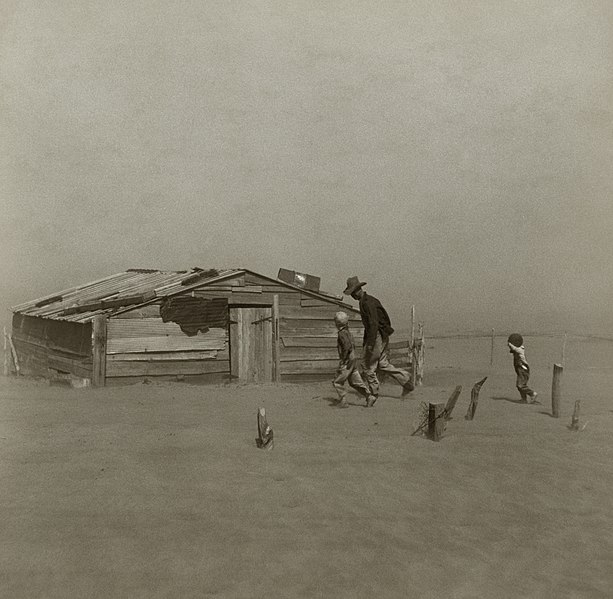
I'm not saying that it will get as bad as this 1942 Alfred Eisenstaedt photo of the dustbowl, at least not this year.
unpublished, from Life


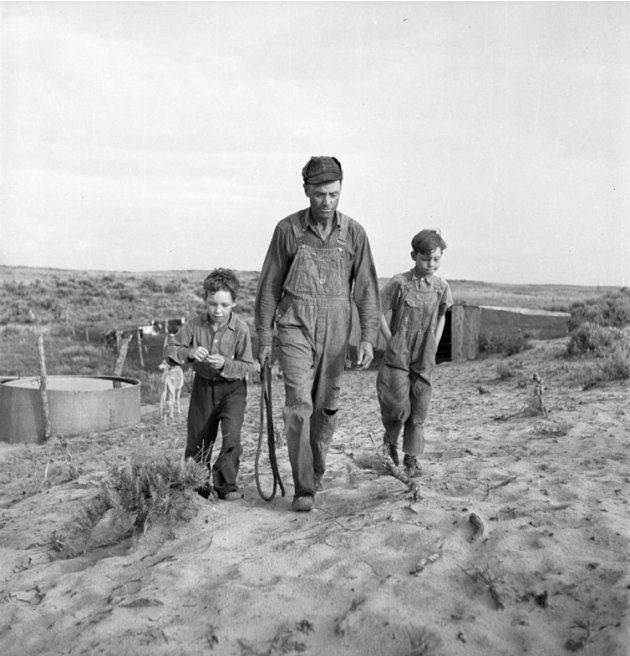
But don't think it can't happen again. Dr. David Schindler, over at the University of Alberta, has pointed out that the Twentieth Century was the wettest century in the Pallister Triangle in the last 10,000 years. It has also been the only century we've farmed in the Triangle, so our perceptions are kind of skewed. And the past century also had four major drought events, including the one above. So Global Climate Change is going to matter here in North America.

Monday, April 30, 2012

Jolly Olde...Well, Not So Much.

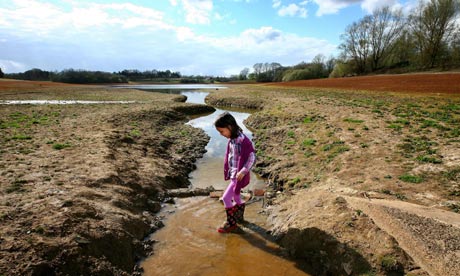
Bewl Water reservoir, near Lamberhurst, Kent, photo from The Guardian website by Gareth Fuller/PA
England is still swinging, but the pendulum only seems to be going from bad to worse and back again. Southern England has been in the grip of a drought for a few years now, as the condition of the reservoir above attests. Now it has started raining across the region, but not the spring rains needed to replenish the groundwater and then the aquifers. Rather, massive storms are slamming into the south, bringing projected dumps of up to 40mm of rain during the day--much of which will run off the drought-hardened soils rather than soaking in. Even if it does soak in, it won't be enough to ease the drought: these rains would have to continue for weeks to begin replenishing the underground aquifers.
The consequences for food production, according to The Guardian are significant:
Farmers, particularly arable farmers and vegetable growers, face a difficult summer as decisions have already been taken on what to grow this year. Further restrictions such as curbs on abstracting groundwater will become more likely if the drought continues. Price rises are likely for thirsty crops such as soft fruit and vegetables, while the price of beer is also expected to increase.
And you know if the price of beer rises, the Conservative government of David Cameron is going to take even more of a bollocking than usual. Because the UK has also slipped into a double dip recession because of the current austerity programme.  Also from the Guardian:
Britain's leading foodbank network, the Trussell Trust, says every single day it is handing out emergency food parcels to parents who are going without meals in order to feed their children, or even considering stealing food to put on the table, as the government's austerity measures start to bite.
The number of people to whom it had issued emergency food parcels had doubled in the last 12 months and was set to increase further as rising living costs, shrinking incomes and welfare cuts take their toll, the trust said, as it published its annual report, which is fast becoming a barometer of social deprivation.
Two foodbanks a week opened up in the UK over the last 12 months to meet an explosion in demand from families living on the breadline, the trust said. The charity currently oversees 201 foodbanks run on a franchise basis across the UK, up from 100 in 2010-11.
Its not much better worldwide. A report published in the magazine Science suggests "Models that link yields of the four largest commodity crops to weather indicate that global maize and wheat production declined by 3.8 and 5.5%, respectively, relative to a counterfactual without climate trends.[...] Climate trends were large enough in some countries to offset a significant portion of the increases in average yields that arose from technology, carbon dioxide fertilization, and other factors." So even when there's good news (increases in average yields) the bad news tends to outweigh it (enough to offset a significant portion).
It might be nice to have a test case for some of the problems we're facing--like the continued uncertainty in the price of oil.  We've passed Peak Oil at this point, but what that means seems to be confused. Neil Reynolds takes on the Club of Rome and Peak Oil in today's Globe and Mail, writing:
The book’s most alarming prediction, of course, dealt with oil – which, it said, would be irretrievably depleted by 2022 – a mere decade from now – at the latest. Yet, “the World Energy Council reports that global proven recoverable reserves of natural gas liquids and crude oil amounted to 1.2 trillion barrels in 2010,” Mr. Kenny says. “That’s enough to last another 38 years at current usage. Add in shale oil, and that’s an additional 4.8 trillion barrels, or a century and a half’s worth of supply at present usage rates. Tar sands, including some huge Canadian deposits, add perhaps six trillion barrels more.”
It should be noted that  "global proven recoverable reserves" is a terribly elastic figure. The Saudis, as one example, have been fudging the books on what their "recoverable reserves" are for almost two decades.It also helps to toss natural gas into the mix--there are large reserves around the planet--so much so that the current price is below the cost of recovery. But what Peak Oil theory said was that once we've passed the halfway point on recovery--which we have--the oil that was left would become more and more difficult to retrieve. And as prices rose, companies would go to greater and greater lengths to retrieve that oil. Its expected (under the theory, that as oil climbs in price, exploration/late production will increase while demand drops off. Once demand has dropped off, prices will begin to decline. Once prices at the pump decline, exploration/pumping will slow while demand rises again. Prices will suddenly spike until more production is brought back on line. There will be tremendous oscillation in prices and availability of oil. There will always be oil, its just that most of us won't be able to afford products made from it.
Energy has become dearer, and so we see the mining of bitumen in the Tar Sands of Alberta, a process that is only economically viable when the price of oil is over $80/bbl. And with energy prices currently sitting at $104/bbl for West Texas Crude, we see both the crazy push to mine the Tar Sands and the rise of fracking to release shale oil (another process like mining the Tar Sands that only happens without proper oversight and when oil prices are high).
But what happens when the oil stops? Actually, it doesn't even have to stop, all it has to do is become too expensive for use in agriculture.  And actually, we have a case study of this: Cuba. As an article in Slate points out:
Unable to afford the fertilizers and pesticides that 20th-century agriculture had taken for granted, the country faced extreme weather events and a limit to the land and water it could use to grow food. The rest of the world will soon face many of the same problems: In the coming decade, according to the OECD, we’ll see higher fuel and fertilizer costs, more variable climate patterns, and limits to arable land that will drive cereal prices 20 percent higher and hike meat prices by 30 percent—and that’s just the beginning. Policymakers can find inspirational and salutary ideas about how to confront this crisis in Cuba, the reluctant laboratory for 21st-century agriculture.
Cuban officials faced the crisis clumsily. They didn’t know how to transform an economy geared toward sweetening Eastern Europe into one that could feed folk at home. Agronomists had been schooled in the virtues of large-scale industrial collective agriculture. When the “industrial” part became impossible, they insisted on yet more collectivization. The dramatic decline in crop production between 1990 and 1994, during which the average Cuban lost 20 pounds, was known as “the Special Period.” Cubans have a line in comedy as dark as their rum.
It finally took land reform to fix many of the problems. The Cuban state was still not ready to give up its control over the land, but realized that allowing management to devolve to the farm level might not be a bad thing. With that devolution, farmers also got usufruct rights--that is, the legal right of using and enjoying the fruits or profits of something belonging to another. In fact, Cuban peasants have been able to boost food production without scarce and expensive imported agricultural chemicals by first substituting more ecological inputs for the no longer available imports, and then by making a transition to more agroecologically integrated and diverse farming systems. A report on this, called the Campesino-to-Campesino agroecology movement of ANAP in Cuba is available online (amazingly, the full text of the report is available for free download). It should also be noted that Cuba pursued its self-sufficiency goals with the aid of one of the best educated populations around (Cuba has 2 percent of Latin America’s population but 11 percent of its scientists). Various scientists were put to work with the farmers to maximize production without industrial farming inputs.
It may not be perfect, but Cuba has managed to supply a significant amount of its own food. In a report from Miguel A. Altieri and Fernando R. Funes-Monzote:
The production of vegetables typically produced by peasants fell drastically between 1988 to 1994, but by 2007 had rebounded to well over 1988 levels [...]. This production increase came despite using 72 percent fewer agricultural chemicals in 2007 than in 1988. Similar patterns can be seen for other peasant crops like beans, roots, and tubers.
Cuba’s achievements in urban agriculture are truly remarkable—there are 383,000 urban farms, covering 50,000 hectares of otherwise unused land and producing more than 1.5 million tons of vegetables with top urban farms reaching a yield of 20 kg/m2 per year of edible plant material using no synthetic chemicals—equivalent to a hundred tons per hectare. Urban farms supply 70 percent or more of all the fresh vegetables consumed in cities such as Havana and Villa Clara.
So the future isn't entirely threatening, its just different.A lot more of us will be peasants again--a designation I, for one, am willing to embrace.