Showing posts with label famine. Show all posts

Wednesday, July 2, 2014

The Questions Begin With Onions

This image is in the public domain because it contains materials that originally came from the Agricultural Research Service, the research agency of the United States Department of Agriculture.

It is rather amazing just how many questions can arise out of a simple onion. Following Noam Chomsky's advice that the only honest reporting is done in the business pages, I was browsing the Bloomberg website when I can across an article about how onion traders were viewing current Indian anti-inflation policy. The article opens with a man named Arun Kumar, a produce market middleman, saying he " has seen many Indian governments try and fail to eliminate middlemen at produce markets who are blamed for hoarding and stoking inflation." One of the big drivers for the concern over inflation and food markets is the lack of monsoon season rains this year--India is experiencing a 45 percent drop in rainfall amounts. A full scale drought, according to HSBC Holdings Plc., could reduce Indian economic growth by as much as a half-percent this year.Food prices in India make up about 50 percent of the consumer price index, which rose 8.28 percent in May of this year alone. (By way of comparison, food prices make up about 15 percent of the US CPI).
Notice of this drought in India comes at the same time that some sixty communities in Saskatchewan and Manitoba are dealing with floods from major storms dropping between 75 and 150 mm of rain in 24 hours. Both the drought and the rains (similar to last year's Alberta rains that flooded Calgary and High River), are driven by global warming changing the amount of water held by the air and changes to weather patterns; India sees 45 percent less rain during monsoon season and southern Saskatchewan and Manitoba get a whole summer's worth of rain in 24 hours.
Both these events will negatively impact the production of food in their respective countries. Bloomberg's reports that, in India:
After an emergency meeting two days ago, Jaitley said the government would ask states to crack down on hoarders, aid imports of pulses and cooking oil, and fix a minimum export price for potatoes and onions to discourage overseas sales. Food Minister Ram Vilas Paswan said India will offload about a quarter of its rice stockpiles.

Wednesday, January 22, 2014

The Horror Show


Well, it’s as official as it needs to get:
“In NOAA’s annual global analyses, researchers put the average world temperature (combined land and ocean surface temperatures) last year at 14.52 C.
That was 0.62 C above the 20th-century average of 13.9 C, making 2013 the 37th consecutive year that the yearly global temperature exceeded the average.
The global land temperature was just shy of 1 C (0.99 C) above the 20th-century average, according to NOAA.
Both NOAA and NASA said that nine out of 10 of the warmest years ever recorded between 1880 and 2013 were within the last 13 years. Only one entry prior to the 2000s, the year 1998, cracked the top 10.
The hottest recorded year so far was in 2010, when a temperature anomaly of 0.66 C was recorded above the 20th-century average. It topped both NOAA and NASA’s lists.”

Another hot year, with the majority coming in the last decade. And back in October, the CBC reported that by 2047, we’re in real trouble:
“A new study on global warming pinpoints the probable dates for when cities and ecosystems around the world will regularly experience hotter environments the likes of which they have never seen before.
And for dozens of cities, mostly in the tropics, those dates are a generation or less away.
“This paper is both innovative and sobering,” said Oregon State University professor Jane Lubchenco, former head of the National Oceanic and Atmospheric Administration, who was not involved in the study.
To arrive at their projections, the researchers used weather observations, computer models and other data to calculate the point at which every year from then on will be warmer than the hottest year ever recorded over the last 150 years.
For example, the world as a whole had its hottest year on record in 2005. The new study, published Wednesday in the journal Nature, says that by the year 2047, every year that follows will probably be hotter than that record-setting scorcher.
Eventually, the coldest year in a particular city or region will be hotter than the hottest year in its past.”
So, about 33 years and we are fully into the new, changed, hotter world. It’s actually conceivable that I could still be alive at that time. I’ll only be 88 in 2047....
I’ve got two kids, and their world is going to be changing over the next decade more than mine has changed over my whole life. And just what are they going to eat? The leaked report from the IPCC says pretty clearly that starvation, poverty, flooding, heat waves, droughts, war and disease are going to get worse, and that much of the worse will occur in cities—particularly when food security gets even worse.
We like to think that Canada is going to come out all right in the hotter, meaner, climate-changed world. Not likely. According to NASA:

”By about 2100, the climate change projections that we have today would suggest that there would be pressure on that grassland so prevalent in [the Canadian Prairies] to move further northward — and at the expense of the forest moving further northward as well,” said NASA climate scientist Duane Walliser, who spoke with CBC News from the Jet Propulsion Laboratory in Pasadena, Calif.
Walliser said that all across the globe, whole ecological zones such as deserts and tundra will be on the move because of “unprecedented” warming at a pace faster than at any time in 10,000 years.
But Western Canada will be among the areas hardest hit.”
NASA’s also drawn up a cute little map that “shows ecological sensitivity for the next century, with purple representing regions only slightly vulnerable to change. The ecological stress increases through blue, green, yellow, and orange areas to red.”
via NASA

I’m not seeing a lot of ways out of this. We will not stop burning hydrocarbons. We refuse to downshift into a simpler, sustainable lifestyle. We just condemn our children to disease, starvation, and death.
In Canada, we face an unprecedented in-migration, with the majority of 330 million desperate Americans and similarly large numbers of Hispanic climate refugees set to pour across our borders (there’s already a million here), and we don’t have the water or food, or basic infrastructure in place to handle an influx like that. Our ostrich-like Prime Minister has his head firmly buried in the oil-sand, and will do nothing that will put the near-trillion-dollar investments in the massive bitumen-mining operation in Alberta at risk. In the US, they’re cracking the Bakken Formation as fast as possible, damaging or destroying water supplies along the way, in order to make the US “energy independent” once again. And the global atmospheric carbon load stands at 396.8 and counting.
By mid-century, grasslands will be hard-pressed to survive over the summer, denying livestock natural forage. Forage they wouldn’t be able to eat during most of the day, because it will be too hot for them as well. Increased CO2 won’t mean increased plant growth if temperatures are rising rapidly and the summers become an annual drought.
Some things I can see managing as a farmer if global climate change only got a little worse: livestock grazing morning and evenings, and being sheltered in cool barns during excessive mid-day heat. Walipinis, below-grade greenhouses, being used to protect plants from high-summer heat as well as lengthening the growing season. But...but if night-time temperatures are too hot, then animals and people won’t get the chance to cool off. That’s a quick road to heat-stroke and death. If the rains become unpredictable, even the best water-harvesting systems become worthless. And too many people trying to live on too little land with too-stretched resources (like water and food), that’s a recipe for a horror show that will make Stalin’s Russia look good by comparison.
No, there’s only one hope for us, and that’s stopping this death-spiral of oil dependency. And that doesn’t look too likely. Buckle up.

Monday, January 6, 2014

The Coming Crisis

About 30 percent of the major global cereal crops – rice, wheat and corn – may have reached their maximum possible yields in farmers' fields, according to University of Nebraska-Lincoln research published this week in Nature Communications. These findings raise concerns about efforts to increase food production to meet growing global populations.
Yields of these crops have recently decreased or plateaued. Future projections that would ensure global food security are typically based on a constant increase in yield, a trend that this research now suggests may not be possible.
Estimates of future global food production and its ability to meet the dietary needs of a population expected to grow from 7 billion to 9 billion by 2050 have been based largely on projections of historical trends. Past trends have, however, been dominated by the rapid adoption of new technologies – some of which were one-time innovations – which allowed for an increase in crop production.
As a result, projections of future yields have been optimistic – perhaps too much so, indicates the findings of UNL scientists Kenneth Cassman and Patricio Grassini, of the agronomy and horticulture department, and Kent Eskridge of the statistics department.
Source: UNL news release
Isn't that good news to start the New Year off with?  Thirty percent of current cropland has topped out its productivity and may actually begin to decline in yields. The authors of the paper suggest that regardless of how much money we dump into research into crops and productivity, "return on these investments is steadily declining in terms impact on raising crop yields." That's the "high-production" industrial agriculture we're talking about. And that's not including increased salinity, loss of cropland to desertification (particularly in Northern China), climate change effects, or any of the other threats to food production we might be facing.
All the indications are that we're facing an extended "Special Period" similar to the one experienced by Cuba after 1991. Which is one of the reasons why I've been reading a lot on the Great Hunger; the Irish famine of 1845-1847.
I expect to be writing a great deal more on the famine in the near future, but for now, let me just hit a few of the high points:
  • The famine happened with a short-term change in historic climate patterns in Ireland. Temperatures went up a little, allowing a previously quiescent mould to get a grip on the potato crop.
  • The Irish were utterly dependent on the potato. Worse, primarily on the "Lumper" cultivar.
  • The Irish economy was crap, undiversified, and beat down over the last century by the English in response to some poor choices on the part of the Catholic Irish on who they supported politically.
  • The English were in the grip of a religious revival that was very Old Testament, and were busy blaming victims for religious reasons rather than looking at political solutions.
  • The English were in the grip of a neo-liberal economic philosophy that demonised interference in the market, and exalted free-trade.
I'd go on, but you might be ahead of me here. Amartya Sen says that there's never been a famine in a democracy, but doesn't say anything about failed states that were once democracies.

Friday, June 7, 2013

Friday Food Link-straveganza

Image sourced from Wikipedia

Well, we know bees are having a difficult time of it. And now its looking like neonicotinoid pesticides have a lot to do with it. Canada and Britain are both resisting the call to ban the neonicotinoids. The UK  Parliament’s  report on neonicotinoid pesticides and their effect on bees can be accessed here. The BBC commentary is here.

Source: Wikipedia

Over at Localfoodplus.ca, there's some comment on the new Ontario Medical Association report that looks at the link between antibiotic-resistant microbes and intensive livestock production. From localfoodplus:
According to the OMA’s report, “antibiotics are not as effective as they once were because bacteria are adapting to them … these resistant bacteria are germs that cause infections like pneumonia, urinary tract infections, and skin infections.”
“Patients are at risk of becoming sicker, taking longer to recover, and in some cases dying from previously treatable diseases,” said OMA president Doug Weir in the report’s press release.
This alarming medical regression poses a rising threat over both patients’ health and the healthcare system. Pointing to already visible Health Care expenses, the OMA cites the increasing costs of MRSA (which Mother Jones defines as “an often-deadly, antibiotic-resistant staph infection”)  at the Sunnybrook Health Sciences Centre in Toronto.
In 2001, the presence of MRSA across Canada was estimated to cost $50 million; in 2010, the National Collaborating Centre for Infectious Diseases (NCCID) estimated that the costs would reach between $104-$187 million annually due to escalating  antibiotic resistance – more than double in approximately 10 years.
While the report lays some culpability upon individuals to use antibiotics more “responsibly” and doctors to “keep better track of [their] patients’ antibiotic histories,” the OMA points a looming finger in the direction on Ontario’s agri-business complex.
Currently, it’s standard practice in Ontario’s agricultural industry to administer antibiotics to healthy animals for the purpose of ‘disease prevention’ and ‘growth acceleration’ – a practice that the Ontario Ministry of Agriculture and Food (OMAF) defines as “intensive, non-therapeutic” antibiotic use.

Algeria famine 1869. Source: Wikipedia

The BBC has been reporting that the only thing we learn from the history of famnine is that we learn nothing from the history of famine--as detailed by the new report from UK think-tank Chatham House:
Famine early warning systems have a good track record of predicting food shortages but are poor at triggering early action, a report has concluded.
The study said the opportunity for early action was being missed by governments and humanitarian agencies.
It said the "disconnect" was starkly apparent in Somalia where no action was taken despite 11 months of warnings.
Up to two million people are estimated to have died in drought-related emergencies since 1970.
The report by UK think-tank Chatham House, Managing Famine Risk: Linking Early Warning to Early Action, looked at the issue of drought-related emergencies on a global scale but focused on the Horn of Africa and the Sahel regions.
"The regions are quite unique in a way because you have these droughts, where there are normally successive failed rains; then you have a process whereby you have subsequent harvest failures then people adopt coping strategies," explained report author Rob Bailey.
Hand of Fatima, Mali. source: Wikipedia

 At Foodfirst, Camille Vignerot and Tiffany Tsang  wrote a piece about the current food crisis in Mali.
Food crises have plagued Mali in recent years due to drought and recurring political conflicts.
The January 2012 massacre of Malian soldiers by armed Tuareg fighters in the far north precipitated the Malian coup in March of 2012 by the National Committee for Recovering Democracy and Restoring the State (NCRDRS). That and the subsequent struggle in the north of Mali involving two groups of Tuareg (Ansar Dine and the National Movement for the Liberation of Azawad), both followed a severe drought in the 2011-2012 season.
In 2011, Mali received only one month of rain, compared to the usual three. As a result, only 11% of Mali’s farmers were able to save seed for the following year’s planting season. This cut the country’s 2012 seed supply by half, severely affecting the rice-growing area in the Mopti region. The drought forced pastoralists to move their animals north six months earlier than usual that year because of a lack of floodplain pasture along the Niger River. This led to overgrazing in northern pastures as usual staggered migrations were disrupted. Those pastoralists who did stay in the southern region were trapped between the sparse floodplains and the violent north. The increased grazing pressure on the land led to conflicts with farmers, especially in the Mopti region.
Leaving famine behind for the land of MOAR!, Michael Pollen is interviewed for the Center for Consumer Freedom.

Saltspring Island via Wikipedia
 Mussels are sustainably raised near here on Saltspring Island by Saltspring Island Mussels. (warning! site contains recipes!)
Also local are the ICC:
The Island Chefs Collaborative (icc) are a liked-minded community of chefs and food and beverage professionals with a common interest in regional food security, the preservation of farmland and the development of local food systems.
And of course if you haven't seen it yet, Bill Gates cracks me up with his Food is Ripe for Innovation essay over at Mashable.com:
I’ve gotten to learn about several new food companies that are creating plant-based alternatives to meat through some monetary investments I’ve made with Khosla Ventures and Kleiner Perkins. Their products are at least as healthy as meat and are produced more sustainably.
But what makes them really interesting is their taste. Food scientists are now creating meat alternatives that truly taste like — and have the same “mouth feel” — as their nature-made counterparts (see two recipes below, for example).
Flavor and texture have been the biggest hurdles for most people in adopting meat alternatives. But companies like Beyond Meat, Hampton Creek Foods and Lyrical are doing some amazing things. Their actual recipes are secret, but the science is straightforward. By using pressure and precisely heating and cooling oils and plant proteins (like powdered soybeans and vegetable fiber), you can achieve the perfect flavor and texture of meat or eggs.
I tasted Beyond Meat’s chicken alternative, for example, and honestly couldn’t tell it from real chicken. Beyond Eggs, an egg alternative from Hampton Creek Foods, does away with the high cholesterol content of real eggs. Lyrical has drastically reduced fat in its non-dairy cheeses. Even things like salt are getting a makeover: Nu-Tek has found a way to make potassium chloride taste like salt (and nothing but salt) with only a fraction of the sodium.
All this innovation could be great news for people concerned about health problems related to overconsumption of fat, salt and cholesterol. It’s important too in light of the environmental impacts of large-scale meat and dairy production, with livestock estimated to produce nearly 51% of the world’s greenhouse gases.
The man should be doing stand-up....

Thursday, June 6, 2013

Food Security and Global Warming


From Al Jazeera:
Researchers are warning that rising global temperatures could see a shift in the world's traditional staples and who grows them.
They predict that maize, wheat and rice production will decrease in many developing countries - forcing farmers to replace them with crops more resistant to heat, drought and flooding.

The prediction, if true, would put more pressure on a world already facing a potential crisis over global food security.

The UN commissioned report says yields of the world's three main sources of calories will decrease by 2050, as temperatures rise.

Wheat is forecast to drop by 13 per cent in developing countries, while rice could see yields fall by 15 per cent. And maize farmers in Africa could lose up to 20 per cent of their crops.

We can see the Great Famine coming. But we're really not planning on doing anything to avoid it....

Tuesday, January 1, 2013

The Food Bubble

Frederick Kaufman is interviewed on his Harper's article The Food Bubble: How Wall Street Starved Millions and Got Away With It. This Democracy Now interview, by Amy Goodman and Juan Gonzalez takes us through the market manipulation that brought on the 2008-2009 food crisis.


Wednesday, September 5, 2012

"We'll Make A Killing"

A malnourished infant in Maradi, Niger. Corbis, from The Independent

From The Independent:
Glencore's director of agriculture trading, Chris Mahoney, sparked the controversy when he said: "The environment is a good one. High prices, lots of volatility, a lot of dislocation, tightness, a lot of arbitrage opportunities.
"We will be able to provide the world with solutions... and that should also be good for Glencore."
Glencore announced pre-tax global profits of £1.4bn.
Because devastation is good for business. Because if you control air, water, or food, you've got your customers by the short and curlies. Fear creates an excellent climate for business--you can justify anything, any price, any change to the rules that control you.
The United Nations, aid agencies and the British Government have lined up to attack the world's largest commodities trading company, Glencore, after it described the current global food crisis and soaring world prices as a "good" business opportunity.

With the US experiencing a rerun of the drought "Dust Bowl" days of the 1930s and Russia suffering a similar food crisis that could see Vladimir Putin's government banning grain exports, the senior economist of the UN's Food and Agriculture Organisation, Concepcion Calpe, told The Independent: "Private companies like Glencore are playing a game that will make them enormous profits."
Ms Calpe said leading international politicians and banks expecting Glencore to back away from trading in potential starvation and hunger in developing nations for "ethical reasons" would be disappointed.
"This won't happen," she said. "So now is the time to change the rules and regulations about how Glencore and other multinationals such as ADM [Archer, Daniels, Midland] and Monsanto operate. They know this and have been lobbying heavily around the world to water down and halt any reform."
Fear stops us from acting in the best interests of us all. This is why fear is good for business--it makes us act the way economists think we should act: solely out of self-interest, without regard for others, for our society, or our planet. Fear is the thing we must first resist.  To quote Frank Herbert from Dune:
I must not fear. Fear is the mind-killer. Fear is the little-death that brings total obliteration. I will face my fear. I will permit it to pass over me and through me. And when it has gone past I will turn the inner eye to see its path. Where the fear has gone there will be nothing. Only I will remain.
Action is better than fear. Action, like fear, is a choice. It is imperative that we choose wisely.

Thursday, August 9, 2012

A Dangerous Way To Test A Theory

Don't think for a minute that I think the folks over at NECSI (The New England Complex Systems Institute, about whom I've written before) are tenting their fingers and cackling in a Mr. Burns-like way while they manipulate the world's food markets in order to test their theory of food price spikes and social unrest. Rather, it is the rest of us who have embarked on the testing program. The researchers at NECSI have been modelling food prices, ethanol production and the effect of speculative money on the international food system. In their model, once the FAO (Food and Agricultural Organization) food price index hits about 215 (or 190 adjusted for inflation), all hell breaks loose. Food prices have been advanced as the most reasonable explanation why, for instance, unrest in the Middle East went so quickly from regional to widespread, birthing what we now know as the Arab Spring. And the Arab Spring followed one of these price spikes. And it makes sense. Bread riots are a recurring theme throughout history. Hunger is a strong motivating force.

FAO Price Index at current prices (black curve) and corrected for inflation (blue curve) between January 2004 and May 2011. Red dashed lines signify the beginning dates of food riots and unrest in North Africa and the Middle East. Black and blue horizontal lines represent the current-price and inflation-adjusted food price thresholds for riots. Bar-Yam et al/arXiv
 
And the researchers at NECSI, following their noses, noted last year that world food prices were going up (driven by corn-to-fuel programs in the US, but even more so by speculative money), and the food price index looked like it would peak above the magic 215 again in 2012. And then climate change kicked in and drought spread across North America. Big money has already bid prices up, driving another speculative bubble in food. To quote from the NECSI press release:
The worst drought in the American Midwest and the highest temperatures in a half-century are poised to trigger an imminent global food crisis, scientists at the New England Complex Systems Institute said Monday. NECSI has warned for months that misguided food-to-ethanol conversion programs and rampant commodity speculation have created a food price bubble, leading to an inevitable spike in prices by 2013. Now it appears the "crop shock" will arrive even sooner due to drought, unless measures to curb ethanol production and rein in speculators are adopted immediately.
FPI over time From the NECSI website

 Canada and the US are probably going to be relatively insulated from the worst effects. We'll see a rise in food prices of, well, 4% or so is being bandied about. But if the markets actually do get crazy, this will probably rise significantly. Spending more on food is not the worst thing that could happen to us—North America has some of the lowest food prices ever in the history of civilization. But taking money out of discretionary spending and putting it toward food will push us closer to a full-on depression and the potential for major social unrest. It is interesting to me that in all the coverage that the current NA drought is getting, the risk to, and effect on, food prices from speculation has been pretty much ignored. Yet, as NECSI research has shown, “while the behavior [of the food price index] could not be explained by supply and demand economics, it could be parsimoniously and accurately described by a model which included both the conversion of corn into ethanol and speculator trend following.” Like the idea of serious banking reform after the appalling criminality of the past decade among the international banks (as I write this Standard Chartered is taking a hammering after the New York state regulator accused the U.K. bank of being involved in laundering money for Iran), reining in speculation in the international food market has been deemed “off the table” apparently. We are facing a bleak future in which billions of us will starve to death, not because there isn't enough to eat, but rather because of the imperative to maximize profit. We've seen this before: in Ireland during the Great Famine, there was always food in the markets, there just wasn't any money for the poor to buy it. And in many famines since the 1950s, food aid has been used as a way to dump excess production and often to destroy local food production and distribution networks to allow foreign companies into the market (this would be one of the major reasons behind the homogenization of world food culture). So once again we will see why forgoing food sovereignty for reliance in imported foodstuffs is historically a very bad idea. And the message will be delivered on the baked bread scent on the breath of the starving.

Sunday, May 6, 2012

Hunger Is Political

In this news report from Al Jazeera, Prerna Suri reports on an Indian iteration of a problem that affects the world: food does not make it to those who need it.


While India has a food security program, it still has some 200 million hungry and malnourished people--and grain to feed them rots in storage facilities that look more like they were specifically designed to feed rats.

Tuesday, May 1, 2012

Pressure's On

The pressure's indeed on--the World Bank is reporting global food price increases, increases due to global warming and oil price increases.


The April Food Price Watch report says "Global food prices have increased by 8% in the last four months since December 2011, and in March 2012 were only 6% below their February 2011 historical peak. All key food prices have increased, except for rice."


Cold weather in extreme cold in Europe, the Russian Federation, and other countries is blamed for upward pressure on wheat prices, while hot and dry conditions in South America have affected sugar, maize, and soybeans. There is a little good news in that a slowdown in maize-to-ethanol conversion in the US is helping put a brake on price rises, as is aa lower value for the Euro.Also, record prices in 2010-2011 have encouraged more planting, which should help offset weather/climate induced shortfalls.
The report also points out some dramatic domestic price changes around the world:
Wheat price increases between March 2011 and March 2012  reached 92% in Belarus and 56% in Moldova, while they declined by 30% in El Salvador, 19% in Kyrgyzstan, and 16% in South Africa. The price of maize rose by 82% in Malawi, 80% in Ethiopia, and 71% in Mexico. The largest maize declines occurred in Honduras (31%), Somalia (20%), and El Salvador (19%). Rice prices in the same period rose by 125% in Uganda, 54% in Tanzania, and 38% in Rwanda. In turn, Bolivia saw its rice prices decline by a more modest 21% and Bangladesh's declined by 18%.
So while there have been some declines in prices, the rises have more than outweighed them. But once again, the shortfalls in production, while worrying, and the price increases, while scary, do not mean that there isn't enough food in the world. Famine is not an automatic byproduct of these shortfalls. Starvation will result from a lack of purchasing power, not a lack of food.
And, to repeat:
 Models that just treat supply and demand are not consistent with the actual price dynamics. There is a consistent firm upward pressure on food prices from the increased demand from ethanol conversion programs, but the big driver of food prices is "specifically due to investor speculation."

Why We're Hungry

Al Jazeera is reporting on the food crisis facing South Sudan:


Look at that market. This is what it looked like in Ireland during the Great Hunger, when the potato crop failed. Food in the markets, none in the belly. What this tells us is something that bears repeating over and over again: .People are hungry because of politics, not a lack of food. People are hungry because they don't have money, not because there's a lack of food. We grow more than enough for the world as it is, we just choose not to feed everyone. Its why we feed so damn much to animals, or bring in supports for foodgrain ethanol production. We have foodbanks because we choose to have them. Because we turn our backs on the poor in our own countries as well as around the world. May the revolutionary cry of the Bolsheviks ring out: "Peace. Land. Bread."

Tuesday, January 17, 2012

Debt and Food: A Common Cause

Eric Reguly, in the weekend Globe and Mail, tries to compare and contrast two different crisis which originated in 2008: the European debt crisis, and the international food crisis. The two crisis were linked, mostly by nervous money fleeing the world's debt markets for commodities (and both were precipitated by the criminal activity engaged in by various investment banks like Goldman Sachs and Bear Stearns prior to the housing bubble popping). The role of speculative money in causing the worldwide food price inflation of 2008 through 2011 is pretty common knowledge. Starbucks president Howard Shultz, as reported in the The Telegraph, has said:
... the current spike in the cost of commodities such as coffee and other foodstuffs is "not based on supply and demand" but based on market speculation. He said that the farmers who actually produce the commodities are receiving a "de minimus" proportion of the price rises. "Right now we are experiencing a very strange and almost inexplicable phenomenon in the commodities market. Without any real supply or demand issues we are witness to the fact that most agricultural food commodities are at record highs at once, and coffee is at a 34-year high." 
Frederick Kaufmann, in The Guardian, follows up with a brief interview with Professor Yaneer Bar-Yam, of the New England Complex Systems Institute (Necsi):
"Prices have been way out of equilibrium in 2011," Bar-Yam told me. "The bubble has not burst yet." According to Bar-Yam, the international thirst for biofuels has put a strain on arable land previously reserved for food production. At the same time as the rise of the biofuel mandate, the rise of investable commodity indexes and other electronically traded funds has offered investors of all stripes a chance to sink their cash in a sparkling new casino of derivative products. As a result, an ever-flowing spring of speculative capital sustains the status quo. But just as food is no ordinary widget, speculation in commodity markets is not simply a matter of financial predation. "The high prices of food have resulted in accumulations of inventories at the same time as people can't afford food," said Bar-Yam, who noted that the Arab spring was triggered by the food-price bubble. In fact, Necsi's quantitative model of speculation predicted the uprisings in Tunisia, Libya and Egypt, and warned that if food prices remain inflated, riots and revolutions will go global sometime between July 2012 and August 2013. "We are at a critical point," said Bar-Yam. "We don't have a stay-the-course option right now." 
Notice that quote: "The high prices of food have resulted in accumulations of inventories at the same time as people can't afford food." That makes it very clear that this is about speculation, not supply and demand.

Wednesday, August 31, 2011

Food Security IS Security

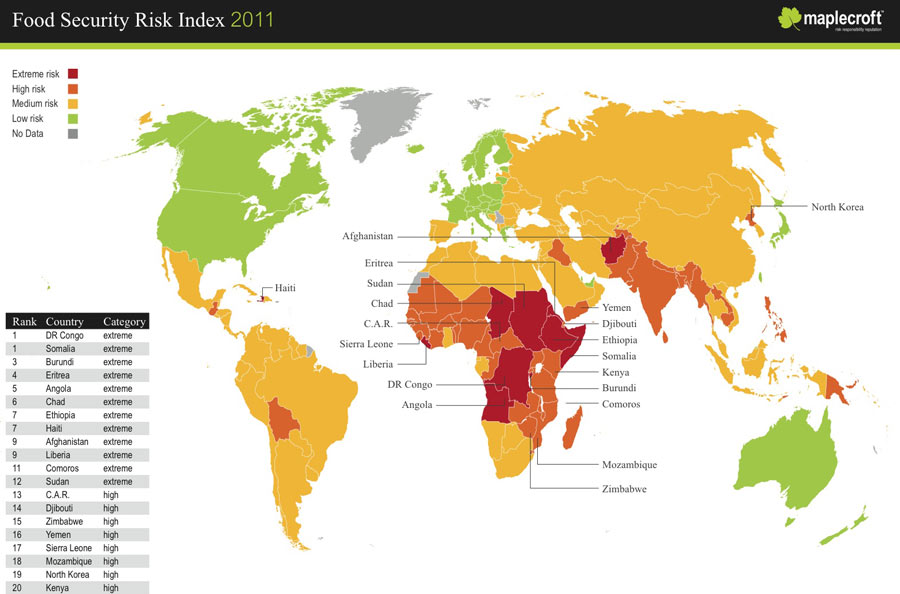
Damian Carrington, over at the Guardian, is pointing out, with reference to the map above, the links between food security and conflict. I'll quote the opening couple of paragraphs:

A new map of food security risk around the world is, in some ways, depressingly familiar. Sub-saharan Africa leaps out as the place where the most people fear for their next meal, while the rich world has more to fear from obesity. But there's plenty of salutary reminders and fascinating detail, like India's food problems and the vulnerability of Spain.
And it demonstrates the sickening, symbiotic relationship between lack of food and conflict: where one leads, the other follows.
We must start with the worst, in the horn of Africa. In Somalia, Ethiopia and Eritrea, human failings mean a severe drought has tipped millions into famine. It's a textbook case of why things go wrong. War begets poverty, leaving food unaffordable. Devastated infrastructure destroys both food production and the ability to truck in emergency food. The collapse of society means the effects of extreme weather such as drought cannot be dealt with. And the fear of violence turns people into refugees, leaving their livelihoods and social networks behind.
I really haven't anything to add to his concise and poignant piece, except to say that overextending your food supply is the classic way empires fall, as detailed in Evan D.G. Fraser and Andrew Rimas' book
Empires of Food: Feast, Famine, and the Rise and Fall of Civilizations.

Friday, May 6, 2011

Having A Hard Time Facing The Future


Report on Business Magazine (May 2011) is running an article this month called “How Do We Feed Seven billion People—and Counting?” In it, reporters interview various people, looking for their take on what is evolving into an international food crisis.
The range of opinions and suggestions is much broader than expected—mostly because several of the interviewees are pushing for more of the same discredited policies that we've been pursuing. Sometimes dressed in new rhetorical clothes, but the same solutions nonetheless.
Jeffrey Sachs, the director of the Earth Institute and special adviser to UN Secretary-General Ban Ki-moon, takes on one of the elephants in the room by saying simply that we can't afford to reach nine billion. And its true, we can't. We could, if we took agriculture and feeding people very seriously indeed, manage—just!—to feed nine billion. But it would be incompatible with the international economic order as it is currently constituted. And, as Sachs is quoted as saying:
“This crisis cannot be solved just by food aid or short-term tricks. We have to look at the basic issue: that politicians are locally oriented and cynical, that they make announcements they don't follow through on, and that they're in the pockets of lobbyists intent on preventing solutions.”
As long as the focus is on maximizing return on investment, and not on farmers making a living by feeding people, we will continue to starve both poor people and poor nations. It will be a brutal way to keep population pressure under control—after all, we are increasing by 80 million people a year at this point—but famine will be a very effective method of international social control. But famine does appear to be the weapon of choice at this time.

Abby Abassian is the senior grains economist at the FAO in Rome, and he mentions the other elephant in the room—if only obliquely. When asked “What caused the latest surge in food prices?” his reply is “In one word—weather. This is not like 2007 and 2008, where we had so many other factors mixed in.”

Tuesday, February 22, 2011

Population Pressures


The global food system will experience an unprecedented confluence of pressures over the next 40 years. On the demand side, global population size will increase from nearly seven billion today to eight billion by 2030, and probably to over nine billion by 2050; many people are likely to be wealthier, creating demand for a more varied, high-quality diet requiring additional resources to produce. On the production side, competition for land, water and energy will intensify, while the effects of climate change will become increasingly apparent. The need to reduce greenhouse gas emissions and adapt to a changing climate will become imperative. Over this period globalisation will continue, exposing the food system to novel economic and political pressures.
So understates the British report The Future of Food and Farming: Challenges and choices for global sustainability. Two billion more people to feed by about 2050, and we can't even get food from farm to plate with the people we've already got.
     We're bloody useless at food, really. We've experience with famine that stretches back to the dawn of time, but we still haven't figured out how to handle famine relief. When food prices began their upward movement in 2008, it was clear that  a lot of people were going to fall off the food delivery waggon. And they did. As Raj Patel points out, "There are 75 million people more undernourished now than in 2008."And that's in the modern fossil fuel age--and that's not the total number of people who are food insecure or actually starving to death. That's just the people added to the total in the last two years.

     Part of the problem is the way we treat food.
These perverse poles of the global food economy, obesity and hunger, reflect the basic reality that while food is elemental to life and health it is conceived as a commodity and not a right--food aid and food banks, which reflect a minimalist conception of food rights, notwithstanding--and the motive force of profit prevails over concerns about equity and nutrition.
The global food economy : the battle for the future of farming p. 13
Food is not a right, but a commodity. As such, steps have to be taken to ensure that the maximum of profit can be realized; thus the use of food aid as a lever to destroy local markets, depress food prices, drive farmers off small holdings and into the cities, and the concentration of land ownership into fewer and fewer hands. none of this actually improves access to food, quality of food, or security of supply--although all of these claims are made, none of them stand up to sustained scrutiny.

Sunday, February 13, 2011

Egypt

Court bakery of Ramses III

Well before 8 o'clock on a late April morning, a line of about 30 eager customers forms at a modest bakery in this working-class neighborhood. With a global food crisis roiling countries from Asia to the edge of Europe, at least 11 people have been killed recently in such lines here, struggling to get their daily bread.
There's no panic, no desperate scrambling for sustenance — a tentative sign of success for an emergency government plan that involves dramatic increases in spending on bread subsidies and the use of Egyptian soldiers as bakers.
"Now we're able to find bread," says Dalia Hafez, 40, seated on a nearby curb in a cappuccino-colored headscarf. "Thanks God, the crisis is over."
For now, anyway. But the aftershocks from the food trauma here are only beginning to be felt. Tensions are continuing to build in this key U.S. ally, evidence that the global food crisis — the product of factors ranging from unusual weather in producing nations to increased competition for grains from biofuels programs — is now about much more than food.
"This crisis threatens not only the hungry, but also peace and stability," the head of the United Nations World Food Program (WFP), Josette Sheeran, warned in a recent speech.
That Egyptian officials regard photos of bakers at work as potentially incendiary is a measure both of bread's unrivaled importance in the Egyptian diet and of the government's concern that continued public discontent over food supplies could metastasize into something more threatening.
"People in Egypt may be considered passive or silent, but there's a limit to this. And when they reach that limit, one day there will be a popular explosion," said lawyer Esam Salam, interviewed at a cafe near Cairo's train station.
USA Today 4/30/2008

The roots of the revolution are in food. Much of my life I've heard the saying that no city is more than three days away from revolution--all you have to do is cut off the food supply. Since the Bush regime decided to encourage the production of ethanol in '07-08, speculators have had a field day in the food futures market. And after years of the "green revolution," increasing reliance on petrochemical inputs, and land hunger (and a failure to reform consolidation and exclusion in land ownership), have combined to produce global unrest over the future of eating.

Friday, February 11, 2011

Short-sighted cuts at NSERC

     The Globe and Mail (12 January, 2011, p. A8) reports that the Natural Sciences and Engineering Research Council (NSERC) has removed food-related research from its target funding areas this year. This means that research into new plant breeds and better farming techniques will continue to be slowed. Of course, this comes just as several organizations, including the United Nations, are warning that we are entering a period of global food crisis.
In the first half of this century, as the world’s population grows to around 9 billion, global demand for food, feed and fibre will nearly double while, increasingly, crops may also be used for bioenergy and other industrial purposes. New and traditional demand for agricultural produce will thus put growing pressure on already scarce agricultural resources. And while agriculture will be forced to compete for land and water with sprawling urban settlements, it will also be required to serve on other major fronts: adapting to and contributing to the mitigation of climate change, helping preserve natural habitats, protecting endangered species and maintaining a high level of biodiversity. As though this were not challenging enough, in most regions fewer people will be living in rural areas and even fewer will be farmers. They will need new technologies to grow more from less land, with fewer hands.

     NSERC insists, in a statement, that "food-related research, despite not being listed as a target area, continues to be a priority for NSERC funding." NSERC funding has been commonly in the areas of traditional plant breeding--like canola, which was developed by Canadian scientists in the 1960s with government funding, and led to increased oil yields per acre.