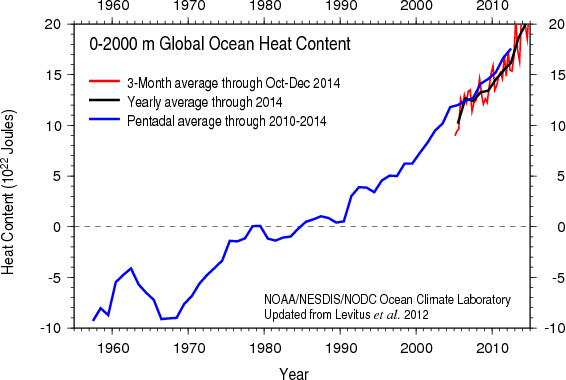
Well, it’s
as official as it needs to get:
“In NOAA’s annual global analyses, researchers put the average world temperature (combined land and ocean surface temperatures) last year at 14.52 C.
That was 0.62 C above the 20th-century average of 13.9 C, making 2013 the 37th consecutive year that the yearly global temperature exceeded the average.
The global land temperature was just shy of 1 C (0.99 C) above the 20th-century average, according to NOAA.
Both NOAA and NASA said that nine out of 10 of the warmest years ever recorded between 1880 and 2013 were within the last 13 years. Only one entry prior to the 2000s, the year 1998, cracked the top 10.
The hottest recorded year so far was in 2010, when a temperature anomaly of 0.66 C was recorded above the 20th-century average. It topped both NOAA and NASA’s lists.”
Another hot year, with the majority coming in the last decade. And back in October, the CBC reported that by 2047, we’re in real trouble:
“A new study on global warming pinpoints the probable dates for when cities and ecosystems around the world will regularly experience hotter environments the likes of which they have never seen before.
And for dozens of cities, mostly in the tropics, those dates are a generation or less away.
“This paper is both innovative and sobering,” said Oregon State University professor Jane Lubchenco, former head of the National Oceanic and Atmospheric Administration, who was not involved in the study.
To arrive at their projections, the researchers used weather observations, computer models and other data to calculate the point at which every year from then on will be warmer than the hottest year ever recorded over the last 150 years.
For example, the world as a whole had its hottest year on record in 2005. The new study, published Wednesday in the journal Nature, says that by the year 2047, every year that follows will probably be hotter than that record-setting scorcher.
Eventually, the coldest year in a particular city or region will be hotter than the hottest year in its past.”
So, about 33 years and we are fully into the new, changed, hotter world. It’s actually conceivable that I could still be alive at that time. I’ll only be 88 in 2047....
I’ve got two kids, and their world is going to be changing over the next decade more than mine has changed over my whole life. And just what are they going to eat? The leaked report from the IPCC says pretty clearly that starvation, poverty, flooding, heat waves, droughts, war and disease are going to get worse, and that much of the worse will occur in cities—particularly when food security gets even worse.
We like to think that Canada is going to come out all right in the hotter, meaner, climate-changed world. Not likely.
According to NASA:
”By about 2100, the climate change projections that we have today would suggest that there would be pressure on that grassland so prevalent in [the Canadian Prairies] to move further northward — and at the expense of the forest moving further northward as well,” said NASA climate scientist Duane Walliser, who spoke with CBC News from the Jet Propulsion Laboratory in Pasadena, Calif.
Walliser said that all across the globe, whole ecological zones such as deserts and tundra will be on the move because of “unprecedented” warming at a pace faster than at any time in 10,000 years.
But Western Canada will be among the areas hardest hit.”
NASA’s also drawn up a cute little map that “shows ecological sensitivity for the next century, with purple representing regions only slightly vulnerable to change. The ecological stress increases through blue, green, yellow, and orange areas to red.”
 |
| via NASA |
I’m not seeing a lot of ways out of this. We will not stop burning hydrocarbons. We refuse to downshift into a simpler, sustainable lifestyle. We just condemn our children to disease, starvation, and death.
In Canada, we face an unprecedented in-migration, with the majority of 330 million desperate Americans and similarly large numbers of Hispanic climate refugees set to pour across our borders (there’s already a million here), and we don’t have the water or food, or basic infrastructure in place to handle an influx like that. Our ostrich-like Prime Minister has his head firmly buried in the oil-sand, and will do nothing that will put the near-trillion-dollar investments in the massive bitumen-mining operation in Alberta at risk. In the US, they’re cracking the Bakken Formation as fast as possible, damaging or destroying water supplies along the way, in order to make the US “energy independent” once again. And the global atmospheric carbon load
stands at 396.8 and counting.
By mid-century, grasslands will be hard-pressed to survive over the summer, denying livestock natural forage. Forage they wouldn’t be able to eat during most of the day, because it will be too hot for them as well. Increased CO2 won’t mean increased plant growth if temperatures are rising rapidly and the summers become an annual drought.
Some things I can see managing as a farmer if global climate change only got a little worse: livestock grazing morning and evenings, and being sheltered in cool barns during excessive mid-day heat. Walipinis, below-grade greenhouses, being used to protect plants from high-summer heat as well as lengthening the growing season. But...but if night-time temperatures are too hot, then animals and people won’t get the chance to cool off. That’s a quick road to heat-stroke and death. If the rains become unpredictable, even the best water-harvesting systems become worthless. And too many people trying to live on too little land with too-stretched resources (like water and food), that’s a recipe for a horror show that will make Stalin’s Russia look good by comparison.
No, there’s only one hope for us, and that’s stopping this death-spiral of oil dependency. And that doesn’t look too likely. Buckle up.