Showing posts with label Grist. Show all posts

Monday, January 26, 2015

That Crushing Sense of Doom

Welcome to a Monday morning--and some lovely news.
First, Grist has reported on the application of nanotechnology to the application of pesticides. It's felt that by creating these ultra-fine droplets (we're talking about sizes in the billionths of a metre), it will take far less volume to treat the same area. So join me in a (very) cautious "yay" (no exclamation point).
Of course, new technologies bring a host of potential problems with them. And in the case of nano-droplet pesticides, these concerns involve how the nano-particles will react with the macro-world. Tiny particles may allow broader contamination of groundwater, leading to higher levels food-chain concentration. Or new ways in which these pesticides might react with mammalian nervous systems (you know, like ours). Things act very differently in the nano-world.
This is, of course, part of the ongoing commodification of technology that Marx and Engels wrote about over a century ago. Research is only seen as valuable if it can be monetized. Ask our Prime Minister, Stephen Harper; he has stopped pretty much all research that is not in the service of capital. This commodification is one of the reasons that so little pure research is being conducted on Canada (as well as the rest of the developed world). It's all about engineering older discoveries into forms suitable for our commodity culture.

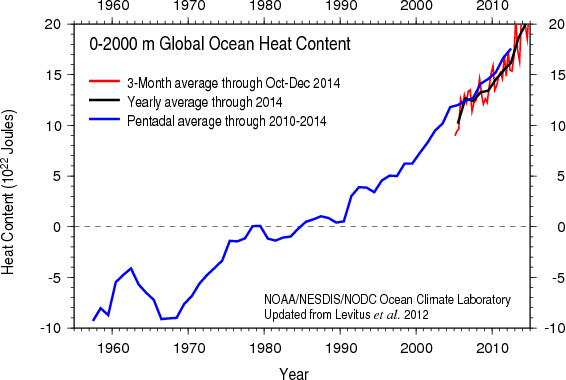
In different news, it looks like 2014 may be one of the top five hottest years on record. But of much more concern is the news, reported in the Guardian, that ocean temperatures are spiking so high that NOAA is having to re-calibrate their scales to accommodate the speed of temperature rise.
Ocean heat content data to a depth of 2,000 meters, from NOAA.
The ocean has been absorbing about 90 percent of global warming energy, so the atmosphere has warmed slower than might have been expected. Because global warming science looks at the amount of energy in the entire climate system, ocean temperatures are essential to understanding how rapid is the rise in global temperatures.
Denialists, by cherry picking atmospheric data, claim that either warming is not happening, or is happening at a much slower rate. The graph above shows the lie in that. So, yes, ocean populations are crashing; yes, we are in the late middle of the Sixth Extinction; and no, humans aren't going to make it. There's simply too many of us too invested in continuing the current system at the cost of everything else. Best case scenario? The koalas take over--all they want is to get stoned and sleep.

Monday, July 14, 2014

The Rabbit Hole Revisited (Updated)


As I posted in The Rabbit Hole the other day, there are a number of studies about organic food coming out these days, some of which are focused on whether or not organically-raised foods are nutritionally better for you. Industrial agriculture is clearly getting worried about public perception, because they are forming astroturf groups (groups that look like they're grassroots, but are actually funded and directed by industry) as part of their push-back against alternatives to the industrial food system. It is an expected strategy now that Big Tobacco owns such a big piece of the manufactured food-like substance industry.
Well, sure as the "super moon" has arrived, so has another study made it into the media. The Guardian has reported on one in an article titled "Clear differences between organic and non-organic food, study finds."  The article begins:
Organic food has more of the antioxidant compounds linked to better health than regular food, and lower levels of toxic metals and pesticides, according to the most comprehensive scientific analysis to date.
The international team behind the work suggests that switching to organic fruit and vegetables could give the same benefits as adding one or two portions of the recommended "five a day".
The study cited is Higher antioxidant and lower cadmium concentrations and lower incidence of pesticide residues in organically grown crops: a systematic literature review and meta-analyses. There's a lot of what Stepghen Stills called "hooray for our side" going on. The British Soil Association cheers the report for showing that "this research [...] shatters the myth that how we farm does not affect the quality of the food we eat."
Of course, there is an opposing viewpoint: Tom Sanders, a professor of nutrition at King's College London said "he was not persuaded by the new work. "You are not going to be better nourished if you eat organic food," he said. "What is most important is what you eat, not whether it's organic or conventional. It's whether you eat fruit and vegetables at all. People are buying into a lifestyle system. They get an assurance it is not being grown with chemicals and is not grown by big business."
So the question of whether organically grown food is nutritionally better for you is still not a solved puzzle. Mostly because nutrition is not a solved puzzle. Despite all the research being produced and released, and commented on by and in the media, we still have no really good idea about what any of the research means. Because double-blind human trials would be unethical, we will probably never definitively know what any of this research does and doesn't mean.
The Guardian, to its credit, does try to address this in a piece by titled Will eating organic food make you healthier? After some back-and-forthing with various studies, claims and counter-claims, there is actually a follow-up interview with one of the study's lead authors, Carlo Leifert where he gets to respond to some of the claims and criticisms around the study. Some of the criticisms and his responses?
Cadmium variation usually results from soil variation:
"We are pretty certain that soil type is averaged out over the many studies [we analysed]."
Higher cadmium levels in conventional crops are still within safe legal limits:
"But cadmium accumulates in the body - you really want to avoid eating it if possible."
Pesticides levels is conventional foods are also beneath maximum recommended levels:
"But there are some conventional crops that do exceed levels (eg 6% of spinach - see paper for more examples). If you want to avoid that it would be helpful to eat food with a lower chance of pesticides. until they start testing combinations of pesticide I am not confident in the regulatory testing regime."
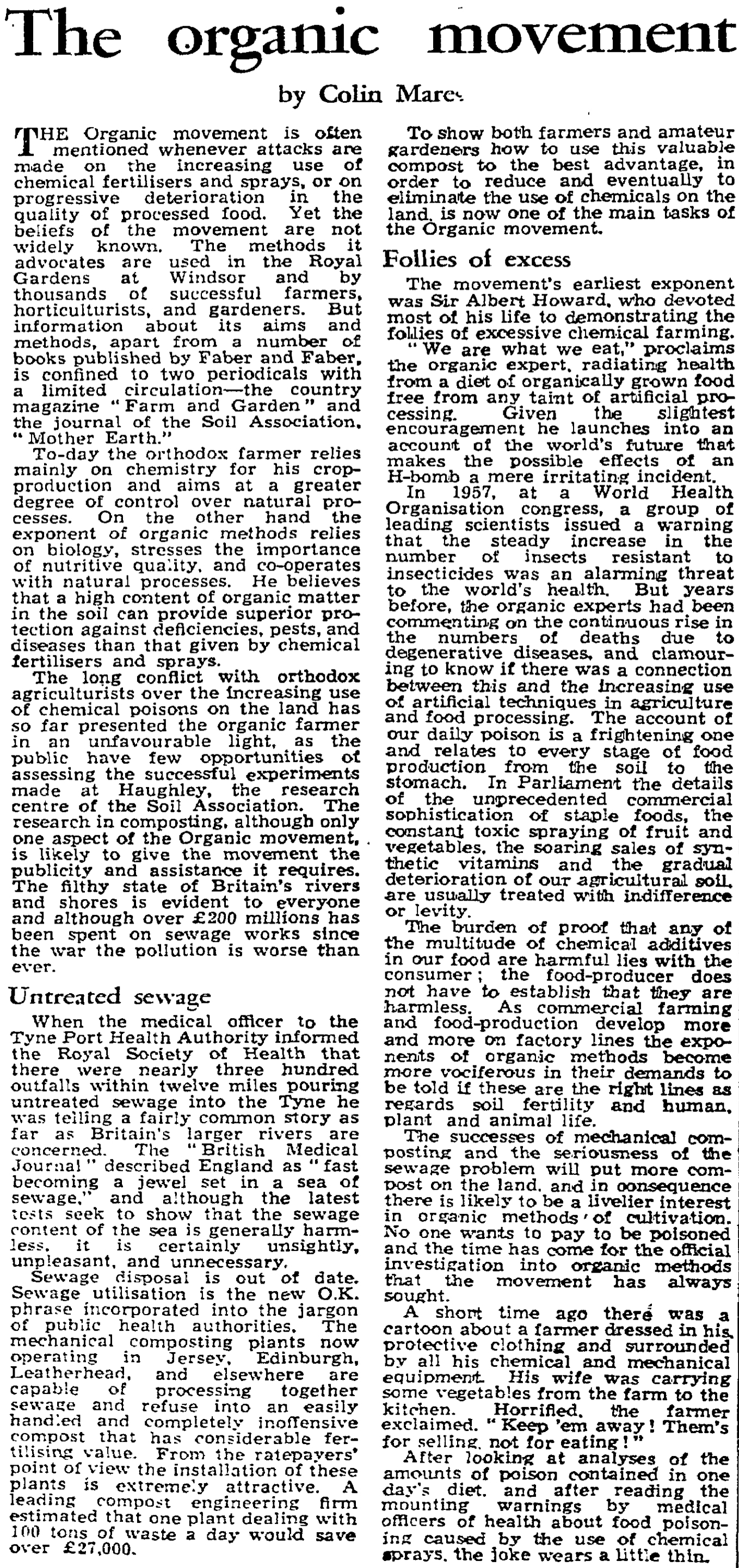
Mathiesen's article is noteworthy for taking a lot of the politics out, and adding a fair bit of the science back in to the whole "is organic better" argument. There's also a link to a great reproduction of an old article called The Organic Movement by Colin Mares (?), which shows that some of these arguments go back decades.

UPDATE:
Another excellent piece by Nathanael  Johnson at Grist on the controversy ( can it really be a controversy when both sides are arguing from positions of scientific uncertainty?).
But what we do know is clear: organic food exposes us to fewer pesticides and herbicides and is better for the soil. And that Industrial Organic is not the same as Sustainable Organic. So buy local organic when you can, and plant a garden (or a plot, or a balcony, or a pot in the window).

Monday, July 7, 2014

The Rabbit Hole

Burial chamber of Sennedjem, Scene: Plowing farmer.
Public Domain

Back on 02 July, Alexis Keinlen retweeted a blogpost suggesting that the differences between organic and "conventional" farming (I always understood that organic was the historically conventional method of farming, but hey...) were not that different. As an example, organic farming has it's own suite of pesticides that are sprayed on fields.
I was quite disappointed by the lack of information contained in the post at Real Clear Science. It cited two systematic reviews, one in the Annals of Internal Medicine (tucked behind a paywall I have no access through), and the other in the American Journal of Clinical Nutrition. The abstract of the first study states in it's conclusion: "The published literature lacks strong evidence that organic foods are significantly more nutritious than conventional foods." (italics mine). The second study, in AJCN, says:
To our knowledge, this is the only systematic review to assess the strength of the totality of available evidence of nutrition-related health effects of consumption of organic foodstuffs. Despite an extensive search strategy, the review only identified 12 relevant articles that met our inclusion criteria and were published, with an English abstract, in peer-reviewed journals over the past ≥50 y. The identified articles were very heterogeneous in terms of their study designs and quality, study population or cell line, exposures tested, and health outcomes measured. This inherent variability prevented any quantitative meta-analysis of the reported results, and from our narrative review, we concluded that evidence of nutrition-related health effects from the consumption of organic food is currently lacking.
Ross Pomeroy, who wrote the blogpost at RCS, has this as his takeaway: "The majority of Americans believe that organic foods are healthier than food grown using conventional methods. The majority of Americans are wrong."
But that's not actually what the studies say. Both quotes above use similar language, saying that "evidence is lacking." There is not a statement that organic food is more or less nutritionally good for you. Rather, there is no evidence either way. A study in Critical Reviews in Food Science and Nutrition sums it up best in it's abstract:
Studies comparing foods derived from organic and conventional growing systems were assessed for three key areas: nutritional value, sensory quality, and food safety. It is evident from this assessment that there are few well-controlled studies that are capable of making a valid comparison. (emphasis mine)
Pomeroy dismisses the claims that organic food is any better for us nutritionally very quickly, and moves on to a jeremiad against organic agriculture for using various pesticides approved under the USDA organic standards. He claims that these sprays are less effective than those used by industrial agriculture and are frequently more damaging to the environment. There is some evidence he may be correct. But he relies on a piece in Academics Review, a site which is itself rather suspect as being an astroturf-type site (being industry-funded propaganda disguised as posts by disinterested parties. A practice that goes back to the Big Tobacco wars).
The website for Fairness and Accuracy In Reporting (FAIR) points out:
The Koch brothers are the conservative billionaire co-owners of a conglomerate of chemical and oil companies, including Koch Ag & Energy Solutions. They and other biotechnology/chemical companies have a lot to lose from the explosive growth of pesticide-free organic foods.
Academics Review claims to be an independent “association of academic professors, researchers, teachers and credentialed authors” from around the world “committed to the unsurpassed value of the peer review in establishing sound science.”
However, recent articles on its website and Facebook page paint a picture of industry-biased, agenda-driven organization focused on discrediting public interest organizations, organic companies, media outlets and scientists who question the safety of GMOs and pesticides, or who tout the benefits of an organic diet.
The co-founder of Academics Review is Bruce Chassy, a recently retired professor of food microbiology at the University of Illinois at Urbana-Champaign. Chassy was among 11 scientists named by the Center for Science in the Public Interest in a complaint (8/21/03) to the journal Nature for failing to disclose “close ties to companies that directly profit from the promotion of agriculture biotechnology.”
As the letter notes, Chassy “has received research grants from major food companies, and has conducted seminars for Monsanto, Genencor, Amgen, Connaught Labs and Transgene”—companies with a large financial stake in pesticides and GMO technologies designed to boost pesticide sales.
Chassey is also on the advisory board of the American Council on Science and Health (ACSH), a group that bills itself as an independent research and advocacy organization devoted to debunking “junk science.” Carl Winter, one of Slate’s key sources, is also on the ACSH board.
However, as Mother Jones (10/28/13) revealed in a expose based on leaked documents, ACSH’s funders include agribusiness giants Syngenta and Bayer CropScience, as well as oil, food and cosmetics corporations that have a vested interest in getting consumers to stop worrying about the health effects of toxic chemical exposures.

Friday, January 24, 2014

Friday Food Security Link-straveganza

Oh, those GMOs. Nathaniel Johnson at Grist has been doing an in-depth series of reports on whether GMOs matter. It's a series that has raised more than a few hackles in the green world, particularly because he has come to the conclusion that spending our political capital opposing GMOs is a waste of time, energy, and money.
Johnson's series is worth reading, as is Tom Philpott's response, and Ramez Naam's generally pro-GMO article. But, kas Nathaniel Johnson writes in his most recent article:
[...]I want to add a note of caution: There’s an entire industry pushing the argument that GMOs are the solution. I agree with the International Assessment of Agricultural Knowledge, Science and Technology for Development that GMOs could be part of the solution, but we shouldn’t let the hype distract us from all the other ideas out there.
There are lots of problems associated with GMOs. I just want to focus directly on fixing those problems, rather than turning GMOs into a vague representative boogieman. I see problems with seed patents, problems with overuse of pesticides, problems with the lack of funding for research on agricultural alternatives. I care deeply about these things. But I’m worried that the discussion has become so ossified over GMOs that it’s not helping those causes. We’ve focused so tightly on GMOs that people tend to lose sight of those bigger things.

Raw Story is reporting that Golden Rice, that long-touted but otherwise invisible genetically modified crop that's supposed to save millions from blindness may actually be a go:
The first genetically-modified rice to be commercially available could be approved for production in the Philippines in two to three years, researchers said Tuesday, despite strong opposition from environmental groups.
Officers of both the International Rice Research Institute (IRRI) and the Philippine government’s agriculture department said the newly-developed “golden rice” had completed field trials, despite vandalism at one test field.
“Golden rice is coming. That is in the pipeline and a lot of the principal development and research has been completed,” said Achim Dobermann, deputy director-general of IRRI.
“At the moment, there is no GM (genetically-modified) rice officially released in any country,” he stressed.
No word on the actual vitamin A content of the rice, or whether kids would still be better off eating a half a carrot a month as a nutrient source. But Golden Rice, which has been in development for at least 25 years was supposed to be the criticism-killer of GMOs, developed with world health rather than tawdry financial gain in mind. Of course, when the Australians decided to breed salt-tolerant wheat, they did it with conventional breeding, meaning that farmers will be allowed to save their own seed.
Raw Story is also reporting on GM trials in the UK of a new genetically modified version of camelina that is high in fish oils:
A genetically-modified plant that produces seeds packed with fish oils is set to be grown in open fields in the UK within months, scientists announced on Friday. The oils could provide feed for farmed fish, the researchers hope, but they could ultimately be used as a health supplement in human foods such as margarine.
Fish oils – specifically omega-3 long-chain polyunsaturated fatty acids – have been shown to cut the risk of cardiovascular disease and are a popular food supplement. But about 80% of the fish oil harvested from the oceans every year is actually fed to other fish being raised in aquaculture. With many fish stocks already over-exploited, the government-funded researchers from Rothamsted Research in Hertfordshire have spent 15 years developing the new GM plant and hope to have permission for field trials by March, with planting to start shortly after if approval is given.
This is typical; we have a significant requirement for food, but a large amount of the food we harvest from the ocean is either by-catch and trashed, or fed to other, more commercially viable, fish. We harvest a hundred calories to eat ten. No bloody wonder the oceans are empty. The only farmed fish that are remotely sustainable are tilapia.
Tilapia via Wikipedia /Bjørn Christian Tørrissen
According to the New York Times:
Americans ate 475 million pounds of tilapia last year, four times the amount a decade ago, making this once obscure African native the most popular farmed fish in the United States. Although wild fish predominate in most species, a vast majority of the tilapia consumed in the United States is “harvested” from pens or cages in Latin America and Asia.
Known in the food business as “aquatic chicken” because it breeds easily and tastes bland, tilapia is the perfect factory fish; it happily eats pellets made largely of corn and soy and gains weight rapidly, easily converting a diet that resembles cheap chicken feed into low-cost seafood.
But, of course, the rush to monetize tilapia has led to problems as well. Fed on corn and soy, farmed tilapia contains relatively small amounts of beneficial omega-3 fatty acids, which are why it is recommended we eat fish in the first place. From the same article: "For the moment, Seafood Watch lists tilapia raised in the United States as a “best choice,” tilapia from Latin America as a “good alternative” and tilapia from China as “to be avoided.”
The report from the International Assessment of Agricultural Knowledge, Science and Technology for Development points out:
Development and sustainability goals should be placed
in the context of (1) current social and economic inequities
and political uncertainties about war and conflicts; (2) uncer-
tainties about the ability to sustainably produce and access
sufficient food; (3) uncertainties about the future of world
food prices; (4) changes in the economics of fossil-based en-
ergy use; (5) the emergence of new competitors for natural
resources; (6) increasing chronic diseases that are partially a
consequence of poor nutrition and poor food quality as well
as food safety; and (7) changing environmental conditions
and the growing awareness of human responsibility for the
maintenance of global ecosystem services (provisioning,
regulating, cultural and supporting).
Today there is a world of asymmetric development, un-
sustainable natural resource use, and continued rural and
urban poverty. Generally the adverse consequences of global
changes have the most significant effects on the poorest and
most vulnerable, who historically have had limited entitlements and opportunities for growth.
Canada, the US, and  Australia did not agree.

Also from Grist, an update on the California drought--in this case a lovely comparison of satellite pictures of California now and at the same time last year:

via Grist / NASA
Oh, and CNN and the John Hopkins School of Medicine report:
More than half of all adults in the United States take some sort of multivitamin; many do so in hopes of preventing heart disease and cancer or even to aid with memory.
But an editorial published in this week's Annals of Internal Medicine says that using supplements and multivitamins to prevent chronic conditions is a waste of money.
"The (vitamin and supplement) industry is based on anecdote, people saying 'I take this, and it makes me feel better,' said Dr. Edgar Miller, professor of medicine and epidemiology at Johns Hopkins University School of Medicine and co-author of the editorial.
"It's perpetuated. But when you put it to the test, there's no evidence of benefit in the long term. It can't prevent mortality, stroke or heart attack."
It's all about the money, honey.
Friday, January 17, 2014

Friday Means...Link-straveganza!

There's bad news coming, and it's called the TPP or Trans-Pacific Partnership. It's another of these Free Trade corporate rights deals being made behind our backs. In Canada, there's a total of three people allowed to see the full text of the deal and they are not allowed to tell Canadians what's in the damned thing until after it has been signed. The TPP would include Japan, Mexico, Canada, Australia, Malaysia, Chile, Singapore, Peru, Vietnam, New Zealand, Brunei, and possibly China. Over at Grist, Heather Smith takes on the recent leak of the draft text and points out just how bad for the planet this deal is going to be.

via University of Colorado
 In somewhat related news, there's been a drought of MSM (main stream media) coverage of global climate change. Grist is once again on the story:
The University of Colorado’s Center for Science & Technology Research monitors mentions of “global warming” and “climate change” in five major U.S. newspapers: The New York Times, The Wall Street Journal, The Washington Post, the Los Angeles Times, and USA Today. Check out the [...] sad graph [above] showing its latest findings

Cacao tree via Luisovalles at Wikipedia
Science Daily is reporting on the use of genetic testing to identify various cultivars of cacao beans;
 The ability to authenticate premium and rare varieties would encourage growers to maintain cacao biodiversity rather than depend on the most abundant and easiest to grow trees. Researchers have found ways to verify through genetic testing the authenticity of many other crops, including cereals, fruits, olives, tea and coffee, but those methods aren't suitable for cacao beans. Zhang's team wanted to address this challenge.
Applying the most recent developments in cacao genomics, they were able to identify a small set of DNA markers called SNPs (pronounced "snips") that make up unique fingerprints of different cacao species. The technique works on single cacao beans and can be scaled up to handle large samples quickly. "To our knowledge, this is the first authentication study in cacao using molecular markers," the researchers state.

Science Daily is also reporting two linked stories. First, that the effects of livestock on climate change are underestimated:
 While climate change negotiators struggle to agree on ways to reduce carbon dioxide (CO2) emissions, they have paid inadequate attention to other greenhouse gases associated with livestock, according to an analysis by an international research team.
A reduction in non-CO2 greenhouse gases will be required to abate climate change, the researchers said. Cutting releases of methane and nitrous oxide, two gases that pound-for-pound trap more heat than does CO2, should be considered alongside the challenge of reducing fossil fuel use.
The researchers’ analysis, “Ruminants, Climate Change, and Climate Policy,” is being published today as an opinion commentary in Nature Climate Change, a professional journal.
And second, that there may be a chance of lowering the emission of greenhouse gases from cattle:
A new research project looks into the possibilities of adapting every aspect of cattle husbandry and selection processes to lower their greenhouse gas emissions.
The key to the project, Garnsworthy says, is that cattle vary by a factor of two or three in the amount of methane their stomachs produce. It is therefore possible to imagine a dairy herd producing the same volume of milk for lower greenhouse gas emissions. In addition, different diets mean that cows can produce the same amount of milk with lower emissions. "It is possible to imagine cutting emissions from cattle by a fifth, using a combination approach in which you would breed from lower-emitting cattle as well as changing their diets," Garnsworthy said.

Katy Salter, writing for The Guardian, points out the rise in expensive slices of toast as the Next Big Thing:
Toast is trendy. Yes, you read that right: toast. Obviously we're not talking marge on Mighty White, but rather the artisanal slices served with hand-churned butter and homemade jams that have been popping up on "toast menus" around San Francisco and now New York. And if that all sounds too yuppy and insufferable for words, brace yourself: there's more. Some of those slices are selling for $4 a pop. That's about £2.43 a slice at the current exchange rate.

Wednesday, January 2, 2013

From Prison to Farm

Over in Illinois, residents spend $48 billion a year on food, 90 percent of which comes from elsewhere. But those who don't think food security will play in Peoria should think again. Peoria received a kind-of gift of an old prison and radar site that comes with some significant restrictions on the land.
Matt Dayhoff / Journal Star
The Hanna City correctional institution was converted into a radar site for the FAA to track aircraft. The state signed the whole place over to Peoria, but because it was still an active radar site, it came with restrictions on what could be done to it.
But now a local resident, Mary Ardapple, a Peoria County board member who owns a local bakery, has taken a look at the place--including the greenhouse. And it's given her the idea to turn the ex-prison into a a food hub and farm incubator site.
Grist has covered the story quite nicely, including how the Illinois Food, Farms and Jobs Act is requiring state institutions like universities and government agencies to source 20% of their food requirements from local sources. I can't even imagine what that would do to local food production; the University of Victoria is now sourcing a lot of its food locally and that alone is changing the face of south island agriculture.
But it's also interesting to note how Illinois is thinking of converting a former prison into a farm and farmer training centre, while here in Canada a proven positive program, that of having prisoners growing a significant part of their own food, has been cancelled because it's not punitive enough.