Showing posts with label adulteration. Show all posts

Monday, November 3, 2014

A History of Fraud

Over at Modern Farmer, they are reporting on a story from Britain about food fraud. In this case it's that
76 samples of “goat cheese” from eight locations all around the UK were tested, and nine were found to have significant amounts of sheep milk in them. Three of those were more than 80% sheep milk, and three others were more than 50% sheep milk.
After the horse-meat scandal,  you would think that food fraud would be reduced. Apparently that's not the case.
This is not a new problem, nor is it restricted to the UK or even Europe. Modern Farmer also hosts an excellent long-form essay on the history of food fraud by Shoshanna Walter. Also included is this lovely list of food scandals. So go read the articles.
  • 1 Swill Milk 
     According to an 1860 New York Times story, the date that “swill milk,” milk polluted by cows fed with distillery runoff, got introduced to the New York population was unknown. But the effect was terrible. Babies fed the milk made by malnourished cows often died, and the backlash prompted landmark food safety hearings.
  • 2 Leaded Wine  As Bee Wilson chronicles in her book, Swindled, wine is a term that contains multitudes: it can be infused with fruit or honey or lead. And until the 1800s, although the evils of ingesting lead were known, there was no real effort to stop pouring it into our wine glasses.

  • 3 The Seal of Bread 
    These days, one doesn’t hear much about poisonous bread, but securing standard ingredients and measurements for bread was a top priority in the Middle Ages, according to Bee Wilson. Bakers were held accountable by actually making a seal on their loaves, an early form of fraud detection, to prevent someone dumping coarse wheat into supposed refined products. The great Bread Scandal of 1757 involved alum being added and bread fraud persisted, by the the 19th century, people regularly stuffed birch bark and twigs into loaves.
  • 4 Not-So-Green-Tea 
    In an 1851 issue of British medical journal The Lancet, a shocking report was issued about a common beverage: green tea. In what became a scandal, it was found that green tea contained colorings and adulterants that included gunpowder. This scandal had been around for a while, as a counterfeit tea ring was prosecuted in 1818 for selling fake fancy varietals. With help from scientists, new methods were developed for testing the contents of tea.
  • 5 The Great Lozenge Scandal 
    The straw that broke the food regulatory back of Britain, according to Bee Wilson, was the Bradford sweets scandal of 1858. The candies were normally made with sugar and gum and some kind of cheap filler — usually plaster but, in this case, the candyman used arsenic. Over 200 people were poisoned — and 20 people died. In 1868, the government passed regulation to keep poisons like arsenic in the hands of chemists.

Friday, January 24, 2014

Friday Food Security Link-straveganza

Oh, those GMOs. Nathaniel Johnson at Grist has been doing an in-depth series of reports on whether GMOs matter. It's a series that has raised more than a few hackles in the green world, particularly because he has come to the conclusion that spending our political capital opposing GMOs is a waste of time, energy, and money.
Johnson's series is worth reading, as is Tom Philpott's response, and Ramez Naam's generally pro-GMO article. But, kas Nathaniel Johnson writes in his most recent article:
[...]I want to add a note of caution: There’s an entire industry pushing the argument that GMOs are the solution. I agree with the International Assessment of Agricultural Knowledge, Science and Technology for Development that GMOs could be part of the solution, but we shouldn’t let the hype distract us from all the other ideas out there.
There are lots of problems associated with GMOs. I just want to focus directly on fixing those problems, rather than turning GMOs into a vague representative boogieman. I see problems with seed patents, problems with overuse of pesticides, problems with the lack of funding for research on agricultural alternatives. I care deeply about these things. But I’m worried that the discussion has become so ossified over GMOs that it’s not helping those causes. We’ve focused so tightly on GMOs that people tend to lose sight of those bigger things.

Raw Story is reporting that Golden Rice, that long-touted but otherwise invisible genetically modified crop that's supposed to save millions from blindness may actually be a go:
The first genetically-modified rice to be commercially available could be approved for production in the Philippines in two to three years, researchers said Tuesday, despite strong opposition from environmental groups.
Officers of both the International Rice Research Institute (IRRI) and the Philippine government’s agriculture department said the newly-developed “golden rice” had completed field trials, despite vandalism at one test field.
“Golden rice is coming. That is in the pipeline and a lot of the principal development and research has been completed,” said Achim Dobermann, deputy director-general of IRRI.
“At the moment, there is no GM (genetically-modified) rice officially released in any country,” he stressed.
No word on the actual vitamin A content of the rice, or whether kids would still be better off eating a half a carrot a month as a nutrient source. But Golden Rice, which has been in development for at least 25 years was supposed to be the criticism-killer of GMOs, developed with world health rather than tawdry financial gain in mind. Of course, when the Australians decided to breed salt-tolerant wheat, they did it with conventional breeding, meaning that farmers will be allowed to save their own seed.
Raw Story is also reporting on GM trials in the UK of a new genetically modified version of camelina that is high in fish oils:
A genetically-modified plant that produces seeds packed with fish oils is set to be grown in open fields in the UK within months, scientists announced on Friday. The oils could provide feed for farmed fish, the researchers hope, but they could ultimately be used as a health supplement in human foods such as margarine.
Fish oils – specifically omega-3 long-chain polyunsaturated fatty acids – have been shown to cut the risk of cardiovascular disease and are a popular food supplement. But about 80% of the fish oil harvested from the oceans every year is actually fed to other fish being raised in aquaculture. With many fish stocks already over-exploited, the government-funded researchers from Rothamsted Research in Hertfordshire have spent 15 years developing the new GM plant and hope to have permission for field trials by March, with planting to start shortly after if approval is given.
This is typical; we have a significant requirement for food, but a large amount of the food we harvest from the ocean is either by-catch and trashed, or fed to other, more commercially viable, fish. We harvest a hundred calories to eat ten. No bloody wonder the oceans are empty. The only farmed fish that are remotely sustainable are tilapia.
Tilapia via Wikipedia /Bjørn Christian Tørrissen
According to the New York Times:
Americans ate 475 million pounds of tilapia last year, four times the amount a decade ago, making this once obscure African native the most popular farmed fish in the United States. Although wild fish predominate in most species, a vast majority of the tilapia consumed in the United States is “harvested” from pens or cages in Latin America and Asia.
Known in the food business as “aquatic chicken” because it breeds easily and tastes bland, tilapia is the perfect factory fish; it happily eats pellets made largely of corn and soy and gains weight rapidly, easily converting a diet that resembles cheap chicken feed into low-cost seafood.
But, of course, the rush to monetize tilapia has led to problems as well. Fed on corn and soy, farmed tilapia contains relatively small amounts of beneficial omega-3 fatty acids, which are why it is recommended we eat fish in the first place. From the same article: "For the moment, Seafood Watch lists tilapia raised in the United States as a “best choice,” tilapia from Latin America as a “good alternative” and tilapia from China as “to be avoided.”
The report from the International Assessment of Agricultural Knowledge, Science and Technology for Development points out:
Development and sustainability goals should be placed
in the context of (1) current social and economic inequities
and political uncertainties about war and conflicts; (2) uncer-
tainties about the ability to sustainably produce and access
sufficient food; (3) uncertainties about the future of world
food prices; (4) changes in the economics of fossil-based en-
ergy use; (5) the emergence of new competitors for natural
resources; (6) increasing chronic diseases that are partially a
consequence of poor nutrition and poor food quality as well
as food safety; and (7) changing environmental conditions
and the growing awareness of human responsibility for the
maintenance of global ecosystem services (provisioning,
regulating, cultural and supporting).
Today there is a world of asymmetric development, un-
sustainable natural resource use, and continued rural and
urban poverty. Generally the adverse consequences of global
changes have the most significant effects on the poorest and
most vulnerable, who historically have had limited entitlements and opportunities for growth.
Canada, the US, and  Australia did not agree.

Also from Grist, an update on the California drought--in this case a lovely comparison of satellite pictures of California now and at the same time last year:

via Grist / NASA
Oh, and CNN and the John Hopkins School of Medicine report:
More than half of all adults in the United States take some sort of multivitamin; many do so in hopes of preventing heart disease and cancer or even to aid with memory.
But an editorial published in this week's Annals of Internal Medicine says that using supplements and multivitamins to prevent chronic conditions is a waste of money.
"The (vitamin and supplement) industry is based on anecdote, people saying 'I take this, and it makes me feel better,' said Dr. Edgar Miller, professor of medicine and epidemiology at Johns Hopkins University School of Medicine and co-author of the editorial.
"It's perpetuated. But when you put it to the test, there's no evidence of benefit in the long term. It can't prevent mortality, stroke or heart attack."
It's all about the money, honey.

Wednesday, September 19, 2012

Trans-Fatty Acids, An Ongoing Problem

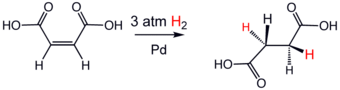
image from Wikipedia


Trans-fatty acids (transfats or TFAs) occur in industrially hydrogenated oils--such as margarine. The process of hydrogenation (adding hydrogen atom pairs to, in this case, unsaturated fats in the presence of a catalyst) converts unsaturated fats into saturated fats (fats that are solid at room temperature) and TFAs. In the early 1900s, apparently half of the whale oil being harvested was treated this way to create a butter substitute similar to margarine.
That TFAs,when consumed in volumes of 5 grams a day or more, lead to an increased chance (23%) of coronary heart disease, is well established. Soft margarine contains far fewer transfats than a fully hydrogenated hard margarine, and some, like Becel, use a different technique for hydrogenation that produces very few transfats. Canada has only voluntary limits on transfat content in food, as does Europe. BMJ online is reporting:
In 2005, a large serving of French fries and nuggets, 100g of microwavable popcorn, and 100g of cake or biscuits or wafers provided more than 30g/100g of TFA in five EU countries in Eastern Europe and between 20g and 30g in eight Western European countries.

In 2009 the analysis revealed that the TFA content in French fries and nuggets had fallen substantially in all the European countries studied. But while the TFA content of popcorn, cakes and biscuits had fallen in Western European countries, this was not the case in Eastern Europe where it remained high.

The same portions still provided high TFA content of between 10g and 20g in Hungary, Poland and the Czech Republic.  But the equivalent menu in Germany, France and the UK provided less than 2g.

Clearer food labelling is one way of curbing trans fatty acid intake, but most countries still rely on food manufacturers to voluntarily reduce the TFA content of their products, the authors point out.

Only a few countries—Denmark, Austria, Switzerland and Iceland—have gone down the legislative route and forced industry to limit the amount of TFA used in foods to 2% of the total fat.

But foods containing trans fats, which can comprise up to 60% of the total fat content, can still legally be sold as shop bought packaged goods, or unpackaged in restaurants and fast food outlets elsewhere in Europe, the authors emphasise.
Clearly, we still have a long way to go. And yet, somehow creating actual regulations around food safety is off the table. Maybe I'm just too old-school; food purity regulation has been a responsibility of government since, well, forever--just as the problem of food adulteration has been around forever. And it strikes me that government failing in ensuring the provision of good food is a failed government. 

Wednesday, June 27, 2012

Additives 1

This interesting piece from the Food Integrity Campaign:
As the health debate over soda continues, new test results reignite concerns regarding manufactured ingredients commonly used in soft drinks and other processed foods. It was enough that mercury has been found in products with high fructose corn syrup thanks to industrial processing, but now industrially produced caramel coloring (ubiquitous in soda to create a more appealing, dark color) has been linked to a carcinogen known as 4-MI.
The Center for Science in the Public Interest (CSPI) found "alarming levels" of the cancer-causing chemical 4 methylimidizole (4-MI) in Coca-Cola drinks around the world. It forms when a solution of sugars is heated with ammonia to make the artificial brown coloring, which is also used in baked goods, soy sauces, gravies and beer.
As of January 2012, California requires a cancer-warning label on soft drinks and other widely consumed products that lead to people consuming at least 30 micrograms of 4-MI per day. In response to that rule, Coke started using an alternative caramel coloring with considerably lower 4-MI levels … but has yet to market the less-contaminated drinks outside California

And then, the interesting part. A chart of 4-MI content by country. And look at who's number two...


This on the heels of renewed interest in how fast food / industrial food manufacturers are using the same deflect and deny tactics employed so successfully by the tobacco industry for so long. And what difference will this make to our current government? I predict "none at all." The current Tory government isn't simply business friendly, it's more like international business' crack whore. The evidence, on the other hand, just keeps piling up: if it has been commercially grown, or modified from the field in any way, it is probably better not to eat it. The only way to have true food security is to democratise the food system. By that I mean to distribute production across as many people as possible, to export nothing we do not priduce in surplus, and to import as little as possible. Canada needs to pursue food sovereigity before it pursues export capacity or the Trans-Pacific Partnership.

Friday, April 6, 2012

The Death of "Pink Slime"

As I reported earlier in my Jamie Oliver post, the makers of "finely textured lean ground beef" have had a pretty difficult couple of weeks. From Gerald Zirnstein (a USDA microbiologist) coining the phrase in 2002, to Kit Foshee bringing his concerns to GAP (the Government Accountability Project) and their Food Integrity Campaign in 2008, and the closing of three of four plants by Beef Products International, and the news that AFA Foods have entered Chapter 11 because of the current storm this week, things have moved pretty fast in the last while.
Beef by-products undergoing processing at a BPI plant. Image sourced: Chicago Tribune

The idea of ammoniating beef to kill e. coli bacteria allowed mechanically separated beef to enter the human food chain--before that it was only approved for use in pet foods. Things started to go off the rails when it was claimed that ammoniated beef trimmings would transmit this e. coli-killing ability to ground beef it was mixed with-- a claim that was never tested.
Ammoniating beef was found to be so effective that, in 2007, "exempt from routine testing of meat used in hamburger sold to the general public." From the beginning, finely textured lean ground beef was seen as both a cheap extender of ground beef (ground beef could conatain up to 15% ftl ground beef without any requirement to list it as an ingredient), and as a way of ensuring that the traditional ground beef was somehow protected against e. coli contamination.The problem was that, at the concentrations required by the USDA, ground beef mixed with ammoniated ground beef smelled bad. Bad enough that shipments of it were occasionally returned as having been spoiled during transport, when in fact they just smelled that way.
Ammonia concentrations were reduced to meet these concerns--thus negating both the ammmoniated beef's protection from e. coli and the alleged "knock-on" effect of protecting the meat it was mixed with.It should be noted, however, that no case of e. coli contamination has been traced back to BPI's ammoniated beef, although there have been several e. coli-related ground beef recalls in the last decade.
Thankfully, ammonia has never been approved as a treatment method for ground meat in Canada, nor is it supposed to be imported (although there seems to be some fuzzy areas around the importation rule, with Health Canada Canada allowing finely textured meat to be "used in the preparation of ground meat" and "identified as ground meat" under certain conditions). With pretty much every major fast food operation in the US using pre-made hamburger patties buying ground beef with the allowed 15% of ammoniated beef, one is left to wonder if any Canadian operation ended up using US-made patties.
Ammonia isn't the only compound used in food processing. For example, we've seen a rise in the use of cellulose as a food extender in the last while, and a report on food fraud has just been published in the April Journal of Food Science (not available online, but there's a press report). In fact, there's an entire site dedicated to food fraud reporting.  On the USDA website, you can get a list of the various chemicals used in industrial food production (links to a pdf). I wish I could say that it was as easy to find something similar on the CFIA website, but it's not. The CFIA websiteseems to be a bit more producer-friendly and a little less consumer-friendly. On the plus side though, there is a dictionary of food additives, available both online and as a downloadable pdf, a guide to meat cuts and the words used on packaging, and some basic food-handling tips.

Sunday, March 25, 2012

Jamie Oliver

I kind of have to admit, I love this guy. He has leveraged his celebrity into not more celebrity, but into actual conciousness raising, actual change. His British School Dinners series made significant changes to the way English children eat at school. When it was shown on the food network here in Canada, it sparked the formation of dozens of groups across the country. Engaged activist parents who began to pay attention to food at school.
Then Jamie took on school food in the USA with Jamie Oliver's Food Revolution. While he didn't have the effect he'd hoped for, what with being turned away from 75 LA school districts when he offered them an opportunity for a cafeteria makeover. America really didn't want anyone to know what kind of crap they were feeding their kids in school. But then this happened:


Jamie showed off the "pink slime" or "finely textured lean ground beef" used as a filler product in commercial ground beef. A USDA study shows that pink slime is used in about 70% of all commercially made ground beef in the US.
Well, things happened. Things like this report from ABC News on 21 March 2012:


Safeway, the #2 supermarket chain in the US is now refusing to stock ground beef containing the filler.That's success. In Colorado, parents have pushed school districts to reject beef using the filler. That's success.
And back in the UK, The Guardian reports that a study published in The Journal of Health Economics  shows:

Jamie Oliver's healthy school dinners continue to produce a marked improvement in national curriculum test results five years after the chef first launched his campaign, according to research.
A study by academics shows children eating the healthier lunches introduced by the TV chef do far better in tests.
Absenteeism from sickness was also said to have dropped by around 14%.
And it is claimed that a child eating the healthier food will earn between £2,103 and £5,476 more over their lifetimes due to their improved literacy.
So you get why I love this guy? Impact. And a positive impact at that.  And it's exactly this kind of impact that has caused industrial food to pursue "ag gag" bills in various state legislatures in the US.Because if you don't know about it, they can keep doing it--no matter what "it" is.

UPDATE: Read a report that said that three of Beef Products Inc.'s four factories producing "pink slime" have been closed for 60 days, pending a review of demand.  The closure may be permanent. Like I said, impact.

UPDATE II: Reuters is reporting that  
Ground beef processor AFA Foods filed for bankruptcy protection on Monday, citing the impact of the uproar over a meat filler dubbed "pink slime" by critics.
The Daily Mail Online is headlining that
'Pink slime' company files for bankruptcy amid controversy over the ammonia treated filler

Jamie Oliver + social media = Chapter 11 proceedings.
I'm guessing that for the company's managers this was like being punched by Mike Tyson with no warning. Can't say that I'm feeling all that concerned for them, although this will affect 650 workers in multiple plants. Defenders, like Texas Governor Rick Perry, seen here chowing down on a "pink slime burger"
(an AP photo that runs with the Daily Mail Online article) claim that the substance was "safe to eat." Don't know that anyone was saying it was "unsafe to eat,"  just that we didn't want to eat the damned stuff. And because it was labelled "finely textured lean ground beef" rather than "ammonia-treated mechanically recovered waste meat-like substance" in general people got a bit perturbed. Interesting that the University of Guelph has chosen today to announce that it will no longer be pursuing research on the "enviro-pig," a pig designed to better withstand the industrial farm conditions under which it would be raised.
Call me crazy, call me idealistic, but you know what I believe? I believe that when you're making a hamburger for human consumption, you should at no time deem it necessary or desirable to treat its ingredients in ammonia. Or any cleaning product, for that matter.
I don't think that's asking a lot--and I don't ask a lot for my fellow burger-eaters. Only that whatever it is that you're putting in my hamburger? That laid out on a table or cutting board prior to grinding, it at least resembles something that your average American might recognize as "meat."

Update III
Over at the Food Integrity Campaign, there's a really nifty timeline of the "pink slime" issue, from it's beginings to the almost total rejection of the product in this past week.  Also, back in 2009, the New York Times ran an excellent article (it must have been, it won awards) about the use of ammoniated beef and the problems that were apparent with the product even then.
You know, I started out wanting to talk about a chef who has leveraged his celebrity to try and do some good in the world. I really didn't see this explosion coming, thinking it was just one more example of the crap we're stuck with eating ,and that until there was a revolution we would continue to be stuck with eating. But, man, did this thing ever achieve critical mass in a hurry!

Monday, November 21, 2011

Infill

I don't usually do this, but with the ongoing impact of the “pink slime” story and there's a pretty good article over at The Street about the increasing use of cellulose as a filler in food, I thought I'd write a little about food additives and adulterants.
Adulterants are distinct from additives in that additives are generally regulated and accepted in use, and adulterants are added to food without the consumers knowledge. In practical terms, additives are legal and adulterants are not.
So the use of cellulose in food is legal. Cellulose is found on the FDA's GRAS list (Generally Regarded As Safe), and so is allowed in food products. The rise in it's use is due primarily to economic pressures to keep food costs down particularly in this period of price spikes from the speculative bubble we're in. The same with “pink slime”; mechanically separated meat treated with ammonia can be added to ground meat products quite legally. Whether we want these substances in our edible food-like products is quite another story.
Adulterants in food have a long and storied history—particularly in bread. Bread, over the years, has had plaster of Paris, alum, sawdust, and mashed potatoes added to it to increase weight or whiteness and defraud the consumer. The British Medical Journal was printing arguments about the presence of adulterants and arguing about how much they mattered back in 1873.
Cellulose is a product on the FDA GRAS list (Generally Regarded As Safe), but the increasing use of filler comes from economic pressures. Commodity prices remain strong (primarily on a bubble due to speculation) and economies remain weak, meaning that producers looking to increase or maintain margins are going to be searching for cheaper alternatives to their traditional products. And food producers are turning to cellulose to add bulk and structure to their edible food-like products.
The use of additives or adulterants (the difference is whether or not the recipient knows about / wants the additive in their food. If it is iodine in salt, that's an additive. If it is plaster of Paris being added to bread, adulterant) in food has a long history, and always for the same reason: economic pressure to supply food as cheaply as possible while maintaining profits. We've seen this with the addition of melamine to milk products in China, in order to more cheaply achieve crude protein content targets. Alum, sawdust, and mashed potatoes have historically been added to bread to increase weight or the whiteness of the flour.
Food adulteration is directly tied to industrialization; both the industrialization of food production and the migration of populations out of the countryside to the cities. Low wages increase the need for cheap food, the drive for cheap food encourages adulteration.
These days, it's the GRAS list that defines the difference between adulterant and additive. That food will have additives is taken as read, as long as the ingredients appear on the GRAS list, it's generally acceptable. Consumers often disagree, as with the addition of HFCS (high fructose corn syrup) to honey. Or pink slime to ground meat products.
Of course, there's always the option of TSP, or Textured Soy Protein. But a fairly recent study shows how the manufacturing process leaves behind a residual level of hexane. Hexane is used as a solvent to separate fats from protein in the making of soy protein (well, in all fairness, not just soy protein. Its used with corn and other plants too, for the same purpose). Mother Jones has an article on the report, along with an FAQ, and Slate weighed in with an article as well. As is pointed out, there has been little research on whether or not hexane, when consumed, is a problem. It certainly is when we breathe it, but as to eating it, well, that seems to be a lot less immediately toxic. There are even alternatives; when it comes to complex processing to create vegetarian fare, mycoprotein has to be a bit better, but not by much. At least they're not currently using a neurotoxin in the process.
But as consumers, we have to ask ourselves, just how much responsibility or concern should we have for the way our food is prepared? Do we want to eat food that is killing those who gather or prepare it? Because, if so, there's a lot more research that needs to be done before we eat various things—particularly out of the industrial food system. For example, pesticides are dangerous to both farmworkers, as this EPA pamphlet demonstrates, and their families.
We create a market for such substances every time we eat food out of the industrial food system. But, as Michael Pollen said in hisWilliams College address, the food system is a fragile thing. What we do as consumers has an impact. If we don't buy something, stores will quit stocking it, meaning fewer people will buy—creating a virtuous circle. Pollen mentions that as few as fifty complaints can get a topic onto a McDonald's board meeting agenda. Positive requests have an impact also. If you ask for more local food, you create a demand that grocers will try to satisfy—meaning more downstream demand for farmers. Anything affects the way the food system acts. It really is that fragile and sensitive. So when you see local produce in your local or chain grocery, ask for the produce manager and compliment him/her. If you don't see local cheese in the dairy aisle, ask for the dairy manager and request it. This can be the politest ruckus you'll ever raise.

Wednesday, March 30, 2011

Adulterated Rice

Image from original article at Weekly Hong Kong

West Coast Woman mentioned seeing an article that reports on China producing adulterated rice for sale. With a little help from Google, I found the story in a number of places; Raw Story and the Globe Tribune are two. They, and most of the other sites, are referencing a story that appeared on Very Vietnam--which itself references an article that first appeared on Weekly Hong Kong. I don't read Korean, so the original article on WHK is inaccessible to me, forcing me to rely on translations for my information.
That being said, it looks like

The "rice" is made by mixing potatoes, sweet potatoes and plastic. The potatoes are first formed into the shape of rice grains. Industrial synthetic resins are then added to the mix. The rice reportedly stays hard even after being cooked.
The Korean-language Weekly Hong Kong reported that the fake rice is being sold in the Chinese town of Taiyuan, in Shaanxi province.
 The report quotes an un-named Chinese Restaurant Association official as saying that eating three bowls of the adulterated rice would be the equivalent of ingesting a plastic bag.
This is the logical outgrowth of an industrial food system that treats food as nothing more than a commodity and severs the relationship between producers and consumers. The goal is to keep the costs of production down and profit margins up.
The "wild west" capitalism of China has lead to other problems with food adulteration before--like Chinese milk and infant formula being contaminated with melamine in order to pass protein level tests.