Showing posts with label food production. Show all posts

Thursday, July 4, 2013

Four New Environmental Research Letters


Implications of regional improvement in global climate models for agricultural impact research 
Global climate models (GCMs) have become increasingly important for climate change science and provide the basis for most impact studies. Since impact models are highly sensitive to input climate data, GCM skill is crucial for getting better short-, medium- and long-term outlooks for agricultural production and food security. The Coupled Model Intercomparison Project (CMIP) phase 5 ensemble is likely to underpin the majority of climate impact assessments over the next few years. We assess 24 CMIP3 and 26 CMIP5 simulations of present climate against climate observations for five tropical regions, as well as regional improvements in model skill and, through literature review, the sensitivities of impact estimates to model error. Climatological means of seasonal mean temperatures depict mean errors between 1 and 18 ° C (2–130% with respect to mean), whereas seasonal precipitation and wet-day frequency depict larger errors, often offsetting observed means and variability beyond 100%. Simulated interannual climate variability in GCMs warrants particular attention, given that no single GCM matches observations in more than 30% of the areas for monthly precipitation and wet-day frequency, 50% for diurnal range and 70% for mean temperatures. We report improvements in mean climate skill of 5–15% for climatological mean temperatures, 3–5% for diurnal range and 1–2% in precipitation. At these improvement rates, we estimate that at least 5–30 years of CMIP work is required to improve regional temperature simulations and at least 30–50 years for precipitation simulations, for these to be directly input into impact models. We conclude with some recommendations for the use of CMIP5 in agricultural impact studies.


Global crop exposure to critical high temperatures in the reproductive period: historical trends and future projections


Long-term warming trends across the globe have shifted the distribution of temperature variability, such that what was once classified as extreme heat relative to local mean conditions has become more common. This is also true for agricultural regions, where exposure to extreme heat, particularly during key growth phases such as the reproductive period, can severely damage crop production in ways that are not captured by most crop models. Here, we analyze exposure of crops to physiologically critical temperatures in the reproductive stage (Tcrit), across the global harvested areas of maize, rice, soybean and wheat. Trends for the 1980–2011 period show a relatively weak correspondence (r = 0.19) between mean growing season temperature and Tcrit exposure trends, emphasizing the importance of separate analyses for Tcrit. Increasing Tcrit exposure in the past few decades is apparent for wheat in Central and South Asia and South America, and for maize in many diverse locations across the globe. Maize had the highest percentage (15%) of global harvested area exposed to at least five reproductive days over Tcrit in the 2000s, although this value is somewhat sensitive to the exact temperature used for the threshold. While there was relatively little sustained exposure to reproductive days over Tcrit for the other crops in the past few decades, all show increases with future warming. Using projections from climate models we estimate that by the 2030s, 31, 16, and 11% respectively of maize, rice, and wheat global harvested area will be exposed to at least five reproductive days over Tcrit in a typical year, with soybean much less affected. Both maize and rice exhibit non-linear increases with time, with total area exposed for rice projected to grow from 8% in the 2000s to 27% by the 2050s, and maize from 15 to 44% over the same period. While faster development should lead to earlier flowering, which would reduce reproductive extreme heat exposure for wheat on a global basis, this would have little impact for the other crops. Therefore, regardless of the impact of other global change factors (such as increasing atmospheric CO2), reproductive extreme heat exposure will pose risks for global crop production without adaptive measures such as changes in sowing dates, crop and variety switching, expansion of irrigation, and agricultural expansion into cooler areas.


Assessing climate change impacts on sorghum and millet yields in the Sudanian and Sahelian savannas of West Africa
Sub-Saharan West Africa is a vulnerable region where a better quantification and understanding of the impact of climate change on crop yields is urgently needed. Here, we have applied the process-based crop model SARRA-H calibrated and validated over multi-year field trials and surveys at eight contrasting sites in terms of climate and agricultural practices in Senegal, Mali, Burkina Faso and Niger. The model gives a reasonable correlation with observed yields of sorghum and millet under a range of cultivars and traditional crop management practices. We applied the model to more than 7000 simulations of yields of sorghum and millet for 35 stations across West Africa and under very different future climate conditions. We took into account 35 possible climate scenarios by combining precipitation anomalies from −20% to 20% and temperature anomalies from +0 to +6 °C.
We found that most of the 35 scenarios (31/35) showed a negative impact on yields, up to −41% for +6 °C/ − 20% rainfall. Moreover, the potential future climate impacts on yields are very different from those recorded in the recent past. This is because of the increasingly adverse role of higher temperatures in reducing crop yields, irrespective of rainfall changes. When warming exceeds +2 °C, negative impacts caused by temperature rise cannot be counteracted by any rainfall change. The probability of a yield reduction appears to be greater in the Sudanian region (southern Senegal, Mali, Burkina Faso, northern Togo and Benin), because of an exacerbated sensitivity to temperature changes compared to the Sahelian region (Niger, Mali, northern parts of Senegal and Burkina Faso), where crop yields are more sensitive to rainfall change. Finally, our simulations show that the photoperiod-sensitive traditional cultivars of millet and sorghum used by local farmers for centuries seem more resilient to future climate conditions than modern cultivars bred for their high yield potential (−28% versus −40% for the +4 °C/ − 20% scenario). Photoperiod-sensitive cultivars counteract the effect of temperature increase on shortening cultivar duration and thus would likely avoid the need to shift to cultivars with a greater thermal time requirement. However, given the large difference in mean yields of the modern versus traditional varieties, the modern varieties would still yield more under optimal fertility conditions in a warmer world, even if they are more affected by climate change.


Impacts of recent climate change on Wisconsin corn and soybean yield trends 

The US Corn Belt supports agroecosystems that flourish in a temperate climate regime that could see significant changes in the next few decades. Because Wisconsin is situated on the northern, cooler fringes of this region, it may be the beneficiary of a warmer climate that could help support higher corn and soybean yields. Here we show that trends in precipitation and temperature during the growing season from 1976–2006 explained 40% and 35% of county corn and soybean yield trends, respectively. Using county level yield information combined with climate data, we determined that both corn and soybean yield trends were enhanced in counties that experienced a trend towards cooler and wetter conditions during the summer. Our results suggest that for each additional degree ( °C) of future warming during summer months, corn and soybean yields could potentially decrease by 13% and 16%, respectively, whereas if modest increases in total summer precipitation (i.e. 50 mm) were to occur, yields may be boosted by 5–10%, counteracting a portion of the negative effects associated with increased temperature. While northern US Corn Belt regions such as Wisconsin may benefit from a warmer climate regime and management changes that lengthen the crop-growing period in spring and autumn, mid- to high-latitude crop productivity may be challenged by additional summertime warming unless adaptive measures are taken.

Friday, July 27, 2012

Local Food Fair!

Not huge, but really a lot of fun. Peppers, the food store on the left of the photo, held a local food producers fair yesterday, to advertise many of the brands they carry. With the two large exhibition tents set up on the right, people started showing up even before the producers had set up.
In addition to Level Ground (about whom I've written before), there were3 numerous other producers, several of whom I was unaware. Portofino is not one of them.
Portofino Bakery
Portofino makes a large variety of breads and supplies a number of outlets, from Peppers to Hotel Grand Pacific. They've become a significant voice among local food producers.
Daksha's Gourmet Spices is producing a line of curry mixes: Butter Chicken, Chicken Curry, Korma, Tikka Masala, Tandoori,Vindaloo, Spicy Fish,Chana Masala, Aloo Gobi and Daal.

Tuesday, July 10, 2012

Monsanto--Taking The Shot

From Alternet:
A so-called “Monsanto rider,” quietly slipped into the multi-billion dollar FY 2013 Agricultural Appropriations bill, would require – not just allow, but require - the Secretary of Agriculture to grant a temporary permit for the planting or cultivation of a genetically engineered crop, even if a federal court has ordered the planting be halted until an Environmental Impact Statement is completed. All the farmer or the biotech producer has to do is ask, and the questionable crops could be released into the environment where they could potentially contaminate conventional or organic crops and, ultimately, the nation’s food supply.
Unless the Senate or a citizen’s army of farmers and consumers can stop them, the House of Representatives is likely to ram this dangerous rider through any day now.
In a statement issued last month, the Center For Food Safety had this to say about the biotech industry’s latest attempt to circumvent legal and regulatory safeguards:
Ceding broad and unprecedented powers to industry, the rider poses a direct threat to the authority of U.S. courts, jettisons the U.S. Department of Agriculture’s (USDA) established oversight powers on key agriculture issues and puts the nation’s farmers and food supply at risk.
In other words, if this single line in the 90-page Agricultural Appropriations bill slips through, it’s Independence Day for the biotech industry.

Wednesday, June 27, 2012

Additives 1

This interesting piece from the Food Integrity Campaign:
As the health debate over soda continues, new test results reignite concerns regarding manufactured ingredients commonly used in soft drinks and other processed foods. It was enough that mercury has been found in products with high fructose corn syrup thanks to industrial processing, but now industrially produced caramel coloring (ubiquitous in soda to create a more appealing, dark color) has been linked to a carcinogen known as 4-MI.
The Center for Science in the Public Interest (CSPI) found "alarming levels" of the cancer-causing chemical 4 methylimidizole (4-MI) in Coca-Cola drinks around the world. It forms when a solution of sugars is heated with ammonia to make the artificial brown coloring, which is also used in baked goods, soy sauces, gravies and beer.
As of January 2012, California requires a cancer-warning label on soft drinks and other widely consumed products that lead to people consuming at least 30 micrograms of 4-MI per day. In response to that rule, Coke started using an alternative caramel coloring with considerably lower 4-MI levels … but has yet to market the less-contaminated drinks outside California

And then, the interesting part. A chart of 4-MI content by country. And look at who's number two...


This on the heels of renewed interest in how fast food / industrial food manufacturers are using the same deflect and deny tactics employed so successfully by the tobacco industry for so long. And what difference will this make to our current government? I predict "none at all." The current Tory government isn't simply business friendly, it's more like international business' crack whore. The evidence, on the other hand, just keeps piling up: if it has been commercially grown, or modified from the field in any way, it is probably better not to eat it. The only way to have true food security is to democratise the food system. By that I mean to distribute production across as many people as possible, to export nothing we do not priduce in surplus, and to import as little as possible. Canada needs to pursue food sovereigity before it pursues export capacity or the Trans-Pacific Partnership.

Wednesday, June 13, 2012

Bragging Rights

Nothing serious. Just had our first vine ripened strawberries on June 1st and Paula just handed me three snap peas to eat. Which is early. And makes me very happy. And there's lots of blossoms on both the peas and strawbs, so there will be more summer goodness.
In addition, the pepper plants are doing well, the shallots are getting big, as are the Royal Burgundy bush beans (though no blossoms yet), and the carrots are all up. The tomatoes are struggling, but not dead yet. And the climbing beans are up and growing. So life is pretty good in the garden.

Tuesday, May 29, 2012

Link-straveganza!

Food Trucks

From The Toronto Standard. Credit: Jen Chan

Sometimes, there's a lot going on. And those days (like today), well, I can't posibly put an explanatory gloss on everything I see. Like food trucks. Not an entirely new phenomena, but suddenly they've taken off again in popularity.Now, I've had some terrific food truck food: at the St. Albert market we used to get pulled pork and bbq beans made with Cattleboyz BBQ sauce that was to die for. And green onion cakes were always a food you bought at a street vendor tent. I've even thought about opening one. But the current mania just seems an invitation to bad food driving out good (in the foodie version of Gresham's Law). Bronwyn Kienapple is asking a few of the same questions in the Toronto Standard.

Occupy The Farm

From Climate Connection.org


Trying to get a handle on what the Occupy movement means seems impossible--except to say that as a movement that seems dedicated to citizen involvement and democratic empowerment, I couldn't be more supportive. The Occupy the Farm group taking over UC Berkley lands and procceeding to plant food crops is an interesting idea. Jeff Conant explores it in more depth at Climate Connection.org.

Corporate Land Purchases


from the Grain website

Not just corporations, but nations (I'm looking at you, China), are busy buying up farmland--particularly in the developing workd--not to grow food to feed indigenous populations, but to support their own populations. This is a good idea from the corporate and national governments perspectives, but really is unsustainable. Carey L. Biron takes on the issue at Farm Land grab.org. Carey Gillam, at the same site, points out the ongoing influence of speculators in investment in agriculture. And at the Grain website, an article pursues the question of how these land grabs are affecting food security in Latin America.


Private Profit, Public Cost

is the issue around pig farms in a new report (pdf) from the WSPA (World Society for the Protection of Animals). Now, I have a few problems with PETA, but I have a lot more concerns around CAFOs. The Financial Post has a pretty neutral article discussing the points contained in the above report.


Food Security and Farms

Both Alternet and Rabble.ca  have articles on Why Big Food Must Go (alternet), and Why Hunger is a Farm Issue (rabble.ca). Both good, and both symptomatic of the discussion that is being heard more and more these days. As Michael Pollen says, the way we raise food is the issue that floats overtop all the other envirinmental issues we face.

The Madness of Smoked Pig Bellies

This recipe got passed around a while back.

Bacon Jam
Ingredients

    1 1/2 pounds sliced bacon, cut crosswise into 1-inch pieces
    2 medium yellow onions, diced small
    3 garlic cloves, smashed and peeled
    1/2 cup cider vinegar
    1/2 cup packed dark-brown sugar
    1/4 cup pure maple syrup
    3/4 cup brewed coffee

Directions

    In a large skillet, cook bacon over medium-high, stirring occasionally, until fat is rendered and bacon is lightly browned, about 20 minutes. With a slotted spoon, transfer bacon to paper towels to drain. Pour off all but 1 tablespoon fat from skillet (reserve for another use); add onions and garlic, and cook until onions are translucent, about 6 minutes. Add vinegar, brown sugar, maple syrup, and coffee and bring to a boil, stirring and scraping up browned bits from skillet with a wooden spoon, about 2 minutes. Add bacon and stir to combine.
    Transfer mixture to a 6-quart slow cooker and cook on high, uncovered, until liquid is syrupy, 3 1/2 to 4 hours. Transfer to a food processor; pulse until coarsely chopped. Let cool, then refrigerate in airtight containers, up to 4 weeks.

When did such a simple product like bacon become the object of such veneration and our latest food of mass destruction?

Monday, April 30, 2012

Jolly Olde...Well, Not So Much.

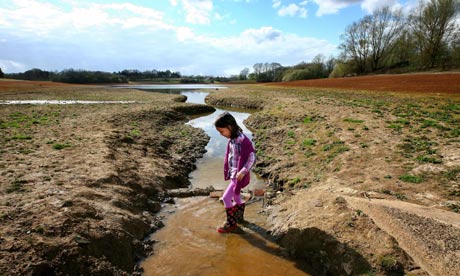
Bewl Water reservoir, near Lamberhurst, Kent, photo from The Guardian website by Gareth Fuller/PA
England is still swinging, but the pendulum only seems to be going from bad to worse and back again. Southern England has been in the grip of a drought for a few years now, as the condition of the reservoir above attests. Now it has started raining across the region, but not the spring rains needed to replenish the groundwater and then the aquifers. Rather, massive storms are slamming into the south, bringing projected dumps of up to 40mm of rain during the day--much of which will run off the drought-hardened soils rather than soaking in. Even if it does soak in, it won't be enough to ease the drought: these rains would have to continue for weeks to begin replenishing the underground aquifers.
The consequences for food production, according to The Guardian are significant:
Farmers, particularly arable farmers and vegetable growers, face a difficult summer as decisions have already been taken on what to grow this year. Further restrictions such as curbs on abstracting groundwater will become more likely if the drought continues. Price rises are likely for thirsty crops such as soft fruit and vegetables, while the price of beer is also expected to increase.
And you know if the price of beer rises, the Conservative government of David Cameron is going to take even more of a bollocking than usual. Because the UK has also slipped into a double dip recession because of the current austerity programme.  Also from the Guardian:
Britain's leading foodbank network, the Trussell Trust, says every single day it is handing out emergency food parcels to parents who are going without meals in order to feed their children, or even considering stealing food to put on the table, as the government's austerity measures start to bite.
The number of people to whom it had issued emergency food parcels had doubled in the last 12 months and was set to increase further as rising living costs, shrinking incomes and welfare cuts take their toll, the trust said, as it published its annual report, which is fast becoming a barometer of social deprivation.
Two foodbanks a week opened up in the UK over the last 12 months to meet an explosion in demand from families living on the breadline, the trust said. The charity currently oversees 201 foodbanks run on a franchise basis across the UK, up from 100 in 2010-11.
Its not much better worldwide. A report published in the magazine Science suggests "Models that link yields of the four largest commodity crops to weather indicate that global maize and wheat production declined by 3.8 and 5.5%, respectively, relative to a counterfactual without climate trends.[...] Climate trends were large enough in some countries to offset a significant portion of the increases in average yields that arose from technology, carbon dioxide fertilization, and other factors." So even when there's good news (increases in average yields) the bad news tends to outweigh it (enough to offset a significant portion).
It might be nice to have a test case for some of the problems we're facing--like the continued uncertainty in the price of oil.  We've passed Peak Oil at this point, but what that means seems to be confused. Neil Reynolds takes on the Club of Rome and Peak Oil in today's Globe and Mail, writing:
The book’s most alarming prediction, of course, dealt with oil – which, it said, would be irretrievably depleted by 2022 – a mere decade from now – at the latest. Yet, “the World Energy Council reports that global proven recoverable reserves of natural gas liquids and crude oil amounted to 1.2 trillion barrels in 2010,” Mr. Kenny says. “That’s enough to last another 38 years at current usage. Add in shale oil, and that’s an additional 4.8 trillion barrels, or a century and a half’s worth of supply at present usage rates. Tar sands, including some huge Canadian deposits, add perhaps six trillion barrels more.”
It should be noted that  "global proven recoverable reserves" is a terribly elastic figure. The Saudis, as one example, have been fudging the books on what their "recoverable reserves" are for almost two decades.It also helps to toss natural gas into the mix--there are large reserves around the planet--so much so that the current price is below the cost of recovery. But what Peak Oil theory said was that once we've passed the halfway point on recovery--which we have--the oil that was left would become more and more difficult to retrieve. And as prices rose, companies would go to greater and greater lengths to retrieve that oil. Its expected (under the theory, that as oil climbs in price, exploration/late production will increase while demand drops off. Once demand has dropped off, prices will begin to decline. Once prices at the pump decline, exploration/pumping will slow while demand rises again. Prices will suddenly spike until more production is brought back on line. There will be tremendous oscillation in prices and availability of oil. There will always be oil, its just that most of us won't be able to afford products made from it.
Energy has become dearer, and so we see the mining of bitumen in the Tar Sands of Alberta, a process that is only economically viable when the price of oil is over $80/bbl. And with energy prices currently sitting at $104/bbl for West Texas Crude, we see both the crazy push to mine the Tar Sands and the rise of fracking to release shale oil (another process like mining the Tar Sands that only happens without proper oversight and when oil prices are high).
But what happens when the oil stops? Actually, it doesn't even have to stop, all it has to do is become too expensive for use in agriculture.  And actually, we have a case study of this: Cuba. As an article in Slate points out:
Unable to afford the fertilizers and pesticides that 20th-century agriculture had taken for granted, the country faced extreme weather events and a limit to the land and water it could use to grow food. The rest of the world will soon face many of the same problems: In the coming decade, according to the OECD, we’ll see higher fuel and fertilizer costs, more variable climate patterns, and limits to arable land that will drive cereal prices 20 percent higher and hike meat prices by 30 percent—and that’s just the beginning. Policymakers can find inspirational and salutary ideas about how to confront this crisis in Cuba, the reluctant laboratory for 21st-century agriculture.
Cuban officials faced the crisis clumsily. They didn’t know how to transform an economy geared toward sweetening Eastern Europe into one that could feed folk at home. Agronomists had been schooled in the virtues of large-scale industrial collective agriculture. When the “industrial” part became impossible, they insisted on yet more collectivization. The dramatic decline in crop production between 1990 and 1994, during which the average Cuban lost 20 pounds, was known as “the Special Period.” Cubans have a line in comedy as dark as their rum.
It finally took land reform to fix many of the problems. The Cuban state was still not ready to give up its control over the land, but realized that allowing management to devolve to the farm level might not be a bad thing. With that devolution, farmers also got usufruct rights--that is, the legal right of using and enjoying the fruits or profits of something belonging to another. In fact, Cuban peasants have been able to boost food production without scarce and expensive imported agricultural chemicals by first substituting more ecological inputs for the no longer available imports, and then by making a transition to more agroecologically integrated and diverse farming systems. A report on this, called the Campesino-to-Campesino agroecology movement of ANAP in Cuba is available online (amazingly, the full text of the report is available for free download). It should also be noted that Cuba pursued its self-sufficiency goals with the aid of one of the best educated populations around (Cuba has 2 percent of Latin America’s population but 11 percent of its scientists). Various scientists were put to work with the farmers to maximize production without industrial farming inputs.
It may not be perfect, but Cuba has managed to supply a significant amount of its own food. In a report from Miguel A. Altieri and Fernando R. Funes-Monzote:
The production of vegetables typically produced by peasants fell drastically between 1988 to 1994, but by 2007 had rebounded to well over 1988 levels [...]. This production increase came despite using 72 percent fewer agricultural chemicals in 2007 than in 1988. Similar patterns can be seen for other peasant crops like beans, roots, and tubers.
Cuba’s achievements in urban agriculture are truly remarkable—there are 383,000 urban farms, covering 50,000 hectares of otherwise unused land and producing more than 1.5 million tons of vegetables with top urban farms reaching a yield of 20 kg/m2 per year of edible plant material using no synthetic chemicals—equivalent to a hundred tons per hectare. Urban farms supply 70 percent or more of all the fresh vegetables consumed in cities such as Havana and Villa Clara.
So the future isn't entirely threatening, its just different.A lot more of us will be peasants again--a designation I, for one, am willing to embrace.

Tuesday, March 27, 2012

John Todd and the New Alchemists

Inventor Jay Baldwin, quoting Buckminister Fuller, says that in order to survive, we need a design revolution. The revolution would have to be comprehensive, anticipatory, and science-based revolution that takes entire systems into account. And this, says Jay Balwin, is exactly what Dr. Jonathan Todd is doing. Jonathan Todd is a Canadian-born environmental scientist and activist. In 1969, he, his wife Nancy Jack Todd, and William McLarney founded The New Alchemy Institute, a small farm just outside Woods Hole in Massachusetts. The goal of the Institute was pretty simple—change the world.
 "Among our major tasks is the creation of ecologically derived human support systems - renewable energy, agriculture, aquaculture, housing and landscapes. The strategies we research emphasize a minimal reliance on fossil fuels and operate on a scale accessible to individuals, families, and small groups. It is our belief that ecological and social transformations must take place at the lowest functional levels of society if humankind is to direct its course toward a greener, saner world."   Fall 1970Bulletin of the New Alchemists

In 1974, John and Nancy returned to Canada to build The Ark, a smaller version of the Institute, at Spry Point, P.E.I. Research At the Ark involved a number of trailblazing and now established green or sustainable elements: solar orientation, solar collectors, wind energy, thermal storage, and composting toilets. These formed the basis for the Living Machine®, his wastewater treatment system. The New Alchemist's built stuff, lots of stuff. They worked at systems thinking, building greenhouses with a built-in aquaculture component, making greenhouses that require minimal inputs. Their work is what has led to things like the “million pounds of food on three acres” people at Growing Power. I remember reading The Book of The New Alchemists and seeing the first examples I'd seen of integrated systems thinking. Here was a greenhouse with above-ground fishtanks serving as supports for the plant benches. The water moderated temperatures in the greenhouse and served as a growing medium for tilapia. The water was cycled back through the plant cultures, fertilizing the plants and cleaning the water. The tilapia are vegetarian fish, and are fed with the greenhouse cleanings (prunings and the like). Most importantly, the New Alchemists kept detailed notes about what they were experimenting with, and distilled the notes into various papers and publications over the years. The Greencenter has become the custodian of this information, and continues to offer it to the world as a kind of open source biological research.

example of a bioshelter design


 Todd eventually decided to pursue his work with the Living Machine® on a larger scale, and is now building organic water treatment systems.

His more recent work is also the topic of a TEDx talk. Not the best talk I've ever watched, but a lot of fascinating stuff being said.

Sunday, March 25, 2012

Jamie Oliver

I kind of have to admit, I love this guy. He has leveraged his celebrity into not more celebrity, but into actual conciousness raising, actual change. His British School Dinners series made significant changes to the way English children eat at school. When it was shown on the food network here in Canada, it sparked the formation of dozens of groups across the country. Engaged activist parents who began to pay attention to food at school.
Then Jamie took on school food in the USA with Jamie Oliver's Food Revolution. While he didn't have the effect he'd hoped for, what with being turned away from 75 LA school districts when he offered them an opportunity for a cafeteria makeover. America really didn't want anyone to know what kind of crap they were feeding their kids in school. But then this happened:


Jamie showed off the "pink slime" or "finely textured lean ground beef" used as a filler product in commercial ground beef. A USDA study shows that pink slime is used in about 70% of all commercially made ground beef in the US.
Well, things happened. Things like this report from ABC News on 21 March 2012:


Safeway, the #2 supermarket chain in the US is now refusing to stock ground beef containing the filler.That's success. In Colorado, parents have pushed school districts to reject beef using the filler. That's success.
And back in the UK, The Guardian reports that a study published in The Journal of Health Economics  shows:

Jamie Oliver's healthy school dinners continue to produce a marked improvement in national curriculum test results five years after the chef first launched his campaign, according to research.
A study by academics shows children eating the healthier lunches introduced by the TV chef do far better in tests.
Absenteeism from sickness was also said to have dropped by around 14%.
And it is claimed that a child eating the healthier food will earn between £2,103 and £5,476 more over their lifetimes due to their improved literacy.
So you get why I love this guy? Impact. And a positive impact at that.  And it's exactly this kind of impact that has caused industrial food to pursue "ag gag" bills in various state legislatures in the US.Because if you don't know about it, they can keep doing it--no matter what "it" is.

UPDATE: Read a report that said that three of Beef Products Inc.'s four factories producing "pink slime" have been closed for 60 days, pending a review of demand.  The closure may be permanent. Like I said, impact.

UPDATE II: Reuters is reporting that  
Ground beef processor AFA Foods filed for bankruptcy protection on Monday, citing the impact of the uproar over a meat filler dubbed "pink slime" by critics.
The Daily Mail Online is headlining that
'Pink slime' company files for bankruptcy amid controversy over the ammonia treated filler

Jamie Oliver + social media = Chapter 11 proceedings.
I'm guessing that for the company's managers this was like being punched by Mike Tyson with no warning. Can't say that I'm feeling all that concerned for them, although this will affect 650 workers in multiple plants. Defenders, like Texas Governor Rick Perry, seen here chowing down on a "pink slime burger"
(an AP photo that runs with the Daily Mail Online article) claim that the substance was "safe to eat." Don't know that anyone was saying it was "unsafe to eat,"  just that we didn't want to eat the damned stuff. And because it was labelled "finely textured lean ground beef" rather than "ammonia-treated mechanically recovered waste meat-like substance" in general people got a bit perturbed. Interesting that the University of Guelph has chosen today to announce that it will no longer be pursuing research on the "enviro-pig," a pig designed to better withstand the industrial farm conditions under which it would be raised.
Call me crazy, call me idealistic, but you know what I believe? I believe that when you're making a hamburger for human consumption, you should at no time deem it necessary or desirable to treat its ingredients in ammonia. Or any cleaning product, for that matter.
I don't think that's asking a lot--and I don't ask a lot for my fellow burger-eaters. Only that whatever it is that you're putting in my hamburger? That laid out on a table or cutting board prior to grinding, it at least resembles something that your average American might recognize as "meat."

Update III
Over at the Food Integrity Campaign, there's a really nifty timeline of the "pink slime" issue, from it's beginings to the almost total rejection of the product in this past week.  Also, back in 2009, the New York Times ran an excellent article (it must have been, it won awards) about the use of ammoniated beef and the problems that were apparent with the product even then.
You know, I started out wanting to talk about a chef who has leveraged his celebrity to try and do some good in the world. I really didn't see this explosion coming, thinking it was just one more example of the crap we're stuck with eating ,and that until there was a revolution we would continue to be stuck with eating. But, man, did this thing ever achieve critical mass in a hurry!

Tuesday, March 20, 2012

Chili Tank

Well, not actually a tank, but a Czech Army Field Kitchen. This short video by Kyle Farquharson and Jennifer Giesbrecht of the University of British Columbia Graduate School of Journalism interviews local Steven Forster and his unique food cart.


Notice, at about 1'10", the display of the different types of carrots being prepped for use. Steven is careful to use local and organic wherever he can when making chili. He operates under the name Opa's Suppenküche. and you can check out another video--showing how the tank is heated using green fire logs made primarily of used coffee grounds. He also serves into biodegradable and compostable bowls.And the chili looks pretty darned good too!

Sunday, March 18, 2012

Spring! (I hope I hope...)

Well, Saturday was a lovely day--meaning it wasn't raining, the sun was out occasionally, and there were no windstorms. I've been getting a bit twitchy watching first the snowdrops appear a month ago, then the crocuses a couple of weeks later, and now all the plum and cherry trees in blossom. The rest of Canada (well, maybe not the True North) have been regularly seeing temperatures ranging from the high single digits into double digits regularly, this being the Winter That Wasn't up here north of 49.
However, this fine example of the way global climate change is going to affect us over the next couple of decades aside, I've been wanting spring to be here already. I know I'm probably early (after all, it seems to be November here, even though it's March), but I'm really not used to planting times in a Mediterranean-like climate. And this year, we've got a garden.
I've written about it before, building the raised beds and setting up the poles that will carry the tunneling plastic. But I started some rosemary seeds six weeks back (like I said, I've been hurrying the season a bit), and some tomato seeds a couple of weeks ago. And rosemary seeds either have really have a crap germination rate, or I'm doing something really really wrong.
But looking at the fragile little sprouts in their peat pellets has been making me want to get my hands dirty. So yesterday, Paula and I went to the garden centre to buy more dirt.
Over the winter we've noticed that the rains have made the soil in the beds less fluffy--which was expected. So now we're topping off the topsoil/compost mix with more soil in order to fill the beds. To the tune of 4+ cubic feet per bed.
Unlike on the farm, we don't have a lot of room, so we're having to look at more intensive methods of growing vegetables this time around. I've always wanted to try forcing potatoes in a cylinder. I first heard about this a couple of decades back as a method for re-using car tires.

Thursday, January 19, 2012

Corporate Food Sells Local

It's a funny ol' world. This ad comes from Hellman's--a company owned by Unilever, one of the larger corporate behemoths straddling our globe. The ad is practically a PSA for Canadian farmers and Canadian food with the seeming contradiction of being put out with one of the global food giants it decries.  Yet, owning local as well as international producers, it's clear that Unilever won't suffer no matter what we as consumers do. Unless wegrow our own food and purchase from local farmers at a local market or through a CSA, the multinationals are still going to make out like bandits. But all that being said, still a good commercial.

Tuesday, January 17, 2012

Debt and Food: A Common Cause

Eric Reguly, in the weekend Globe and Mail, tries to compare and contrast two different crisis which originated in 2008: the European debt crisis, and the international food crisis. The two crisis were linked, mostly by nervous money fleeing the world's debt markets for commodities (and both were precipitated by the criminal activity engaged in by various investment banks like Goldman Sachs and Bear Stearns prior to the housing bubble popping). The role of speculative money in causing the worldwide food price inflation of 2008 through 2011 is pretty common knowledge. Starbucks president Howard Shultz, as reported in the The Telegraph, has said:
... the current spike in the cost of commodities such as coffee and other foodstuffs is "not based on supply and demand" but based on market speculation. He said that the farmers who actually produce the commodities are receiving a "de minimus" proportion of the price rises. "Right now we are experiencing a very strange and almost inexplicable phenomenon in the commodities market. Without any real supply or demand issues we are witness to the fact that most agricultural food commodities are at record highs at once, and coffee is at a 34-year high." 
Frederick Kaufmann, in The Guardian, follows up with a brief interview with Professor Yaneer Bar-Yam, of the New England Complex Systems Institute (Necsi):
"Prices have been way out of equilibrium in 2011," Bar-Yam told me. "The bubble has not burst yet." According to Bar-Yam, the international thirst for biofuels has put a strain on arable land previously reserved for food production. At the same time as the rise of the biofuel mandate, the rise of investable commodity indexes and other electronically traded funds has offered investors of all stripes a chance to sink their cash in a sparkling new casino of derivative products. As a result, an ever-flowing spring of speculative capital sustains the status quo. But just as food is no ordinary widget, speculation in commodity markets is not simply a matter of financial predation. "The high prices of food have resulted in accumulations of inventories at the same time as people can't afford food," said Bar-Yam, who noted that the Arab spring was triggered by the food-price bubble. In fact, Necsi's quantitative model of speculation predicted the uprisings in Tunisia, Libya and Egypt, and warned that if food prices remain inflated, riots and revolutions will go global sometime between July 2012 and August 2013. "We are at a critical point," said Bar-Yam. "We don't have a stay-the-course option right now." 
Notice that quote: "The high prices of food have resulted in accumulations of inventories at the same time as people can't afford food." That makes it very clear that this is about speculation, not supply and demand.

Saturday, November 19, 2011

Death for Innovation

 I'm not sure that I agree with all of Joe Cunnigham's column over at the Pincher Creek Voice. But I do know that he has certainly identified the problem. At least Joe was producing a value-added product that he could ship around the world. When we were producing fresh veg, we couldn't save product from day to day. We had to sell it same day or forgo any possible profit on it.
This really is an excellent column from someone who has been in the trenches of small production. It is clear that we need a second food system, distinct from the international industrial one we live with now. One that supports small producers, local producers, and artisanal producers.  Anyway, let me introduce you to Joe Cunningham:
  I spent the last ten years of my life as a small food producer. It was an interesting journey. I say “was” because I have recently gone into semi-retirement from the gourmet smoked fish business my wife, Janice Day, and I operated here in PIncher Creek. Most Pincher Creekians do not know there was a fish producing business in Pincher Creek for ten years and it gave me a chuckle every time I watched the reaction of someone here finding this out for the first time. They werenʼt ill-informed - how would they be expected to know?  Ninety-nine percent of what we made went to specialty stores and expensive restaurants in Calgary and Banff. It had to.


Iʼm not being flippant. For years we agonized over pricing our products high enough to stay in business. Eventually we settled on a pricing scheme that placed us at roughly double that of similar category, however inferior, supermarket products. We were successful! ... well... sort of. You see, we grew at a reasonable rate, got rave reviews from all over the planet (some food writers going so far as to say we made the best cold smoked product in the world), operated on a mean and lean budget, were courted by Alberta Agriculture, and were proud of the little innovations and inventions we came up with to make our small operation work as efficiently as possible. Hereʼs the catch - we didnʼt make enough money to justify continuing, on a purely economic basis. We were living near poverty so we could continue experiencing the personal, cultural and artistic gratification of making something of intrinsic value while living a lifestyle with an element of independence. Although by the time we had worn ourselves out we were selling about
$115,000.00 worth of stuff a year, we werenʼt even clearing minimum wage for our efforts. Somethingʼs gotta give eventually.

Itʼs the same story elsewhere. Over those ten years Janice and I got to know a lot of other small food producers in Alberta, and elsewhere - vegetable growers, apiary owners, makers of sauces, condiments and frozen gourmet food, ranchers, bakers, cheese makers, coffee roasters, and oyster growers ...etc., etc., etc. Their experiences were related to us in an endless stream of commonality and challenges. At least we werenʼt alone.

Read the rest of this excellent column at The Pincher Creek Voice.