|
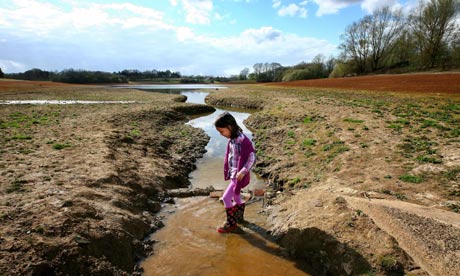
| Bewl Water reservoir, near Lamberhurst, Kent, photo from The Guardian website | by Gareth Fuller/PA |
England is still swinging, but the pendulum only seems to be going from bad to worse and back again. Southern England has been
in the grip of a drought for a few years now, as the condition of the reservoir above attests. Now it has started
raining across the region, but not the spring rains needed to replenish the groundwater and then the aquifers. Rather, massive storms are slamming into the south, bringing projected dumps of up to 40mm of rain during the day--much of which will run off the drought-hardened soils rather than soaking in. Even if it does soak in, it won't be enough to ease the drought: these rains would have to continue for
weeks to begin replenishing the underground aquifers.
The consequences for food production,
according to The Guardian are significant:
Farmers, particularly arable farmers and vegetable growers, face a
difficult summer as decisions have already been taken on what to grow
this year. Further restrictions such as curbs on abstracting groundwater
will become more likely if the drought continues. Price rises are
likely for thirsty crops such as soft fruit and vegetables, while the
price of beer is also expected to increase.
And you know if the price of beer rises, the Conservative government of David Cameron is going to take even more of a bollocking than usual. Because the UK has also slipped into a double dip recession because of the current austerity programme.
Also from the Guardian:
Britain's leading foodbank network, the Trussell Trust,
says every single day it is handing out emergency food parcels to
parents who are going without meals in order to feed their children, or
even considering stealing food to put on the table, as the government's
austerity measures start to bite.
The number of people to whom it
had issued emergency food parcels had doubled in the last 12 months and
was set to increase further as rising living costs, shrinking incomes
and welfare
cuts take their toll, the trust said, as it published its annual
report, which is fast becoming a barometer of social deprivation.
Two
foodbanks a week opened up in the UK over the last 12 months to meet an
explosion in demand from families living on the breadline, the trust
said. The charity currently oversees 201 foodbanks run on a franchise
basis across the UK, up from 100 in 2010-11.
Its not much better worldwide. A report published in the magazine
Science suggests "Models that link yields of the four largest commodity crops to weather indicate that global maize and wheat production declined
by 3.8 and 5.5%, respectively, relative to a counterfactual without climate trends.[...] Climate trends were large enough in some countries to offset a significant portion of the increases
in average yields that arose from technology, carbon dioxide fertilization, and other factors." So even when there's good news (increases in average yields) the bad news tends to outweigh it (enough to offset a significant portion).
It might be nice to have a test case for some of the problems we're facing--like the continued uncertainty in the price of oil. We've passed Peak Oil at this point, but what that means seems to be confused. Neil Reynolds takes on the Club of Rome and Peak Oil in
today's Globe and Mail, writing:
The book’s most alarming prediction, of course, dealt with oil – which,
it said, would be irretrievably depleted by 2022 – a mere decade from
now – at the latest. Yet, “the World Energy Council reports that global
proven recoverable reserves of natural gas liquids and crude oil
amounted to 1.2 trillion barrels in 2010,” Mr. Kenny says. “That’s
enough to last another 38 years at current usage. Add in shale oil, and
that’s an additional 4.8 trillion barrels, or a century and a half’s
worth of supply at present usage rates. Tar sands, including some huge
Canadian deposits, add perhaps six trillion barrels more.”
It should be noted that "global
proven recoverable reserves" is a terribly elastic figure. The Saudis, as one example, have been fudging the books on what their "recoverable reserves" are for almost two decades.It also helps to toss natural gas into the mix--there are large reserves around the planet--so much so that the current price is below the cost of recovery. But what Peak Oil theory said was that once we've passed the halfway point on recovery--which we have--the oil that was left would become more and more difficult to retrieve. And as prices rose, companies would go to greater and greater lengths to retrieve that oil. Its expected (under the theory, that as oil climbs in price, exploration/late production will increase while demand drops off. Once demand has dropped off, prices will begin to decline. Once prices at the pump decline, exploration/pumping will slow while demand rises again. Prices will suddenly spike until more production is brought back on line. There will be tremendous oscillation in prices and availability of oil. There will always be oil, its just that most of us won't be able to afford products made from it.
Energy
has become dearer, and so we see the mining of bitumen in the Tar Sands of Alberta, a process that is only economically viable when the price of oil is over $80/bbl. And with energy prices currently sitting at $104/bbl for West Texas Crude, we see both the crazy push to mine the Tar Sands and the rise of fracking to release shale oil (another process like mining the Tar Sands that only happens without proper oversight and when oil prices are high).
But what happens when the oil stops? Actually, it doesn't even have to stop, all it has to do is become too expensive for use in agriculture. And actually, we have a case study of this: Cuba. As an article in
Slate points out:
Unable to afford the fertilizers and pesticides that 20
th-century
agriculture had taken for granted, the country faced extreme weather
events and a limit to the land and water it could use to grow food. The
rest of the world will soon face many of the same problems: In the
coming decade,
according to the OECD,
we’ll see higher fuel and fertilizer costs, more variable climate
patterns, and limits to arable land that will drive cereal prices 20
percent higher and hike meat prices by 30 percent—and that’s just the
beginning. Policymakers can find inspirational and salutary ideas about
how to confront this crisis in Cuba, the reluctant laboratory for 21
st-century agriculture.
Cuban officials faced the crisis clumsily. They didn’t know how to
transform an economy geared toward sweetening Eastern Europe into one
that could feed folk at home. Agronomists had been schooled in the
virtues of large-scale industrial collective agriculture. When the
“industrial” part became impossible, they insisted on yet more
collectivization. The dramatic decline in crop production between 1990
and 1994, during which the average Cuban lost 20 pounds, was known as
“the Special Period.” Cubans have a line in comedy as dark as their rum.
It finally took land reform to fix many of the problems. The Cuban state was still not ready to give up its control over the land, but realized that allowing management to devolve to the farm level might not be a bad thing. With that devolution, farmers also got
usufruct rights--that is,
the legal right of using and enjoying the fruits or profits of something belonging to another. In fact, Cuban peasants have been able to boost food production without scarce
and expensive imported agricultural chemicals by first substituting more
ecological inputs for the no longer available imports, and then by
making a transition to more agroecologically integrated and diverse
farming systems. A report on this, called the
Campesino-to-Campesino agroecology movement of ANAP in Cuba is available online (amazingly, the full text of the report is available for free download). It should also be noted that Cuba pursued its self-sufficiency goals with the aid of one of the best educated populations around (Cuba has 2 percent of Latin America’s population but 11 percent of its scientists). Various scientists were put to work with the farmers to maximize production without industrial farming inputs.
It may not be perfect, but Cuba has managed to supply a significant amount of its own food. In a
report from
Miguel A. Altieri and Fernando R. Funes-Monzote:
The production of vegetables typically produced by peasants fell
drastically between 1988 to 1994, but by 2007 had rebounded to well over
1988 levels [...]. This production increase came despite using
72 percent fewer agricultural chemicals in 2007 than in 1988. Similar
patterns can be seen for other peasant crops like beans, roots, and
tubers.
Cuba’s achievements in urban agriculture are truly remarkable—there
are 383,000 urban farms, covering 50,000 hectares of otherwise unused
land and producing more than 1.5 million tons of vegetables with top
urban farms reaching a yield of 20 kg/m2 per
year of edible plant material using no synthetic chemicals—equivalent to
a hundred tons per hectare. Urban farms supply 70 percent or more of
all the fresh vegetables consumed in cities such as Havana and Villa
Clara.
So the future isn't entirely threatening, its just
different.A lot more of us will be peasants again--a designation I, for one, am willing to embrace.