Showing posts with label self-sufficiency. Show all posts

Sunday, May 20, 2012

Hungry For Change

I have to say, I love this sort of thing--this is a student-produced, neighbourhood-generated video on a social issue (of course its food security--do I ever talk about anything else these days?)
Here, students look at the concept of a "food desert", a place where there are no grocery stores. All the while that they were interviewing people, I kept thinking "Hey! There's a vacant lot. Use that." Sure enough, they are also involved with an urban farm with a farmer's market component.
This is also a particularly American video. It takes place in an African-American neighbourhood, and there is a deep undercurrent of issues of race. But at the same time, the solutions are practical and applicable to pretty much any urban area.


Umoja Students from North Lawndale College Prep, Manley, and Ace Technical 
High Schools teamed with Free Spirit Media to discover the facts about the food 
desert in North Lawndale, Chicago.

In the end, you have to question how this situation could have become so dire. Food deserts? How the hell do you not feed people? Why should we have to educate people in what constitutes good food? And a big reason for many of the problems we face, I think, is because we are nations of immigrants that destroyed the indigenous cultures, leaving us with no food culture of our own (and not much other place particular culture either, but that's for a different venue). We don't recognize terrior, we have no real place-specific foods (no equivalent to Parmesan cheese which is made in Parma, from Parman cows, the whey of which is fed to hogs which then become prosciutto). We have no generational attachment to the land in North America, and while many immigrants had an attachment to owning land, a house in the suburbs has fulfilled that desire. There is no equivalent to, say, the attachment to land reform and land ownership you find among the peasants of  South America, or the Northern European peasants from whom I am descended. Land hunger has been diverted into house hunger.
But this video points out another truism; that, given tools, people are ready, willing, and able to make changes in their local environments that contribute to self-determination. In many ways, it boils down to an old punk slogan: DIY or Die. Because culture is made, not consumed.

Monday, April 30, 2012

Jolly Olde...Well, Not So Much.

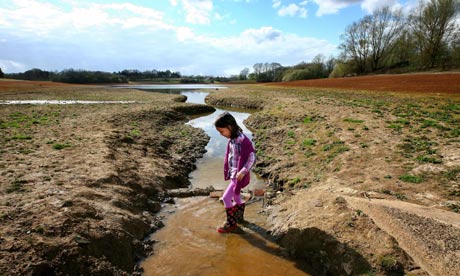
Bewl Water reservoir, near Lamberhurst, Kent, photo from The Guardian website by Gareth Fuller/PA
England is still swinging, but the pendulum only seems to be going from bad to worse and back again. Southern England has been in the grip of a drought for a few years now, as the condition of the reservoir above attests. Now it has started raining across the region, but not the spring rains needed to replenish the groundwater and then the aquifers. Rather, massive storms are slamming into the south, bringing projected dumps of up to 40mm of rain during the day--much of which will run off the drought-hardened soils rather than soaking in. Even if it does soak in, it won't be enough to ease the drought: these rains would have to continue for weeks to begin replenishing the underground aquifers.
The consequences for food production, according to The Guardian are significant:
Farmers, particularly arable farmers and vegetable growers, face a difficult summer as decisions have already been taken on what to grow this year. Further restrictions such as curbs on abstracting groundwater will become more likely if the drought continues. Price rises are likely for thirsty crops such as soft fruit and vegetables, while the price of beer is also expected to increase.
And you know if the price of beer rises, the Conservative government of David Cameron is going to take even more of a bollocking than usual. Because the UK has also slipped into a double dip recession because of the current austerity programme.  Also from the Guardian:
Britain's leading foodbank network, the Trussell Trust, says every single day it is handing out emergency food parcels to parents who are going without meals in order to feed their children, or even considering stealing food to put on the table, as the government's austerity measures start to bite.
The number of people to whom it had issued emergency food parcels had doubled in the last 12 months and was set to increase further as rising living costs, shrinking incomes and welfare cuts take their toll, the trust said, as it published its annual report, which is fast becoming a barometer of social deprivation.
Two foodbanks a week opened up in the UK over the last 12 months to meet an explosion in demand from families living on the breadline, the trust said. The charity currently oversees 201 foodbanks run on a franchise basis across the UK, up from 100 in 2010-11.
Its not much better worldwide. A report published in the magazine Science suggests "Models that link yields of the four largest commodity crops to weather indicate that global maize and wheat production declined by 3.8 and 5.5%, respectively, relative to a counterfactual without climate trends.[...] Climate trends were large enough in some countries to offset a significant portion of the increases in average yields that arose from technology, carbon dioxide fertilization, and other factors." So even when there's good news (increases in average yields) the bad news tends to outweigh it (enough to offset a significant portion).
It might be nice to have a test case for some of the problems we're facing--like the continued uncertainty in the price of oil.  We've passed Peak Oil at this point, but what that means seems to be confused. Neil Reynolds takes on the Club of Rome and Peak Oil in today's Globe and Mail, writing:
The book’s most alarming prediction, of course, dealt with oil – which, it said, would be irretrievably depleted by 2022 – a mere decade from now – at the latest. Yet, “the World Energy Council reports that global proven recoverable reserves of natural gas liquids and crude oil amounted to 1.2 trillion barrels in 2010,” Mr. Kenny says. “That’s enough to last another 38 years at current usage. Add in shale oil, and that’s an additional 4.8 trillion barrels, or a century and a half’s worth of supply at present usage rates. Tar sands, including some huge Canadian deposits, add perhaps six trillion barrels more.”
It should be noted that  "global proven recoverable reserves" is a terribly elastic figure. The Saudis, as one example, have been fudging the books on what their "recoverable reserves" are for almost two decades.It also helps to toss natural gas into the mix--there are large reserves around the planet--so much so that the current price is below the cost of recovery. But what Peak Oil theory said was that once we've passed the halfway point on recovery--which we have--the oil that was left would become more and more difficult to retrieve. And as prices rose, companies would go to greater and greater lengths to retrieve that oil. Its expected (under the theory, that as oil climbs in price, exploration/late production will increase while demand drops off. Once demand has dropped off, prices will begin to decline. Once prices at the pump decline, exploration/pumping will slow while demand rises again. Prices will suddenly spike until more production is brought back on line. There will be tremendous oscillation in prices and availability of oil. There will always be oil, its just that most of us won't be able to afford products made from it.
Energy has become dearer, and so we see the mining of bitumen in the Tar Sands of Alberta, a process that is only economically viable when the price of oil is over $80/bbl. And with energy prices currently sitting at $104/bbl for West Texas Crude, we see both the crazy push to mine the Tar Sands and the rise of fracking to release shale oil (another process like mining the Tar Sands that only happens without proper oversight and when oil prices are high).
But what happens when the oil stops? Actually, it doesn't even have to stop, all it has to do is become too expensive for use in agriculture.  And actually, we have a case study of this: Cuba. As an article in Slate points out:
Unable to afford the fertilizers and pesticides that 20th-century agriculture had taken for granted, the country faced extreme weather events and a limit to the land and water it could use to grow food. The rest of the world will soon face many of the same problems: In the coming decade, according to the OECD, we’ll see higher fuel and fertilizer costs, more variable climate patterns, and limits to arable land that will drive cereal prices 20 percent higher and hike meat prices by 30 percent—and that’s just the beginning. Policymakers can find inspirational and salutary ideas about how to confront this crisis in Cuba, the reluctant laboratory for 21st-century agriculture.
Cuban officials faced the crisis clumsily. They didn’t know how to transform an economy geared toward sweetening Eastern Europe into one that could feed folk at home. Agronomists had been schooled in the virtues of large-scale industrial collective agriculture. When the “industrial” part became impossible, they insisted on yet more collectivization. The dramatic decline in crop production between 1990 and 1994, during which the average Cuban lost 20 pounds, was known as “the Special Period.” Cubans have a line in comedy as dark as their rum.
It finally took land reform to fix many of the problems. The Cuban state was still not ready to give up its control over the land, but realized that allowing management to devolve to the farm level might not be a bad thing. With that devolution, farmers also got usufruct rights--that is, the legal right of using and enjoying the fruits or profits of something belonging to another. In fact, Cuban peasants have been able to boost food production without scarce and expensive imported agricultural chemicals by first substituting more ecological inputs for the no longer available imports, and then by making a transition to more agroecologically integrated and diverse farming systems. A report on this, called the Campesino-to-Campesino agroecology movement of ANAP in Cuba is available online (amazingly, the full text of the report is available for free download). It should also be noted that Cuba pursued its self-sufficiency goals with the aid of one of the best educated populations around (Cuba has 2 percent of Latin America’s population but 11 percent of its scientists). Various scientists were put to work with the farmers to maximize production without industrial farming inputs.
It may not be perfect, but Cuba has managed to supply a significant amount of its own food. In a report from Miguel A. Altieri and Fernando R. Funes-Monzote:
The production of vegetables typically produced by peasants fell drastically between 1988 to 1994, but by 2007 had rebounded to well over 1988 levels [...]. This production increase came despite using 72 percent fewer agricultural chemicals in 2007 than in 1988. Similar patterns can be seen for other peasant crops like beans, roots, and tubers.
Cuba’s achievements in urban agriculture are truly remarkable—there are 383,000 urban farms, covering 50,000 hectares of otherwise unused land and producing more than 1.5 million tons of vegetables with top urban farms reaching a yield of 20 kg/m2 per year of edible plant material using no synthetic chemicals—equivalent to a hundred tons per hectare. Urban farms supply 70 percent or more of all the fresh vegetables consumed in cities such as Havana and Villa Clara.
So the future isn't entirely threatening, its just different.A lot more of us will be peasants again--a designation I, for one, am willing to embrace.

Wednesday, November 16, 2011

Intense (ive) Agriculture

Two innovative projects popped up on my radar (thanks, Jeff!) involving urban farming this week. One is a storefront farm in Hackney, London, called FARM:shop, and the other is Riverpark Farm in New York City.
Both are responses to the fallout from 2008 and the ongoing international economic crisis sparked by American corporate criminality. In Hackney, the number of disused storefronts has sparked a municipal initiative to fill them at least temporarily with art projects and the like. Something and Son took a look at the cubic footage they had available, and created a café/workspace/venue/ and an intensive food production space.

Honestly, Something and Son has the air of an art installation, talking about how their “displays” change with the seasons. They claim to be the world's first “urban farming hub” (whatever that is supposed to mean), but the ideas they've used involving food production are not all that innovative. FARM:shop's food production is directly descended from the work of the New Alchemy Institute (NAI), which, from 1971 through 1991 conducted a major research and education initiative on a farm in Massachusetts. They explored green-housing/aquaculture synergies, formulated the 90-day-compost plans used by most gardeners today, and rigorously documented their work. They even built one of their “Ark “ projects in Prince Edward Island, testing their theories in a less hospitable clime.
The New Alchemists weren't the first either, building on both academic and farm-based work that had gone before them. But, thankfully, they were a part of the 60s diaspora that documented their work,leaving behind not only a record of their work, but a group of people still pushing forward environmental design.

Monday, November 7, 2011

Community Garden

About six months back, Paula finally got a spot in the University of Victoria's Community Garden. By the end of August, they were ready to move the garden to its new location. And since then, gardeners have been busy preparing things for the next growing season.
  

The garden is located in what was nothing more than a grassy field for years. Pipes have been laid for water, and after the plots themselves were laid out, the sod was lifted in each of them. The best thing about the garden is the two metre high deer fence around it--there are a lot of deer on campus.

Paula and Ben, our son, originally laid out the beds in the new plot. Formal raised beds are new to me--on the farm, we used a rotary tiller to break up the earth and then used a hilling blade to hump it into a rounded long mound. As you can see, here we have a much more formal series of boxes--each lined on the bottom with landscape cloth to discourage anything from working its way up from underneath.
The boxes are spaced so that they are slightly further apart than my feet are long--enabling me to stand between the beds.Each had a layer of leaves laid in, and then covered with a mixture of compost and topsoil.The recent rains seem to have compressed the soil a bit.
The old strawberry garden was moved a week or so back, so Paula planted some of the extras in the one bed. This still needs to be mulched.


I salvaged what was left of a soaker hose that had been run over by a lawnmower (not by me!), and cut it into shorter pieces to fit in the beds. I found some L and T fittings at Rona and laid the hose out until I ran out. So far, this bed and the strawberries have hose in them, and the third bed and the empty space are still waiting. But I got a clockwork timer today (spring driven) that will enable us to turn the water on and leave.
The polytunnel hoops are 25mm electrical conduit held in the D holders for the next size up. The conduit came in three metre lengths--longer than I wanted-- but once I bent them into their holders, it didn't seem necessary to shorten them. Poly clearly still has to be installed....
The fourth space in the plot isn't being ignored; it is slated to have a cold frame built for it. Among other things, we're hoping this gives us a place to overwinter herbs.
Its strange to imagine overwintering anything. Out on the prairies, most everything is planted in May and out of the ground by mid-October at the latest. Here, things are different. Up the peninsula, someone is successfully growing citrus trees. Kiwi fruit are farmed nearby. Here at the bottom of Vancouver Island, the temperate rainforest is modified by a local micro-climate that gives us even milder weather. A lot of rain in the winter, sure, but seldom snow, and even less seldom, -20C. I've never gardened out here, so this year looks to be very experimental.

Sunday, November 6, 2011

The Rice Shortage

A few years back--about 2008--there was rice rationing in the US and a great fear of rice shortages around the world. This lead to a certain amount of panic, particularly in Asia where citizens have traditionally consumed 70-80% of their calories in rice. The story of what actually happened is a combination of non-transparent markets, panic, reasonable actions on the part of governments, corrupt actions on the part of governments and their officials, reasonable actions on the part of consumers, screwy international trade activity, and just a general mess.
NPR ran a great story on the "crisis" and thankfully it's available in a podcast of the show Planet Money.

There's also a short interview with economist Peter Timmer on their website. But what is interesting are the lessons learned from the crisis. If you listen to the whole story, you hear that the lesson that the WTO and  Western economists take away from the "crisis" is exactly the opposite of the lesson learned by the governments involved. The interesting thing is, both sides appear to be right; open markets and transparency are good, but food security is a necessity. The problem is, neither side can see that maybe both lessons need to be learned.

Friday, March 4, 2011

Feeding People Is Easy review

Recently finished reading Colin Tudge's book Feeding People is Easy, a book about food security that offers a couple of focused ideas for reforming the world food system.

Feeding People is Easy is a bit different than most of the food security library I'm reading my way through. First off, it doesn't spend all its time on discussing what's wrong with the current food system. And that's good, because Raj Patel, Eric Schlosser, and Michael Pollan have really covered that aspect, and covered it well. Colin Tudge takes the approach that:
The world's most powerful governments, industries,and their attendant experts and intellectuals have their minds set on quite different goals, and are pulling in quite different directions--to a large extent completely opposite to what is really required. To be sure, the title of this book [Feeding People is Easy] is a little hyperbolic: the human population will reach nine billion by 2050 and it won't exactly be easy to feed everybody to the highest standards. Yet it should be well within our grasp. Indeed this goal is so obviously achievable that it would surely be extraordinarily remiss not to give it a try. In this book I will explain how. But the harder task by far is to by-pass the powers-that-be. To do what needs doing we have to re-invent democracy, or rather to make it work almost for the first time in the history of civilization, for the chief rule of democracy--that we should be able to get rid of our "leaders" when they cease to function on our behalf--has gone missing. "They" do not know how to run the world, but they do know how to hang on to power. In the last chapter, I will be addressing this, too. Revolution is not required. Renaissance is what's needed--and that is very achievable.
(page 13)
Tudge argues that our current inability to feed the world (according to Raj Patel, "There are 75 million people more undernourished now than in 2008") has nothing to do with the inhospitality of the earth, or some basic flaw in humankind, but that it has "everything to do with policy." That we do not feed everyone is a matter of decisions we have made--maybe not individually, but certainly in our political centres. These decisions are things like deciding to treat food as a commodity, and driving people off the land in order to "modernize" agriculture. "Real agriculture," argues Tudge, involves having people on the land growing crops.
The cause of all our troubles has almost nothing to do with the difficulties that nature presents us with. The fault lies almost entirely with policy and strategy: ideas and courses of action dreamed up by human beings. If we, humanity, analyzed our own problems more astutely and from first principles, and if we did things differently, then even at this late hour we could create a world that was good for everyone, and for all our fellow creatures, forever. We should certainly be thinking of the next 10,000 years, or indeed of the next million. There is no good biological reason why our species should not last at least that long. That we should be seriously doubting our ability to make the world safe even for our grandchildren is ludicrous.
(page 18)

Tuesday, March 1, 2011

Something Good

     I read a lot, and a lot about food security. I try and synthesize the information I read into a whole and to communicate from a position of intellectual coherence. But occasionally I run across a bit of writing that is just excellent and needs no real gloss from me. Today is one of those moments.
     I'm currently burning through Colin Tudge's book Feeding People is Easy. I'm really appreciating how solutions oriented the book is. (An article of his in the journal Public Health Nutrition is available as a pdf here.) But in the meantime, he pretty well summed up my feelings with this passage:
    But never in all history have the powers-that-be had the wherewithal to operate on the global scale as they do now. Never have they been able, as now, to take the whole of world farming by the scruff of its neck and ram it so procrusteanly into a structure and philosophy that are so alien to its purpose, and so at odds with the needs of humanity and the biological and physical constraints of the world. The powers-that-be behave as if they were playing a game--which indeed they are: a game of money and power. They are forever lecturing protestors like me about the need to be "realistic"; but the only reality they recognize is the political-economic, commercial-military power game that they happen to be engaged in, and which makes them rich. They have no feel at all for the physical realities of the world itself, and the creatures within it, and for the ways in which farming has, in reality, been practiced this past ten thousand years, and by whom.  They have a great deal of "data", which they collect and publish selectively and manipulate with the aid of lawyers and other rhetoricians this way and that, largely for our bamboozlement, but that is not the same thing at all. The world is suffering, possibly terminally, from a huge irony: that the powers-that-be live in a fantasy world of their own devising, blind to every observation that is in any way inconvenient, yet they believe that they really do know what they are doing, and that they alone are the realists. We are dying of their illusions.
(pages 46-47)
"...take the whole of world farming by the scruff of its neck and ram it so procrusteanly into a structure and philosophy that are so alien to its purpose...." That just sums up our approach to the natural world. The difficulty is, Gaia will fight back. Contrary to popular belief, it is we who must adapt or die.

Friday, February 11, 2011

Alcohol Is Not Food

Okay, beer was once food. But as a general rule, it's safe to say that alcohol is not food. Yet we're willing to convert food calories to alcohol calories and then burn them in our cars rather than eat them. It's things like this that make me understand why Gaia is thinking about thinning the human herd.
Famine is one of those things on my mind these days. The UN is warning of food shortages and a crisis in distribution, prices are rising steadily as big money is finding big profits in speculating on food futures markets, and global warming is devastating worldwide production. But we still don't see the linkages between the diverse issues facing us--which, I have to say, leaves me batting my head against a wall. We love the "traditional" western diet, but it takes 700 food calories to produce 100 calories of animal protein. And that doesn't include the calories expended to produce the initial 700 calories. This is the same problem we're facing in fossil fuel production; eventually it takes more energy to produce a barrel of oil than a barrel of oil contains (the Alberta tar sands is approaching this already). That is simply unsustainable, whether it's food or oil--and particularly when it's food AND oil.