Showing posts with label raised beds. Show all posts

Thursday, March 14, 2013

Hugelkultur. No, really.

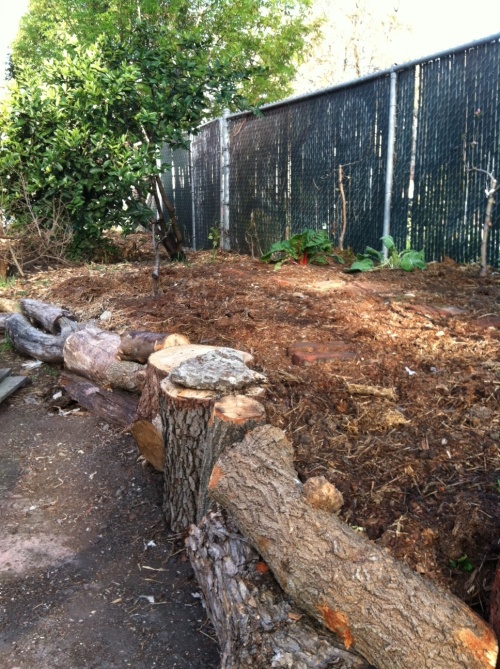
wood-edged bed at Ghost Town Farm

Novella Carpenter's latest post over at Ghost Town Farm talks about the random nature of her raised bed construction. I love it--the use of whatever free materials happen to be found, being pressed into service to form beds. We're currently in a community garden, and I'm all about straight edges, and not looking sloppy so I don't tick off the neighbours. Not that anyone actually cares, it's just my mindset.
But Novella (have I told you yet to go read/buy her books?) just cheerfully tosses stuff together with a freedom I envy, making beds that are not intimidating. The random nature emphasizes that gardening isn't a one-size-fits-all process, but rather an activity that is meant to suit the gardener.
But as I'm browsing the comments, I notice one from Paula (not my life-partner Paula, a different Paula) who writes one of the best titled gardening/urban agriculture blogs around; Weeding For Godot. I am going to be eating my liver over not thinking that one up for weeks....
Regardless of my title envy, and to continue the story,  Paula mentions that Novella should be looking into hugelkultur, what with the access to all that lovely wood. I think to myself "Hugelkultur? Was is das "Hugelkultur"?" (No, really. I often think like that. I don't pretend to understand my brain, I just hope it keeps working...) And I came across this nice little video explaining the basics of hugelkultur:


So, to quote Patsy from Ab Fab; "Right. Cheers. Thanks a lot." Thanks, Paula and Novella.

Sunday, May 20, 2012

Hungry For Change

I have to say, I love this sort of thing--this is a student-produced, neighbourhood-generated video on a social issue (of course its food security--do I ever talk about anything else these days?)
Here, students look at the concept of a "food desert", a place where there are no grocery stores. All the while that they were interviewing people, I kept thinking "Hey! There's a vacant lot. Use that." Sure enough, they are also involved with an urban farm with a farmer's market component.
This is also a particularly American video. It takes place in an African-American neighbourhood, and there is a deep undercurrent of issues of race. But at the same time, the solutions are practical and applicable to pretty much any urban area.


Umoja Students from North Lawndale College Prep, Manley, and Ace Technical 
High Schools teamed with Free Spirit Media to discover the facts about the food 
desert in North Lawndale, Chicago.

In the end, you have to question how this situation could have become so dire. Food deserts? How the hell do you not feed people? Why should we have to educate people in what constitutes good food? And a big reason for many of the problems we face, I think, is because we are nations of immigrants that destroyed the indigenous cultures, leaving us with no food culture of our own (and not much other place particular culture either, but that's for a different venue). We don't recognize terrior, we have no real place-specific foods (no equivalent to Parmesan cheese which is made in Parma, from Parman cows, the whey of which is fed to hogs which then become prosciutto). We have no generational attachment to the land in North America, and while many immigrants had an attachment to owning land, a house in the suburbs has fulfilled that desire. There is no equivalent to, say, the attachment to land reform and land ownership you find among the peasants of  South America, or the Northern European peasants from whom I am descended. Land hunger has been diverted into house hunger.
But this video points out another truism; that, given tools, people are ready, willing, and able to make changes in their local environments that contribute to self-determination. In many ways, it boils down to an old punk slogan: DIY or Die. Because culture is made, not consumed.

Friday, May 18, 2012

The Garden Update

I planted early this year--my first year planting in this climate. Of course, it was radishes, which are an early crop to begin with.I learned from my brother that you plant radishes early and cover them with floating crop cover (a spun-bonded fabric of polyester threads that allows light and water through the weave). The crop cover does two things; it offers maybe a degree of frost protection and it doesn't allow pests to get through. So you end up with radishes without worms.
In Alberta, we would lay out our pieces of crop cover, mark their size, and then plant to that size. The crop cover was carefully re-folded, and stored for next year, as we only had so much and could only get it in massive commercial rols that I could never afford. So the pieces from my brother (Frank Klassen of Sunnyside Fruit and Vegetables) ended up lasting us most of a decade.
Crop cover is very light (a few grams per sq. metre)--important, because it has to lay directly on top of the plants and mustn't interfere with their growth. It's now available pretty much everywhere (here in Victoria at Buckerfields and Lee Valley) and in home garden sizes. Which I think is a real boon to small growers.

Radishes at three weeks under crop cover

I was in a hurry when I planted the radishes this year and over-planted. They're far too close together. But they came up nicely, and delivered what they're supposed to--that first blast of colour and flavour in the spring after a winter of preserved food and store-bought vegetables.


The Big One

We had the last of the first crop of radishes for dinner last night. A couple of small rows will go into the same bed for eating in June. But Paula found the radish above while cleaning out the last of the radishes. Normally radishes like this would be woody and inedible, but this one was still crunchy and tasty.Actually the flavour was less intense than the smaller versions of the same cultivar. This one was more like a daikon radish--lots of crunch, less intense.
Currently, under a tunnel, we've got some transplant pepper plants, beets (up), shallots (up, from sets), Royal Burgundy beans (bush beans that produce purple beans that turn deep green when steamed. Also up.), and carrots (Paris Market, I think, but not up the last time I checked).
Paula's transplant peas (at the far end of the crop cover picture above) are huge and ready to flower. Should have fresh peas before too long! We've also got some tomatoes in with more to go, potatoes in (some yellows that sprouted in the cupboard) and squash. The medlar tree has leafed out and should make it through the summer (assuming I water it regularly), but has taken a bit of a hit from an insect attack to the leaves. Nothing fatal, though. Summer's starting to look tasty.....


Tuesday, May 15, 2012

The Urban Experience (II)

The CBC covered the story of the urban garden going in in Vancouver this week. What is most interesting is to see how they are building the garden: pallets, cloth/tarp, boxes, soil. In doing this, I'm sure Concord Pacific is getting a great return somewhere along the way (although no one is saying where). But that's fine. What is important is how much food is expected to be grown on an unused parking lot--something like 100,000 kilos. SoleFood has their work cut out for them. Growing that much will be a lot of work--even if not grown in the most sustainable manner. But this is all to the good.
It is, of course, nothing really new. Cuba has been doing this since 1988 and the collapse of the Soviet Union. In Havana, the local government authorized people to use, free of charge, state-owned vacant lots in and around Havana. During the years 1990-1994 (the "special period" when food imports evaporated and the average Cuban lost 9 kilos of weight) it was estimated that more than 27,000 people were linked to some 1,800 hectares of community gardens. Cuba has made great strides in achieving food sovereignty since then.


Sunday, May 13, 2012

The Urban Experience

From The Vancouver Sun website:


A parking lot is not exactly the place you might expect to see organic beans, bok choy and baby beets growing in abundance.

But part of the empty lot on the former Expo lands on the north side of False Creek will become a two-acre urban farm, bursting with 40 varieties of fruits and vegetables, if all goes according to plan.

“It’s an enormous leap,” said Michael Ableman, an urban farmer and director of Solefood, an organization that creates agriculture jobs and training for inner-city residents.

It’s the largest city farm attempted in Vancouver, and will be tended mostly by residents of the Downtown Eastside. The group plans to employ 25 people along with four farming apprentices and sell its produce to restaurants and farmers’ markets. The farm is portable, growing in containers above ground, because the site is on a three-year lease.

“We’re demonstrating this can in fact be considered a serious enterprise for urban areas. We’re not talking about community gardens any more. We’re taking it up a level,” said Ableman, who founded the Centre for Urban Agriculture in Santa Barbara, Calif., in 1981 and now farms on Saltspring Island.

Sunday, March 18, 2012

Spring! (I hope I hope...)

Well, Saturday was a lovely day--meaning it wasn't raining, the sun was out occasionally, and there were no windstorms. I've been getting a bit twitchy watching first the snowdrops appear a month ago, then the crocuses a couple of weeks later, and now all the plum and cherry trees in blossom. The rest of Canada (well, maybe not the True North) have been regularly seeing temperatures ranging from the high single digits into double digits regularly, this being the Winter That Wasn't up here north of 49.
However, this fine example of the way global climate change is going to affect us over the next couple of decades aside, I've been wanting spring to be here already. I know I'm probably early (after all, it seems to be November here, even though it's March), but I'm really not used to planting times in a Mediterranean-like climate. And this year, we've got a garden.
I've written about it before, building the raised beds and setting up the poles that will carry the tunneling plastic. But I started some rosemary seeds six weeks back (like I said, I've been hurrying the season a bit), and some tomato seeds a couple of weeks ago. And rosemary seeds either have really have a crap germination rate, or I'm doing something really really wrong.
But looking at the fragile little sprouts in their peat pellets has been making me want to get my hands dirty. So yesterday, Paula and I went to the garden centre to buy more dirt.
Over the winter we've noticed that the rains have made the soil in the beds less fluffy--which was expected. So now we're topping off the topsoil/compost mix with more soil in order to fill the beds. To the tune of 4+ cubic feet per bed.
Unlike on the farm, we don't have a lot of room, so we're having to look at more intensive methods of growing vegetables this time around. I've always wanted to try forcing potatoes in a cylinder. I first heard about this a couple of decades back as a method for re-using car tires.

Monday, November 7, 2011

Community Garden

About six months back, Paula finally got a spot in the University of Victoria's Community Garden. By the end of August, they were ready to move the garden to its new location. And since then, gardeners have been busy preparing things for the next growing season.
  

The garden is located in what was nothing more than a grassy field for years. Pipes have been laid for water, and after the plots themselves were laid out, the sod was lifted in each of them. The best thing about the garden is the two metre high deer fence around it--there are a lot of deer on campus.

Paula and Ben, our son, originally laid out the beds in the new plot. Formal raised beds are new to me--on the farm, we used a rotary tiller to break up the earth and then used a hilling blade to hump it into a rounded long mound. As you can see, here we have a much more formal series of boxes--each lined on the bottom with landscape cloth to discourage anything from working its way up from underneath.
The boxes are spaced so that they are slightly further apart than my feet are long--enabling me to stand between the beds.Each had a layer of leaves laid in, and then covered with a mixture of compost and topsoil.The recent rains seem to have compressed the soil a bit.
The old strawberry garden was moved a week or so back, so Paula planted some of the extras in the one bed. This still needs to be mulched.


I salvaged what was left of a soaker hose that had been run over by a lawnmower (not by me!), and cut it into shorter pieces to fit in the beds. I found some L and T fittings at Rona and laid the hose out until I ran out. So far, this bed and the strawberries have hose in them, and the third bed and the empty space are still waiting. But I got a clockwork timer today (spring driven) that will enable us to turn the water on and leave.
The polytunnel hoops are 25mm electrical conduit held in the D holders for the next size up. The conduit came in three metre lengths--longer than I wanted-- but once I bent them into their holders, it didn't seem necessary to shorten them. Poly clearly still has to be installed....
The fourth space in the plot isn't being ignored; it is slated to have a cold frame built for it. Among other things, we're hoping this gives us a place to overwinter herbs.
Its strange to imagine overwintering anything. Out on the prairies, most everything is planted in May and out of the ground by mid-October at the latest. Here, things are different. Up the peninsula, someone is successfully growing citrus trees. Kiwi fruit are farmed nearby. Here at the bottom of Vancouver Island, the temperate rainforest is modified by a local micro-climate that gives us even milder weather. A lot of rain in the winter, sure, but seldom snow, and even less seldom, -20C. I've never gardened out here, so this year looks to be very experimental.