Showing posts with label corruption. Show all posts

Monday, July 7, 2014

The Rabbit Hole

Burial chamber of Sennedjem, Scene: Plowing farmer.
Public Domain

Back on 02 July, Alexis Keinlen retweeted a blogpost suggesting that the differences between organic and "conventional" farming (I always understood that organic was the historically conventional method of farming, but hey...) were not that different. As an example, organic farming has it's own suite of pesticides that are sprayed on fields.
I was quite disappointed by the lack of information contained in the post at Real Clear Science. It cited two systematic reviews, one in the Annals of Internal Medicine (tucked behind a paywall I have no access through), and the other in the American Journal of Clinical Nutrition. The abstract of the first study states in it's conclusion: "The published literature lacks strong evidence that organic foods are significantly more nutritious than conventional foods." (italics mine). The second study, in AJCN, says:
To our knowledge, this is the only systematic review to assess the strength of the totality of available evidence of nutrition-related health effects of consumption of organic foodstuffs. Despite an extensive search strategy, the review only identified 12 relevant articles that met our inclusion criteria and were published, with an English abstract, in peer-reviewed journals over the past ≥50 y. The identified articles were very heterogeneous in terms of their study designs and quality, study population or cell line, exposures tested, and health outcomes measured. This inherent variability prevented any quantitative meta-analysis of the reported results, and from our narrative review, we concluded that evidence of nutrition-related health effects from the consumption of organic food is currently lacking.
Ross Pomeroy, who wrote the blogpost at RCS, has this as his takeaway: "The majority of Americans believe that organic foods are healthier than food grown using conventional methods. The majority of Americans are wrong."
But that's not actually what the studies say. Both quotes above use similar language, saying that "evidence is lacking." There is not a statement that organic food is more or less nutritionally good for you. Rather, there is no evidence either way. A study in Critical Reviews in Food Science and Nutrition sums it up best in it's abstract:
Studies comparing foods derived from organic and conventional growing systems were assessed for three key areas: nutritional value, sensory quality, and food safety. It is evident from this assessment that there are few well-controlled studies that are capable of making a valid comparison. (emphasis mine)
Pomeroy dismisses the claims that organic food is any better for us nutritionally very quickly, and moves on to a jeremiad against organic agriculture for using various pesticides approved under the USDA organic standards. He claims that these sprays are less effective than those used by industrial agriculture and are frequently more damaging to the environment. There is some evidence he may be correct. But he relies on a piece in Academics Review, a site which is itself rather suspect as being an astroturf-type site (being industry-funded propaganda disguised as posts by disinterested parties. A practice that goes back to the Big Tobacco wars).
The website for Fairness and Accuracy In Reporting (FAIR) points out:
The Koch brothers are the conservative billionaire co-owners of a conglomerate of chemical and oil companies, including Koch Ag & Energy Solutions. They and other biotechnology/chemical companies have a lot to lose from the explosive growth of pesticide-free organic foods.
Academics Review claims to be an independent “association of academic professors, researchers, teachers and credentialed authors” from around the world “committed to the unsurpassed value of the peer review in establishing sound science.”
However, recent articles on its website and Facebook page paint a picture of industry-biased, agenda-driven organization focused on discrediting public interest organizations, organic companies, media outlets and scientists who question the safety of GMOs and pesticides, or who tout the benefits of an organic diet.
The co-founder of Academics Review is Bruce Chassy, a recently retired professor of food microbiology at the University of Illinois at Urbana-Champaign. Chassy was among 11 scientists named by the Center for Science in the Public Interest in a complaint (8/21/03) to the journal Nature for failing to disclose “close ties to companies that directly profit from the promotion of agriculture biotechnology.”
As the letter notes, Chassy “has received research grants from major food companies, and has conducted seminars for Monsanto, Genencor, Amgen, Connaught Labs and Transgene”—companies with a large financial stake in pesticides and GMO technologies designed to boost pesticide sales.
Chassey is also on the advisory board of the American Council on Science and Health (ACSH), a group that bills itself as an independent research and advocacy organization devoted to debunking “junk science.” Carl Winter, one of Slate’s key sources, is also on the ACSH board.
However, as Mother Jones (10/28/13) revealed in a expose based on leaked documents, ACSH’s funders include agribusiness giants Syngenta and Bayer CropScience, as well as oil, food and cosmetics corporations that have a vested interest in getting consumers to stop worrying about the health effects of toxic chemical exposures.

Friday, February 22, 2013

Feeling a Little Horse...

via BBC
The last couple of weeks have seen a growing awareness of how horse meat has entered the British food chain in an unregulated and unexpected manner. It has been blamed on organized crime and lax inspectors and what not all.
From the Guardian:
Europe's unfolding horsemeat scandal took a new twist on Saturday when it emerged that key intermediaries involved in the trade appeared to be using a similar secretive network of companies to the convicted arms trafficker Viktor Bout.
The Organised Crime and Corruption Reporting Project (OCCRP) identified an intermediary firm, Draap Trading, based in Limassol, Cyprus, as playing a pivotal role in shipping horsemeat across Europe.
Draap has confirmed that it bought horsemeat from two Romanian abattoirs. The company sold the meat to French food processors including Spanghero, which supplied another French company, Comigel, that turned it into frozen meals for the likes of food firm Findus, some of which had a meat content that was almost 100% horse.
Draap, which is owned by a trust in the British Virgin Islands tax haven, insists the meat it sold into France was labelled as horse. Spanghero says the meat arrived labelled "beef". Jan Fasen, who runs Draap and has denied any wrongdoing, was convicted last year of selling South American horsemeat as German and Dutch beef.
But It is a good opportunity to reflect on just how complex the food system is--and how that complexity breeds potential failure points. Each link in the chain above is another point at which inspection or regulation failed. Draap claims it labelled its product "horse." Spanghero (which is back in operation), claims it wasn't. Even within the European Union, this is a pretty complicated supply chain; by my count, it involves a minimum of six countries.
Supply chains for food map over supply chains for illegal arms. In Meat: a benign extravagance, Simon Fairlie describes how recapturing British food waste into the food system could provide a daily serving of pork for every Briton. But it won't happen--the  current system is too entrenched, too powerful. At least until they get caught serving horse to people....


This news report from 1948 from the British Pathé archives shows how horses were killed and sold on the black market to back-street restaurants, who then served it to customers who thought they eating steak or veal. The problem was so bad that some breeds of horse were even threatened with extinction
In the video, it is interesting to see how consumer demand for meat is characterized as being "so offensive to the British character". Horse was clearly doing damage to the legitimate slaughter trade, and consent needed to be manufactured. Because there isn't anything inherently wrong with eating horse, or dog, or whatever. There are only cultural issues--like the love of horses the filmmakers exploit here.

Will Hutton, in The Observer, has tied the introduction of horsemeat into the foodchain to the anti-government actions of post-Thatcher Thatcherites:
Paterson is one of the Tories who joyfully shared the scorched earth months of the summer of 2010 when war was declared on quangos and the bloated, as they saw it, "Brownian" state. The Food Standards Agency was a natural candidate for dismemberment. Of course an integrated agency inspecting, advising and enforcing food safety and hygiene should be broken up. As an effective regulator, it was disliked by "wealth-generating" supermarkets and food companies. Its 1,700 inspectors were agents of the state terrifying honest-to-God entrepreneurs with unannounced spot checks and enforced "gold-plated" food labelling. Regulation should be "light touch".
No Tory would say that now, not even Paterson, one of the less sharp knives in the political drawer. He runs the ministry that took over the FSA's inspecting function at the same time as it was reeling from massive budget cuts, which he also joyfully cheered on. He finds himself with no answer to the charge that his hollowed-out department, a gutted FSA with 800 fewer inspectors and eviscerated local government were and are incapable of ensuring public health.
Paterson, beneath the ideological bluster, is as innocent about business as Bambi. Even the most callow observer could predict that with the wholesale slaughter of horses across the continent as recession hit the racing industry – horsemeat production jumped by 52% in 2012 – some was bound to enter the pan-European network of abattoirs, just-in-time buying, industrial refrigeration units, food brokers and giant supermarkets that deliver British and European consumers their food.

Monday, August 6, 2012

Pushback 1


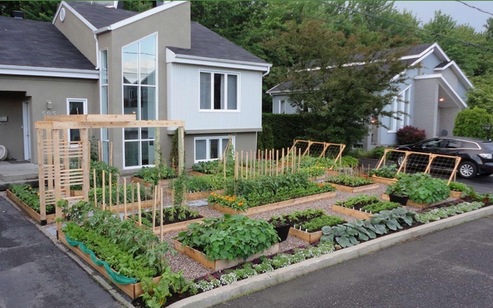
That's a lovely house, don't you think? And a nice yard in front of it.But Drummondville, Qe. (about 100 km NE of Montreal) doesn't seem to think so. After apparently getting a verbal approval from the town's Environmental Inspector, CBC reports that the couple who planted this lovely garden were served with a notice that they had to tear it out within 7 days or face fines of between $100 and $300 a day.
A follow-up report notes that the tear-out date has been extended to 01 September. It also notes that "Drummondville plans to make it illegal to grow vegetables on front lawns anywhere in the city." Apparently the city "held public consultations on the new rule and it said no one objected."
This is the beginning of push back; expect to see more and more of this. I expect it will be framed as a "property values" argument, and be claimed as being non-discriminatory because the new bylaws will affect everyone the same way (ask the residents of Africville how that worked out for them...).  Drummondville is saying that a 30% grass rule already exists--from the look of the above photo, sodding the paths would come close to taking care of that requirement).
In the US, things are the same. According to an article in Grist, push back is occuring there too:
[In] Tulsa [they] bulldozed the entire thing.
If you start looking for stories like these, you’ll turn them up in droves. In 2010, Clarkston, Ga., fined a gardener named Steve Miller for planting too many vegetables. In 2011, Oak Park, Mich., told Julie Bass she couldn’t grow any vegetables in her front yard because vegetables weren’t “suitable” yard plants. (“You can look all throughout the city and you’ll never find another vegetable garden that consumes the entire front yard,” a city official told the local TV station.) And in Chatham, N.J., Mike Bucuk, a young would-be organic farmer, had to fight with the entire town just to grow some vegetables his family’s property.
Gardens are productive. They serve a purpose, and part of that purpose leads to reduced sales for some businesses (fresh produce markets, or farmer's markets, often face stiff opposition from major supermarket players. Here in BC, Save-On Foods is supposed to be one of the big anti-farmer's-market forces). 
But home gardens breed neither fear nor consumption, the two major drivers of modern society. They encourage independence and self-reliance, neither of which sells industrial food. In fact, farmer's markets and home gardens produce exactly what the industrial food system cannot supply: good quality, good tasting produce.
And don't kid yourself. Industrial food will fight back against the home producers, the small and alternative producers. They have to--their business model is based on compliance, on being unable to see any alternatives. Local food has scared them (there are various talking heads that have produced "studies" showing that best-case New Zealand lamb has a smaller carbon footprint than worst-case local lamb, for instance). Industrial food already sends a private police force into the Canadian prairies to see what you're growing and if they can put a stop to it (check out the Percy Schmeiser story, as one example). Industrial food will continue to follow the Big Tobacco playbook to slow the challenge to its business. Like Big Tobacco, there are billions of dollars a year at stake as long as they can keep us solitary, afraid, and dependent. The solution is straightforward: be fearless (read Farm city : the education of an urban farmer by Novella Carpenter, or her blog). Form community. Grow, raise, or produce anything of your own. Its not your job to keep Industrial Agriculture on the top of the food chain. Its your job to do what's best for you, your family and community, and the planet.