Showing posts with label Bill Gates. Show all posts

Friday, June 7, 2013

Friday Food Link-straveganza

Image sourced from Wikipedia

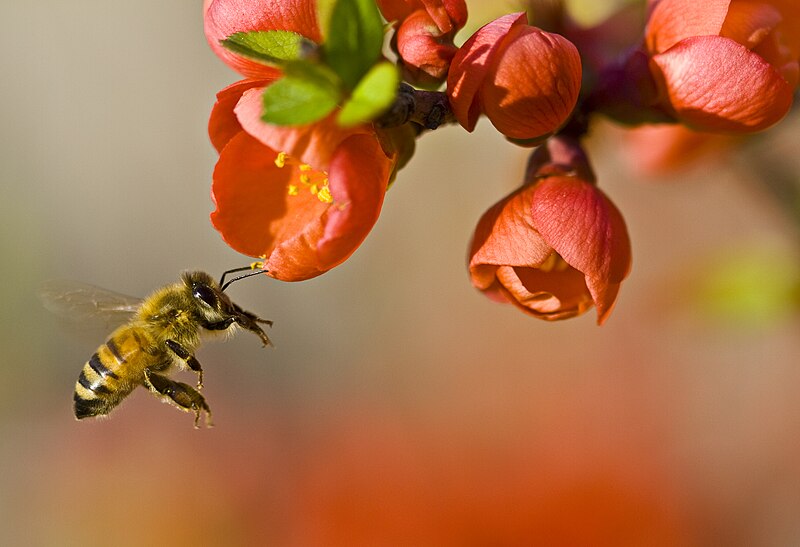
Well, we know bees are having a difficult time of it. And now its looking like neonicotinoid pesticides have a lot to do with it. Canada and Britain are both resisting the call to ban the neonicotinoids. The UK  Parliament’s  report on neonicotinoid pesticides and their effect on bees can be accessed here. The BBC commentary is here.

Source: Wikipedia

Over at Localfoodplus.ca, there's some comment on the new Ontario Medical Association report that looks at the link between antibiotic-resistant microbes and intensive livestock production. From localfoodplus:
According to the OMA’s report, “antibiotics are not as effective as they once were because bacteria are adapting to them … these resistant bacteria are germs that cause infections like pneumonia, urinary tract infections, and skin infections.”
“Patients are at risk of becoming sicker, taking longer to recover, and in some cases dying from previously treatable diseases,” said OMA president Doug Weir in the report’s press release.
This alarming medical regression poses a rising threat over both patients’ health and the healthcare system. Pointing to already visible Health Care expenses, the OMA cites the increasing costs of MRSA (which Mother Jones defines as “an often-deadly, antibiotic-resistant staph infection”)  at the Sunnybrook Health Sciences Centre in Toronto.
In 2001, the presence of MRSA across Canada was estimated to cost $50 million; in 2010, the National Collaborating Centre for Infectious Diseases (NCCID) estimated that the costs would reach between $104-$187 million annually due to escalating  antibiotic resistance – more than double in approximately 10 years.
While the report lays some culpability upon individuals to use antibiotics more “responsibly” and doctors to “keep better track of [their] patients’ antibiotic histories,” the OMA points a looming finger in the direction on Ontario’s agri-business complex.
Currently, it’s standard practice in Ontario’s agricultural industry to administer antibiotics to healthy animals for the purpose of ‘disease prevention’ and ‘growth acceleration’ – a practice that the Ontario Ministry of Agriculture and Food (OMAF) defines as “intensive, non-therapeutic” antibiotic use.

Algeria famine 1869. Source: Wikipedia

The BBC has been reporting that the only thing we learn from the history of famnine is that we learn nothing from the history of famine--as detailed by the new report from UK think-tank Chatham House:
Famine early warning systems have a good track record of predicting food shortages but are poor at triggering early action, a report has concluded.
The study said the opportunity for early action was being missed by governments and humanitarian agencies.
It said the "disconnect" was starkly apparent in Somalia where no action was taken despite 11 months of warnings.
Up to two million people are estimated to have died in drought-related emergencies since 1970.
The report by UK think-tank Chatham House, Managing Famine Risk: Linking Early Warning to Early Action, looked at the issue of drought-related emergencies on a global scale but focused on the Horn of Africa and the Sahel regions.
"The regions are quite unique in a way because you have these droughts, where there are normally successive failed rains; then you have a process whereby you have subsequent harvest failures then people adopt coping strategies," explained report author Rob Bailey.
Hand of Fatima, Mali. source: Wikipedia

 At Foodfirst, Camille Vignerot and Tiffany Tsang  wrote a piece about the current food crisis in Mali.
Food crises have plagued Mali in recent years due to drought and recurring political conflicts.
The January 2012 massacre of Malian soldiers by armed Tuareg fighters in the far north precipitated the Malian coup in March of 2012 by the National Committee for Recovering Democracy and Restoring the State (NCRDRS). That and the subsequent struggle in the north of Mali involving two groups of Tuareg (Ansar Dine and the National Movement for the Liberation of Azawad), both followed a severe drought in the 2011-2012 season.
In 2011, Mali received only one month of rain, compared to the usual three. As a result, only 11% of Mali’s farmers were able to save seed for the following year’s planting season. This cut the country’s 2012 seed supply by half, severely affecting the rice-growing area in the Mopti region. The drought forced pastoralists to move their animals north six months earlier than usual that year because of a lack of floodplain pasture along the Niger River. This led to overgrazing in northern pastures as usual staggered migrations were disrupted. Those pastoralists who did stay in the southern region were trapped between the sparse floodplains and the violent north. The increased grazing pressure on the land led to conflicts with farmers, especially in the Mopti region.
Leaving famine behind for the land of MOAR!, Michael Pollen is interviewed for the Center for Consumer Freedom.

Saltspring Island via Wikipedia
 Mussels are sustainably raised near here on Saltspring Island by Saltspring Island Mussels. (warning! site contains recipes!)
Also local are the ICC:
The Island Chefs Collaborative (icc) are a liked-minded community of chefs and food and beverage professionals with a common interest in regional food security, the preservation of farmland and the development of local food systems.
And of course if you haven't seen it yet, Bill Gates cracks me up with his Food is Ripe for Innovation essay over at Mashable.com:
I’ve gotten to learn about several new food companies that are creating plant-based alternatives to meat through some monetary investments I’ve made with Khosla Ventures and Kleiner Perkins. Their products are at least as healthy as meat and are produced more sustainably.
But what makes them really interesting is their taste. Food scientists are now creating meat alternatives that truly taste like — and have the same “mouth feel” — as their nature-made counterparts (see two recipes below, for example).
Flavor and texture have been the biggest hurdles for most people in adopting meat alternatives. But companies like Beyond Meat, Hampton Creek Foods and Lyrical are doing some amazing things. Their actual recipes are secret, but the science is straightforward. By using pressure and precisely heating and cooling oils and plant proteins (like powdered soybeans and vegetable fiber), you can achieve the perfect flavor and texture of meat or eggs.
I tasted Beyond Meat’s chicken alternative, for example, and honestly couldn’t tell it from real chicken. Beyond Eggs, an egg alternative from Hampton Creek Foods, does away with the high cholesterol content of real eggs. Lyrical has drastically reduced fat in its non-dairy cheeses. Even things like salt are getting a makeover: Nu-Tek has found a way to make potassium chloride taste like salt (and nothing but salt) with only a fraction of the sodium.
All this innovation could be great news for people concerned about health problems related to overconsumption of fat, salt and cholesterol. It’s important too in light of the environmental impacts of large-scale meat and dairy production, with livestock estimated to produce nearly 51% of the world’s greenhouse gases.
The man should be doing stand-up....

Friday, March 29, 2013

Friday Food Security Link-straveganza

Been a busy couple of weeks--from friends in hospital to a broken tooth and trying to deal with taking four courses and agreeing to cover the volunteer coordinator at the Rainbow Kitchen for a day , I'm pretty much in full flight from reality this week.
So, as a reality check, about how many calories are you supposed to be eating in a given day?  I'm not going to mention the food pyramid--Marion Nestle's book Food Politics pretty much disabused me of thinking it has any real-world validity. What I'm talking about is the actual volume. We have a strong tendency to underestimate the caloric value of foods--as well as the volumes on our plates--so it might be worth reviewing. Thankfully I don't have to do anything other than embed this lovely short film on that exact topic (Thanks to the lovely people over at the BC Food Security Gateway for pointing me towards this in the first place).


.

The topic of honey laundering raised its evil little head again this week. So, also thanks to the BC Food Security Gateway, I headed over to the USP Food Fraud Database to check what adulterants are most often found in honey. There were 125 hits; one for using honey in adulterating saffron and 124 where honey had been adulterated with corn syrup, inverted syrups, high-fructose corn syrup, sugar syrups from corn, sugar cane, sugar beet, and maple syrup. That's on top of the current technique of heating honey and running it through ultra-fine filters to remove any trace of pollen from it. That way it cannot be traced to its country of origin and can be sold around the world to adulterate local honey.
When it comes to adulterating other foods, The Salt blog over at NPR is a good place to start reading. From losing your extra-virginity:
Extra-virgin olive oil is a ubiquitous ingredient in Italian recipes, religious rituals and beauty products. But many of the bottles labeled "extra-virgin olive oil" on supermarket shelves have been adulterated and shouldn't be classified as extra-virgin, says New Yorker contributor Tom Mueller.
Mueller's new book, Extra Virginity: The Sublime and Scandalous World of Olive Oil, chronicles how resellers have added lower-priced, lower-grade oils and artificial coloring to extra-virgin olive oil, before passing the new adulterated substance along the supply chain. (One olive oil producer told Mueller that 50 percent of the olive oil sold in the United States is, in some ways, adulterated.)
The term "extra-virgin olive oil" means the olive oil has been made from crushed olives and is not refined in any way by chemical solvents or high heat.
"The legal definition simply says it has to pass certain chemical tests, and in a sensory way it has to taste and smell vaguely of fresh olives, because it's a fruit, and have no faults," he tells Fresh Air's Terry Gross. "But many of the extra-virgin olive oils on our shelves today in America don't clear [the legal definition]."
to the ongoing

Raw, sliced horse meat, served in Japan as Basashi   Via Wikipedia

 horsemeat-as-beef issue:
How did the Romanian horse meat wind up in the British spaghetti sauce? Follow its path, and you'll get a quick tutorial in the complexities of the global food trade.
Since horse meat first turned up in Irish burgers four weeks ago, the saga of horse masquerading as cow has become a pan-European scandal. Horse meat has turned up in beef tortellini in Germany; cottage pies sold at schools in Lancashire, England; and frozen lasagna in Norway, England and other countries.
Investigators seeking the source of the horseflesh say it may have come from two slaughterhouses in Romania, with perhaps a detour in Poland, before wending its way through at least six other European countries. Along the way, there were plenty of opportunities for it to have been mislabeled, repackaged or misrepresented.
Here's The Associated Press's tale of the trail:
"At least some of the horse meat originated at abattoirs in Romania, and was sent through a Cyprus-registered trader to a warehouse in the Netherlands. A French meat wholesaler, Spanghero, bought the meat from the trader, then resold it to the French frozen food processor Comigel. The resulting food was marketed in Britain and other countries under the Sweden-based Findus label as lasagna and other products containing ground beef."
 to the "hucksters [who] sometimes use Sudan red dye to amp up paprika, which in its natural state is often a demure reddish brown. Sudan red is a potent carcinogen, banned for use in food worldwide," and why
via Wikipedia

 Illinois is worried about the use of lion meat, all in all, The Salt is a pretty good source for food news.

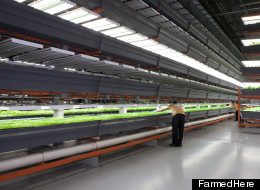
I've talked before about Will Allen and Growing Power, the intensive farming operation centred in Milwaukee, WI that produces food year round. It's a well-thought-out integrated system that uses waste water from a tilapia pond to water plants, heat from composting material to heat the greenhouses and tilapia pond, and other such innovations. Well, from the look of things, someone else has noticed and gone large-scale commercial with many of the ideas found at Growing Power.
Farmed Here is doing much the same thing. From HuffPo:
Occupying 90,000 square feet of a formerly abandoned suburban Chicago warehouse, FarmedHere is not only the first indoor vertical farm of its kind in the nation -- it's also the largest.
Celebrating its grand opening in Bedford Park, Ill., on Friday, FarmedHere utilizes a soil-free, aquaponic process to grow organic greens that are both tastier and more sustainable than traditional farming.
Here's how it works: Plants are grown in beds stacked as much as six high by using a mineral-rich water solution which is derived from tanks of hormone-free tilapia offering up nutrients to the plants in a controlled environment that ensures optimal growing.
And, finally, Bill Gates is taking up the cause of global food security. From an article he wrote for Mashable:
The global population is on track to reach 9 billion by 2050. What are all those people going to eat? With billions of people adding more animal protein to their diets — meat consumption is expected to double by 2050 — it seems clear that arable land for raising livestock won’t be able to keep up.
That’s one reason why I’m excited about innovations taking place now in food production, which especially interests me as someone who worries about the poor getting enough to eat. 
[...]
I tasted Beyond Meat’s chicken alternative, for example, and honestly couldn’t tell it from real chicken. Beyond Eggs, an egg alternative from Hampton Creek Foods, does away with the high cholesterol content of real eggs. Lyrical has drastically reduced fat in its non-dairy cheeses. Even things like salt are getting a makeover: Nu-Tek has found a way to make potassium chloride taste like salt (and nothing but salt) with only a fraction of the sodium.
All this innovation could be great news for people concerned about health problems related to overconsumption of fat, salt and cholesterol. It’s important too in light of the environmental impacts of large-scale meat and dairy production, with livestock estimated to produce nearly 51% of the world’s greenhouse gases.
 Well, we survived the Mulroney/Reagan/Thatcher years, hopefully we'll survive this as well. Gates impresses me (particularly after reading his book back in the 80s) as a guy with loads of money, loads of influence, a disproportionate belief in the benefits of technology, and opinions based on talking to the first three people he meets. He's thrilled by the idea of turning plants into mock-meat with no consideration of the energy imbalance this requires. He repeats the common wisdom that the feed to meat conversion ratio is 10:1--Simon Fairlie, in Meat: A Benign Extravagance, points out that while that's reasonably true for cattle, the conversion ratio is much better for pigs and is great for poultry, and that ruminants are the best way to bring otherwise unusable land into the food chain. This also ignores the fact that animals are the simplest, most effective way of building soil. This kind of technological imperative thinking generally brings disaster, as it forgets that we are messing about with an interconnected system, and as such we need to be a lot more careful about changing parts of it.