Showing posts with label Growing Power. Show all posts

Monday, August 18, 2014

Jennifer and the City


Food and the City: Urban Agriculture and the New Food Revolution
Jennifer Cockrall-King
Amherst, New York
ISBN: 978-1-61614-458-6
available as an e-book


I have to say that Canadians have produced a lot of really great books on food and food systems in the last decade or so. And Jennifer Cockrall-King has taken her place in the ranks of Canadian food writers.
The book opens with a (mercifully) brief overview of the modern food system that focuses on the varied challenges the industrial food system faces; from climate change to peak oil and peak water. JCK then gets into the meat of the book, a tour of urban agriculture in France, the UK, the US, Canada, and ending up with two tours of Cuba. Each section (broken down by city) opens with some history of the city, farm, or person being visited. From the perpetuation of urban agriculture through the history of Paris, to a brief and inspiring bio of Will Allen, JCK offers us something special about her visit.
In Paris, for example, she opens with an anecdote about seeing a police station, “an excellent example of 1970s Brutalist architecture, designed to intimidate and terrorize,” where someone had planted grapevines in the street-level window wells. She “burst out laughing at the juxtaposition of these vines struggling to soften the intentional harshness of this impersonal, aggression-inspired building. Neither the vines' efforts nor the efforts of the gardener who planted them were in vain. The vines were winning.”
Because the book is meant to be inspiring rather than depressing, these are the stories she tells; stories where “the vines [are] winning.” And it's nice, as a Canadian, to read of cities here as well. So many books concentrate on what's happening in the US—understandable, as the potential market there is ten times larger than here in Canada. But Canada is at the forefront of thinking about food and feeding people. From Graham Riches work on the birth of food banks and his prescience on how they would become part of the fabric of feeding people as the social safety net here is slowly hacked apart, to Fraser and Rimas' Empires of Food showing how agricultural production forms the basis of civilization and empire (and the inevitable collapse of both), to Lorraine Johnson's City Farmer: Adventures in Food Growing which offers up the polite Canadian way of urban agriculture (as opposed to Novella Carpenter's more guerilla approach in Oakland). So JCK's overview of the urban ag movement in Vancouver and Toronto is welcome.
Of course, she does refer to Vancouver as being on Canada's “Left Coast,” a stereotype we could probably do without. She does live in my old home town (Edmonton, Alberta), in a province where politics have been silenced by big oil money, and the only movement is on the right to make the province even more of an American colony. To anyone coming from a petro-state, British Columbia's politics would look crazy. But all it means is that politics still matters out here, people still care.
And they care about food. Vancouver's large Asian and Indian communities have invigorated both the flavour palette and the urban agriculture movement. The same has happened in Toronto, which is fitting as the cities are both the largest in Canada, and the most unaffordable. So there is more pressure to think about, and get involved in, urban agriculture.
After her developed-world tour, Jennifer Cockrall-King ends up in Cuba, the epicentre of post-peak thinking and a world leader in agro-ecological research. JCK's visits to Cuba supports much of what I said in an earlier post (Cuba, Si!). Cuba is not perfect, but they are the essential test-bed for a post-consumerist, post-oil world. In Cuba, rationing mixed with local free-market farmer's markets provide a limited but universally accessible food system.Interestingly, a system that worked well in the UK during and after the Second World War. Cuba also upends our traditional thinking about social status and pay; top-level farmers earn considerably more than “white collar” professionals. Here in Canada, of course, the easiest way for a farmer to become a millionaire is to start farming with two million dollars. You'll have a million soon enough.
Jennifer Cockrall-King's book is an excellent overview of the variety of approaches to urban agriculture in the developed world. From the unbroken (though badly damaged) historic production systems of Paris, to the allotment garden and the memory of the Victory Gardens of the Second World War in the UK, and the North American experiments, we see everything from guerilla gardeners to the entrepreneurs and SPIN (Small Plot Intensive) urban farming movement. Most are farming for love, more than expected farm for money, and all of them bring an element of hope to the people around them. And, slowly, all are helping restore the agricultural knowledge-base we're going to need in the not-so-distant future.

Friday, March 29, 2013

Friday Food Security Link-straveganza

Been a busy couple of weeks--from friends in hospital to a broken tooth and trying to deal with taking four courses and agreeing to cover the volunteer coordinator at the Rainbow Kitchen for a day , I'm pretty much in full flight from reality this week.
So, as a reality check, about how many calories are you supposed to be eating in a given day?  I'm not going to mention the food pyramid--Marion Nestle's book Food Politics pretty much disabused me of thinking it has any real-world validity. What I'm talking about is the actual volume. We have a strong tendency to underestimate the caloric value of foods--as well as the volumes on our plates--so it might be worth reviewing. Thankfully I don't have to do anything other than embed this lovely short film on that exact topic (Thanks to the lovely people over at the BC Food Security Gateway for pointing me towards this in the first place).


.

The topic of honey laundering raised its evil little head again this week. So, also thanks to the BC Food Security Gateway, I headed over to the USP Food Fraud Database to check what adulterants are most often found in honey. There were 125 hits; one for using honey in adulterating saffron and 124 where honey had been adulterated with corn syrup, inverted syrups, high-fructose corn syrup, sugar syrups from corn, sugar cane, sugar beet, and maple syrup. That's on top of the current technique of heating honey and running it through ultra-fine filters to remove any trace of pollen from it. That way it cannot be traced to its country of origin and can be sold around the world to adulterate local honey.
When it comes to adulterating other foods, The Salt blog over at NPR is a good place to start reading. From losing your extra-virginity:
Extra-virgin olive oil is a ubiquitous ingredient in Italian recipes, religious rituals and beauty products. But many of the bottles labeled "extra-virgin olive oil" on supermarket shelves have been adulterated and shouldn't be classified as extra-virgin, says New Yorker contributor Tom Mueller.
Mueller's new book, Extra Virginity: The Sublime and Scandalous World of Olive Oil, chronicles how resellers have added lower-priced, lower-grade oils and artificial coloring to extra-virgin olive oil, before passing the new adulterated substance along the supply chain. (One olive oil producer told Mueller that 50 percent of the olive oil sold in the United States is, in some ways, adulterated.)
The term "extra-virgin olive oil" means the olive oil has been made from crushed olives and is not refined in any way by chemical solvents or high heat.
"The legal definition simply says it has to pass certain chemical tests, and in a sensory way it has to taste and smell vaguely of fresh olives, because it's a fruit, and have no faults," he tells Fresh Air's Terry Gross. "But many of the extra-virgin olive oils on our shelves today in America don't clear [the legal definition]."
to the ongoing

Raw, sliced horse meat, served in Japan as Basashi   Via Wikipedia

 horsemeat-as-beef issue:
How did the Romanian horse meat wind up in the British spaghetti sauce? Follow its path, and you'll get a quick tutorial in the complexities of the global food trade.
Since horse meat first turned up in Irish burgers four weeks ago, the saga of horse masquerading as cow has become a pan-European scandal. Horse meat has turned up in beef tortellini in Germany; cottage pies sold at schools in Lancashire, England; and frozen lasagna in Norway, England and other countries.
Investigators seeking the source of the horseflesh say it may have come from two slaughterhouses in Romania, with perhaps a detour in Poland, before wending its way through at least six other European countries. Along the way, there were plenty of opportunities for it to have been mislabeled, repackaged or misrepresented.
Here's The Associated Press's tale of the trail:
"At least some of the horse meat originated at abattoirs in Romania, and was sent through a Cyprus-registered trader to a warehouse in the Netherlands. A French meat wholesaler, Spanghero, bought the meat from the trader, then resold it to the French frozen food processor Comigel. The resulting food was marketed in Britain and other countries under the Sweden-based Findus label as lasagna and other products containing ground beef."
 to the "hucksters [who] sometimes use Sudan red dye to amp up paprika, which in its natural state is often a demure reddish brown. Sudan red is a potent carcinogen, banned for use in food worldwide," and why
via Wikipedia

 Illinois is worried about the use of lion meat, all in all, The Salt is a pretty good source for food news.

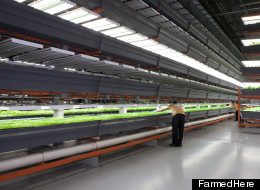
I've talked before about Will Allen and Growing Power, the intensive farming operation centred in Milwaukee, WI that produces food year round. It's a well-thought-out integrated system that uses waste water from a tilapia pond to water plants, heat from composting material to heat the greenhouses and tilapia pond, and other such innovations. Well, from the look of things, someone else has noticed and gone large-scale commercial with many of the ideas found at Growing Power.
Farmed Here is doing much the same thing. From HuffPo:
Occupying 90,000 square feet of a formerly abandoned suburban Chicago warehouse, FarmedHere is not only the first indoor vertical farm of its kind in the nation -- it's also the largest.
Celebrating its grand opening in Bedford Park, Ill., on Friday, FarmedHere utilizes a soil-free, aquaponic process to grow organic greens that are both tastier and more sustainable than traditional farming.
Here's how it works: Plants are grown in beds stacked as much as six high by using a mineral-rich water solution which is derived from tanks of hormone-free tilapia offering up nutrients to the plants in a controlled environment that ensures optimal growing.
And, finally, Bill Gates is taking up the cause of global food security. From an article he wrote for Mashable:
The global population is on track to reach 9 billion by 2050. What are all those people going to eat? With billions of people adding more animal protein to their diets — meat consumption is expected to double by 2050 — it seems clear that arable land for raising livestock won’t be able to keep up.
That’s one reason why I’m excited about innovations taking place now in food production, which especially interests me as someone who worries about the poor getting enough to eat. 
[...]
I tasted Beyond Meat’s chicken alternative, for example, and honestly couldn’t tell it from real chicken. Beyond Eggs, an egg alternative from Hampton Creek Foods, does away with the high cholesterol content of real eggs. Lyrical has drastically reduced fat in its non-dairy cheeses. Even things like salt are getting a makeover: Nu-Tek has found a way to make potassium chloride taste like salt (and nothing but salt) with only a fraction of the sodium.
All this innovation could be great news for people concerned about health problems related to overconsumption of fat, salt and cholesterol. It’s important too in light of the environmental impacts of large-scale meat and dairy production, with livestock estimated to produce nearly 51% of the world’s greenhouse gases.
 Well, we survived the Mulroney/Reagan/Thatcher years, hopefully we'll survive this as well. Gates impresses me (particularly after reading his book back in the 80s) as a guy with loads of money, loads of influence, a disproportionate belief in the benefits of technology, and opinions based on talking to the first three people he meets. He's thrilled by the idea of turning plants into mock-meat with no consideration of the energy imbalance this requires. He repeats the common wisdom that the feed to meat conversion ratio is 10:1--Simon Fairlie, in Meat: A Benign Extravagance, points out that while that's reasonably true for cattle, the conversion ratio is much better for pigs and is great for poultry, and that ruminants are the best way to bring otherwise unusable land into the food chain. This also ignores the fact that animals are the simplest, most effective way of building soil. This kind of technological imperative thinking generally brings disaster, as it forgets that we are messing about with an interconnected system, and as such we need to be a lot more careful about changing parts of it.