Showing posts with label Novella Carpenter. Show all posts

Monday, August 18, 2014

Jennifer and the City


Food and the City: Urban Agriculture and the New Food Revolution
Jennifer Cockrall-King
Amherst, New York
ISBN: 978-1-61614-458-6
available as an e-book


I have to say that Canadians have produced a lot of really great books on food and food systems in the last decade or so. And Jennifer Cockrall-King has taken her place in the ranks of Canadian food writers.
The book opens with a (mercifully) brief overview of the modern food system that focuses on the varied challenges the industrial food system faces; from climate change to peak oil and peak water. JCK then gets into the meat of the book, a tour of urban agriculture in France, the UK, the US, Canada, and ending up with two tours of Cuba. Each section (broken down by city) opens with some history of the city, farm, or person being visited. From the perpetuation of urban agriculture through the history of Paris, to a brief and inspiring bio of Will Allen, JCK offers us something special about her visit.
In Paris, for example, she opens with an anecdote about seeing a police station, “an excellent example of 1970s Brutalist architecture, designed to intimidate and terrorize,” where someone had planted grapevines in the street-level window wells. She “burst out laughing at the juxtaposition of these vines struggling to soften the intentional harshness of this impersonal, aggression-inspired building. Neither the vines' efforts nor the efforts of the gardener who planted them were in vain. The vines were winning.”
Because the book is meant to be inspiring rather than depressing, these are the stories she tells; stories where “the vines [are] winning.” And it's nice, as a Canadian, to read of cities here as well. So many books concentrate on what's happening in the US—understandable, as the potential market there is ten times larger than here in Canada. But Canada is at the forefront of thinking about food and feeding people. From Graham Riches work on the birth of food banks and his prescience on how they would become part of the fabric of feeding people as the social safety net here is slowly hacked apart, to Fraser and Rimas' Empires of Food showing how agricultural production forms the basis of civilization and empire (and the inevitable collapse of both), to Lorraine Johnson's City Farmer: Adventures in Food Growing which offers up the polite Canadian way of urban agriculture (as opposed to Novella Carpenter's more guerilla approach in Oakland). So JCK's overview of the urban ag movement in Vancouver and Toronto is welcome.
Of course, she does refer to Vancouver as being on Canada's “Left Coast,” a stereotype we could probably do without. She does live in my old home town (Edmonton, Alberta), in a province where politics have been silenced by big oil money, and the only movement is on the right to make the province even more of an American colony. To anyone coming from a petro-state, British Columbia's politics would look crazy. But all it means is that politics still matters out here, people still care.
And they care about food. Vancouver's large Asian and Indian communities have invigorated both the flavour palette and the urban agriculture movement. The same has happened in Toronto, which is fitting as the cities are both the largest in Canada, and the most unaffordable. So there is more pressure to think about, and get involved in, urban agriculture.
After her developed-world tour, Jennifer Cockrall-King ends up in Cuba, the epicentre of post-peak thinking and a world leader in agro-ecological research. JCK's visits to Cuba supports much of what I said in an earlier post (Cuba, Si!). Cuba is not perfect, but they are the essential test-bed for a post-consumerist, post-oil world. In Cuba, rationing mixed with local free-market farmer's markets provide a limited but universally accessible food system.Interestingly, a system that worked well in the UK during and after the Second World War. Cuba also upends our traditional thinking about social status and pay; top-level farmers earn considerably more than “white collar” professionals. Here in Canada, of course, the easiest way for a farmer to become a millionaire is to start farming with two million dollars. You'll have a million soon enough.
Jennifer Cockrall-King's book is an excellent overview of the variety of approaches to urban agriculture in the developed world. From the unbroken (though badly damaged) historic production systems of Paris, to the allotment garden and the memory of the Victory Gardens of the Second World War in the UK, and the North American experiments, we see everything from guerilla gardeners to the entrepreneurs and SPIN (Small Plot Intensive) urban farming movement. Most are farming for love, more than expected farm for money, and all of them bring an element of hope to the people around them. And, slowly, all are helping restore the agricultural knowledge-base we're going to need in the not-so-distant future.

Thursday, July 17, 2014

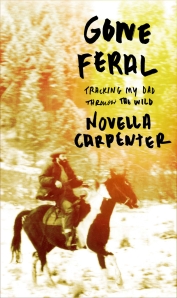
Gone Feral. A Review.

Image via novellacarpenter.net

Novella Carpenter, the author of the excellent memoir Farm City: The education of an urban farmer, is back with a new book, Gone Feral: Tracking my dad through the wild. If you read her first book, about her move to Oakland and the founding of GhostTown Farm (and if you haven’t, you really should), you may think you know Ms. Carpenter and her dedication to creating rural environments inside an urban area. Channeling the spirit of the original English Diggers (and the later Digger movement in San Francisco, for that matter), she and her Significant Other Bill moved from Seattle to Oakland, fetching up in a rather less-than-savoury part of town. By turns heroic, crafty, and just plain lucky, Carpenter manages to take over an unused lot next to her rather tired apartment and convert it into an actual urban farm, raising everything from vegetables to chickens to some most memorable pigs. Step by step, Ms. Carpenter leads the reader through her unusual life, her unique neighbours, and her funky, and productive, farm.
Gone Feral  on the other hand, is a different sort of journey, but still told in a unique and compelling voice. Spare prose, clear progression, and a dedication to telling the story of the day her father went missing, and her (re) discovery of him, make for a compelling read. I had expected to enjoy the book based on my experience with Farm City, but I hadn’t expected to become so wrapped up in the read that I ate this book in one gulp (with several cups of tea).
    Novella’s parents were part of the hippie/alternative/back-to-the-land movement of the late 60s and early 70s. They found and purchased some lovely land outside Orofino, Idaho. They moved into a battered mobile home, slowly built their own house, gardened, raised animals, found local work, and fell apart. Regretfully, not a unique story from that (or this) time. Her mother moved to the Pacific Northwest with Novella and her sister, and her father stayed behind. Then, on October 17th, 2009, Novella received a call that her father was missing. Although he resurfaced some weeks later, none the worse for the wear, the experience sent Ms. Carpenter off on a quest to find her father.
    This is primarily a book about a daughter trying to reconnect with her father, struggling to understand his life and choices, and, most importantly, trying to figure out what happened. Throughout the book there are reasons, revelations, and reconnections, and the resolution, this being real life and not a novel, may not be as satisfying as you might hope (although I found a deep resonance with it). But almost by accident, Carpenter addresses a topic that I have been considering for some time (and written about here on the blog): why were there so many failures in the back-to-the-land movement?
Novella Carpenter photo copyright Sarah Henry
    We see Carpenter’s parents meet and move onto a farm in Idaho. We see how difficult it was for them as a couple and family to achieve their dreams (and how much of the dream became a nightmare). And as Novella negotiates her father’s history, many of the reasons for the failure become clear. But across the holler from her parents are some other back-to-the-landers. And they, ultimately, are not a failure.
    Novella describes the differences between the Carpenters and their neighbours: the Carpenters are alone, following the homesteader narrative of America. The neighbours? To begin with, there are two couples. After some time, they build a second house on the property. They invite their neighbours to an annual solstice party.
    The homesteader narrative of America is a myth. Particularly in the east, the settlers were moving onto farms that were established, had been cultivated for decades if not longer, often had full storehouses of food and seed, and in many ways, were better than their equivalents in Europe at the time. It was just that their occupants had recently died from contact with the European settlers. There was very little of the “two people and a horse” homesteading
happening at all. But the myth of an empty land and heroic settlers was much more satisfying than the reality of “we killed them all and took their stuff.”
    And it was this myth that led so many landers astray. The belief that you had to do it all alone, that you had to be totally self-sufficient, that belief doomed them.
    The Farm, the collective founded around the same time as the Carpenter’s began their attempt, succeeded, and still survives. But that was because the people who founded The Farm took their community with them, and built links with the local community. The Carpenter’s neighbours took a smaller community with them, but also built links with the local community. They made friends, asked advice, lent a hand. In short, mutual aid trumps self-sufficiency. And it’s no different today.
    In Gone Feral, Novella carpenter explores a family history that “does not repeat, but rhymes.” So to does the current rural repopulation rhyme but not repeat. In the former, the story is compelling and extremely readable. In the latter, the story is not yet done.

Tuesday, August 7, 2012

East Coast vs West Coast


I've recently finished a couple of urban farming memoirs: Novella Carpenter's Farm City: the education of an urban farmer and My Empire of Dirt : how one man turned his big city backyard into a farm : a cautionary tale by Manny Howard. Both were interesting to read, but both were really American in their assumptions. Novella Carpenter wrote her book from Oakland, CA, while Manny Howard was writing his from Brooklyn, and the bi-coastal divide is really apparent in their approaches, their style, and their outcomes. Manny, like Julie Powell of Julie and Julia fame, takes on a project that becomes obsessive and relationship-destroying. We meet him suffering a moment in his life that I remember well, the moment when you look around at the reality of being married and having young children. You suddenly realize that it's not all about you, and you are a grown-up now, even if you don't feel like it, want it, or believe it. Its disorienting at best, and in our modern consumer-oriented, atomized culture, distressing. We've created a culture that is best served when we remain self-obsessed adolescents for our entire lives, where “growing up” is seen as the end of the best times rather than a transition into a richer time. In Manny Howard's case, there is a serendipitous phone call from an editor: “How about you turn your yard into an urban farm and live off it for a month?” I can only assume that there was large amounts of alcohol available at that story meeting..... Manny is trapped in that space between adolescent invulnerability and adult sense, and so agrees. His expenses will be covered and there's a nice chunk of change at the end of it all. It is, for anyone who's ever thought about turning their yard into a farm, a perfect situation. You do the work, and someone else pays the bills. Manny bulls ahead, clearing out his backyard, installing a French drain system, and trucking in a load of good topsoil. His aspirations quickly spiral out of control, as he plans a garden, ducks, chickens, and rabbits. His approach is best described when he notes that “this cage, like the rest, was built on the driveway with no plans.” He's never gardened, let alone farmed, and there's no time to do the research up front, so go, go, go! His wife, a long-suffering, highly paid executive at a New York publishing firm (yes, a chauffeured town car picks her up and drops her off daily), watches her husband descend into a madness of obsession and manure, where his definition of the perfect world is radically different from her own. And he appears committed to taking the two children with him into this nightmare. Ultimately, Manny doesn't do a good job of living for a month from the work of his hands. Its not all his fault—there is, after all, a tornado that touches down on his street. And his forays into home meat production are ill-considered at best. All of which stand in stark contrast to the joyous madness happening in Oakland. Novella and her partner Bill move into GhostTown, a neighbourhood in Oakland that is barely functional, where there are shootings blocks away, where the best you can say is that it has become a Temporary Autonomous Zone. Bill, Novella's partner, refits vehicles to burn bio-diesel made from recycled vegetable oil. She works miscellaneous temp or part-time jobs, and comes from a pair of 70s back-to-the-landers. Suffice it to say, Novella is not without clue. Not that she makes it easy on herself. GhostTown is a tough place to live—almost unimaginable for a Canadian working class kid like myself. But when she spies the seemingly abandoned lot next door, Novella hatches a plan. Like the Diggers of England, and the Diggers of San Francisco, she sees that ownership and use must go together. So she begins to clear an abandoned city lot in order to build a garden. And right from the get-go, people start showing up to help. This would be Reader's Digest stuff, except for the strong whiff of counter-culture and the lack of respect for property rights. So, more Utne Reader then.... Novella's book is filled with people who are not her. The people she talks with about how to kill a pig, the drunks and druggies, her neighbours. In each case she tries to give the reader an impression of who this person is, to help make the same connection to them that she felt. The farm is central, but the real story in Farm City is the web of relationships that develop in the temporary Autonomous Zone. Novella gains self-definition when she meets Willow, the woman who drives the area's food security program by farming vacant space and refers to herself as an “urban farmer.” It is a label that Novella quickly adopts (and with good reason). Novella builds gardens,and then decides to indulge in the gateway drug of the urban agriculture movement: chickens. Or, in this case, chickens, turkeys, and ducks. Chickens really are a gateway drug. They add something alive to the landscape—whether urban or rural—and by the time they are ready to lay eggs, you're already addicted to watching alien-yet-understandable activities. And the first time you steal eggs from a nest, you know you're never going back again. I've a farming background, even though I was brought up in the city, so I have always known about the linkage between raising an animal and having to kill one. But killing an animal, any animal, is one of the rituals of humanity from which we have become abstracted. Death is something we shelter ourselves from, hide away, and by doing so, make more powerful. Death is the act that separates the gardener from the farmer. Death is the hurdle that has to be cleared. Both Manny Howard and Novella Carpenter manage it, but Novella manages it with grace and understanding. The two books reflect their authors, but also the places they are written about. Manny Howard's is intense and neurotic—much like the Greater New York area seems to be. Novella Carpenter's book is sprawling and inviting, a masterful combination of memoir and research. Perhaps my being more of a West Coaster than an East Coaster affects my response to the two books. Or maybe being a hippie at heart and a back-to-the-lander myself defines my response. But I'd rather read about Novella's successes rather than Manny's meltdown.