Showing posts with label food prices. Show all posts

Wednesday, March 25, 2015

Profits First, You Know

"RawBacon" by Jonathunder - Own work.
Licensed under CC BY-SA 3.0 via Wikimedia Commons -
http://commons.wikimedia.org/wiki/File:RawBacon.JPG#/media/File:RawBacon.JPG

CBC is reporting on how food manufacturers are handling their desire to maintain their profit margins. Because consumers are "sensitive to price increases," manufacturers are shrinking volumes rather than pushing a higher price at the till.
While this allows prices to be kept stable, it also allows for massive profit increases.Shrinking a package of bacon from 500 grams to 375 grams is the equivalent of a 25% price hike. You may also have noticed that the slices are thinner as well--to make it look like the same number of portions.
Lay's potato chips--already renowned as being more bag than chips, has also shrunk their portions from 200 grams to 180 grams; a 10% change.
And even in the world of milk, where producers (at least in Canada) are generally guaranteed a fair price for their production by provincial milk quota, dairies are messing with standard sizes. Instead of 1, 2, and 4 cup volumes (250, 500, 1000 millilitres), they have begun selling 237 and 473 millilitre volumes.
From an historical perspective, we are paying a remarkably low portion of our income for food. And here in BC, we depend on California for an amazing amount of our produce. So with the extended drought in Cali and the neglect of our local production, consumers here have been getting progressively squeezed. It just happens to come at a time when corruption in the financial industry has left the real economy reeling worldwide. Massive speculation in food markets led to price spikes in 2008 - 2009, and had various countries stopping exports of various foods (such as wheat from Russia). Since then, things have settled down, but both the race for profits and climate change have kept consumer prices for food on an upward trending line.
Things are not going to get better. Research in Canada has shown that farmers growing patented seed may see production of up to $350/acre, but may see net profits as low as $1.50/acre. This is not a recipe for bringing more farmers on-stream (although it will continue to maintain the massive profits seen by their suppliers and those buying their product).

Friday, June 28, 2013

A Quick Round-up

The Globe and Mail ran an excellent obit of Tony Koulakis, the owner of the Montreal greasy spoon Cosmo Snack Bar.
Out went high-falutin’ words like “nouveau,” “au jus” and “reduction.” Montreal foodies, their palates jaded by decades of haute cuisine, fairly tripped over themselves to find multiple ways of saying “artery-clogging,” “heart attack on a plate” and “the ultimate hangover food.”
“Out of this world” was a standard.
For 35 years behind the counter at Cosmo Snack Bar, on Montreal’s Sherbrooke Street West, proprietor Tony Koulakis (no, his name wasn’t Cosmo) served up all-day breakfasts that would cause palpitations in cardiologists. Eggs, bacon, glistening sausage and Tony’s signature hash brown potatoes, in portions fit for a stevedore, were heaped onto plates that were often chipped – that is, if you could snag one of the 11 rickety vinyl-topped diner stools at the counter (some regulars preferred the ones plastered with duct tape). Tables? Only outside on the sidewalk, in the summer.
When smoking was still allowed in restaurants, four of the stools were designated “non-smoking.” Bills would be randomly rounded up or down.
The very definition of the greasy spoon, the hole-in-the-wall eatery is a Montreal landmark where, on weekends especially, diners stand three-deep to tuck into: The “Creation” sandwich, an egg, salami, lettuce, tomato and cheese monstrosity (it used to contain sausage as well, until that was deemed overkill); the Good Morning Burger, a hamburger topped by a fried egg; and the ungodly MishMash omelette: bacon, four eggs, ham, sausage, salami, tomatoes, onions and cheese, all fried in margarine, with a side of hash browns (the concoction was once sent for chemical analysis and clocked in at a gut-busting 1,800 calories).
Nothing cost more than $10. And the place offered 15 types of bread. It was once estimated that Mr. Koulakis went through 25 loaves of rye, kimmel and black Russian bread a day, and fried 20 dozen eggs and 25 pounds of bacon every day, too.
From 7 a.m. to 6 p.m., every day but Monday, the mustachioed, baseball-capped Tony laughed, cooked, kibbitzed and faux-hollered. And smoked. Quebec’s politics and hockey were always on the menu. Out of milk? No problem – just send a diner across the street to the grocery. When orders were placed, he would call out, “nice breakfast, Niki!” Which worked, because the person holding the spatula was often either his daughter, Niki, or his son, Nikos, standing maybe a metre away. Or both.
We would all be lucky to have an obit that good.
Also in the Globe is an article by Charles Abbott, discussing the proposed purchase of Smithfield Foods (the world's largest pork processor) by  Shuanghui International Holdings of China. The part that interested me?
Led by Ms Stabenow, 15 of the 20 senators on the Agriculture Committee and the leaders of the Senate Finance Committee wrote last week to Treasury Secretary Jack Lew to say food security must be a factor when regulators decide whether to approve the sale. (emphasis mine)
The letter recommends that food safety and and food supply experts should be given roles in the review process, while China's Commerce Ministry said "the transaction was unrelated to food safety issues." really? Because what gets me is how when it's a foreign government taking over US food chain suppliers, it's about food safety and security. But when it's US giants taking over the food chain of other countries, it's about free trade.
Of course it's about security and safety. It is more difficult to ensure compliance with food safety when dealing with foreign-held corporations. the few government regulations that are still in place are more difficult to enforce--look at Canada's relationship with Tyson.
But more interesting still is the issue of food security raising it's head. When the goal of a company is to use one country to supply the food needs of another, how can you ensure food security in both countries? Under international trade regimes currently in place, you can't. If you try, your government can, and will be, sued under the WTO rules. Canada's had that happen too many times just with the US for it to be considered a theoretical occurrence.
But with international trade regulation superseding national sovereignty, perhaps it's time for a re-think. We could ignore the international food trade--at least for the most part--and under the rubric of national security, devise a second, more secure, local food system. Set a goal: "The national secure food system must be able to supply 80% of  the country's food needs," and insist that this means fruits/vegetables/grains/proteins. Standards of production for the system could be set higher than those for the industrial food system (think "organic" and "sustainable"). And covered under "national security," it would be much harder to subvert. Yeah, I think there's an idea here.....
And finally, the Globe is also reporting that:
Over the past five years, food prices have risen at nearly double the rate of the rest of items used to calculate the consumer price index, according to an analysis by Statistics Canada.
While the price of the items went up by a cumulative 10.7 per cent during that time period, food prices went up by 19 per cent.
Even the economic crash didn't slow the pace--while most other items became cheaper between October, 2008, and January, 2009--food prices continued to rise, both in Canada and around the world. Between 2007 and 2008 international food prices increased by 58 per cent. Of the 39 countries the Organization for Economic Co-Operation and Development tracked between 2007 and 2012 the majority, 24 countries, saw food prices go up greater rate than overall inflation. (sic) Globe and Mail, B3, 28 June, 2013.
It wasn't your imagination. You really are getting kicked in the stomach. 

Friday, July 20, 2012

A Year Getting Worse II

The US drought is starting to raise eyebrows in the business world. So we can expect our politicians to start noticing soon. That usually means that its going to cost the taxpayer for some ad hoc design program that's intended to be a temporary measure, but has a good chance of becoming a permanent feature distorting markets across the globe. The beginnings of this are in place as the US has declared 1,297 counties in 29 states “disaster areas.” The USDA has cut its corn production forecast by 1.8 billion bushels and lowered yield expectations to 146 b/a from 166 b/a back in June of this year. Corn futures have hit an all time high of $8US a bushel, and as the primary crop in the US is industrial corn, that makes a heck of a difference (all figures current to 19 July/12). So what does this mean for you and I, sitting here in Canada, wondering what to do next? Well, it means some of our industrial farmers will be doing better this year. But with Canada's integration with global markets, it does not mean that Canadians will see any benefit. We will not be seeing any drop or even stability in the prices we pay in the supermarket. About 40% of North American corn production is used for animal feed (regardless of whether or not its good for the animals involved) so we can expect to see a hike in meat prices come through the industrial food system. When? That's a trickier story. If markets are efficient and honest, meat prices should begin to rise over the next six to twelve months. This would mean producers looking at older, cheaper supplies they have in stock and calculating when they will run out and newer, more pricey supplies begin to be used. What is far more likely—as the oil industry has shown us time and time again—is that the old stock will become re-valued at the new international price, and prices will rise immediately, in order to maximize profits. There is actually wiggle room available: about 40% of corn grown in NA is designated for biofuel production. With dramatically increased feed-stock prices, corn-derived fuel will quickly become uneconomic to produce and sell (unless, of course, oil heads well north of $120/bbl in the very near future). Reduced demand from biofuel manufacturers would free up stocks to go for animal feed, and help keep a check on the price rise. The problem, of course, is the ubiquity of corn in the food system. If you're shopping the produce aisles, you might be in reasonable shape. But if you shop the inner aisles you'll find corn or corn-derived products in pretty much everything. For example, the citric acid used as a preservative in tomato sauce: corn-derived. HFCS (high-fructose corn syrup), of course. But also margarine, candies, ketchup (and catsup), peanut butter, and mayonnaise. (And a lot of non-food products like paint, printing inks, and photographic films). But this is going to be the new normal. If not drought, floods. If not floods, tornadoes. Or other extreme weather events. North Americans have had artificially low food prices for decades, and that period is about to come to a close as a result of global climate change. Recent projections have put temperature rise at 8-10 degrees over the rest of the century. This means that all of us are going to be to suffering for a short time, those of us under 40 are really going to notice the changes, and those under twenty might not make it.

Saturday, July 14, 2012

A Year Getting Worse

Al Jazeera English is reporting
The US department of agriculture has declared a natural disaster in 26 states where the Midwest drought has done considerable damage to this year's corn crop.
High temperatures and drought in the farm belt have devastated farms and are pushing up the price of corn and other crops.
This is both as bad as it sounds and not quite as bad as it sounds. As  Hannah Poturalski, a staff writer with the Middletown Journal in Ohio puts it: "Ohio is among 29 states with counties now designated as natural disaster areas due to the drought." That is to say, it's not the entire state that has declared drought condition, but counties within it have. Still, when you look at the map, the situation is pretty severe.


According to the US Drought Monitor on July 05, 2012, "Analysis of the latest drought monitor data revealed that 46.84 percent of the nation’s land area is in various stages of drought, up from 42.8 percent a week ago...Looking only at the 48 contiguous states, 55.96 percent of the country’s land area is in moderate drought or worse." in the July 10, 2012 news release, the Drought Monitor notes:
[W]ith the hot weather that covered much of the central and eastern United States, only a few scattered areas of dryness and drought experienced significant improvement. In addition, the areas with the greatest temperature anomalies (average daily maxima 10 to 13 degrees above normal) generally coincided with an area of scant rainfall across the Midwest, northwestern Ohio Valley, and southern Great Plains, resulting in another week of widespread deterioration and expansion of dryness and drought in these regions.
In the hottest areas last week, which were generally dry, crop conditions deteriorated quickly. In the 18 primary corn-growing states, 30 percent of the crop is now in poor or very poor condition, up from 22 percent the previous week. In addition, fully half of the nation’s pastures and ranges are in poor or very poor condition, up from 28 percent in mid-June. The hot, dry conditions have also allowed for a dramatic increase in wildfire activity since mid-June. During the past 3 weeks, the year-to-date acreage burned by wildfires increased from 1.1 million to 3.1 million as of this writing.
That's about 4800 square miles or 12545 square kilometres burned over so far this year.  The Drought Monitor has also produced the following animation of drought conditions in the US over the last 12 weeks:
 There is some hope for rain in some area this week, but overall, this means trouble. With corn crops not producing ears (check out the Al Jazeera footage, above), and with pasture, soy, and other crops affected, the industrial food system is going to be seriously strained this year. Combined with big money building speculative bubbles in the food system, we could be facing a doubling or better of food costs this year.

According to the National Oceanic and Atmospheric Administration (NOAA), the period from January through June was "the warmest first half of any year on record for the contiguous United States."
The average temperature was 52.9 degrees Fahrenheit, or 4.5 degrees above average, NOAA said on Monday. Twenty-eight states east of the Rockies set temperature records for the six-month period.
A heat wave blistered most of the United States in June, with more than 170 all-time temperature records broken or tied during the month. On June 28 in Norton, Kan., for instance, the temperature reached 118 degrees, an all-time high. On June 26, Red Willow, Neb., set a temperature record of 115 degrees, eclipsing the 114-degree mark set in 1932.

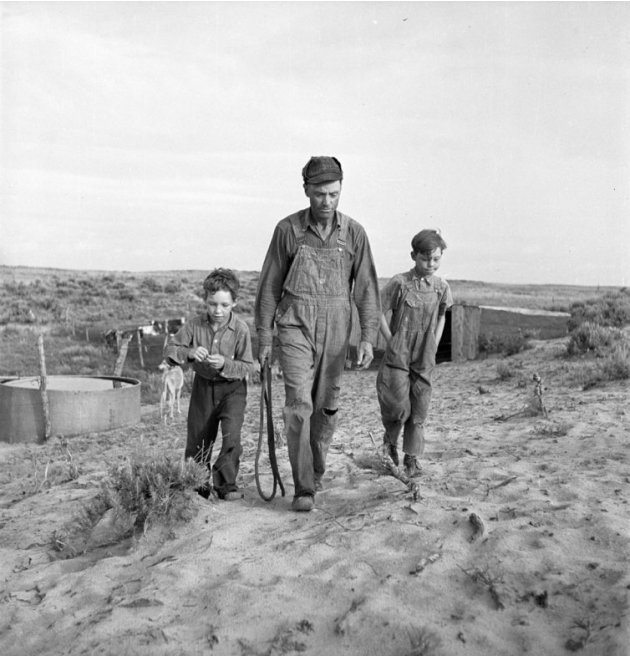
I'm not saying that it will get as bad as this 1942 Alfred Eisenstaedt photo of the dustbowl, at least not this year.
unpublished, from Life


But don't think it can't happen again. Dr. David Schindler, over at the University of Alberta, has pointed out that the Twentieth Century was the wettest century in the Pallister Triangle in the last 10,000 years. It has also been the only century we've farmed in the Triangle, so our perceptions are kind of skewed. And the past century also had four major drought events, including the one above. So Global Climate Change is going to matter here in North America.