Sunday, May 6, 2012

Hunger Is Political

In this news report from Al Jazeera, Prerna Suri reports on an Indian iteration of a problem that affects the world: food does not make it to those who need it.


While India has a food security program, it still has some 200 million hungry and malnourished people--and grain to feed them rots in storage facilities that look more like they were specifically designed to feed rats.

Friday, May 4, 2012

Keep It Simple

I do like it when things are kept simple. Michael Pollan's "Don't eat anything with more than five ingredients" is a good example. As is this mnemonic device:

Thursday, May 3, 2012

Canada first wealthy nation to be probed by UN food monitor

By Sarah Schmidt, Postmedia News May 2, 2012 OTTAWA — Canada has the dubious distinction of being the first wealthy nation in the world to face a probe by the United Nations Special Rapporteur on the right to food.
The 11-day mission begins Saturday, and will take Olivier De Schutter to Toronto, Ottawa, Montreal, Winnipeg and Edmonton, as well as remote aboriginal communities in Manitoba and Alberta. Until now, the independent expert appointed by the UN's Human Rights Council has been dispatched to countries such as South Africa, Cuba and Lebanon to probe those nations' records on ensuring people have access to food.
Canada, well known as a major food exporter, is the first developed country facing a probe since the UN created the position in 2000, and the report on the mission, to be presented to the UN Human Rights Council, will be part of Canada's official international human rights record.
In addition to examining the challenges facing aboriginal people, De Schutter, a professor of law based in Belgium, will probe food supply chains in Canada and government policies and programs that affect the right to food. He will be meeting with aboriginal leaders and non-governmental organizations, as well as federal officials at Health Canada and in the Department of Aboriginal Affairs and Northern Development. While in Ottawa, he will also meet with NDP leader Thomas Mulcair.

Wednesday, May 2, 2012

Don't Tick Off The Neighbours


I don't know everything behind this, but it sounds depressingly familiar. I undertand how large volumes of uncomposted horse manure might tick off the neighbours, but why the Lantzville council has such a hate on for the farm baffles me. If it was a bylaw issue, it would have been solved already. As it is, who knows. You can also visit Compassion Farm's website.

Lantzville's Compassion Farm Continues To Be Harassed For Growing Healthy Food

by Kim Goldberg on Monday, 30 April 2012 at 13:49 ·
 
FOR IMMEDIATE RELEASE, April 30, 2012, Lantzville, British Columbia 

Last week Dirk Becker and Nicole Shaw of Compassion Farm in Lantzville, BC, founders of the Bowen Road Farmers Market, received another letter from the District of Lantzville (D.O.L.).

This letter states they are contravening the DOL small business bylaw by selling rain barrels.

In January of this year, Becker and Shaw met with the new mayor and signed an agreement to discontinue the importation of any manure onto their property. They were given to understand that this agreement would appease council and were told it would appease their neighbor, Jim Brash, whose campaigning against their use of horse manure is on-going.

This April they were informed that council wants to 'reinspect' their property. Ensuing communication revealed that Council is unwilling to disclose what they are looking for. Therefore, Becker and Shaw responded that they see no point in yet another inspection since nothing of significance has changed since the last inspections--by various levels of government: Regional District of Nanaimo Bylaw Enforcement, the Vancouver Island Health Authority, the Ministry of Environment and the Ministry of Agriculture.
Further, no manure has been brought to the property in question since the above-mentioned agreement was signed.

On April 24th they received a letter informing them that council has a problem with their rain barrels.

In the same week, a friend who has donated grass clippings for 10 years shared a letter received from the RDN, threatening legal action if he continues to bring grass clippings to Compassion Farm.

"There doesn't seem to be an end in sight,” says Becker. “The District of Lantzvile has moved the goal posts several times. Urban Farming is a global movement and is moving past being 'allowed' or 'permitted' to being supported, encouraged and protected".

Tuesday, May 1, 2012

Pressure's On

The pressure's indeed on--the World Bank is reporting global food price increases, increases due to global warming and oil price increases.


The April Food Price Watch report says "Global food prices have increased by 8% in the last four months since December 2011, and in March 2012 were only 6% below their February 2011 historical peak. All key food prices have increased, except for rice."


Cold weather in extreme cold in Europe, the Russian Federation, and other countries is blamed for upward pressure on wheat prices, while hot and dry conditions in South America have affected sugar, maize, and soybeans. There is a little good news in that a slowdown in maize-to-ethanol conversion in the US is helping put a brake on price rises, as is aa lower value for the Euro.Also, record prices in 2010-2011 have encouraged more planting, which should help offset weather/climate induced shortfalls.
The report also points out some dramatic domestic price changes around the world:
Wheat price increases between March 2011 and March 2012  reached 92% in Belarus and 56% in Moldova, while they declined by 30% in El Salvador, 19% in Kyrgyzstan, and 16% in South Africa. The price of maize rose by 82% in Malawi, 80% in Ethiopia, and 71% in Mexico. The largest maize declines occurred in Honduras (31%), Somalia (20%), and El Salvador (19%). Rice prices in the same period rose by 125% in Uganda, 54% in Tanzania, and 38% in Rwanda. In turn, Bolivia saw its rice prices decline by a more modest 21% and Bangladesh's declined by 18%.
So while there have been some declines in prices, the rises have more than outweighed them. But once again, the shortfalls in production, while worrying, and the price increases, while scary, do not mean that there isn't enough food in the world. Famine is not an automatic byproduct of these shortfalls. Starvation will result from a lack of purchasing power, not a lack of food.
And, to repeat:
 Models that just treat supply and demand are not consistent with the actual price dynamics. There is a consistent firm upward pressure on food prices from the increased demand from ethanol conversion programs, but the big driver of food prices is "specifically due to investor speculation."

Why We're Hungry

Al Jazeera is reporting on the food crisis facing South Sudan:


Look at that market. This is what it looked like in Ireland during the Great Hunger, when the potato crop failed. Food in the markets, none in the belly. What this tells us is something that bears repeating over and over again: .People are hungry because of politics, not a lack of food. People are hungry because they don't have money, not because there's a lack of food. We grow more than enough for the world as it is, we just choose not to feed everyone. Its why we feed so damn much to animals, or bring in supports for foodgrain ethanol production. We have foodbanks because we choose to have them. Because we turn our backs on the poor in our own countries as well as around the world. May the revolutionary cry of the Bolsheviks ring out: "Peace. Land. Bread."

Monday, April 30, 2012

Jolly Olde...Well, Not So Much.

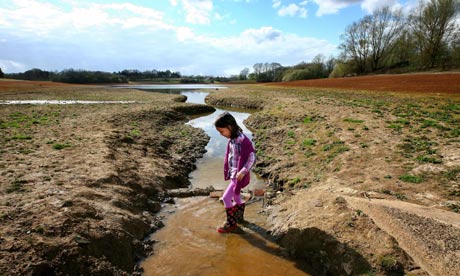
Bewl Water reservoir, near Lamberhurst, Kent, photo from The Guardian website by Gareth Fuller/PA
England is still swinging, but the pendulum only seems to be going from bad to worse and back again. Southern England has been in the grip of a drought for a few years now, as the condition of the reservoir above attests. Now it has started raining across the region, but not the spring rains needed to replenish the groundwater and then the aquifers. Rather, massive storms are slamming into the south, bringing projected dumps of up to 40mm of rain during the day--much of which will run off the drought-hardened soils rather than soaking in. Even if it does soak in, it won't be enough to ease the drought: these rains would have to continue for weeks to begin replenishing the underground aquifers.
The consequences for food production, according to The Guardian are significant:
Farmers, particularly arable farmers and vegetable growers, face a difficult summer as decisions have already been taken on what to grow this year. Further restrictions such as curbs on abstracting groundwater will become more likely if the drought continues. Price rises are likely for thirsty crops such as soft fruit and vegetables, while the price of beer is also expected to increase.
And you know if the price of beer rises, the Conservative government of David Cameron is going to take even more of a bollocking than usual. Because the UK has also slipped into a double dip recession because of the current austerity programme.  Also from the Guardian:
Britain's leading foodbank network, the Trussell Trust, says every single day it is handing out emergency food parcels to parents who are going without meals in order to feed their children, or even considering stealing food to put on the table, as the government's austerity measures start to bite.
The number of people to whom it had issued emergency food parcels had doubled in the last 12 months and was set to increase further as rising living costs, shrinking incomes and welfare cuts take their toll, the trust said, as it published its annual report, which is fast becoming a barometer of social deprivation.
Two foodbanks a week opened up in the UK over the last 12 months to meet an explosion in demand from families living on the breadline, the trust said. The charity currently oversees 201 foodbanks run on a franchise basis across the UK, up from 100 in 2010-11.
Its not much better worldwide. A report published in the magazine Science suggests "Models that link yields of the four largest commodity crops to weather indicate that global maize and wheat production declined by 3.8 and 5.5%, respectively, relative to a counterfactual without climate trends.[...] Climate trends were large enough in some countries to offset a significant portion of the increases in average yields that arose from technology, carbon dioxide fertilization, and other factors." So even when there's good news (increases in average yields) the bad news tends to outweigh it (enough to offset a significant portion).
It might be nice to have a test case for some of the problems we're facing--like the continued uncertainty in the price of oil.  We've passed Peak Oil at this point, but what that means seems to be confused. Neil Reynolds takes on the Club of Rome and Peak Oil in today's Globe and Mail, writing:
The book’s most alarming prediction, of course, dealt with oil – which, it said, would be irretrievably depleted by 2022 – a mere decade from now – at the latest. Yet, “the World Energy Council reports that global proven recoverable reserves of natural gas liquids and crude oil amounted to 1.2 trillion barrels in 2010,” Mr. Kenny says. “That’s enough to last another 38 years at current usage. Add in shale oil, and that’s an additional 4.8 trillion barrels, or a century and a half’s worth of supply at present usage rates. Tar sands, including some huge Canadian deposits, add perhaps six trillion barrels more.”
It should be noted that  "global proven recoverable reserves" is a terribly elastic figure. The Saudis, as one example, have been fudging the books on what their "recoverable reserves" are for almost two decades.It also helps to toss natural gas into the mix--there are large reserves around the planet--so much so that the current price is below the cost of recovery. But what Peak Oil theory said was that once we've passed the halfway point on recovery--which we have--the oil that was left would become more and more difficult to retrieve. And as prices rose, companies would go to greater and greater lengths to retrieve that oil. Its expected (under the theory, that as oil climbs in price, exploration/late production will increase while demand drops off. Once demand has dropped off, prices will begin to decline. Once prices at the pump decline, exploration/pumping will slow while demand rises again. Prices will suddenly spike until more production is brought back on line. There will be tremendous oscillation in prices and availability of oil. There will always be oil, its just that most of us won't be able to afford products made from it.
Energy has become dearer, and so we see the mining of bitumen in the Tar Sands of Alberta, a process that is only economically viable when the price of oil is over $80/bbl. And with energy prices currently sitting at $104/bbl for West Texas Crude, we see both the crazy push to mine the Tar Sands and the rise of fracking to release shale oil (another process like mining the Tar Sands that only happens without proper oversight and when oil prices are high).
But what happens when the oil stops? Actually, it doesn't even have to stop, all it has to do is become too expensive for use in agriculture.  And actually, we have a case study of this: Cuba. As an article in Slate points out:
Unable to afford the fertilizers and pesticides that 20th-century agriculture had taken for granted, the country faced extreme weather events and a limit to the land and water it could use to grow food. The rest of the world will soon face many of the same problems: In the coming decade, according to the OECD, we’ll see higher fuel and fertilizer costs, more variable climate patterns, and limits to arable land that will drive cereal prices 20 percent higher and hike meat prices by 30 percent—and that’s just the beginning. Policymakers can find inspirational and salutary ideas about how to confront this crisis in Cuba, the reluctant laboratory for 21st-century agriculture.
Cuban officials faced the crisis clumsily. They didn’t know how to transform an economy geared toward sweetening Eastern Europe into one that could feed folk at home. Agronomists had been schooled in the virtues of large-scale industrial collective agriculture. When the “industrial” part became impossible, they insisted on yet more collectivization. The dramatic decline in crop production between 1990 and 1994, during which the average Cuban lost 20 pounds, was known as “the Special Period.” Cubans have a line in comedy as dark as their rum.
It finally took land reform to fix many of the problems. The Cuban state was still not ready to give up its control over the land, but realized that allowing management to devolve to the farm level might not be a bad thing. With that devolution, farmers also got usufruct rights--that is, the legal right of using and enjoying the fruits or profits of something belonging to another. In fact, Cuban peasants have been able to boost food production without scarce and expensive imported agricultural chemicals by first substituting more ecological inputs for the no longer available imports, and then by making a transition to more agroecologically integrated and diverse farming systems. A report on this, called the Campesino-to-Campesino agroecology movement of ANAP in Cuba is available online (amazingly, the full text of the report is available for free download). It should also be noted that Cuba pursued its self-sufficiency goals with the aid of one of the best educated populations around (Cuba has 2 percent of Latin America’s population but 11 percent of its scientists). Various scientists were put to work with the farmers to maximize production without industrial farming inputs.
It may not be perfect, but Cuba has managed to supply a significant amount of its own food. In a report from Miguel A. Altieri and Fernando R. Funes-Monzote:
The production of vegetables typically produced by peasants fell drastically between 1988 to 1994, but by 2007 had rebounded to well over 1988 levels [...]. This production increase came despite using 72 percent fewer agricultural chemicals in 2007 than in 1988. Similar patterns can be seen for other peasant crops like beans, roots, and tubers.
Cuba’s achievements in urban agriculture are truly remarkable—there are 383,000 urban farms, covering 50,000 hectares of otherwise unused land and producing more than 1.5 million tons of vegetables with top urban farms reaching a yield of 20 kg/m2 per year of edible plant material using no synthetic chemicals—equivalent to a hundred tons per hectare. Urban farms supply 70 percent or more of all the fresh vegetables consumed in cities such as Havana and Villa Clara.
So the future isn't entirely threatening, its just different.A lot more of us will be peasants again--a designation I, for one, am willing to embrace.

Monday, April 9, 2012

Not Looking Good

There is a lot of serious, high-level worry going on over the state of  our current and future world food supply these days. Such as the Planet Under Pressure conference that just wound up at the end of March. As the New York Times reported about a year ago:

A rising unease about the future of the world’s food supply came through during interviews this year with more than 50 agricultural experts working in nine countries.
These experts say that in coming decades, farmers need to withstand whatever climate shocks come their way while roughly doubling the amount of food they produce to meet rising demand. And they need to do it while reducing the considerable environmental damage caused by the business of agriculture.
Agronomists emphasize that the situation is far from hopeless. Examples are already available, from the deserts of Mexico to the rice paddies of India, to show that it may be possible to make agriculture more productive and more resilient in the face of climate change. Farmers have achieved huge gains in output in the past, and rising prices are a powerful incentive to do so again.
Source: NYT.com
Of course, if we really wanted to increase productivity, we'd do something about the size of our farms. Most of the world has small farms that are highly productive--weather permitting. But particularly here in North America and in Europe, farm sizes are large, which means high productivity per worker, but a lower calorie yield per acre. This is known as the Inverse Size Yield Relationship, and coupled with traditional farming techniques, means a higher sustainable yield from small farms over large ones. Here in Victoria, the founding farmers of Saanich Organics, a farmer-run local food distributor, have published All The Dirt: Reflections on organic farming. None of them runs more than a couple of acres, choosing to farm intesively and sustainably, rather than even try to take on a small Canadian farm of a couple of hundred acres. And they're making it pay.
But the combination of biofuel production in the US and commodities speculation following the 2008 crash, mean that food prices are headed back up again this year. Same reasons, just another speculation-driven price bubble.But, in order to ensure that speculators make their nut, a few hundred million more people will drop into food insecurity, and those already hungry will die.


We're facing a perfect storm: population pressures, unregulated capitalism, an international monopsony/monopoly market in foodstuffs, climate change seriously messing up weather patterns, the list goes on. As a society, we won't stop--Canadian rime Minister Stephen Harper has announced that the environment will not inhibit Canadian resource (read: petrochemical and mining) extraction and export. On the climate front, this winter Canada has seen records going back 150 fall regularly; one "warmest day" record was smashed by 20°C.

But this boat's too big to turn.Too many people are making far too much money with things the way they are now. As Yvo de Boer, former head of the UN Intergovernmental Panel on Climate Change and now Special Global Advisor to KPMG, notes [pdf], “if companies had to pay for the full environmental costs of their activities, they would have lost 41 cents out of every (US) $1 earned in 2010. The external environmental costs of 11 key industry sectors rose by almost 50 percent between 2002 and 2010, from $566 billion to $854 billion.”And if you own the governments, are you going to allow a sudden tax increase of 41%? Even if it means saving the planet for your children? No, and not just because you are legally constrained from doing so, but because destruction of the world just means you better get yours now. But you don't want to believe it might well be the end of civilization (Hell, I don't want to believe it). Just like Pol Pot didn't see himself as a genocidal monster, we don't want to see ourselves as environmental criminals. But it doesn't change the fact that we are.
Over at Climate Change Agriculture and Food Security, they're worried about feeding the world in 2050. Using the following video as a teaching tool, they're showing us what a small target we're currently trying to hit. They also point out how we might make the target a bit bigger. So they, at least, are trying to remain optomistic.


Over at the Council on Foreign Relations, Laurie Garrett is interviewed about how the stumbling value of the US dollar and rising international food prices mean that donor pledges are worth less (although not yet worthless). $300 million just doesn't buy what it used to. So what does that mean for the starving? To say nothing of how food aid is used by governments to destroy local food markets and buy access for "their" multinational industrial food corporations. (If you dump free food onto a market you change the price local farmers can get for their crops to zero, and everyone knows, you can't compete with free. This destroys local farming communities and infrastructure, leaving the field clear for the Monsanto's and ConAgra's to come in preaching the "Green Revolution" doctrine of big farms and monocropping with high input costs). This would be an example of the law of unintended consequences, except that it was intentional.
And, in Thailand, there's a new delicacy on the menu:

Friday, April 6, 2012

The Death of "Pink Slime"

As I reported earlier in my Jamie Oliver post, the makers of "finely textured lean ground beef" have had a pretty difficult couple of weeks. From Gerald Zirnstein (a USDA microbiologist) coining the phrase in 2002, to Kit Foshee bringing his concerns to GAP (the Government Accountability Project) and their Food Integrity Campaign in 2008, and the closing of three of four plants by Beef Products International, and the news that AFA Foods have entered Chapter 11 because of the current storm this week, things have moved pretty fast in the last while.
Beef by-products undergoing processing at a BPI plant. Image sourced: Chicago Tribune

The idea of ammoniating beef to kill e. coli bacteria allowed mechanically separated beef to enter the human food chain--before that it was only approved for use in pet foods. Things started to go off the rails when it was claimed that ammoniated beef trimmings would transmit this e. coli-killing ability to ground beef it was mixed with-- a claim that was never tested.
Ammoniating beef was found to be so effective that, in 2007, "exempt from routine testing of meat used in hamburger sold to the general public." From the beginning, finely textured lean ground beef was seen as both a cheap extender of ground beef (ground beef could conatain up to 15% ftl ground beef without any requirement to list it as an ingredient), and as a way of ensuring that the traditional ground beef was somehow protected against e. coli contamination.The problem was that, at the concentrations required by the USDA, ground beef mixed with ammoniated ground beef smelled bad. Bad enough that shipments of it were occasionally returned as having been spoiled during transport, when in fact they just smelled that way.
Ammonia concentrations were reduced to meet these concerns--thus negating both the ammmoniated beef's protection from e. coli and the alleged "knock-on" effect of protecting the meat it was mixed with.It should be noted, however, that no case of e. coli contamination has been traced back to BPI's ammoniated beef, although there have been several e. coli-related ground beef recalls in the last decade.
Thankfully, ammonia has never been approved as a treatment method for ground meat in Canada, nor is it supposed to be imported (although there seems to be some fuzzy areas around the importation rule, with Health Canada Canada allowing finely textured meat to be "used in the preparation of ground meat" and "identified as ground meat" under certain conditions). With pretty much every major fast food operation in the US using pre-made hamburger patties buying ground beef with the allowed 15% of ammoniated beef, one is left to wonder if any Canadian operation ended up using US-made patties.
Ammonia isn't the only compound used in food processing. For example, we've seen a rise in the use of cellulose as a food extender in the last while, and a report on food fraud has just been published in the April Journal of Food Science (not available online, but there's a press report). In fact, there's an entire site dedicated to food fraud reporting.  On the USDA website, you can get a list of the various chemicals used in industrial food production (links to a pdf). I wish I could say that it was as easy to find something similar on the CFIA website, but it's not. The CFIA websiteseems to be a bit more producer-friendly and a little less consumer-friendly. On the plus side though, there is a dictionary of food additives, available both online and as a downloadable pdf, a guide to meat cuts and the words used on packaging, and some basic food-handling tips.

Wednesday, April 4, 2012

This Little Piggie

Was dubbed the Enviropig by researchers at Ontario's University of Guelph.

From the University of Guelph website
 It was developed (when it's a genetically modified organism, can you really use the word "bred"?) in 1999 to deal with the problem of too much phosphorus in swine manure spread on fields. Phosphorus is linked to massive, river-choking, algal blooms, and run-off from manure-treated fields have been point sources for phosphorus.
Of course, this is only a problem when you have too much swine manure to spread--typically a problem with industrial scale hog rearing operations. These operations can house upwards of 500,000 hogs on one site. When the Enviropig (dubbed "Frankenswine" by detractors) was developed, one of the creators enthused that industrial hog operations would be able to support twice the hogs on the same footprint of land. Oh, and with no increase in phosphorus run-off.
This is typical of factory farming; Each problem caused by industrial farming practice has to have a technological solution that allows the same type of farming to continue. That the problem might be the raising of too damn many hogs on to small a space is never addressed.
That there are feed additives that can reduce swine manure phosphorus levels are also unacceptable as they would raise the cost per carcass (according to the Globe and Mail article) by ~$1.70Can. The money put into developing Enviropig, on the other hand, would be diffused over millions of hogs per year. But the public never came on board with eating GMO animals. Quoted in the Toronto Star,
Cecil Forsberg, an emeritus professor of molecular and cellular biology at the university who was in charge of the project, said he agreed with the decision.
When the first such pig was created in 1999, he said, “I had the feeling in seven or eight or nine years that transgenic animals probably would be acceptable. But I was wrong. It’s time to stop the program until the rest of the world catches up,” he said. “And it is going to catch up.”
 I'm not convinced that we will "catch up." I suspect that the violent swings of global climate change over the next 20 years will give us a lot more to worry about than how much pig we have to eat. The question is more "will we be able to acquire enough calories to maintain life?" Industrial farming may be at it's historical high-water mark.