
Tuesday, June 12, 2012
Visualize Variety
A stunning photo--thanks to Milkwood Permaculture--of heirloom tomatoes. This is a reminder of what the world is supposed to look like; exuberant diversity.


Tuesday, June 5, 2012
Food, Near Food, and Vitamins
We've all heard the story of scurvy; a disease aboard ship, traced to a vitamin C deficiency, the introduction of lime juice to the sailor's diet, and hurrah! Problem solved! The moral of the story? That sometimes diet is not enough, and you have to take supplementary vitamins and minerals.
What we're not really thinking about is why the sailors faced scurvy in the first place. Navy life was brutal, badly paid, and if you weren't an officer, you were the lowest of the low—roughly equivalent to footpads and cut-purses. And the food was horrible. In the damp confines of the ship, everything developed moulds and spoiled, there was no refrigeration, and food storage techniques were less than effective. Hardtack, or ship's bread, was nothing much more than flour, water, and maybe salt, fashioned into a biscuit and baked four times to drive all the water out of it. Properly prepared, it would last effectively forever on board ship, but provided a badly nutrient-deficient food for sailors.
Today we take nutritional supplements for many different reasons—scurvy and beri beri no longer among them. We take anti-oxidants to protect against heart disease or cancer. We hear repeated statements about how good they are, and how we should all be taking various pills—you know, if we actually care about our health. Problem with this all is, we don't actually know if these supplements are doing us any good.
Turns out, they're not. Research over the last three or four years is showing that not only may they not be doing us any good, but they are actually being linked to earlier death in certain populations (primarily women). There are questions being raised about dose absorption from pills, timed-release seems to mean poorer uptake rates, and on and on.
In response, we hear people saying “All you have to do is eat properly and you won't need supplements.” Hey, I've said it myself. Concentrate on cooking from scratch, use lots of whole vegetables rather than processed ones, and everything should be fine. Except... it's probably not fine. Thomas F. Pawlick, in his book The End of Food (a good Canadian boy, btw. And what is it about Canadians that they write so many excellent books about the food system?) talks about a number of tests—Canadian, American, and British—that show similar results: over the last half century or so, the nutritional content of food has changed. And seldom for the better.
In 2002, André Picard reported on a joint investigation by CTV and the Globe and Mail that looked at nutritional content of six fruits and vegetables. They published this table of the changes in the nutritional make-up between 1951 and 1999:
What we're not really thinking about is why the sailors faced scurvy in the first place. Navy life was brutal, badly paid, and if you weren't an officer, you were the lowest of the low—roughly equivalent to footpads and cut-purses. And the food was horrible. In the damp confines of the ship, everything developed moulds and spoiled, there was no refrigeration, and food storage techniques were less than effective. Hardtack, or ship's bread, was nothing much more than flour, water, and maybe salt, fashioned into a biscuit and baked four times to drive all the water out of it. Properly prepared, it would last effectively forever on board ship, but provided a badly nutrient-deficient food for sailors.
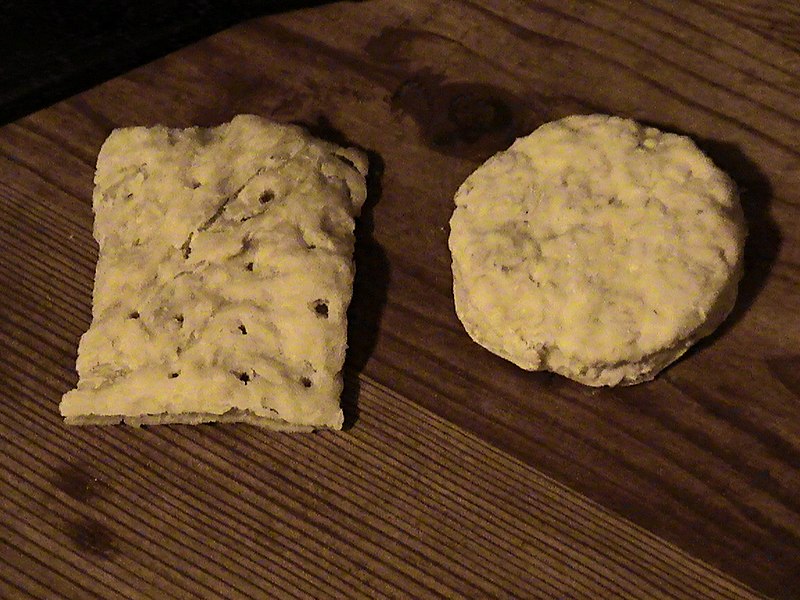 |
| Reproduction hardtack (from wikipedia) |
Turns out, they're not. Research over the last three or four years is showing that not only may they not be doing us any good, but they are actually being linked to earlier death in certain populations (primarily women). There are questions being raised about dose absorption from pills, timed-release seems to mean poorer uptake rates, and on and on.
In response, we hear people saying “All you have to do is eat properly and you won't need supplements.” Hey, I've said it myself. Concentrate on cooking from scratch, use lots of whole vegetables rather than processed ones, and everything should be fine. Except... it's probably not fine. Thomas F. Pawlick, in his book The End of Food (a good Canadian boy, btw. And what is it about Canadians that they write so many excellent books about the food system?) talks about a number of tests—Canadian, American, and British—that show similar results: over the last half century or so, the nutritional content of food has changed. And seldom for the better.
 |
| Thomas F. Pawlick |
In 2002, André Picard reported on a joint investigation by CTV and the Globe and Mail that looked at nutritional content of six fruits and vegetables. They published this table of the changes in the nutritional make-up between 1951 and 1999:
Food
|
Calcium
|
Iron
|
Vitamin A
|
Vitamin C
|
Thiamine
|
Riboflavin
|
Niacin
|
Apple
|
20.0
|
-55.3
|
-41.1
|
16.0
|
-75.0
|
-66.7
|
-30.0
|
Banana
|
-23.8
|
-41.7
|
-81.2
|
-13.0
|
0
|
-100.0
|
-1.4
|
Broccoli
|
-62.8
|
-33.9
|
-55.9
|
-10.1
|
-40.0
|
-42.9
|
-2.7
|
Onion
|
-37.5
|
-52.9
|
-100.0
|
-54.8
|
56.9
|
-41.2
|
135.3
|
Potato
|
-27.5
|
-58.6
|
-100.0
|
-57.4
|
-14.6
|
-50.0
|
44.9
|
Tomato
|
-55.7
|
-18.8
|
-43.4
|
-1.6
|
0
|
21.8
|
46.3
|
Notice how some of the listed foods have lost all their nutritional content in one category or another: Bananas have lost all their riboflavin, Onions and potatoes have lost all their vitamin A. And across these seven categories, the majority have lost significant amounts of nutritional value.
In the UK, the story is similar. British researcher Anne-Marie Mayer published a study called Historical Changes in the Mineral Content of Fruits and Vegetables [pdf] (British Food Journal, 99(6), 1997, 207-211) in which she wrote:
In the UK, the story is similar. British researcher Anne-Marie Mayer published a study called Historical Changes in the Mineral Content of Fruits and Vegetables [pdf] (British Food Journal, 99(6), 1997, 207-211) in which she wrote:
There were significant reductions in the levels of calcium, magnesium, copper and sodium in vegetables, and magnesium, iron, copper, and potassium in fruits. The greatest change was the reduction in copper levels in vegetables to less than one-fifth of the old level. The only mineral that showed no significant differences over the 50-year period was phosphorus. [p. 209]
Pawlick has also looked into the US experience, particularly that of tomatoes. “Tomatoes were once among the best sources of these vitamins [A and C]. But 100 grams of today's fresh tomato contain 30.7 percent less Vitamin A and 16.9 percent less Vitamin C (ascorbic acid) than its 1963 counterpart. [emphasis in original] It also has fully 61.5 percent less calcium [...], 11.1 percent less phosphorus, 9 percent less potassium, 7.97 percent less niacin, 10 percent less iron and 1 percent less thiamine.” [p. 6 The End of Food]
That's since 1963—the numbers look worse if you go back to the nutrient tables produced by the USDA in 1950. Then it becomes apparent that while the tomato may be down 10 percent in its iron content since 1963, it is down 25 percent since 1950. But there are increases as well: fats (lipids) are up by 65 percent and sodium is up by 200 percent.
This is also true in processed tomatoes; canned tomato juice is down 35.4 percent on iron content and 30.5 percent of its Vitamin A—again since 1963. Vitamin A is down 47 percent in tomato juice since 1950. And these are only the primary vitamin and mineral components that have been measured. We really have no idea as to any change in the micro-nutrient component of what we're forced to consider as food.
So conventional agriculture has left us with an ongoing legacy of lots of cheap food, but of declining nutritional value. [Oh, and don't you love that bit of Orwellian Newspeak? Industrial agricultural methods—only about 60 years old—are referred to as “conventional,” while the techniques that date back to the beginning of agriculture have their own, separate classification of “organic.”] To replace the missing nutrients, we're expected to pick up oral multivitamins—which may or may not be bio-utilizable and which seem to shorten some lifespans.
What's to be done? It's pretty straightforward; begin cutting industrially-produced foods out of your diet. Replace it with homegrown food (because most of the changes in the various cultivars has been to increase storage life and transportability) grown from heritage seeds. Save your own seed and plant in good quality soil replenished with compost from your food waste. Preserve your own food wherever possible (really, its not that difficult). Even if you can't be entirely self-sufficient (and that is difficult to do), you can be a great deal more self-reliant and reduce your intake of poor quality food by replacing it with high-quality real food.
Thursday, May 31, 2012
Jiro Dreams Of Sushi

Jiro Ono has been making sushi since forever. At 85, he's still making sushi; over and over we watch his hands forming the perfect rice bundle. In The Story of Sushi, by Trevor Corsin, he writes:
A sushi chef wants the grains lined up along the length of the finished rectangle. That way the grains will stick to each other without lots of extra squeezing. A tightly packed nigiri [hand-packed sushi] is bad. The chef's goal is a piece of sushi just firm enough to stay in one piece while the customer handles it, but loose enough that it will immediately disintegrate in the mouth. When a perfect nigiri crumbles apart on the tongue, the grains of rice mingle instantly with the fish, combining tastes and textures. The sensation some diners feel is gratitude because the chef has calibrated the sushi so perfectly that they hardly have to chew.
Researchers have conducted MRI scans of nigiri made by master sushi chefs. The scans reveal that a master chef's nigiri disintegrates easily on the tongue because it contains more empty space than a nigiri made by a novice. Scans of nigiri made by sushi robots showed a product tightly compressed, with almost no empty space on the interior at all. [pp. 91-92]To watch Jiro Ono's hands, and the hands of his son and apprentices, shape and re-shape grains of rice into perfectly tensioned rectangles is hypnotic: their hands perform a precise set of actions over and over again. And at the end of each series of actions are sushi of perfect size and tension.
Anthony Bourdain has, of course, eaten Jiro Ono's sushi: fifteen courses in twenty minutes. Bourdain is one of those people I both admire and envy: he writes well, eats well, and gives great food-gasm.
But this film is about more than one man making sushi in a ten-seat restaurant (Jiro runs the only Michelin 3 Star restaurant with so few seats and no washroom in the restaurant, and yet the Michelin guide said "three stars is the only rating suitable for this restaurant. It is worth traveling to Japan just to eat there."). It is about old-school standards. An apprenticeship runs about 10 years under Jiro.He says, "Once you make a decision to do something, learn to love it. It must take all your time." He knows what he's talking about; he's been working and making sushi since he was ten years old. At one point the comment is made "What's the difference between Jiro at 40 and now? He's quit smoking." Jiro talks, in the film, about doing the same thing over and over until you're good at it. But to seek perfection, you must then continue to do it over and over, all the while looking for ways to improve.
In the trailer (above) you see one of the changes that have happened in the last 15 years: his son now rides down to get the fish every morning. After Jiro had a heart attack at age seventy, this job passed to his son. But the men Yoshikazu meets at the markets are as old-school as Jiro. They too have served long apprenticeships, learned their trade so deeply as to dream of it as Jiro does of sushi. The tuna purchaser who reads tuna with his fingers, massaging a bit of fish and saying "The way it feels tells me how it will taste." After buying from the same tuna supplier for so many years, Jiro, and by extension Yoshikazu, trust his supplies. The same is true of the rice supplier, who won't sell the rice he sells Jiro to anyone esle--unless Jiro says to--even though he knows that the quality of the rice he sells to Jiro still requires Jiro's techniques in preparation to be as good. Yet he reserves one grade of rice for the sushi master he's sold to for so long.
Jiro's world, the world of this film, is a world where nothing replaces time and practice. We hear from Yoshikazu how many apprentices simply disappear. We also meet the ones who stay. Jiro explains that by the time he prepares the sushi, 95% of the work is already done by his crew. He has the easy job. One apprentice must "massage the octopus" (a process by which a partially cleaned but living octopus is tenderized) for 40-50 minutes. Why? Because it is better. And better takes time and focus.
Jiro Dreams of Sushi ends with a plea for sustainable fishing practices. There is some archival footage of a tuna that makes a whale look small being cut up. Quite the difference even with the big boys we see in the film. If we pursued perfection instead of the quick and the easy, I suspect that there would be more to go around, instead of pursuing a course of rabid consumption for the cheapest price. Maybe, and I know this is heresy in the modern world, maybe we're not supposed to have everything we want.
Tuesday, May 29, 2012
Link-straveganza!
Food Trucks
 |
| From The Toronto Standard. Credit: Jen Chan |
Sometimes, there's a lot going on. And those days (like today), well, I can't posibly put an explanatory gloss on everything I see. Like food trucks. Not an entirely new phenomena, but suddenly they've taken off again in popularity.Now, I've had some terrific food truck food: at the St. Albert market we used to get pulled pork and bbq beans made with Cattleboyz BBQ sauce that was to die for. And green onion cakes were always a food you bought at a street vendor tent. I've even thought about opening one. But the current mania just seems an invitation to bad food driving out good (in the foodie version of Gresham's Law). Bronwyn Kienapple is asking a few of the same questions in the Toronto Standard.
Occupy The Farm
 | |||
| From Climate Connection.org |
Trying to get a handle on what the Occupy movement means seems impossible--except to say that as a movement that seems dedicated to citizen involvement and democratic empowerment, I couldn't be more supportive. The Occupy the Farm group taking over UC Berkley lands and procceeding to plant food crops is an interesting idea. Jeff Conant explores it in more depth at Climate Connection.org.
Corporate Land Purchases
 |
| from the Grain website |
Not just corporations, but nations (I'm looking at you, China), are busy buying up farmland--particularly in the developing workd--not to grow food to feed indigenous populations, but to support their own populations. This is a good idea from the corporate and national governments perspectives, but really is unsustainable. Carey L. Biron takes on the issue at Farm Land grab.org. Carey Gillam, at the same site, points out the ongoing influence of speculators in investment in agriculture. And at the Grain website, an article pursues the question of how these land grabs are affecting food security in Latin America.
Private Profit, Public Cost
is the issue around pig farms in a new report (pdf) from the WSPA (World Society for the Protection of Animals). Now, I have a few problems with PETA, but I have a lot more concerns around CAFOs. The Financial Post has a pretty neutral article discussing the points contained in the above report.
Food Security and Farms
Both Alternet and Rabble.ca have articles on Why Big Food Must Go (alternet), and Why Hunger is a Farm Issue (rabble.ca). Both good, and both symptomatic of the discussion that is being heard more and more these days. As Michael Pollen says, the way we raise food is the issue that floats overtop all the other envirinmental issues we face.
The Madness of Smoked Pig Bellies
This recipe got passed around a while back.
Bacon Jam
Ingredients
1 1/2 pounds sliced bacon, cut crosswise into 1-inch pieces
2 medium yellow onions, diced small
3 garlic cloves, smashed and peeled
1/2 cup cider vinegar
1/2 cup packed dark-brown sugar
1/4 cup pure maple syrup
3/4 cup brewed coffee
Directions
In a large skillet, cook bacon over medium-high, stirring occasionally, until fat is rendered and bacon is lightly browned, about 20 minutes. With a slotted spoon, transfer bacon to paper towels to drain. Pour off all but 1 tablespoon fat from skillet (reserve for another use); add onions and garlic, and cook until onions are translucent, about 6 minutes. Add vinegar, brown sugar, maple syrup, and coffee and bring to a boil, stirring and scraping up browned bits from skillet with a wooden spoon, about 2 minutes. Add bacon and stir to combine.
Transfer mixture to a 6-quart slow cooker and cook on high, uncovered, until liquid is syrupy, 3 1/2 to 4 hours. Transfer to a food processor; pulse until coarsely chopped. Let cool, then refrigerate in airtight containers, up to 4 weeks.
When did such a simple product like bacon become the object of such veneration and our latest food of mass destruction?
Food Integrity Campaign
Food Integrity Campaign is an American organization that helped spread the word about "pink slime." Now, its all about meat inspection changes, bringing on this photo:
Depressing what industrial food manufacturers think we should be eating....
 |
| From the Food Integrity Campaign |
Depressing what industrial food manufacturers think we should be eating....
Monday, May 28, 2012
Urban Farmers
A lovely project from Fire and Light Media Group: a series of short (and long) videos introducing you to urban farmers.
The trailer (above) is longer than many of the short films, but is a real delight; so many people passionate about growing food! The urban farming movement is really taking off--particularly with the experience of Cuba to draw on.
This is a shot of an urban farm in Havana--a farm a lot bigger than pretty much every urban farm in North America. But what has been done in Cuba can be translated into cities here in Canada. In Victoria we have a under-used program that puts growers together with people who would like to see their gardens be used. There are a number of community gardens--like the one up at the University of Victoria that Paula and I are involved with. There's also the Greater Victoria Compost Education Centre, a great resource for converting waste into soil. We had them come out to the Rainbow Kitchen (old site) and do a compost education day last fall. And Lifecycles, who worked on a fruit harvesting program (among so many other projects) last fall that filled a 20cf freezer with sliced, cored apples at the Rainbow Kitchen. Apples picked from the huge number of urban apple trees in this city.
We forget that urban farming can also grow livestock. And not just chickens, but rabbits (my aunt supplemented her income and the family's food with a rabbit hutch on the family garden plot back in Manitoba decades ago), or pigeons (we forget that pigeons are edible, domesticated, and have been considered suitable for kings as well as commoners). There is a tremendous potential for integrating food production into our lives in the city. It is really a shame we don't do it more often.
The trailer (above) is longer than many of the short films, but is a real delight; so many people passionate about growing food! The urban farming movement is really taking off--particularly with the experience of Cuba to draw on.
 |
| Photo from the City Farmer website |
This is a shot of an urban farm in Havana--a farm a lot bigger than pretty much every urban farm in North America. But what has been done in Cuba can be translated into cities here in Canada. In Victoria we have a under-used program that puts growers together with people who would like to see their gardens be used. There are a number of community gardens--like the one up at the University of Victoria that Paula and I are involved with. There's also the Greater Victoria Compost Education Centre, a great resource for converting waste into soil. We had them come out to the Rainbow Kitchen (old site) and do a compost education day last fall. And Lifecycles, who worked on a fruit harvesting program (among so many other projects) last fall that filled a 20cf freezer with sliced, cored apples at the Rainbow Kitchen. Apples picked from the huge number of urban apple trees in this city.
We forget that urban farming can also grow livestock. And not just chickens, but rabbits (my aunt supplemented her income and the family's food with a rabbit hutch on the family garden plot back in Manitoba decades ago), or pigeons (we forget that pigeons are edible, domesticated, and have been considered suitable for kings as well as commoners). There is a tremendous potential for integrating food production into our lives in the city. It is really a shame we don't do it more often.
Sunday, May 27, 2012
The Battle Moves North
 |
| from Earth First News |
From Locals Supporting Locals:
Monsanto coming to Richmond to try to overturn Council decisionAt the same time, apparently the BC government is tryining to slide through an Ag Gag law.
This Tuesday Richmond Council voted unanimously at a general meeting, with the Mayor and all Councillors present, to pass a resolution to make Richmond the eighth GE free crop zone in B.C. The wording of the resolution is on the Richmond Council website, at http://www.richmond.ca/cityhall/council/agendas/gp/2012/052212_minutes.htmTen people spoke in favour of the resolution. This now has to go through the formal process of being passed at a Council meeting, which will happen on the 28th May at 7 p.m. at Richmond City Hall.We've been informed that Crop Life, the Public Relations wing of Monsanto and other biotech companies, will be coming to the Council meeting on the 28th May. They have already begun their lobbying efforts to try and get Richmond Council to change its mind.If you are in or near Richmond, please turn out for the meeting. Some Councillors may waver under corporate pressure, and a big turn out of the public will make all the difference and hold them firm to their decisions. Several Councillors spoke passionately about their concerns with genetic engineering, and a big public showing will give them more courage.If Richmond becomes a GE zone this will have a really big impact on other parts of the Province. As a large municipality with about 200 farms and where GE corn is being grown, people will see that if this can be done in Richmond, it can be done anywhere in the Province. GE Free BC is already getting emails from other municipalities where environmental activists want to get a GE Free resolution passed. This is why Monsanto is sending in the PR guys.
Who would this affect? Anyone. My significant other, author Paula Johanson, recently wrote a book titled Fish: from catch to the table which addressed the safety of farmed fish--this law would have affected her work.
Legislation being proposed by the BC's Liberal government will make it illegal and punishable for a person, including citizens or journalists, to disclose information relating to reportable animal disease in the Canadian province. Bill 37, The Animal Health Act, over-rides BC's Freedom of Information Act, making it unlawful for the public or the press to speak publicly about an agriculture-related disease outbreak or identify the location of an outbreak such as the deadly bird flu or a viral outbreak of IHNV at a salmon aquaculture feedlot.
 |
| Fake Foods by Paula Johanson |
 |
| Photo from Living Food FIlms website |
In April of 1996, Mr. Lyman (former cattle rancher and now President, Voice for a Viable Future)) was invited to appear on Oprah to discuss Mad Cow disease, food production, and the rendering process. He was part of a discussion of experts, including an expert from the beef industry, about food safety in the U.S. This included a discussion of potential health risks from e-colii and mad cow disease (which only weeks before was making headlines in Britain and throughout the world). When Mr. Lyman explained that cows are being fed to cows, Ms. Winfrey seemed to be repulsed by this thought, and exclaimed that it had just stopped her cold from eating another hamburgerLyman was sued under an Ag Gag law, the Texas Food Disparagement Act, and it took four years and a heap of money to end the lawsuit brought by a Texas beef ranchers organization. Since then, there has been a pause, but these laws are back.
Thursday, May 24, 2012
Michael Pollan interviewed
Amy Goodman, the host of Democracy Now!, interviews Michael Pollan on the release of the paperback edition of In Defense of Food (the book written from the essay Unhappy Meals that appeared in the New York Times Magazine). Michael takes on HFCS, five ingredient Haagen Das, and the marketing of foodsince he first released In Defense of Food.
Pollan lays out the two basic rules for buying food: don't buy any food you've seen advertised, and don't buy any food that makes a health claim.
A fascinating interview.
Pollan lays out the two basic rules for buying food: don't buy any food you've seen advertised, and don't buy any food that makes a health claim.
A fascinating interview.
Tuesday, May 22, 2012
Peace. Bread. Land
The struggle for social justice is deeply tied to the struggle for land reform around the world. At a conference in Islamabad Monday, participants echoed the rallying cry of the Bolshevik revolutionaries: Peace. Bread. Land.
The Express Tribune is reporting today that participants in a conference had "underlined the need for equal distribution of land rather than land reforms and ensuring food sovereignty, rather food security in the country.
They pointed out that due to corporatisasion of farming and giving land to foreigners, not only food security, but due food sovereignty is largely at the stake."
The call for countries to be food sovereign is pretty much worldwide, at this point. Participants in the Pakistan conference pointed to a " military-bureaucracy-feudal troika" standing in the way of land reform. According to the Express Times, "It was also highlighted that lands are given to generals, bureaucrats, cricketers and actors, but not to peasants, who are the real owners."
Increasingly, we are also seeing members of the national business press seeing problems with the continuing commodifying of everything threatening nation-states. The article closes with "Pakistan Business Review Chief Editor Dr Shahida Wazarat also advocated land reforms. “There will be adverse affects on food security if corporate farming continues in future,” she opined."
Sunday, May 20, 2012
Hungry For Change
I have to say, I love this sort of thing--this is a student-produced, neighbourhood-generated video on a social issue (of course its food security--do I ever talk about anything else these days?)
Here, students look at the concept of a "food desert", a place where there are no grocery stores. All the while that they were interviewing people, I kept thinking "Hey! There's a vacant lot. Use that." Sure enough, they are also involved with an urban farm with a farmer's market component.
This is also a particularly American video. It takes place in an African-American neighbourhood, and there is a deep undercurrent of issues of race. But at the same time, the solutions are practical and applicable to pretty much any urban area.
Umoja Students from North Lawndale College Prep, Manley, and Ace Technical
High Schools teamed with Free Spirit Media to discover the facts about the food
desert in North Lawndale, Chicago.
In the end, you have to question how this situation could have become so dire. Food deserts? How the hell do you not feed people? Why should we have to educate people in what constitutes good food? And a big reason for many of the problems we face, I think, is because we are nations of immigrants that destroyed the indigenous cultures, leaving us with no food culture of our own (and not much other place particular culture either, but that's for a different venue). We don't recognize terrior, we have no real place-specific foods (no equivalent to Parmesan cheese which is made in Parma, from Parman cows, the whey of which is fed to hogs which then become prosciutto). We have no generational attachment to the land in North America, and while many immigrants had an attachment to owning land, a house in the suburbs has fulfilled that desire. There is no equivalent to, say, the attachment to land reform and land ownership you find among the peasants of South America, or the Northern European peasants from whom I am descended. Land hunger has been diverted into house hunger.
But this video points out another truism; that, given tools, people are ready, willing, and able to make changes in their local environments that contribute to self-determination. In many ways, it boils down to an old punk slogan: DIY or Die. Because culture is made, not consumed.
Subscribe to:
Posts (Atom)