Showing posts with label sustainable fisheries. Show all posts

Friday, February 1, 2013

Mackerel Overfishing II

Satellite image of trawler mud trails off the Louisiana coast via Wikipedia

Over in the UK, mackerel has fallen off the sustainable fisheries list (as I mentioned the other day). Today, George Monbiot over at the Guardian, writes about the new quota rules in place on the mackerel and other fisheries. Of course the news isn't good. I'm reminded of Rapa Nui or Easter Island, when they were able to see that the trees they depended on for survival were being harvested at an unsustainable rate. Rapa Nui is not a really big island, and there is actually a vantage point where you can stand and look around at the whole island. You could see that there were only a few trees left, and you knew that if you didn't stop cutting them down, there would never be another tree. Ever. And when the colonial powers "discovered" the island some years later, there were only a few, half-starved, quite crazy, islanders left. With the head-building frenzy on them, they had knowingly cut down every tree on the island. What little soil there was on the island could now erode away. The boats needed for fishing soon fell into disrepair and became useless. And what was formerly a stable, functional society, had fallen to fallen to religious mania and breath-taking stupidity.
That is the history being played out in our fisheries. Stocks that would have lasted forever with handlining and small boat nets have fallen to the massively stupid trawlers. To a process that not only took too many fish too fast, but destroyed the environment needed by the stocks to replenish themselves. Not only are we as insane as the Easter islanders were, we are that stupid with industrial efficiency.  In Canada, we destroyed the cod fishery (anyone else notice how it's really not coming back?) and we're in the process of destroying the West Coast salmon fishery.
I'll end with a quote from Monbiot's article:
Just before Christmas (which could explain the paucity of coverage the story received), the British government gleefully tore up the scientific advice, trampled the evidence, ignored the pleas of conservationists and gave two fingers to common sense by fighting to prevent the European Union from cutting the catch in the seas surrounding this country.
The chief executive of the Scottish Fishermen's Federation, Bertie Armstrong, who plainly has a lively sense of humour, called it "a good outcome based on the science". To show how badly this industry has been rolled up in its own nets, he added that "the decision [by the EU] to set our overall share of the mackerel at the traditional level was also a sensible move."
What he is celebrating here is the EU's refusal to resolve the mackerel dispute with Norway, Iceland and the Faroes. All four players insist on awarding themselves a quota way in excess of what the stock can tolerate, with the result mackerel, until a year ago one of the few species not in serious trouble, is now being fished at a completely unsustainable rate. That, dear reader, is a "sensible move".
Again and again over the past few decades, our fishing industry has clamoured noisily to cut its own throat, then responded with astonishment and fury when it collapses as a result. Is there a clearer example of being blinded to your long-term interests by short-term greed?
All this has been accompanied by the government's failure to establish the 127 marine conservation zones it promised, and even more astonishing refusal to exclude industrial activities (principally commercial fishing) from any of the 31 it deigns to designate.

Tuesday, January 29, 2013

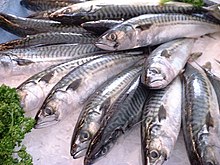
Mackerel--Welcome to the Overfished List

Mackerel via Wikipedia
The Guardian is reporting that mackerel have been taken off the "fish to eat" list:
For years it has been trumpeted as a popular sustainable fish, renowned for its health benefits and favoured by celebrity chefs.
But the UK's biggest marine charity, the Marine Conservation Society (MCS), has removed mackerel from its "fish to eat" list recommending that it should only be consumed occasionally, like monkfish and plaice. The society is advising consumers to eat herrings or sardines instead.
The MCS says international arguments about quotas mean mackerel is no longer a sustainable choice. Overfishing led to the suspension of the north-east Atlantic stock's Marine Stewardship Council certification as a sustainable fishery.
There has been an increasingly bitter three-year dispute between Iceland and the EU – mainly the UK – over who has the right to land the once-plentiful fish.

Thursday, May 31, 2012

Jiro Dreams Of Sushi


Spent a delightful 80 minutes or so in the company of Jiro Ono, his son Yoshikazu, and lots and lots of sushi.  The opening ten minutes or so reminded me overwhelmingly of Gereon Wetzel's El Bulli: Cooking in Progress, the last film I paid money to see.  The similarity? Both films contain lengthy sequences of watching their respective chefs work, and in both cases you are watching men of uncommon skill concentrating with extraordinary intensity on food that they are making.
Jiro Ono has been making sushi since forever. At 85, he's still making sushi; over and over we watch his hands forming the perfect rice bundle. In The Story of Sushi, by Trevor Corsin, he writes:
   A sushi chef wants the grains lined up along the length of the finished rectangle. That way the grains will stick to each other without lots of extra squeezing. A tightly packed nigiri [hand-packed sushi] is bad. The chef's goal is a piece of sushi just firm enough to stay in one piece while the customer handles it, but loose enough that it will immediately disintegrate in the mouth. When a perfect nigiri crumbles apart on the tongue, the grains of rice mingle instantly with the fish, combining tastes and textures. The sensation some diners feel is gratitude because the chef has calibrated the sushi so perfectly that they hardly have to chew.
   Researchers have conducted MRI scans of nigiri made by master sushi chefs. The scans reveal that a master chef's nigiri disintegrates easily on the tongue because it contains more empty space than a nigiri made by a novice. Scans of nigiri  made by sushi robots showed a product tightly compressed, with almost no empty space on the interior at all. [pp. 91-92]
 To watch Jiro Ono's hands, and the hands of his son and apprentices, shape and re-shape grains of rice into perfectly tensioned rectangles is hypnotic: their hands perform a precise set of actions over and over again. And at the end of each series of actions are sushi of perfect size and tension.
Anthony Bourdain has, of course, eaten Jiro Ono's sushi: fifteen courses in twenty minutes. Bourdain is one of those people I both admire and envy: he writes well, eats well, and gives great food-gasm.


But this film is about more than one man making sushi in a ten-seat restaurant (Jiro runs the only Michelin 3 Star restaurant with so few seats and no washroom in the restaurant, and yet the Michelin guide said "three stars is the only rating suitable for this restaurant. It is worth traveling to Japan just to eat there."). It is about old-school standards. An apprenticeship runs about 10 years  under Jiro.He says, "Once you make a decision to do something, learn to love it. It must take all your time." He knows what he's talking about; he's been working and making sushi since he was ten years old. At one point the comment is made "What's the difference between Jiro at 40 and now? He's quit smoking." Jiro talks, in the film, about doing the same thing over and over until you're good at it. But to seek perfection, you must then continue to do it over and over, all the while looking for ways to improve.


In the trailer (above) you see one of the changes that have happened in the last 15 years: his son now rides down to get the fish every morning. After Jiro had a heart attack at age seventy, this job passed to his son. But the men Yoshikazu meets at the markets are as old-school as Jiro. They too have served long apprenticeships, learned their trade so deeply as to dream of it as Jiro does of sushi. The tuna purchaser who reads tuna with his fingers, massaging a bit of fish  and saying "The way it feels tells me how it will taste." After buying from the same tuna supplier for so many years, Jiro, and by extension Yoshikazu, trust his supplies. The same is true of the rice supplier, who won't sell the rice he sells Jiro to anyone esle--unless Jiro says to--even though he knows that the quality of the rice he sells to Jiro still requires Jiro's techniques in preparation to be as good. Yet he reserves one grade of rice for the sushi master he's sold to for so long.
Jiro's world, the world of this film, is a world where nothing replaces time and practice. We hear from Yoshikazu how many apprentices simply disappear. We also meet the ones who stay. Jiro explains that by the time he prepares the sushi, 95% of the work is already done by his crew. He has the easy job. One apprentice must "massage the octopus" (a process by which a partially cleaned but living octopus is tenderized) for 40-50 minutes. Why? Because it is better. And better takes time and focus.
Jiro Dreams of Sushi ends with a plea for sustainable fishing practices. There is some archival footage of a tuna that makes a whale look small being cut up. Quite the difference even with the big boys we see in the film. If we pursued perfection instead of the quick and the easy, I suspect that there would be more to go around, instead of pursuing a course of rabid consumption for the cheapest price. Maybe, and I know this is heresy in the modern world, maybe we're not supposed to have everything we want.

Sunday, July 10, 2011

Empty Oceans Follow-up

I wrote about the international fishery’s problems with by-catch about six weeks back, and how so many fish are being caught, killed, and then dumped overboard because they are not currently in season or are not in quota. Its a terrible waste, and is doing nothing to ensure we have a sustainable source of food from the ocean.
So the other day, gonzo filmmaker and favourite Victoria brother-in-law Karl Johanson spotted an article he thought would interest me. Recently, David Watson (currently a student in the Innovation Design Engineering joint course between the Royal College of Art and Imperial College, London), submitted a design for a retro-fit for fishing nets designed to reduce the problem of nets catching too many small fish along with the commercial-sized ones to the Victorinox sustainable design competition. It is a very interesting design in that it addresses a couple of problems; that small fish can't escape commercial trawling nets, and that when they can escape, they can't see the way out.
I know that when I think of a trawling net being pulled through the ocean, I think of a curtain where large fish get caught up trying to pass through the holes. The reality is a bit different, where an open bag is pulled through the water, and the netting's holes collapse, allowing primarily water to pass through. Small fish either can't get out or are crushed in the mass of fish being swept up.
David Watson's design solution is fairly straightforward; reinforcing grommets that hold the netting open. And because the small fish often can't see their way out, he's included a couple of LED lights in each grommet (nicely powered by small turbine in the grommet, powered by the motion of the net through the water).

Its an elegant solution, one where you fit the net with reinforcing grommets and then pretty much forget about it. And its one solution that will never be used. Even if the cost of the grommets was a nickle each installed, the sheer number needed makes the cost prohibitive. And without effective international regulation, any requirements to install these grommets would quickly un-level the playing field, making adoption untenable. Such is the reality of a globalized food system: the worst and cheapest practices become the de facto standard.
Its the same on-land as it is in the oceans. If Ghana has no regulation on agricultural practices and produces cheap food, that's the food that will end up on your plate. Unless, of course you're paying attention and make a conscious choice not to purchase it. When it comes to fish, the Monterey Bay Aquarium produces a sustainable seafood guide that helps you make better choices about what goes on your plate. And keep in mind, that while prairie-farmed rainbow trout are a good choice, ocean-raised Atlantic salmon from the Pacific coast are a terrible choice.

Wednesday, May 4, 2011

One Reason Our Oceans Are Empty

Just reading in The Guardian that the European Union is finally trying to deal with the issue of by-catch. By-catch (or "discards" in the article) are the fish discarded by fish boats because the fish are of low commercial demand or the boat has no quota for catching the species. It is one of the unintended consequences of the quota system of fishing: no quota, you don't land the catch.
This is not to say that the fish are in any way no good or inedible. It is simply that if you are fishing, say, halibut, you don't want to land other fish with your catch; you only have quota to catch halibut. Rockfish, ling cod, whatever else gets swept up in your nets gets tossed back overboard.
The volume of by-catch is large--often up to fifty percent of the catch. We might like to think that if you're fishing coho, that coho is all you catch, but it's simply not the case. The problem is particularly difficult with trawlers--the nets tend to sweep up everything they can, leaving the sorting for the men on deck.
European Union commissioner Maria Damanaki brought forward a plan [.pdf] earlier this year to ban discards. Speaking in Brussels 03 May 2011, she said ;
"Legislators must establish a new legal framework that removes all compulsory discarding. We also need clear objectives and time limits. And the fishing industry should devise ways in which the fish they don't want, is simply not caught in the first place. Or if it is caught we can help them to build storage mechanisms, to wait for a better price."

The fishing industry is not onside. Anything that means landing less than the highest-priced catch means difficulty for the industry. The problem is, the public is no longer buying the reasons for by-catch. As Ms. Damanaki says:
"We live in a hungry world and we cannot keep a policy that obliges fishermen to throw away perfectly good food. Just look at the picture behind me showing fishermen throwing away big cod, because they ran out of quota. There is no way that we can explain this to the people on the street."
 In the UK, the arguments against by-catch disposal are being led by chef Hugh Fearnley-Whittingstall , who has signed on over a half-million supporters to change the by-catch rules. And it's having an effect--sales of sustainably-fished varieties are up in the UK.


Here in North America, we too have similar rules about by-catch and also waste enormous amounts of fish.And in a world where the once full oceans are being rapidly converted into deserts--much like farmland is rapidly being converted to desert--we really can't afford this. As Greenpeace pointed out in 2008:
Bycatch also undermines the recovery of protected species. In the North Atlantic trawling is netting huge numbers of juvenile cod, undermining efforts at rebuilding decimated Atlantic cod stocks. For example on the Grand Banks, cod fishing is banned but in 2003 an estimated 90 per cent of the biomass was caught as bycatch in other groundfish fisheries. Our wild king salmon populations in the northeast Pacific are also suffering with about 160,000 fish being caught as bycatch in the Alaskan pollock fishery last year. This mass incidental catch resulted in a collapse of a subsistence fishery because not enough fish returned from the ocean to spawn.

The World Wildlife Fund is also concerned.  The Fisheries Council of Canada seems to think that things are well under control [.pdf], but How We Fish offers a .pdf brochure on all the things we don't know. And with our new government here in Canada, don't expect to see conservation on the agenda--which baffles me. One would think Conservatives would be wanting to conserve resources, it being right there in their name. Instead, look for maximum exploitation to be the order of the day.