Monday, August 6, 2012

Pushback 1


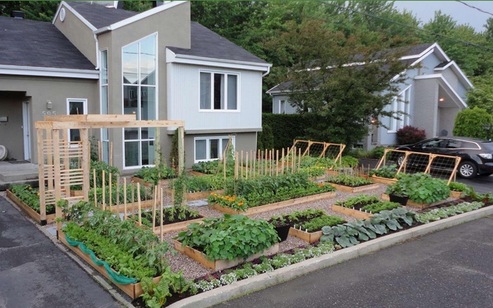
That's a lovely house, don't you think? And a nice yard in front of it.But Drummondville, Qe. (about 100 km NE of Montreal) doesn't seem to think so. After apparently getting a verbal approval from the town's Environmental Inspector, CBC reports that the couple who planted this lovely garden were served with a notice that they had to tear it out within 7 days or face fines of between $100 and $300 a day.
A follow-up report notes that the tear-out date has been extended to 01 September. It also notes that "Drummondville plans to make it illegal to grow vegetables on front lawns anywhere in the city." Apparently the city "held public consultations on the new rule and it said no one objected."
This is the beginning of push back; expect to see more and more of this. I expect it will be framed as a "property values" argument, and be claimed as being non-discriminatory because the new bylaws will affect everyone the same way (ask the residents of Africville how that worked out for them...).  Drummondville is saying that a 30% grass rule already exists--from the look of the above photo, sodding the paths would come close to taking care of that requirement).
In the US, things are the same. According to an article in Grist, push back is occuring there too:
[In] Tulsa [they] bulldozed the entire thing.
If you start looking for stories like these, you’ll turn them up in droves. In 2010, Clarkston, Ga., fined a gardener named Steve Miller for planting too many vegetables. In 2011, Oak Park, Mich., told Julie Bass she couldn’t grow any vegetables in her front yard because vegetables weren’t “suitable” yard plants. (“You can look all throughout the city and you’ll never find another vegetable garden that consumes the entire front yard,” a city official told the local TV station.) And in Chatham, N.J., Mike Bucuk, a young would-be organic farmer, had to fight with the entire town just to grow some vegetables his family’s property.
Gardens are productive. They serve a purpose, and part of that purpose leads to reduced sales for some businesses (fresh produce markets, or farmer's markets, often face stiff opposition from major supermarket players. Here in BC, Save-On Foods is supposed to be one of the big anti-farmer's-market forces). 
But home gardens breed neither fear nor consumption, the two major drivers of modern society. They encourage independence and self-reliance, neither of which sells industrial food. In fact, farmer's markets and home gardens produce exactly what the industrial food system cannot supply: good quality, good tasting produce.
And don't kid yourself. Industrial food will fight back against the home producers, the small and alternative producers. They have to--their business model is based on compliance, on being unable to see any alternatives. Local food has scared them (there are various talking heads that have produced "studies" showing that best-case New Zealand lamb has a smaller carbon footprint than worst-case local lamb, for instance). Industrial food already sends a private police force into the Canadian prairies to see what you're growing and if they can put a stop to it (check out the Percy Schmeiser story, as one example). Industrial food will continue to follow the Big Tobacco playbook to slow the challenge to its business. Like Big Tobacco, there are billions of dollars a year at stake as long as they can keep us solitary, afraid, and dependent. The solution is straightforward: be fearless (read Farm city : the education of an urban farmer by Novella Carpenter, or her blog). Form community. Grow, raise, or produce anything of your own. Its not your job to keep Industrial Agriculture on the top of the food chain. Its your job to do what's best for you, your family and community, and the planet.

Sunday, August 5, 2012

500,000 Scoville Units--That's Not Too Many, Is It?

I'm making lunch today (a big lunch that will take the place of dinner), and I thought it was a good time to try a few new things. You know, now that my significant other is out of the house and can't try and change my mind. Like poaching tongue the other day. That was a decision she suggested might have been in error....
That's really unfair. Paula is very supportive when I cook, but there are some things she just has no interest in (like tongue, or offal of any sort). And also, our spice palette differs. I like to pull out the spice weasel occasionally and "kick it up a notch." And that notch is sometimes over her limit. So the time to try a ground chili powder that comes in a test tube and is rated at 500,00 scoville units is probably when she is out of the house.
I picked about five pounds of veg yesterday from the community garden plot we have, and thought I should do something with it. So, lunch. And what am I having? Well, baked potato (allegedly from BC, but how do you really know?). A pork chop--again, supposed to have been grown on the Island and certified cruelty-free. This one I trust a bit more because the store is small and local, the meat comes in once a week and is cut on premise, and I know the owner. So I pay a bit more, more secure in trusting that I'm getting what I pay for.
And I went out in the backyard yesterday and picked small purple plums. Sun-warmed, beautifully ripe, I ate most of what I picked. Even though I was disturbing one of the residents--a hummingbird flew up, tick tick tick-ed angrily at me about being in front of his favourite flower, and then perched a little more than arm's length away to watch what the crazy ape was doing.

Tuesday, July 31, 2012

Link-straveganza II

From the US Food Integrity Campaign:
If food recalls continue to predispose people to experience recall overload, the government's recall data should at least be reliable and effective. A new Government Accountability Office (GAO) report criticizes the Food and Drug Administration's (FDA) lack of public information on how the agency will implement its new recall authority as well as the uncertainty of FDA's recall data.
The Food Safety Modernization Act (FSMA) signed into law in January 2011 finally gave FDA the ability to order companies to recall food products it deems unsafe, an important power given the previous danger of companies choosing not to remove adulterated products from the market. It remains unclear, however, how successful FDA will be in carrying out this new authority.
From the report:
But without publicly available procedures, regulations, or industry guidance on how the agency will implement its authority—including how the agency will weigh evidence on whether a recall is necessary—the agency cannot ensure that it applies practices uniformly or consistently or that it provides clear information for the food industry to follow or consumers and the public to understand. Such ambiguity could be particularly troublesome with regard to outbreaks of foodborne illnesses, which can occur any time—indeed, have already occurred since FDA assumed its new authority—and demand clear and timely agency reactions.

Next, an 8-minute documentary about a Fair Trade / CSA-inspired fishing program from the East coast.


And, lord knows, we need more of this kind of thinking in the food chain.

Especially now that Canada is seeing severe drought conditions in the East. The Globe and Mail reported (30 July):
Weeks of drought have turned much of Ontario’s prime agricultural land into a dust bowl. And it is corn farmers, especially in the southwest and eastern parts of the province, who have been the hardest hit.
“It is a bad year in eastern Canada and it is getting worse,” said Evan Fraser, a geography professor who studies global food security at the University of Guelph, west of Toronto. The far southwest part of Ontario is “looking grim,” Dr. Fraser said, and in other parts of the province “it’s a bit of a wait-and-see game.”

This Magazine brings up one of the little-discussed aspects of turning small-scale organic agriculture into large-scale industrial organic food production: migrant labour.
Organic regulations give value to everything from animal welfare, soil systems, and biodiversity to watersheds and air quality—concepts of sustainability focused almost exclusively on the physical environment. Farms go to extreme lengths to close the gap between farmer and eater: consumers are invited to open farm days for tours, food is meticulously labeled and sourced, and farm owners are no longer faceless, appearing on websites, packaging and TV commercials. In all this effort to exist outside conventional food practices and eat guilt-free, however, there is one link in the food chain consumers know shockingly little about: the migrant worker producing all this wonderful food.
The myth of the family run, locally staffed farm has somehow remained despite fundamental changes to both the scale and style of organic agricultural production in Canada. While many farms are still family owned and operated, the labour usage line is blurring between large-scale organics and conventional agriculture.

Friday, July 27, 2012

Local Food Fair!

Not huge, but really a lot of fun. Peppers, the food store on the left of the photo, held a local food producers fair yesterday, to advertise many of the brands they carry. With the two large exhibition tents set up on the right, people started showing up even before the producers had set up.
In addition to Level Ground (about whom I've written before), there were3 numerous other producers, several of whom I was unaware. Portofino is not one of them.
Portofino Bakery
Portofino makes a large variety of breads and supplies a number of outlets, from Peppers to Hotel Grand Pacific. They've become a significant voice among local food producers.
Daksha's Gourmet Spices is producing a line of curry mixes: Butter Chicken, Chicken Curry, Korma, Tikka Masala, Tandoori,Vindaloo, Spicy Fish,Chana Masala, Aloo Gobi and Daal.

Thursday, July 26, 2012

National Food Plans

Australians have come to a bit of a disconnect with their government. The Australian government announced that they would pursue the development of a first-ever National Food Plan for the country, prior to the 2010 general election. The call was put out by (apparently now ex-) Woolworths chief Michael Luscombe, who is quoted as saying;
 "If you think about our food value chain, from the producers down, it is covered by multiple departments at federal and state level, and then there are many regulatory bodies.
"Because it's such a complex challenge for all of us, there's no one minister that has an over-arching approach at one point in time -- that has a view on how things are happening."
Australians took their own meaning from the call for submissions on the topic. Many of them were like Cathy Xiao Chen, who called for more urban food production and a strong organics recycling program. Or Carolyn Ballard, who wanted to see an integrated land/water/health program directed towards long-term sustainability.
The problem was, the Australian government really wasn't interested in hearing about these ideas. Michael Luscombe was calling for a free-trade-based, minimum-regulation regime focused on increased "food manufacturing." As The Australian reported: "The retailer had recommended a super-ministry, or "one minister with overall responsibility"." And that's what Australians got--a report focused on the dominant paradigm of a growth- and export-oriented model. Not much mention of a sustainable and secure food supply in-country.
Traditionally, and I'm talking here of "traditionally" stretching from Ur and the birth of agriculture until quite recently, the role of government was to manage a safe and secure food supply for their own people. After they had planned for famine, then they looked at taxing and controlling the flow of exported foodstuffs and the creation of empires. And every empire has learned, once you stop paying attention to the coming famine (and there's always a coming famine), once you allow your food system to become reliant on imports to keep the population fed, you were balancing a pyramid on its apex rather than its base. And that is an unsustainable model.

Food Crisis Part II

Al Jazeera is one of the few media outlets talking about the impact of the US drought on the rest of the world. The 2008 price spike brought down governments in the Middle East, and sparked uprisings in Africa and Latin America.  With so much of the corn crop decimated, there's really no telling what to expect over the next 18 months. Oh, and when you look at the list of the the top three food-secure nations? Notice Canada doesn't make it. The Harper government may well pay for years of neglecting a national food strategy.


THE IMPACT OF THE US DROUGHT:
  • About 60 per cent of continental US is experiencing drought conditions
  • The US is the world's largest corn producer, and provides up to 60 per cent of the world's food aid
  • The price of corn has increased by 34 per cent in the last month
  • The US government says nearly 40 per cent of the corn crop is in poor condition
  • Most US farmers have crop insurance in case of losses

FOOD SECURE NATIONS:
  • The US is ranked as the most food-secure nation in the world, with an average of 14 per cent of household expenditure being spent on food. Second is Denmark, followed by Norway
  • The most food-secure nations benefit from ample resources, high incomes and subsidies for farmers
  • The least food-secure nations are in sub-Saharan Africa, with the DR Congo scoring most poorly with 70 per cent of household income there spent on food despite the country's huge agricultural potential
  • Chad and Burundi suffer from similar circumstances

Tuesday, July 24, 2012

Abolish the Food Industry(?)

Back in February, Raj Patel wrote an article for Atlantic Magazine titled Abolish The Food Industry. Provocative title. Provocative article. And it was based on an article in Nature called The Toxic Truth About Sugar that made the argument for legislation around sugar consumption. Again, very provocative--sepecially in this coprorate world of ours. Patel's article isn't very long, and Atlantic Magazine has seen fit to release it online. I wish the same could be said of Nature, who are asking ~$25 to view the Toxic Truth article. I'll leave Cory Doctorow to explain why this is just stupid.
Raj Patel photo via Jan Sturmann and Wikipedia

But CBC's Jian Ghomeshi interviewed Patel on his article and that interview is available online and is quite worth listening to. Patel makes it clear that he's not actually planning the abolition of industrial food--at least not yet. But he is making the point that democratic discussion is so stunted that we scarcely even recognize the possibility exists. As the judge pointed out in the San Francisco "no smokes in pharmacies" judgement; while advertising is a form of free speech, "selling cigarettes isn't."
Anyway, to get you started, an excerpt from Raj Patel's article:
The analogy of tobacco with food isn't perfect, clearly. People who eat Twinkies often want to eat Twinkies, and we all need to eat. But it's increasingly common to see the medical literature push forward an understanding of sugar addiction and it's also true that our food choices are far from free, in no small part because of the commercial and cultural power of the food industry. Weaned as most of us are on Big Food's free speech, we ought to be suspicious of our instincts when it comes to food.
This week's Nature article doesn't argue for the abolition of Big Food, but indicts the industry nonetheless: "Sugar is cheap, sugar tastes good, and sugar sells, so companies have little incentive to change." Limiting the power of these corporations to sell their products -- just as we limit alcohol and tobacco companies -- ought to be widely agreed, and the battle among health professionals in the years to come will see the transformation of this proposition into an axiom.
The food industry tastes its own blood in the water, and is responding aggressively to the nicks and cuts from public health professionals. It's unwise to underestimate the chutzpah of an industry that spread trans fats across the Western diet in the 20th century, and made a marketing pitch of their removal in the 21st. So the industry has adopted a strategy that counters a pound of sugar with an ounce of nutrition.

Monday, July 23, 2012

Nose To Tail 1

Spent my Sunday in the kitchen, dodging the Significant Other, who was baking bread and cinnamon rolls. I, on the other hand, was trying my hand at a couple of new things.
First up was rolls. I had meant to pick up some won-ton wrappers at the local market (Victoria is extremely lucky in that we have both a large Asian community and a local grocery chain that caters to them. This means access to a lot of items that are more difficult to find in the majors—like the black-skinned Silky chickens that are the breed used in traditional Chinese cooking). Instead of buying the won-ton wrappers, I found egg roll wrappers. The ingredient list was short (five items, only one of which was a preservative), and they were cheap (around two bucks), and they had a suggested use recipe on the front. So, I was sold.
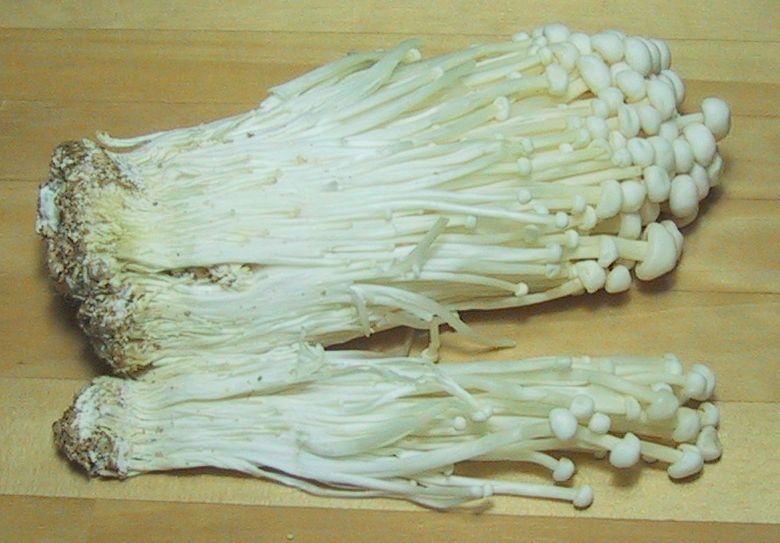
 So, lunch was pretty simple. Ground pork, spiced and flavoured, fried up. Added rice flour to thicken the juices. Flipped it out onto a plate. Put the skillet back on the stove and added about 25mm of (GM free) canola oil and let it heat. Peeled a wrap off the stack, wet the edges with a flour/water paste, and began building. I kept it pretty simple; spiced meat, enoki mushrooms, and bean sprouts.
Enoki Mushrooms--Photo by Chris 73 / Wikimedia Commons

Created the roll (following the folding instructions on the package, but really, it is pretty straightforward), slipped it into the hot oil, and went back to make another. Apparently I heated the oil just right. As I put one in, the previous roll was ready for flipping or removal. No smoke, no excessive browning. Just nice, crisp, deep-fried rolls.
 With lunch under our belts (and the rolls were good enough that it was difficult to stop eating them, so the belt was a bit strained), my next chore was poaching tongue. I had bought two pork tongues Friday, and, on getting them home, put them in brine for about twenty-four hours as per my guru of nose-to-tail eating, Jennifer McLagan.
Odd Bits cover from Jennifer McLagan

Sunday, July 22, 2012

Better Animal Husbandry

Le Point online and Time Magazine are both reporting an interesting story about better animal husbandry in France. In an experiment, Languedoc-Roussillon winemaker Jean-Charles Tastavy partnered with farmer Claude Chaballier after reading about Spanish ad Canadian studies indicating that happier cattle produced better tasting meat. Tastavy suggested that they try feeding a couple of animals on the pomace from his wine-making operation. The cattle were not adverse to the pressed grape leavings washed down with water, and eventually the two decided to try the cattle on wine. Tastavy and Chaballier scaled the wine recommendation for humans up to cattle, and began trying them on ~1.5 litres per day.
Yes, the cattle seemed happier than their teetotal counterparts. But after slaughter, it was noticed that the meat from the imbibing cattle was different. As Time reports:
Michelin-starred chef Laurent Pourcel had a taste of the “viande de luxe” — luxury beef — and hedges that there’s a bustling market for it among a foodie crowd. It has a “very special texture, beautiful, marbled and tender, which caramelizes while cooking.”
Tastavy and Chaballier are expanding their pilot program in the coming year. Because, even though the feeding costs have tripled (from $6 to $18), the price the Vinbovin-labelled meat fetches has gone up as well--to ~$122/kilo. Which, for a small producer, is a heck of a nice return.

Urban Agriculture--Venezuela

Venezuela  has been moving towards more urban agriculture over the last couple of years. But, as the report from Al Jazeera below shows, results have been mixed. In comparison, the urban agriculture movement in Cuba has done very well. I think the difference is in buy in; in Cuba, the population was faced with a crisis when their agricultural inputs collapsed. The Cuban government responded by removing roadblocks and creating support structures for both urban and rural small agricultural projects. The Venezuelan experience seems to have been more top down.


In North America, the rise of the city chicken is an indication that there is a strong desire for urban agricultural projects, but municipal bylaws keep getting in the way. If our governments were to get out of the way and quit forbidding (which is, I think, more accurate than "allow") more agricultural use of urban land, I don't think we would need much in the way of assistance to get a proper urban agriculture movement off the ground. The agro-ecological principles of farmer-to-farmer peer counselling would take off by itself.