Showing posts with label recipes. Show all posts

Wednesday, October 21, 2015

Quince!

The prize-winning quince
Photo by E. B. Klassen CC BY-SA
Creative Commons Licenses


I've had a bit of luck recently and come into possession of about 4 kilos (10 pounds) of quince. This has meant that I can do a bit of experimenting with new recipes above making some quince jelly.
Quince likes to be cooked--in fact, without it, quince is almost inedible. It's like medlars in that way. Medlars need to be bletted, quince really need to be cooked. I found a recipe for "rosy poached quince" that I decided to try. It involves simmering the quince in a poaching liquid for at least an hour, during which the quince go from white, hard, fibrous pieces of fruit to a beautiful red, soft morsel.
I got the poaching liquid ready and peeled and cut up the quince. Peeling's easy, but the coring and cutting is a bit harder. Quince, before cooking, are pretty tough. I saved the peels into a small pot, covered them with water an set them to boil and then simmer for an hour, while the fruit went into the poaching liquid. Quince are very high in pectin, so the thinking was to extract both pectin and flavour from the peels while preparing the fruit.
The other recipe I really wanted to try was for slow-roasted quince. Technically, this is braised quince, because you're cooking them in a moist environment. And you slow-roast them for five to six hours. I started both batches in the morning, so the poached quince was something to try for lunch, while the slow-roast was clearly for dinner.
Because the poached quince can and do keep for a week in the refrigerator, the volume of prepared quince wasn't daunting. We had some poached quince for lunch, and then had three or four dinner deserts out of them over the subsequent week. And they were excellent. Quince are delicious and have a lovely scent, so keeping a close rein on spicing is important. I added a couple of allspice berries and a clove to the poaching liquid, and didn't find them necessary at all.
The slow-raost quince have an apple grated over them to help keep thedm from drying out in the oven. I used an Ambrosia, which worked well. Crisp enough to grate well; almost flavourless, so it didn't interfere with the flavour of the quince; and moist enough to keep the quince from drying out.
The braising liquid from the slow-roast quince was added to the liquid saved after boiling the peels, and a bit of the poaching liquid was also tossed in the pot. I broaght it up to a boil, simmered it until the volume was reduced by about 30%, and then jarred the result. This has given me a beautiful, deep red quince jelly. And with the high pectin content, nothing had to be added to jell it. In fact, quince is often used as a jelling agent for other fruit.
We had guests in this weekend, and to amuse their palates, I put a small amount of quince jelly on a cracker, added a bit of liver pâté on top, and topped it with an unknown herb cheese.*  The sweet floral of the quince jelly pairs extremely well with the savoury of the pâté.
The braising liquid also worked well as a drink vinegar. A small amount in a glass then filled with carbonated water was delightful. Next up: Membrillo.


*This came from the remains of a cheese brought back from Amsterdam, passed on to my Significant Other's aunt, who passed it on to us. It's insanely good, creamy and toothsome with a wonderful flavour, and we have no idea what it's called or how to get more.

Tuesday, July 8, 2014

Dang. Now I'm Hungry.

I don't know about you, but leftover milk, or milk that's past useability, really never appears at our house. But it seems that it does in a lot of houses--in the UK there's 290,000 tonnes of milk wasted each year. All part of that wasted 30-50 percent of food in developed countries.

But over at The Guardian, Rachel Kelly has a few (well, 14) ways to deal with leftover milk. I'm more likely to have made too much rice and be looking for a way to use it that doesn't involve making another stir fry. My favourite use is by making rice pudding.

I brought a rice pudding to one of the Friday lunches we attend at the Centre for Community and Cooperative Based Economies (CCCBE) at the University of Victoria. it was my standard, adjust-for-size recipe:

  • a couple or more eggs
  • beaten with vanilla, a pinch of salt, some sugar and cinnamon or nutmeg
  • some cooked, leftover rice
  • a small handful of raisins
  • milk sufficient to cover the rice
  • remixed and baked at 175C or 350F until a lovely light brown shows up on top and the pudding is set.
  • Best served hot with cream over top.

I've eaten this as breakfast, lunch, dinner, and as a snack food, simply because it tastes good and qualifies as comfort food for me (and, nutritionally, isn't too bad either).

But when I presented this for lunch, one of the attendees was confused; a visiting scholar from Iran, this was nothing like the rice pudding he was used to. So the next week, he had his wife create one of her rice puddings. Short grain white rice cooked in milk to create a porridge. Sweetened and spiced with cardamon and cinnamon (among others). Served cold.

And wow! What a difference! Light and flavourful, I was transported to a shady courtyard on a hot summer day. My rice pudding is hearty and filling. This is a cool light treat. Similar ingredients, radically different end result.

This is why I love the whole free trade in recipes thing. There's so much to learn that no one can learn it all. And there are so many great flavours to discover.


Monday, January 13, 2014

A Philosphy of Food--In One Serving

Shaker Lemon Pie
via Cmadler / Wikipedia 


Over the last month or so, I've put my energy towards finally making a consistent, decent pie crust. Turns out, it's not all that difficult. It's not yet the perfect pie crust, but it is consistent and enjoyable.
I practiced making pastry by making a Shaker lemon pie (well, two at a time, actually). And as I mixed dough and prepped the filling, I realized that this is a pie that sums up my philosophy of food in one crazy intense dish.
I've made this pie for over twenty years, off and on. I think I first read the recipe in Esquire magazine (although I could be completely mistaken--it has been a lot of years, after all). Most of the time I cheated and bought premade pie crusts, as I regularly made the most inedible crusts on the planet. I've always cooked, but baking has been one of the forgotten skills around me. After getting married, I discovered that my Significant Other (the writer Paula Johanson) loved to bake cookies and cakes and the like, making my efforts at best redundant. I still occasionally made an Impossible Pie from a recipe out of the United Church Ladies Auxiliary cookbook produced by our local church. That's a pie where you mix all the ingredients in one bowl, and as it bakes it separates into shell, filling, and topping as if by magic. It kinda worked when I did it, and as it had coconut and sugar, was always quite snackable, but not what you'd call serious baking. And as Paula got into breads and rolls, I just backed away from baking and left the territory to her.
But while there was a plethora of baking powder biscuits, breads, and cakes, pie was one of those things that didn't get made very often. Until I found the recipe in Esquire.
The filling is simple: I've quoted it from memory many times.
    1. 2 large lemons (with the ends cut off and the pith and seeds removed)
    2. 2 cups 9500 ml) of sugar
    3. 4 eggs
Yeah, that's it. Three ingredients. As it was explained originally, the lemons are sliced so thin that it takes all of Appalachian Spring by Aaron Copland  playing to get through the task. Lemons are then macerated in the sugar, and, some hours later, the beaten eggs are stirred in. Into a pie shell, a lattice or full top, and into the oven.

Monday, September 23, 2013

“The rose speaks of love silently, in a language known only to the heart.”


I get depressed, sometimes. Reading about the industrial diet, the more I understand the fragility and corruption of the international food system digging into the structural problems of food production, all of these things can become overwhelming. I write with the desire to change things, but sometimes it feels like all my posts look the same:
The system's broken. We're all gonna die.The system's broken. We're all gonna die.The system's broken. We're all gonna die.The system's broken. We're all gonna die.The system's broken. We're all gonna die.The system's broken. We're all gonna die.The system's broken. We're all gonna die.The system's broken. We're all gonna die.The system's broken. We're all gonna die.The system's broken. We're all gonna die.The system's broken. We're all gonna die.The system's broken. We're all gonna die.The system's broken. We're all gonna die.The system's broken. We're all gonna die.The system's broken. We're all gonna die.The system's broken. We're all gonna die.The system's broken. We're all gonna die.The system's broken. We're all gonna die.The system's broken. We're all gonna die.The system's broken. We're all gonna die.The system's broken. We're all gonna die.The system's broken. We're all gonna die.The system's broken. We're all gonna die.The system's broken. We're all gonna die.
I know that urban farms are springing up across North America, that Joel Salatin's leading the charge to more sustainable farming out east, Milkwood Permaculture is doing the same sort of thing down south, and hundreds of people are making moves towards a better tomorrow. There is hope. Really.
So a couple of days back I was thinking about what it says at the top of the page: Discussion of farm policy, food security, and food. With recipes. And as I walked the dog out in the park near where I'm currently living, I noticed that the feral rose bushes were covered in hips. My head was ping-ponging between the Depression of  the 1930s and the current state of affairs, and I had been considering differences in how people ate, then and now. So I came back a couple of hours later with both the dog and a jug and picked the rose hips at the top of the page.
They were in great shape:

As you can see, the hips had ripened and maximized their flesh (that little 0.3 mm thick layer between the skin and the seed package). I pulled the flower ends off each hip, tossed the hips in a pot, added a bit of water, and boiled them until they popped. After the hips had cooked down to mush, I strained the seeds and skins out of the pot, and began to boil the remainder down.
Once everything had begun to evaporate, I added a couple of cups of sugar, on my way to jam. the, wondering if I had any pectin in the house, I looked out the kitchen window, and spotted these:


There's the remains of a quince tree slowly being killed by a holly in the front yard. There was a fairly big (well, relatively big, for this tree, under these conditions) fruit visible from the window. When I went out, I found a small handful of the fruit.
Quince has an extensive history of use, but the one I was interested in comes from the fruit's high pectin content. I took the largest fruit, diced it up small, and tossed it into the jelly.
As the quince cooked in, I continued to intensify the jam. I had a few of those little tiny jam jars you get in hotels, so I cleaned them out, made sure the lids fit. And used them, and a larger two cup container, to hold the jam. I used the small ones because I know that I'm going to be asked for a sample of the rose hip jam, and these make perfect testers.
The jam is strongly scented, hasn't properly set (which is pretty normal, as far as I can tell. I've never seen/tasted rose hip jam that had fully set), and tastes somewhere between really great and inedible. It also has a slightly mealy texture.
I've made this before--the last time was more than twenty years back. This time, of the three ingredients, two were grown within 100 metres of here. If I had a beehive, this could have been the most local jam I've ever made. Probably still is.
This sort of thing helps. I love cooking, and making something like this jam reminds me that the earth would actually rather have us here. We serve an ecological purpose. We just have to remember that, and try to fit ourselves into the world, rather than demanding the world adapt to what we want. Now I just need to make some sourdough bread with local wheat flour.

Friday, July 5, 2013

Friday Food Link-straveganza

With a warning that Canada should be paying particular attention to--but won't--the Guardian is reporting on the public policy failure around floods.


Flood on agricultural land
A high proportion of the most valuable agricultural land is at risk of flooding, the MPs said. Photograph: Christopher Furlong/Getty Images  via The Guardian


Ministers are failing to protect the UK's most valuable farmland from flooding, posing a long-term risk to the security of UK food production, according to an influential group of MPs.
A run of poor weather since 2011 has led to extensive flooding of properties but has also severely dented the production of many foods, with the UK now being a net importer of wheat.
The environment select committee's report also said the government's spending by the Department for Environment, Food and Rural Affairs (Defra) to protect homes from flooding is not keeping pace with the rising risk, which is increasing as climate change intensifies downpours, and were also failing to act effectively to block the building of new homes on floodplains.
"Record rainfall in the past two years has led to extensive flooding, cost the economy millions and caused disruption and distress to householders and communities across the UK," said Anne McIntosh, a Conservative MP, and chair of the commons select committee on environment, food and rural affairs.
Extreme weather events are not just a problem for the UK. In a related article, the Guardian reports on the new UN World Meteorological Organization report that points out the unprecedented climate extremes seen around the world over the last decade.
If you think the world is warming and the weather getting nastier, you're right, according to the United Nations agency committed to understanding weather and climate.
The World Meteorological Organization says the planet "experienced unprecedented high-impact climate extremes" in the ten years from 2001 to 2010, the warmest decade since the start of modern measurements in 1850.
Those ten years also continued an extended period of accelerating global warming, with more national temperature records reported broken than in any previous decade. Sea levels rose about twice as fast as the trend in the last century.
A WMO report, The Global Climate 2001-2010, A Decade of Climate Extremes, analyses global and regional temperatures and precipitation, and extreme weather such as the heat waves in Europe and Russia, Hurricane Katrina in the US, tropical cyclone Nargis in Myanmar, droughts in the Amazon basin, Australia and East Africa, and floods in Pakistan.

Looking at something a bit lighter, let's learn how to make an excellent lamb kofte, shall we?  Felicity Cloake writes in the Word of Mouth blog about the process. As an aside, this is part of a series of posts; How to Cook the Perfect. And this is how you present a recipe in a blog post, people. We've really got to up our game. This gives you the information you need, the context to work from, and a sense that maybe the writer has actually tried to make the recipe (I'm reminded of the scene in Julie and Julia where Julia Child discovers that Ms. Rombauer hasn't checked the recipes in Joy of Cooking to see if they even work). It's like linking to source articles when writing an opinion piece--it adds a level of verifiability to your work.


So here's Felicity herself to tell you about the process of making kofte.

There's also a report that world food prices have fallen--not much, but still...
Global food prices fell 1% in June due to improving supply prospects, the United Nations' food agency has said , raising forecasts for wheat and maize output in the new season.
Food prices spiked during the summer of 2012 due to a historic drought in the US but prospects for a rebound in global grain supply and good weather forecasts are now weighing on markets.
The Food and Agriculture Organisation's (FAO) price index that measures price changes for a basket of cereals, oil seeds, dairy, meat and sugar, fell for a second month running to 211.3 points in June – its lowest level since February.
 That puts food prices below the threshold for civil unrest, according to NECSI--the New England Complex Systems Institute, about whom I've blogged before.

If you haven't discovered it yet, there's a lovely interactive map  sponsored by The economist that lets you see where you--and pretty much everyone else, ranks in terms of food security. Click on your country (or the country you're interested in) and pull up the world ranking of food security and what went into generating that rank. Canada, by the way, ranks 8th worldwide. Among the key findings?
Falling national incomes hurt food security in some developed countries over the past year.
Greece recorded the steepest fall among developed nations, dropping six places. Greece’s GDP has plummeted by more than 20% since the 2008-09 global recession. Income per person dropped in most advanced economies in the past year, the result of weak economies. Although this reduced food security in these countries, they remain, for the most part, in the top 20% of the index and thus are not in serious danger of food insecurity.

And, finally, if you're not following the Journal of Peasant Studies, you're missing out. Open source, peer reviewed.

Tuesday, February 12, 2013

Fat Tuesday

In the spirit of Fat Tuesday, may I present Thomas Dawson’s 1585 recipe on how to make a good pancake.
(in fairness, this is my updating from a mediocre scan of the original book) Compliments of the British Library.

To Make Pancakes
Take of new thick cream a pint, four or five yolks of eggs, a handful of flour and two or three spoonfuls of ale and sweeten with a good handful of sugar,a spoonful of cinnamon and a little ginger: Then take a frying pan and put a little piece of butter, as long as your thumb, and when it is molten brown cast it out of your pan and with a ladle put to the further side of your pan from your stuff, and hold your pan aloft so that your stuff may run about all over all the pan as thin as may be: Then set it to the fire, and let the fire be very soft, and when one side is baked, then turn the other, and bake them as dry as you can without burning.

A few notes:
  • The sugar would be loaf sugar in this case, and you'd have to break the amount of sugar from the loaf before using it.
  • Notice the use of cinnamon and ginger. The spice trade was very advanced at this time, and cinnamon and ginger would have been available to the middle class as a regular ingredient.
  • The ingredient list makes it clear that these are more what we would consider crepes than the heavier pancake.
  • I take no responsibility for the taste of the result. Our ale and the writer's ale will be completely different, making these beer batter crepes an entirely different taste experience.

Tuesday, September 11, 2012

Mrs Beeton


Ah, Mrs Beeton and her Book of Household Management. Such a delight to slip away from the everyday and let her ornate prose pull you back into a time that seems so much simpler than our own (but, to be fair, was at least as complex and distressing for those living through it).
Isabella Mary Mayson (March 12, 1836 – January 1865), universally known as Mrs Beeton, was the author of Mrs Beeton’s Book of Household Management and is the most famous cookery writer in British history.
Isabella was born at 24 Milk Street, Cheapside, London. Her father Benjamin Mason died when she was young and her mother Elizabeth Jerram remarried a Henry Dorling. She was sent to school in Heidelberg in Germany and afterward returned to her stepfather’s home in Epsom.
On a visit to London, she was introduced to Samuel Orchard Beeton, a publisher of books and popular magazines, whom she married on 10 July 1856.She began to write articles on cooking and household management for her husband’s publications.
In 1859–1861, she wrote a monthly supplement to The Englishwoman’s Domestic Magazine.
In October 1861, the supplements were published as a single volume.

I love reading the old recipes and  it bothers me sometimes that so many of the items Mrs. B takes for granted are so much more difficult for the cook to acquire today. Like wild duck and most game....
And Mrs. B's background information is so perfect. Writing about the husbandry of pigs, she writes:
But however few, or however many, young pigs there may be to the farrow, there is always one who is the dwarf of the family circle, a poor, little, shrivelled, half-starved anatomy, with a small melancholy voice, a staggering gait, a woe-begone countenance, and a thread of a tail, whose existence the complacent mother ignores, his plethoric brothers and sisters repudiate, and for whose emaciated jaws there is never a spare or supplemental teat, till one of the favoured gormandizers, overtaken by momentary oblivion, drops the lacteal fountain, and gives the little squeaking straggler the chance of a momentary mouthful. This miserable little object, which may be seen bringing up the rear of every litter, is called the Tony pig, or the Anthony; so named, it is presumed, from being the one always assigned to the Church, when tithe was taken in kind; and as St. Anthony was the patron of husbandry, his name was given in a sort of bitter derision to the starveling that constituted his dues; for whether there are ten or fifteen farrows to the litter, the Anthony is always the last of the family to come into the world.

Of course it makes sense to tithe the small runt to the church. And the  line "one of the favoured gormandizers, overtaken by momentary oblivion, drops the lacteal fountain, and gives the little squeaking straggler the chance of a momentary mouthful" just kills me. So much better than saying "the runt only gets access to a teat when one of the other piglets finishes and falls asleep." "Lacteal fountain"--so cool.
And one of the great things about the internet is how projects like this one become available. I don't think I could put enough people together from my own social circle to pursue a project like this, but with the new connectivity, you can put enough people together from wherever they are.

Thursday, September 6, 2012

With Recipies

From The Guardian. Photograph: Felicity Cloake

I don't talk about cooking as much as I think I should--there's always some other lunacy on the part of international food corporations or governments that sets me off. But The Guardian has a lovely piece by Felicity Cloake on fried chicken in Britain.
What I like about the piece is that Ms. Cloake has obviously done a bit of research before writing this post. From reading up on historic recipes, to testing various versions, Ms. Cloake actually give an overview of what's going on with the process of making a piece of fried chicken.

From the post:
It can't be denied that, done well, it's pretty addictive stuff: juicy meat (on the bone for maximum flavour) encased in a crisp, salty and yes, ever-so-slightly greasy crust is always going to be an attractive prospect. And while there are a few trendy food vans serving up gourmet versions, and London's first "fried chicken & beer" restaurant opens in Brixton later this month, for most of us the best way to indulge is at home. That way, you can tell exactly what lurks beneath that finger-lickin' good batter ...

Monday, July 23, 2012

Nose To Tail 1

Spent my Sunday in the kitchen, dodging the Significant Other, who was baking bread and cinnamon rolls. I, on the other hand, was trying my hand at a couple of new things.
First up was rolls. I had meant to pick up some won-ton wrappers at the local market (Victoria is extremely lucky in that we have both a large Asian community and a local grocery chain that caters to them. This means access to a lot of items that are more difficult to find in the majors—like the black-skinned Silky chickens that are the breed used in traditional Chinese cooking). Instead of buying the won-ton wrappers, I found egg roll wrappers. The ingredient list was short (five items, only one of which was a preservative), and they were cheap (around two bucks), and they had a suggested use recipe on the front. So, I was sold.
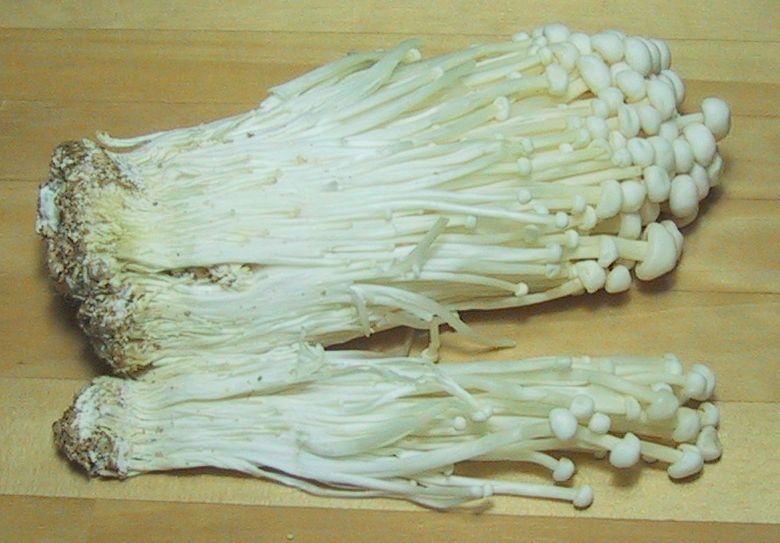
 So, lunch was pretty simple. Ground pork, spiced and flavoured, fried up. Added rice flour to thicken the juices. Flipped it out onto a plate. Put the skillet back on the stove and added about 25mm of (GM free) canola oil and let it heat. Peeled a wrap off the stack, wet the edges with a flour/water paste, and began building. I kept it pretty simple; spiced meat, enoki mushrooms, and bean sprouts.
Enoki Mushrooms--Photo by Chris 73 / Wikimedia Commons

Created the roll (following the folding instructions on the package, but really, it is pretty straightforward), slipped it into the hot oil, and went back to make another. Apparently I heated the oil just right. As I put one in, the previous roll was ready for flipping or removal. No smoke, no excessive browning. Just nice, crisp, deep-fried rolls.
 With lunch under our belts (and the rolls were good enough that it was difficult to stop eating them, so the belt was a bit strained), my next chore was poaching tongue. I had bought two pork tongues Friday, and, on getting them home, put them in brine for about twenty-four hours as per my guru of nose-to-tail eating, Jennifer McLagan.
Odd Bits cover from Jennifer McLagan

Saturday, March 10, 2012

Geek Food (?)

More from archive.org. This is an episode of Geek Food--from what I can discover, Geek Food was an audio blog that made the jump to video and then disappeared. But I liked how this couple made pizza for a housefull of people. I hadn't thought about using a white sauce as a base on pizza before--and the idea of melting cream cheese into it is a great one.


Of course, I immediately thought that a fresh cheese might be better than the cream cheese, but I do recognize that they were under the gun on the pizza. Oh, and check out how their mise en place were set up so nicely beforehand.

A recipe I've used to make fresh cheese (called variously fresh, ricotta, or quark) is pretty simple:

8c whole milk (3.8% mf)
 1/2 teaspoon salt
5 tablespoons vinegar

  • heat the milk and salt to ~203°F / 95°C--this should be done slowly over a lower heat and take about 40 minutes
  • add the vinegar and stir slowly about three times. This will clabber the milk.
  • remove from heat and let stand ~20 minutes (this give the milk time to finish clabbering.
  • skim off the curds and allow to drain in cheesecloth for about half an hour.
et voilà! fresh cheese! Use immediately, or, if storing, try to use it within the next two days.

Friday, November 18, 2011

Pulled Pork

Just attended the Friday lunch at the The Centre for Co-operative and Community-Based Economy up at UVic, something I've been doing for a couple of months now. It is one of those things that reminds me that I have an intellectual life as well as an everyday life—and that's a good thing. Sometimes I forget, as the days fill up with the clutter of activities around dogs, the Kitchen and the basics of staying alive. Lunch at the Centre reminds me that I have been trained to think critically and to communicate my thoughts clearly. I may be a bit out of practise, but that doesn't mean giving up on who I am.
One of the things I love about attending is that it gives me the chance to cook for a group that is bigger than just Paula, and smaller than the crowd at the Kitchen. There is a lunch supplied, but I'm welcome to supplement it, which I have done by making soup and stew a couple of times. Today was a slightly larger group than usual, about 20, and I pulled out some pork rib trimmings and made pulled pork, which were served on a slider bun from Portofino bakery. Apparently the pork was flavoured properly, as there were no leftovers (and I saw at least one person make it through three servings—very gratifying!), and after lunch I was asked a couple of times for the recipe. This is really gratifying, as it lets me know that I'm not just getting good at cooking for my own taste, but that my taste translates into good flavours for others palate.
So, as promised, here's my Cheap and Easy Pulled Pork recipe.

Bernie's Pulled Pork (easy version) 

Start with a cheap bit of pork. I found rib trimmings at Real Canadian Wholesale Club out in Esquimalt for about $2/kg, and I bought a lot. You know, because it was cheap and only about half of it was usable meat.
Braise the meat. Braising is cooking meat in a wet environment in a closed container. So toss the meat in a roaster or a foil-covered pan (the roaster is better). Add a braising mix; I used balsamic vinegar (75 ml), white wine (250 ml), tomatoes (six or so plum) a couple of bay leaves, some salt, pepper, star anise, cloves, whole allspice, some rough-chopped carrots (scraped), celery, and probably a couple of other things I noticed laying around. The wine and vinegar and tomatoes are essential, for their acidity, but everything else is random and optional. Put the lid on the pan and place it in a 175° C (350° F) oven for a couple of hours. Take it out when is smells great and is falling apart.
Don't throw away the braising liquid—it is incredibly flavourful! Strain it into a pot, toss the hard bits, and boil hard until the volume is reduced by half or more. Taste. Yeah, that's umami. Normally you'd use it as a sauce on the braised meat, but today is different. Put it away for tomorrow.
Shred the pork. Pull it off the bone and tear it between two forks. You're pretty much done. Put the shredded pork in a pot—I like to use a slow cooker. Now dump a bottle of BBQ sauce over it. I used Bulls-Eye Guinness flavoured for today's, but that's not essential. Whatever you have or is cheap is fine. It just saves you having to make your own. Mix the sauce and meat together and begin heating it up. Taste it. It's probably too sweet, so add a bit of balsamic vinegar. Keep flavouring it until you're satisfied. I used a little Lee and Perrin's Worcestershire Sauce with the balsamic, and some fig and balsamic glaze. Don't go overboard, but don't be afraid. You're looking for the perfect marriage of sweet and acid to bring out the umami of the braised shredded pork.
Let the whole pot simmer at about 70° C (160°F) for a while. Keep testing. If there's any left, serve on a fresh bun. Accept compliments.

Want to do the complex version? Make your own BBQ sauce without using any prepared ingredients (like ketchup). There you go.

Tuesday, September 13, 2011

Taking on the Giant


    I've been spending a fair bit of time thinking about foods that are under-used, ignored, or simply have fallen out of favour. An excellent example of this is Fat : an appreciation of a misunderstood ingredient with recipes by Jennifer McLagan, a book that attempts to single-handedly restore one of the most irrationally hated substances in cooking to its rightful place. Another is Bones: recipes, history and lore, coincidentally also by Jennifer McLagan.
    Bones, fat, and offal interest me because historically we've eaten all of them, yet currently we eat almost none of them. There are many vegetables that have suffered the same fate; like the pumpkin. Between mid-October and New Years, we eat a few pumpkin pies (usually commercially made, or made with commercial filling), but the majority of pumpkins are cut into jack o'lanterns and discarded a day or two later.
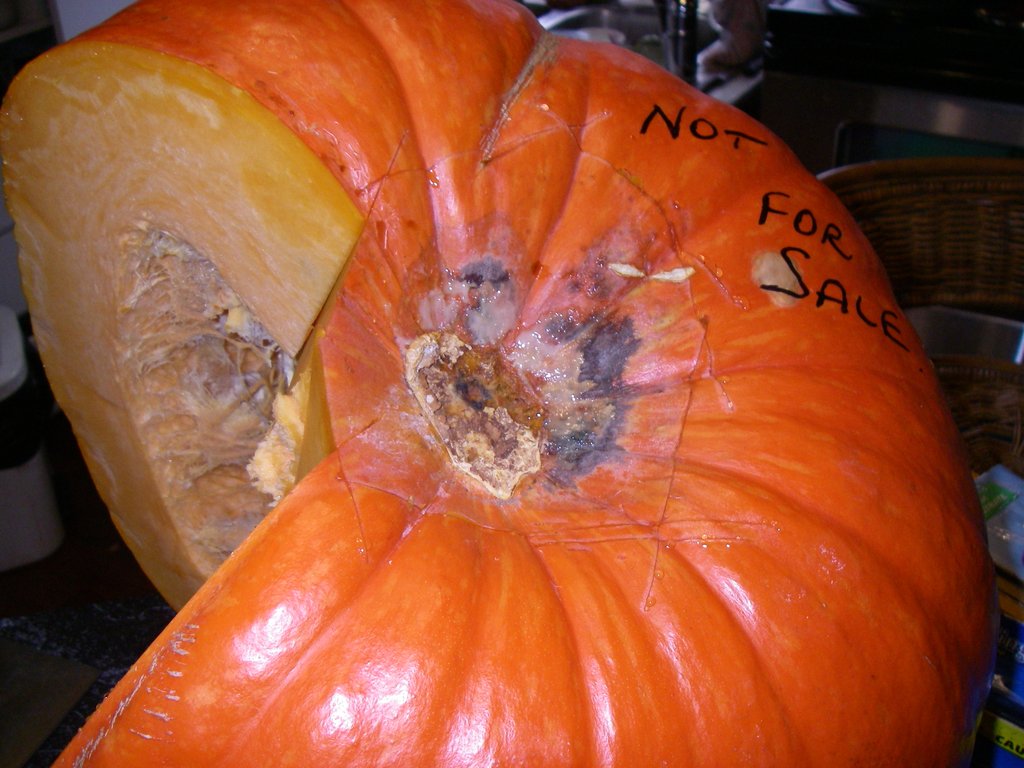
    So I ended up with a massive pumpkin back in early November. Maybe no Atlantic Giant, but it was a good 18 kilos or so. When reading Annie Hill's  book Voyaging on a Small Income, I learned that squash can be stored for extended periods with not much more than a quick wipe-down with a 5% bleach solution. The bleach impairs the growth of fungus and other microorganisms that degrade the shell of a squash, and once that's accomplished, squash slowly desiccate, but will last a long time without spoiling.
    A few weeks after rescuing this pumpkin, I noticed a little bit of white mold starting to grow on some of the rind scars, so I wiped it down and let it sit on a counter in the kitchen for the last eight weeks or so while I figured out what to do with it. It didn't really matter what I cooked it into, this was a big squash and was going to require a lot of preservation after that first cut. Yesterday I decided to get on with the job and picked up the pumpkin for the first time in months.
    And it was a good thing I did; I hadn't managed to stop all spoilage on the squash. Around the stem, the pumpkin rind had begun to soften and rot, but the pumpkin itself was in remarkably good shape.

Sunday, February 20, 2011

Dinner on the Cheap

     I've been reading Bill Buford's excellent book Heat: an amateur's adventures as a kitchen slave, line cook, pasta maker, and apprentice to a Dante-quoting butcher in Tuscany (which is an terrific read--I doubt you can get through it without reading choice passages aloud!) in which he describes braising at it's most basic. So today, while in a local grocery store, while thinking about Buford and Anthony Bordain, I picked up a tray of the cheapest meat I could find. Described on the package as "pork bones for stewing," I could see that there was actually a fair bit of meat on the bone, and that this would give me a chance to pursue braising as described by Buford.
     Talking about braising short ribs at Mario Batali's three star restaurant in New York, Buford writes:
After the browning, the rest is straightforward. [...] There are five remaining steps.
One. remove the now brown and glistening ribs (using tongs, por favor) from the rondo and make a braising liquid, the stuff that's going to cover the ribs while they cook. In this method, the liquid is the essential ingredient, and it doesn't matter what it is as long as it's wet and plentiful (in an Irish pot roast, it's water), although the ideal liquid is both flavoring and flavorful and is made from one part wine (at Babbo, about three magnums' worth, which, as it happens, is not the Barolo of the dish's name but a perfectly acceptable, very cheap California Merlot) and one part meat broth (say, a chicken stock), plus loads of vegetables: some carrots, an onion, two stalks of celery, and five peeled cloves of garlic, all roughly chopped, which you throw back into the rondo, still hot, and stir. You add the wine, the broth, a can of tomatoes, and cook for a few minutes.
Two. Put the now-browned ribs in a roasting pan, pour the braising liquid over them, add some rosemary and thyme, put a lid on top, stick it in the oven (350 degrees), and forget about it.
Three. (Three hours later, the ribs now cooked.) Turn the braising liquid into a sauce, although the instruction itself raises an obvious question: what is a sauce? In this preparation, for instance, this is what you do: first you remove the ribs and set them aside to cool; then you pour the liquid they were cooked in through a strainer into another pot. This liquid, even before you'd begun cooking the ribs in it, had been pretty rich, being a broth that had been made from chicken feet, plus lots of vegetables, herbs, and plenty of wine. Then the ribs themselves had been cooked in it. (The bones of any animal, simmered slowly, make for a wet, intense expression of the meat; here you're getting a double expression, like a broth made from a broth.) Next, you take this dense, aromatic, already highly extracted liquid and hammer it: you put it back on a burner and boil it to hell. Just torch it. Full blast. Lots of yellow-frothy melted fat will rise disgustingly to the surface. You skim this off and keep boiling the thing until it's reduced by more than half, when, lo and behold, it is no longer a braising liquid or a broth: it's a sauce. The result is very, very, very concentrated. (In fact, it's really almost French.)
Four. Once the ribs are cool, you discover that the bones have loosened themselves from the meat and come right out. You also discover that what's left is really quite ugly. It consists of two parts: a muscly tendon of some kind (the texture is non unlike a baseball catcher's mitt) that is smooshed, by way of a fatty sinew, to the meat. The two parts can be pulled apart by hand. The bit that looks like a catcher's mitt is, in addition to being very ugly, entirely inedible. With great pleasure, you throw this away. The other bit is quite yummy, although you need to trim it into a rectangle, eliminating any fatty goo. But, curiously, mixed in with your good short ribs are a number of mutants. In these, for some reason, there is no distinction between the two parts, the bad and good bits (that is, catcher's mitt and dinner). They're all mushed together, and you can't pull them apart without tearing the thing to shreds, which is what you do: tear the thing to shreds to find something, anything really, that Cesar can use to make the family meal with.
Five. Assembly. Your meat is now arranged like so many dead toy soldiers, neatly tidied up. The sauce has been skimmed of fat and reduced to something that could be described as the food equivalent of most male movie stars: dark, rich, and thick. Everything is ready, Next you want to put it away in a fashion that allows you to retrieve it quickly, blast it in an oven, and serve: say, six short ribs in a half-hotel pan (which isn't a pan, either, but a tray, and is half the size of the full hotel not-actually-a-pan-but-a-tray pan, or in normal life what you cook brownies in), pour some sauce on top to keep the meat moist, and bundle the whole thing up first with plastic wrap, then with foil, tightly, tightly, so that, once stacked on the floor of the walk-in, it can be stepped on (and in the frantic rush of service, things happen--they always happen) without short-rib juice squirting out and adhering to the bottom of your shoes, leaving a disgraceful track to the toilet when you finally get a chance to go. What you now have is a wholly typical restaurant preparation, in which most of the work is done long before the dish is even ordered (and if a restaurant can do it, why can't you?). It keeps for a week.
These steps--brown meat, make a liquid, cook meat in it, remove it, and reduce the liquid until it's a sauce--are the same for every braised dish everywhere. Lamb shanks are done this way; so, too, are lamb shoulders, veal shanks, wild boar hams, venison shoulders: it's all the same.

pp. 74-75