One thing that the Al Jazeera news network gets right is their coverage of essential issues. CBC, here in Canada, used to do a lot of this, but under the current federal government, has been forced to cut back. Thankfully, there are still a few journalists trying to get a bigger story, and set it in context.
A 101 East investigation traces the food footprint of a bowl of wonton soup. Along the way, they expose the toxic stew this soup has become. A very nasty business.
But this isn't about "Oh, look how bad it is in China." China is emblematic of the problems we face when the footprint of what we eat isn't transparent, isn't regulated and monitored, and isn't confined to one country.
Video sourced from Al Jazeera
Friday, December 5, 2014


Monday, November 3, 2014
A History of Fraud
Over at Modern Farmer, they are reporting on a story from Britain about food fraud. In this case it's that
This is not a new problem, nor is it restricted to the UK or even Europe. Modern Farmer also hosts an excellent long-form essay on the history of food fraud by Shoshanna Walter. Also included is this lovely list of food scandals. So go read the articles.
76 samples of “goat cheese” from eight locations all around the UK were tested, and nine were found to have significant amounts of sheep milk in them. Three of those were more than 80% sheep milk, and three others were more than 50% sheep milk.After the horse-meat scandal, you would think that food fraud would be reduced. Apparently that's not the case.
This is not a new problem, nor is it restricted to the UK or even Europe. Modern Farmer also hosts an excellent long-form essay on the history of food fraud by Shoshanna Walter. Also included is this lovely list of food scandals. So go read the articles.
- 1 Swill Milk According to an 1860 New York Times story, the date that “swill milk,” milk polluted by cows fed with distillery runoff, got introduced to the New York population was unknown. But the effect was terrible. Babies fed the milk made by malnourished cows often died, and the backlash prompted landmark food safety hearings.
- 2 Leaded Wine As Bee Wilson chronicles in her book, Swindled, wine is a term that
contains multitudes: it can be infused with fruit or honey or lead. And
until the 1800s, although the evils of ingesting lead were known, there
was no real effort to stop pouring it into our wine glasses.
- 3 The Seal of Bread These days, one doesn’t hear much about poisonous bread, but securing standard ingredients and measurements for bread was a top priority in the Middle Ages, according to Bee Wilson. Bakers were held accountable by actually making a seal on their loaves, an early form of fraud detection, to prevent someone dumping coarse wheat into supposed refined products. The great Bread Scandal of 1757 involved alum being added and bread fraud persisted, by the the 19th century, people regularly stuffed birch bark and twigs into loaves.
- 4 Not-So-Green-Tea In an 1851 issue of British medical journal The Lancet, a shocking report was issued about a common beverage: green tea. In what became a scandal, it was found that green tea contained colorings and adulterants that included gunpowder. This scandal had been around for a while, as a counterfeit tea ring was prosecuted in 1818 for selling fake fancy varietals. With help from scientists, new methods were developed for testing the contents of tea.
- 5 The Great Lozenge Scandal The straw that broke the food regulatory back of Britain, according to Bee Wilson, was the Bradford sweets scandal of 1858. The candies were normally made with sugar and gum and some kind of cheap filler — usually plaster but, in this case, the candyman used arsenic. Over 200 people were poisoned — and 20 people died. In 1868, the government passed regulation to keep poisons like arsenic in the hands of chemists.
Thursday, October 16, 2014
The End of Inequality
 |
| http://blogactionday.org |
The Americas were founded in genocide, built on slavery, and flowered by exporting the same form of colonialist activity around the world. Now, in late stage capitalism, the public good is trashed for corporate profit, financial speculation ensures hundreds of millions are left in near starvation, and corporate power has usurped the functioning of government of every stripe. The horror of it all is that we see this as normal, and not only haven't we strung up the offending parties, but instead, we do our best to emulate them. And, as Thomas Piketty has explicated in Capital, we have returned to an age when wealth is reserved for inheritors, not creators.
While what is now called the developed world has seen massive benefits from the Age of Carbon, all the undeveloped world has seen is warfare, exploitation, and destruction. Now, our addiction to hydrocarbons has reached the point where we are willing to destroy what groundwater we have left in order to pursue the last scraps of “wealth” left under our feet. Or, specifically here in Canada, we allow the First Nations people to die from poverty, to slowly die from myriad cancers, and to face starvation in order that a very few can become obscenely rich, and a few thousand more can become wealthy by world average standards. Meanwhile, our “democratic” governments must pay fealty to the exploiter class while our public infrastructure is destroyed by rising temperatures while impoverished local governments are left to struggle with the aftermath.
This all serves to maintain the illusion that the world around us in “normal.” Yet while we carefully kept the benefits to ourselves, we have dumped the costs on the environment (those un-payed-for externalities that business cannot survive without), and we've carefully lied to the bill collector so that those in the undeveloped world are pursued for the outstanding debt while we seemingly get off Scot-free. Island nations around the world are drowning in slow motion, drought and desertification spread across the equatorial and sub-equatorial world, and yet we allow foreign firms and governments to purchase unimaginably large swaths of the undeveloped world to produce food for export back to the developed world. We acquired the debt, but leave others to pay for it.
Ultimately, of course, the Great Mother doesn't give a rat's ass about our petty games. We don't figure this all out, she'll shake us off like so many dead skin cells, and give the planet back to the trees. We need to adopt the first tenet of the Hippocratic Oath (first, do no harm) as our guiding principle, or we can plan on seeing our children, our parents, ourselves, die slowly and horribly, crying out to an uncaring universe for succour.
Thursday, August 21, 2014
Living on an Acre
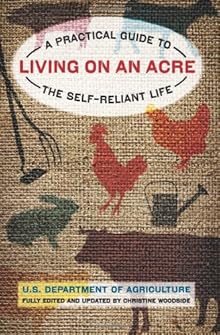
Living On An Acre 2nd edition: A Practical Guide to the Self-Reliant Life
U.S. Department of Agriculture Fully edited and updated by Christine Woodside
Lyons Press, © 2010
Guilford, Connecticut
ISBN: 978-1-59921-885-4
Originally published as Living on a Few Acres, and published in 1978, the original of this book was published to provide practical information and assistance to the back-to-the-land movement. This new edition is intended for the same audience although it focuses on smaller acreage. Living on an Acre walks a fine line between being encouraging and cautionary. It opens with a chapter titled “Pluses and Minuses” and the sub-section “Face the Realities” opens with a checklist:
- Do you want to be a part-time farmer on a few acres and keep a full-time job in town?
- Can you find a farm that suits your needs in a place where you are willing to live?
- How much will it cost? If more than your savings, can you obtain financing?
- Do you have the knowledge and skills needed to operate a small farm?
- What about financing the production process?
- How and where will you sell your produce?
When I worked off-farm, back in the day, I frequently found myself driving 5000 kilometres (3100 miles)/month—which drove me crazy. But the income paid for school supplies, utilities, and (of course) the ever increasing price of gasoline and car repairs. The insanity of working to afford the transportation costs of working is what lead us to the joyous moment of getting rid of our car and joining the Victoria Car Share Co-op.
I've considered the question of low farm incomes and have long wondered why farms don't take more of the process into their own hands. Selling, as we did, our production directly to the public through farmer's markets and the connections we made there, allowed us to receive a far more reasonable return. There were problems; getting up at 5:00 am to drive an hour and a half to Vegreville to have our chickens and turkeys processed (it has to be done at a licensed and inspected facility in order to be able to sell to the public rather than home use). The butcher we liked being forced out of small animal butchering by the lack of return, meaning we had to haul lambs to a abattoir we didn't really like in order to keep selling them. But, we could set a fair price for free-range animals and keep more of the money in our hands. And we ate like kings. But the loss of small, local slaughter operations isn't mentioned in Living on an Acre.
One of the great things about this book is the practical information it contains. How much land is needed for pasturing a horse? What are the housing requirements for goats? Should you build your own house? These are questions addressed here by the various writers. The must-read chapter is Growing and Raising: How to do it. The topics covered are great—from growing fruit trees, to nursery operations, to raising small and large stock, and even vacation farms. Traditional and non-traditional ways to provide yourself with an income get a good overview/introduction. The only lack is in marketing instructions. The sections on raising rabbits and chickens would be good reading for anyone contemplating raising these animals in the city.
Overall, this is a book that provides an introduction to many of the problems and concerns with moving to a rural life. The chapter The big picture offers short (often too short) essays from people who have made the transition. But Living on an Acre does offer the information you need in order to answer the questions the book ask. At the end of it, you'll have a better idea whether rural life is for you.
Monday, August 18, 2014
Jennifer and the City

Food and the City: Urban Agriculture and the New Food Revolution
Jennifer
Cockrall-King
Prometheus Books,
2012
Amherst, New York
ISBN:
978-1-61614-458-6
available as an
e-book
I have to say that
Canadians have produced a lot of really great books on food and food
systems in the last decade or so. And Jennifer Cockrall-King has
taken her place in the ranks of Canadian food writers.
The book opens with
a (mercifully) brief overview of the modern food system that focuses
on the varied challenges the industrial food system faces; from
climate change to peak oil and peak water. JCK then gets into the
meat of the book, a tour of urban agriculture in France, the UK, the
US, Canada, and ending up with two tours of Cuba. Each section
(broken down by city) opens with some history of the city, farm, or
person being visited. From the perpetuation of urban agriculture
through the history of Paris, to a brief and inspiring bio of Will Allen, JCK offers us something special about her visit.
In Paris, for
example, she opens with an anecdote about seeing a police station,
“an excellent example of 1970s Brutalist architecture, designed to
intimidate and terrorize,” where someone had planted grapevines in
the street-level window wells. She “burst out laughing at the
juxtaposition of these vines struggling to soften the intentional
harshness of this impersonal, aggression-inspired building. Neither
the vines' efforts nor the efforts of the gardener who planted them
were in vain. The vines were winning.”
Because the book is
meant to be inspiring rather than depressing, these are the stories
she tells; stories where “the vines [are] winning.” And it's
nice, as a Canadian, to read of cities here as well. So many books
concentrate on what's happening in the US—understandable, as the
potential market there is ten times larger than here in Canada. But
Canada is at the forefront of thinking about food and feeding people.
From Graham Riches work on the birth of food banks and his prescience
on how they would become part of the fabric of feeding people as the
social safety net here is slowly hacked apart, to Fraser and Rimas'
Empires of Food showing how
agricultural production forms the basis of civilization and empire
(and the inevitable collapse of both), to Lorraine Johnson's City Farmer: Adventures in Food Growing
which offers up the polite Canadian way of urban agriculture (as
opposed to Novella Carpenter's more guerilla approach in Oakland). So
JCK's overview of the urban ag movement in Vancouver and Toronto is
welcome.
Of
course, she does refer to Vancouver as being on Canada's “Left
Coast,” a stereotype we could probably do without. She does live in
my old home town (Edmonton, Alberta), in a province where politics have been silenced by
big oil money, and the only movement is on the right to make the
province even more of an American colony. To
anyone coming from a petro-state, British Columbia's politics would
look crazy. But all it means is that politics still matters
out here, people still care.
And
they care about food. Vancouver's large Asian and Indian communities
have invigorated both the flavour palette and the urban agriculture
movement. The same has happened in Toronto, which is fitting as the
cities are both the largest in Canada, and the most unaffordable. So
there is more pressure to think about, and get involved in, urban
agriculture.
After
her developed-world tour, Jennifer Cockrall-King ends up in Cuba, the
epicentre of post-peak thinking and a world leader in agro-ecological
research. JCK's visits to Cuba supports much of what I said in an
earlier post (Cuba, Si!). Cuba is not perfect, but they are the
essential test-bed for a post-consumerist, post-oil world. In Cuba,
rationing mixed with local free-market farmer's markets provide a
limited but universally accessible food
system.Interestingly, a system that worked well in the UK during and after the Second World War. Cuba also upends our traditional thinking about social status
and pay; top-level farmers earn considerably more than “white
collar” professionals. Here in Canada, of course, the easiest way for a
farmer to become a millionaire is to start farming with two million
dollars. You'll have a
million soon enough.
Jennifer
Cockrall-King's book is an excellent overview of the variety of
approaches to urban agriculture in the developed world. From the
unbroken (though badly damaged) historic production systems of Paris,
to the allotment garden and the memory
of the Victory Gardens of the Second World War in the UK, and the
North American experiments, we see everything from guerilla gardeners
to the entrepreneurs and SPIN (Small Plot Intensive) urban farming
movement. Most are farming for love, more than expected farm for
money, and all of them bring an element of hope to the people around
them. And, slowly, all are helping restore the agricultural
knowledge-base we're going to need in the not-so-distant future.
Thursday, August 7, 2014
The Vampire Squid and the Garden
 |
| Drought map via NOAA Yellow is lower level drought, dark red is higher |
The Globe and Mail
Report on Business (01 August 2014, p B1, B8) ran a report on how
rising prices are starting to impact consumer meat choices, and how
that's affecting the bottom line of Maple Leaf Meats (who are
currently restructuring). The article points out how bacon prices are
up by about 26 percent and pork chops are up 18 percent, even though
Statistics Canada claims prices are only up 3 percent from a year
earlier.
There are a number
of reasons offered for the rise in meat prices; the arrival of a
piglet-killing virus (porcine epidemic diarrhoea) which has driven up
the cost of a pig by 24 percent, the drought of 2012 that drove up
the cost of feed and led to herd culls, and a 5 percent depreciation
of the Canadian dollar pushing prices higher north of the border. BMO
Capital Markets economist Aaron Goertzen takes the “most obvious
statement of the year” award by pointing out that consumers are
avoiding the now-pricier beef and pork by buying chicken or cheaper
kinds of protein.
But one reason for
higher prices gets no traction in the article at all—or indeed
pretty much anywhere else with the exception of the New England Complex Systems Institute (NECSI). NECSI has been warning about the
influence of futures traders in the food system for several years
now. As did Matt Taibbi in Griftopia: bubble machines, vampiresquids, and the long con that is breaking America (2010),
upon which I'm relying for for describing the system.
In
a functioning commodity market, there are three players; buyers,
sellers, and speculators called futures traders. Buyers and sellers
(farmers and food companies) can arrange contracts with each other to
guarantee the price of a commodity like wheat or corn (or pretty much
any other physical substance, like platinum or oil). A producer wants
to ensure that they get a fair price for their wheat, so they offer a
future delivery for an agreed-upon price. This works for a buyer, as
they want to have a certain and non-fluctuating price for the
commodity they need. Called physical hedging,
these contracts allow an amount of certainty in an uncertain world.
If the price of a commodity rises unexpectedly, the producer forgoes
some profit in exchange for a guaranteed price. If the price drops,
the buyer forgoes some profit in exchange for a guaranteed price.
Wednesday, August 6, 2014

Monday, August 4, 2014
Everything Is Connected (Water Edition)
 |
| Beluga photo via premier.gov.ru |

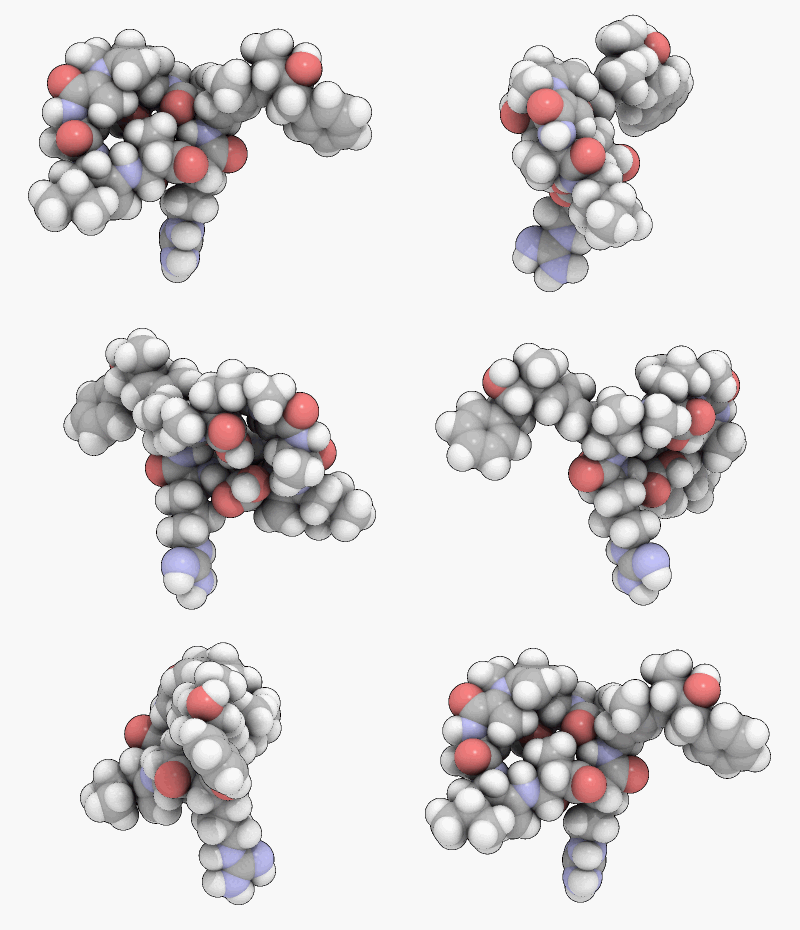
A while back I found out the whole story about why Beluga whales were washing up on the shores of the St. Lawrence around Montreal--whales whose carcases were so contaminated with toxins that they had to be handled as toxic waste. Turns out it had to do with farmers in the American Midwest applying fertilizer to their fields. Excess nitrogen and phosphorus was washing into the rivers in the (rather immense) Mississippi catchment basin, concentrating in the waterways, spilling out into the Gulf where it was creating a dead zone. Algae from the dead zone found their way up the Atlantic coast in blooms, generating the neurotoxin found in red tide. Various predators concentrated the toxin up the food chain as the bloom moved north, finally resulting in dead whales in the St. Lawrence. Everything is connected.
 |
| Lake Erie photo via National Oceanic Service |
 |
| microcystin-LR molecule via Toxmais, mostly because it's so frickin' cool! |
Tuesday, July 29, 2014
Will The Soil Save Us?
 |
| Image © Rodale Books |
The answer depends
on your view of human adaptability in the face of global warming. If
you are thinking about how the role of national and local governments
have been superseded by international trade agreements assigning more
power to corporations than governments, well, then we're doomed. If
you're thinking about the innate conservatism of farmers and other
food producers and the immense stranded costs they would face with
any change to the way we produce food, well, then you have to pretty
much figure we're doomed. But if you think about the way people
respond to disasters like Katrina, Sandy, the Calgary flood of 2013,
or earthquakes and tsunamis in Japan, the way we refuse to duplicate
the infrastructure that failed and instead rebuild taking the changed
conditions into account, well, then you have to figure we're doomed.
You might think
that I'm a bit defeatist, that I'm rather cynical when it comes to
the future of humanity on this planet. And you'd be right. The
tremendous control exerted by international corporate structures over
our everyday lives, limiting the choices we can conceive of or
discuss, suggest to me that without a major international democratic
revolution there is really not much chance of turning this Titanic
from it's fated course. The cry of “Iceberg! Dead ahead!” went up
in the late sixties/early seventies, and overall we haven't paid a
blind bit of notice since.
Kristin Ohlson
doesn't exactly share my feeling that this big boat is going down,
and the only people who will make it are those who launched their
lifeboats early. In keeping with her American sense of optimism, she
charts the rise of alternative agricultural methods and the (small)
communities that have arisen around them. Primarily, this is the rise
of “soil farmers,” those who concentrate their efforts on growing
soil over growing cash crops. She justifiably calls these New
Agriculture practitioners “heroes of the underground.”
Ohlson meets a
number of very interesting people in the soil farming movement.
People like Allan Savory (whose TED talk is quite remarkable but who faces serious criticism) who's
work in Zimbabwe is claimed to be restoring the damaged veldt, and Jay Fuhrer and
Burleigh County, where people interested in New Agriculture (my
title) learn how to build soil on working land.
It's an entertaining ride, very accessible to the lay reader. She briefly recaps the history of global warming (which should be known to every person on the planet by now, but, distressingly, is not), cruises through in introduction to soil microbiology, and then focuses the remainder of the book on permaculture practice through different characters and how they interact.
It's an entertaining ride, very accessible to the lay reader. She briefly recaps the history of global warming (which should be known to every person on the planet by now, but, distressingly, is not), cruises through in introduction to soil microbiology, and then focuses the remainder of the book on permaculture practice through different characters and how they interact.
The focus on
characters to introduce practice is a smart one, allowing a great
deal of information to unfold through talking with people. The book
feels like a great conversation between he writer and reader (as the
best of these books do) and avoids any unsightly info-dumps. The best
practitioners of this style—Michael Pollan and Mark Bittman spring
to mind—create the impression of having learned an enormous amount
while reading one of their books. What they do, is to introduce the
reader to a topic and give them enough information, artfully
conveyed, to allow the reader to participate in a greater
conversation on the issue. And Ohlson does her best to live up to
this standard of writing, for which I'm very grateful.
The downside is
that the book offers up a simple single solution to our problems.
This is a problem, but one we all suffer from. We like the idea that
one person, heroically doing one thing against great odds, can save
the world. And that's bullshit. We didn't get into this crisis by one
person doing one thing, and we won't get out like that. The only way
out is, as Mao put it, to let a thousand flowers bloom. Each person
has to begin taking a step forward. We don't really know which step
is the important one, so we had better be taking a lot of different
ones. And as we start to move on this crisis, we need to form
linkages between us—individuals, groups, municipalities, nations.
As Kristin Ohlson describes the formation and structure of the
microbial world of the soil, so too do we need an ecology of change.
An inter-related web of groups and individuals exchanging tactics,
techniques, and actions, each moving us in a general direction so
that as the crisis evolves, so too can our responses. You don't have
to be right, you just have to be trying.
This is the sort of
information we desperately need in order to find a way forward into a
world where we'll survive global warming. After reading this book I
don't think that the soil will save us. But I do think that soil
farming/New Ag/permaculture, is one of the big tools we'll have to
use to ensure a future. But it's also going to take Radical
Democracy, and a movement to Occupy Food, the simplicity movement,
and probably the total bankrupcy of the global economy, to get where
we need to go. But in the meantime, get up, stand up. And as Public
Enemy said “Bring the noize!”
Friday, July 25, 2014
Problems/Solutions/Problems
 |
| "Farming near Klingerstown, Pennsylvania". Licensed under Public domain via Wikimedia Commons |
But this is not my review of Soil, but the title is serving as a jumping-off point for some other things I've been reading and thinking about. Such as how we're facing this massive increase in population over the rest of this century.
It seems we're expected to increase world population from six to eight or nine billion before we top out. And somehow we need to feed all these people, an accomplishment made all the more difficult by peak oil, global warming, and the question of equitable distribution. The argument is made by industrial agriculture advocates that without high-tech, capital intensive farming, we'll never be able to feed everyone.
But here's the thing; modern agriculture is not a solution. Hell, pre-1900 agriculture is not a solution. Agriculture is the problem. Not the only one, true, but approximately a fifth of the problem. It's not that global warming will impact our ability to grow food in different areas, it's that growing food is contributing to global warming.
The FAO reports that:
[...]estimates of greenhouse gas data show that emissions from agriculture, forestry and fisheries have nearly doubled over the past fifty years and could increase an additional 30 percent by 2050, without greater efforts to reduce them.
[...]Agricultural emissions from crop and livestock production grew from 4.7 billion tonnes of carbon dioxide equivalents* (CO2 eq) in 2001 to over 5.3 billion tonnes in 2011, a 14 percent increase. The increase occurred mainly in developing countries, due to an expansion of total agricultural outputs.
Meanwhile, net GHG emissions due to land use change and deforestation registered a nearly 10 percent decrease over the 2001-2010 period, averaging some 3 billion tonnes CO2 eq/yr over the decade. This was the result of reduced levels of deforestation and increases in the amount of atmospheric carbon being sequestered in many countries.
* Carbon dioxide equivalents, or CO2 eq, is a metric used to compare emissions from different greenhouse gases based on their global warming potential.
Subscribe to:
Posts (Atom)