Showing posts with label book reviews. Show all posts
Showing posts with label book reviews. Show all posts
Friday, September 18, 2015
The Emergent Agriculture--a review
There is not a lot that is new in Gary Kleppel's book The Emergent Agriculture: Farming, Sustainability, and the Return of the Local Economy. A cogent, well-reasoned take-down of industrial ag--but then, there's a herd of those, ranging from succinct to verbose (for the record, Kleppel is more towards the succinct end of the spectrum). A call for a more appropriate agriculture? Read that. An overview of New Ag farms? Nice, but seen that.
Where Kleppel's book shines is in the discussion of the new/old structures of how food moves from producer to consumer. And it should; Kleppel is himself both an academic and a farmer.
Antonio Gramsci described a group of people who, though members of the working class or the bourgeoisie, are an organically developed "thinking class" that "articulate, through the language of culture, the feelings and experiences which the masses could not express for themselves." He called them "public intellectuals." There should be a name for those who, although they hold membership in the traditional academic intelligentsia, chose to immerse themselves in traditional forms of work. We need more of these two groups, and Gary Kleppel, professor of biology at SUNY Albany, is definitely in the latter group.
When trying to see the shape of a new way of living, a new societal paradigm, it helps to have the kind of training given to those who pursue an academic career. Such training helps one to see both the large view and the details. When your talking about agriculture, it really helps to have gotten your hands dirty.
When Kleppel talks about the new/old methods of marketing food, it helps that he's worked a farmer's market and participated in a CSA (community supported agriculture). When we grew food, it was quite clear that the place most farmers fell down was in the marketing of their products.
When farmers get $0.02 out of the sale price of a loaf of bread, the correct response is not to grow more wheat. The better response is to find ways to capture more of the profit from your production.
I kept saying that our customers didn't come for the vegetables as much as they came for the connection. They wanted the story. An example: We had a number of zucchini that were not straight, but curved around small scars in their skins. People hesitated to buy them until I pointed out that these scars came from our pesticide; chickens. The occasional peck at a bug would scar the zucchini skin, leaving it to heal slightly bent. The damage was quickly seen as a mark, not of failure, but of superiority. These were not perfect because of the type of farming we did.
These are the connections celebrated in Gary Kleppel's book; unmediated links between producer and consumer. But not every farmer is ready to be a farmer, an ecologist, and a marketer. This is an area that he misses--the role of the co-operative movement. Co-ops can fill the gap of missing abilities. Small cheesemakers. Farmer's supplying a group-owned store. While the future may play out the way The Emergent Agriculture suggest, it will also be more complex, more intricate, than it suggests. Good book, though.


Thursday, August 21, 2014
Living on an Acre
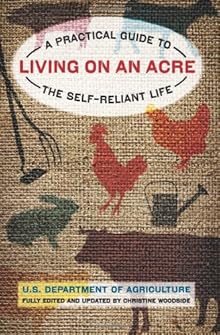
Living On An Acre 2nd edition: A Practical Guide to the Self-Reliant Life
U.S. Department of Agriculture Fully edited and updated by Christine Woodside
Lyons Press, © 2010
Guilford, Connecticut
ISBN: 978-1-59921-885-4
Originally published as Living on a Few Acres, and published in 1978, the original of this book was published to provide practical information and assistance to the back-to-the-land movement. This new edition is intended for the same audience although it focuses on smaller acreage. Living on an Acre walks a fine line between being encouraging and cautionary. It opens with a chapter titled “Pluses and Minuses” and the sub-section “Face the Realities” opens with a checklist:
- Do you want to be a part-time farmer on a few acres and keep a full-time job in town?
- Can you find a farm that suits your needs in a place where you are willing to live?
- How much will it cost? If more than your savings, can you obtain financing?
- Do you have the knowledge and skills needed to operate a small farm?
- What about financing the production process?
- How and where will you sell your produce?
When I worked off-farm, back in the day, I frequently found myself driving 5000 kilometres (3100 miles)/month—which drove me crazy. But the income paid for school supplies, utilities, and (of course) the ever increasing price of gasoline and car repairs. The insanity of working to afford the transportation costs of working is what lead us to the joyous moment of getting rid of our car and joining the Victoria Car Share Co-op.
I've considered the question of low farm incomes and have long wondered why farms don't take more of the process into their own hands. Selling, as we did, our production directly to the public through farmer's markets and the connections we made there, allowed us to receive a far more reasonable return. There were problems; getting up at 5:00 am to drive an hour and a half to Vegreville to have our chickens and turkeys processed (it has to be done at a licensed and inspected facility in order to be able to sell to the public rather than home use). The butcher we liked being forced out of small animal butchering by the lack of return, meaning we had to haul lambs to a abattoir we didn't really like in order to keep selling them. But, we could set a fair price for free-range animals and keep more of the money in our hands. And we ate like kings. But the loss of small, local slaughter operations isn't mentioned in Living on an Acre.
One of the great things about this book is the practical information it contains. How much land is needed for pasturing a horse? What are the housing requirements for goats? Should you build your own house? These are questions addressed here by the various writers. The must-read chapter is Growing and Raising: How to do it. The topics covered are great—from growing fruit trees, to nursery operations, to raising small and large stock, and even vacation farms. Traditional and non-traditional ways to provide yourself with an income get a good overview/introduction. The only lack is in marketing instructions. The sections on raising rabbits and chickens would be good reading for anyone contemplating raising these animals in the city.
Overall, this is a book that provides an introduction to many of the problems and concerns with moving to a rural life. The chapter The big picture offers short (often too short) essays from people who have made the transition. But Living on an Acre does offer the information you need in order to answer the questions the book ask. At the end of it, you'll have a better idea whether rural life is for you.
Monday, August 18, 2014
Jennifer and the City

Food and the City: Urban Agriculture and the New Food Revolution
Jennifer
Cockrall-King
Prometheus Books,
2012
Amherst, New York
ISBN:
978-1-61614-458-6
available as an
e-book
I have to say that
Canadians have produced a lot of really great books on food and food
systems in the last decade or so. And Jennifer Cockrall-King has
taken her place in the ranks of Canadian food writers.
The book opens with
a (mercifully) brief overview of the modern food system that focuses
on the varied challenges the industrial food system faces; from
climate change to peak oil and peak water. JCK then gets into the
meat of the book, a tour of urban agriculture in France, the UK, the
US, Canada, and ending up with two tours of Cuba. Each section
(broken down by city) opens with some history of the city, farm, or
person being visited. From the perpetuation of urban agriculture
through the history of Paris, to a brief and inspiring bio of Will Allen, JCK offers us something special about her visit.
In Paris, for
example, she opens with an anecdote about seeing a police station,
“an excellent example of 1970s Brutalist architecture, designed to
intimidate and terrorize,” where someone had planted grapevines in
the street-level window wells. She “burst out laughing at the
juxtaposition of these vines struggling to soften the intentional
harshness of this impersonal, aggression-inspired building. Neither
the vines' efforts nor the efforts of the gardener who planted them
were in vain. The vines were winning.”
Because the book is
meant to be inspiring rather than depressing, these are the stories
she tells; stories where “the vines [are] winning.” And it's
nice, as a Canadian, to read of cities here as well. So many books
concentrate on what's happening in the US—understandable, as the
potential market there is ten times larger than here in Canada. But
Canada is at the forefront of thinking about food and feeding people.
From Graham Riches work on the birth of food banks and his prescience
on how they would become part of the fabric of feeding people as the
social safety net here is slowly hacked apart, to Fraser and Rimas'
Empires of Food showing how
agricultural production forms the basis of civilization and empire
(and the inevitable collapse of both), to Lorraine Johnson's City Farmer: Adventures in Food Growing
which offers up the polite Canadian way of urban agriculture (as
opposed to Novella Carpenter's more guerilla approach in Oakland). So
JCK's overview of the urban ag movement in Vancouver and Toronto is
welcome.
Of
course, she does refer to Vancouver as being on Canada's “Left
Coast,” a stereotype we could probably do without. She does live in
my old home town (Edmonton, Alberta), in a province where politics have been silenced by
big oil money, and the only movement is on the right to make the
province even more of an American colony. To
anyone coming from a petro-state, British Columbia's politics would
look crazy. But all it means is that politics still matters
out here, people still care.
And
they care about food. Vancouver's large Asian and Indian communities
have invigorated both the flavour palette and the urban agriculture
movement. The same has happened in Toronto, which is fitting as the
cities are both the largest in Canada, and the most unaffordable. So
there is more pressure to think about, and get involved in, urban
agriculture.
After
her developed-world tour, Jennifer Cockrall-King ends up in Cuba, the
epicentre of post-peak thinking and a world leader in agro-ecological
research. JCK's visits to Cuba supports much of what I said in an
earlier post (Cuba, Si!). Cuba is not perfect, but they are the
essential test-bed for a post-consumerist, post-oil world. In Cuba,
rationing mixed with local free-market farmer's markets provide a
limited but universally accessible food
system.Interestingly, a system that worked well in the UK during and after the Second World War. Cuba also upends our traditional thinking about social status
and pay; top-level farmers earn considerably more than “white
collar” professionals. Here in Canada, of course, the easiest way for a
farmer to become a millionaire is to start farming with two million
dollars. You'll have a
million soon enough.
Jennifer
Cockrall-King's book is an excellent overview of the variety of
approaches to urban agriculture in the developed world. From the
unbroken (though badly damaged) historic production systems of Paris,
to the allotment garden and the memory
of the Victory Gardens of the Second World War in the UK, and the
North American experiments, we see everything from guerilla gardeners
to the entrepreneurs and SPIN (Small Plot Intensive) urban farming
movement. Most are farming for love, more than expected farm for
money, and all of them bring an element of hope to the people around
them. And, slowly, all are helping restore the agricultural
knowledge-base we're going to need in the not-so-distant future.
Tuesday, July 29, 2014
Will The Soil Save Us?
 |
| Image © Rodale Books |
The answer depends
on your view of human adaptability in the face of global warming. If
you are thinking about how the role of national and local governments
have been superseded by international trade agreements assigning more
power to corporations than governments, well, then we're doomed. If
you're thinking about the innate conservatism of farmers and other
food producers and the immense stranded costs they would face with
any change to the way we produce food, well, then you have to pretty
much figure we're doomed. But if you think about the way people
respond to disasters like Katrina, Sandy, the Calgary flood of 2013,
or earthquakes and tsunamis in Japan, the way we refuse to duplicate
the infrastructure that failed and instead rebuild taking the changed
conditions into account, well, then you have to figure we're doomed.
You might think
that I'm a bit defeatist, that I'm rather cynical when it comes to
the future of humanity on this planet. And you'd be right. The
tremendous control exerted by international corporate structures over
our everyday lives, limiting the choices we can conceive of or
discuss, suggest to me that without a major international democratic
revolution there is really not much chance of turning this Titanic
from it's fated course. The cry of “Iceberg! Dead ahead!” went up
in the late sixties/early seventies, and overall we haven't paid a
blind bit of notice since.
Kristin Ohlson
doesn't exactly share my feeling that this big boat is going down,
and the only people who will make it are those who launched their
lifeboats early. In keeping with her American sense of optimism, she
charts the rise of alternative agricultural methods and the (small)
communities that have arisen around them. Primarily, this is the rise
of “soil farmers,” those who concentrate their efforts on growing
soil over growing cash crops. She justifiably calls these New
Agriculture practitioners “heroes of the underground.”
Ohlson meets a
number of very interesting people in the soil farming movement.
People like Allan Savory (whose TED talk is quite remarkable but who faces serious criticism) who's
work in Zimbabwe is claimed to be restoring the damaged veldt, and Jay Fuhrer and
Burleigh County, where people interested in New Agriculture (my
title) learn how to build soil on working land.
It's an entertaining ride, very accessible to the lay reader. She briefly recaps the history of global warming (which should be known to every person on the planet by now, but, distressingly, is not), cruises through in introduction to soil microbiology, and then focuses the remainder of the book on permaculture practice through different characters and how they interact.
It's an entertaining ride, very accessible to the lay reader. She briefly recaps the history of global warming (which should be known to every person on the planet by now, but, distressingly, is not), cruises through in introduction to soil microbiology, and then focuses the remainder of the book on permaculture practice through different characters and how they interact.
The focus on
characters to introduce practice is a smart one, allowing a great
deal of information to unfold through talking with people. The book
feels like a great conversation between he writer and reader (as the
best of these books do) and avoids any unsightly info-dumps. The best
practitioners of this style—Michael Pollan and Mark Bittman spring
to mind—create the impression of having learned an enormous amount
while reading one of their books. What they do, is to introduce the
reader to a topic and give them enough information, artfully
conveyed, to allow the reader to participate in a greater
conversation on the issue. And Ohlson does her best to live up to
this standard of writing, for which I'm very grateful.
The downside is
that the book offers up a simple single solution to our problems.
This is a problem, but one we all suffer from. We like the idea that
one person, heroically doing one thing against great odds, can save
the world. And that's bullshit. We didn't get into this crisis by one
person doing one thing, and we won't get out like that. The only way
out is, as Mao put it, to let a thousand flowers bloom. Each person
has to begin taking a step forward. We don't really know which step
is the important one, so we had better be taking a lot of different
ones. And as we start to move on this crisis, we need to form
linkages between us—individuals, groups, municipalities, nations.
As Kristin Ohlson describes the formation and structure of the
microbial world of the soil, so too do we need an ecology of change.
An inter-related web of groups and individuals exchanging tactics,
techniques, and actions, each moving us in a general direction so
that as the crisis evolves, so too can our responses. You don't have
to be right, you just have to be trying.
This is the sort of
information we desperately need in order to find a way forward into a
world where we'll survive global warming. After reading this book I
don't think that the soil will save us. But I do think that soil
farming/New Ag/permaculture, is one of the big tools we'll have to
use to ensure a future. But it's also going to take Radical
Democracy, and a movement to Occupy Food, the simplicity movement,
and probably the total bankrupcy of the global economy, to get where
we need to go. But in the meantime, get up, stand up. And as Public
Enemy said “Bring the noize!”
Monday, July 21, 2014
Flood Forecast--Bad And Getting Worse
 |
| Image copyright Rocky Mountain Books |
Spent a couple of hours this weekend reading Flood Forecast: Climate risk and resiliency in Canada by Robert Sandford and Kerry Freek. Flood Forecast is part of the Rocky Mountain Books Manifesto series, which, according to their website:
[Is] one of the most unique non-fiction series in Canadian publishing. The books in this collection are meant to be literary, critical and cultural studies that are provocative, passionate and populist in nature. The goal is to encourage debate and help facilitate change whenever and wherever possible. Books in this uniquely packaged, hardcover series are perfect for general readers, academic markets and book lovers.
Paperback size but hard-covered, well designed, and engagingly written (and timely), the first half of this book looks at the Alberta flood of 2013 which took out houses from Canmore to High River. The second half of the book looks at the flooding, three weeks later, of the flooding in and around the greater Toronto area.
The differences between the two floods are as instructive as the similarities. In Calgary, Mayor Nenshi moved quickly into action, becoming the public face of the official reaction to the flood, co-ordinating the response, but generally staying out of the way of those doing the emergency work. Toronto had Mayor Rob Ford.
In Alberta, the provincial government failed pretty much completely in their duties. Alberta has had the same party in power for some 40+ years, the Progressive Conservatives. This means that there has been an unbroken continuity in governance. So when provincial government officials claimed that a flood of this magnitude could not have been predicted, they knew they were lying. Flooding of this scope had been predicted as early as 1979 and had almost occurred in 2005--both times on the same party’s watch. This same government had commissioned, in partnership with the City of Calgary, a report of the flood potential of the Bow and Elbow rivers that was completed and submitted in 2012, a year before the flood. The report pointed out that development in the floodplain had the effect of restricting the space in which water could move and would slow floodwaters down, ensuring higher flood levels. The report also noted that a flood reaching Calgary would result in unprecedented damage. Alberta government officials also claimed that the flood was a “once in a thousand year” event that no-one could have anticipated. Calculations by John Pomeroy and his team (most of whom had been on-site in Canmore during the rains that led to the flooding) released their calculations in November 2013 that showed the rain event was not only not a thousand year event, but not even a once a century event. Rather it was a once-in-45-year event. So not even a once in a lifetime event, but an event that should have been planned for. Government had just failed in it’s duty to prepare for it. In a later interview in the Calgary Herald, Pomeroy was quoted as saying that the Alberta government response to the flood “was reminiscent of what you would expect in a developing country.”
Three weeks later, a weather system dropped 100 mm of rain on Toronto in about two hours (exceeding the 50+ year old record for same day rainfall). The city’s systems were overwhelmed, with more than a million cubic metres of raw sewage ending up in Lake Ontario. 37 of 69 transit stations were without service, stranding some 1,400 passengers for three hours, and left 300,000 residents without power and caused major flight delays. Eventually there were $940 million in private damage claims and some $60 million in damage to the City of Toronto (about $55 million of which was not covered by insurance).
But where Alberta’s government had abdicated their responsibility and worked hard only on a cover-up of what they knew and when, Ontario had already been working towards a better infrastructure response. That response was clearly not in place during July of 2013, but work has been underway for several years.
One example is that Toronto (and other municipalities) had made downspout disconnection from the sewer system mandatory. Diverting this flow to lawns reduces the infiltration rate of rainwater, easing the strain on storm drains and reducing the likelihood of basement flooding. Floodplain mapping, ignored for 20 years in Alberta, has been updated in the last decade in Ontario, helping municipalities plan development. And while Toronto’s infrastructure replacement from 50’s standards to something more reflective of today and tomorrow’s requirements will cost multi-billions of dollars, there is a programme in place to make the necessary changes.
While the authors focus on the particular (in this case, their respective floods), they don't fail to notice the larger implications of the extreme weather events. Mention is made of both Siberia and Colorado experiencing extreme dry weather, wildfires, and then extreme rainfall, all in the same season. This kind of roller-coaster is going to batter, if not destroy, our economy. Our personal, local, and national planning is going to have to take into account the possibility of multiple extreme weather events arriving one after the other over short periods of time. Which is going to beat the hell out of our agricultural system.
Toronto’s response is far from perfect, or even timely enough, but at least there is some sort of planning and response for a climate-changed world going on. The authors of Flood Forecast are not sanguine about the response to flood events in either locale, particularly in the face of growing climate severity. But they are willing to give credit where credit is due. Their book is short, pointed, and very readable, and as such is an important contribution to the necessary civic dialogue now taking place around climate change.
Thursday, July 17, 2014
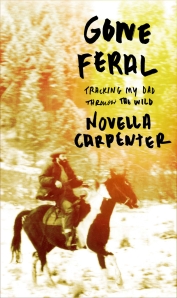
Gone Feral. A Review.
 |
| Image via novellacarpenter.net |
Novella Carpenter, the author of the excellent memoir Farm City: The education of an urban farmer, is back with a new book, Gone Feral: Tracking my dad through the wild. If you read her first book, about her move to Oakland and the founding of GhostTown Farm (and if you haven’t, you really should), you may think you know Ms. Carpenter and her dedication to creating rural environments inside an urban area. Channeling the spirit of the original English Diggers (and the later Digger movement in San Francisco, for that matter), she and her Significant Other Bill moved from Seattle to Oakland, fetching up in a rather less-than-savoury part of town. By turns heroic, crafty, and just plain lucky, Carpenter manages to take over an unused lot next to her rather tired apartment and convert it into an actual urban farm, raising everything from vegetables to chickens to some most memorable pigs. Step by step, Ms. Carpenter leads the reader through her unusual life, her unique neighbours, and her funky, and productive, farm.
Gone Feral on the other hand, is a different sort of journey, but still told in a unique and compelling voice. Spare prose, clear progression, and a dedication to telling the story of the day her father went missing, and her (re) discovery of him, make for a compelling read. I had expected to enjoy the book based on my experience with Farm City, but I hadn’t expected to become so wrapped up in the read that I ate this book in one gulp (with several cups of tea).
Novella’s parents were part of the hippie/alternative/back-to-the-land movement of the late 60s and early 70s. They found and purchased some lovely land outside Orofino, Idaho. They moved into a battered mobile home, slowly built their own house, gardened, raised animals, found local work, and fell apart. Regretfully, not a unique story from that (or this) time. Her mother moved to the Pacific Northwest with Novella and her sister, and her father stayed behind. Then, on October 17th, 2009, Novella received a call that her father was missing. Although he resurfaced some weeks later, none the worse for the wear, the experience sent Ms. Carpenter off on a quest to find her father.
This is primarily a book about a daughter trying to reconnect with her father, struggling to understand his life and choices, and, most importantly, trying to figure out what happened. Throughout the book there are reasons, revelations, and reconnections, and the resolution, this being real life and not a novel, may not be as satisfying as you might hope (although I found a deep resonance with it). But almost by accident, Carpenter addresses a topic that I have been considering for some time (and written about here on the blog): why were there so many failures in the back-to-the-land movement?
 |
| Novella Carpenter photo copyright Sarah Henry |
We see Carpenter’s parents meet and move onto a farm in Idaho. We see how difficult it was for them as a couple and family to achieve their dreams (and how much of the dream became a nightmare). And as Novella negotiates her father’s history, many of the reasons for the failure become clear. But across the holler from her parents are some other back-to-the-landers. And they, ultimately, are not a failure.
Novella describes the differences between the Carpenters and their neighbours: the Carpenters are alone, following the homesteader narrative of America. The neighbours? To begin with, there are two couples. After some time, they build a second house on the property. They invite their neighbours to an annual solstice party.
The homesteader narrative of America is a myth. Particularly in the east, the settlers were moving onto farms that were established, had been cultivated for decades if not longer, often had full storehouses of food and seed, and in many ways, were better than their equivalents in Europe at the time. It was just that their occupants had recently died from contact with the European settlers. There was very little of the “two people and a horse” homesteading
happening at all. But the myth of an empty land and heroic settlers was much more satisfying than the reality of “we killed them all and took their stuff.”
And it was this myth that led so many landers astray. The belief that you had to do it all alone, that you had to be totally self-sufficient, that belief doomed them.
The Farm, the collective founded around the same time as the Carpenter’s began their attempt, succeeded, and still survives. But that was because the people who founded The Farm took their community with them, and built links with the local community. The Carpenter’s neighbours took a smaller community with them, but also built links with the local community. They made friends, asked advice, lent a hand. In short, mutual aid trumps self-sufficiency. And it’s no different today.
In Gone Feral, Novella carpenter explores a family history that “does not repeat, but rhymes.” So to does the current rural repopulation rhyme but not repeat. In the former, the story is compelling and extremely readable. In the latter, the story is not yet done.
Tuesday, July 15, 2014
Books On My Desk part 1
These are just books that have accumulated on my desk and haven't made it to the bookshelves yet--from modern deconstructions of the food system to older books about food security. One in the latter category is:
The Home Vegetable Garden (Small holdings series-No. 2) produced by the Canadian Legion Educational Services, and published in 1945.
This book was apparently the second in a series of courses designed to train people in how to maintain a small holding. It starts out with stating that a quarter to a third of an acre should suffice to produce sufficient vegetables for fresh table use, canning, drying, and storing.
"Though a home garden, in most cases, will not provide the grower with a cash income and is not intended to, it will prevent the necessity of a very considerable cash outlay, it contributes to self-sufficiency, and of course 'a dollar saved is a dollar earned'."
It's a terrific little volume of about 175 pages, with chapters on general planning, bulb crops, perennial vegetable crops, potatoes, etc, with a short quiz at the end of each chapter. There's also information on storage of fresh and canned veg and disease control, and the whole is intended as a course at the end of which you've submitted an exam to be marked, and then you continue into the next course in the series.
Some of the info, like the recommendation to burn all plant trash at the end of the season (to help manage pests and disease) may have been superseded by the recommendation to compost everything (with the note that a good compost pile will heat up enough to sterilize weed seeds and kill pests), but things like how to build a temporary hotbed or coldframe are still quite valid. (A hotframe is a sprouting bed build over composting horse manure, which provides a warm environment to promote seedling growth. A coldframe is a small space that relies on passive solar to harden off early crop seedlings). Most interesting are the descriptions of various heritage seeds and what their strengths and weaknesses are. Some of these varieties are still available from places like Jim Ternier's Prairie Garden Seeds or West Coast Seeds in Canada. Overall, an excellent self-educator.
 |
| image via Michael Pollan |
Michael Pollan's Food Rules: an eater's manifesto was the follow-up to In Defense of Food and is a collection of short epigrams to help the modern eater manage to supermarket jungle. "Avoid food products that contain more than five ingredients" is a perfect example; most processed, highly- or over-processed foods will contain more than five preservatives. This helps you remember to follow another epigram: "Shop the peripheries of the supermarket and stay out of the middle." Because the outside is where you find food--vegetables, meats, eggs, dairy. The aisles are where you find the over-processed near foods. The book is divided into sections that reference the summation of In Defense of Food: Eat food. Not too much. Mostly plants. Which is still darned good advice.
 |
| Image copyright Random House |
The Hundred Mile Diet: a year of local eating by Alisa Smith and J.B. MacKinnon is very close to my heart. This book is as local as the diet they tried to stick to for a year. Packed with history, local colour, and the terribly engaging story of their decision to attempt to eat within an arbitrary perimeter for a year. That seemingly simple decision caused shock-waves around the world. It is partly because of this book that British supermarkets began tagging their goods with "food miles" stickers. The "grow local, buy local" movement got an enormous jump-start from this accessible and amusing read. In Canada, it lead the authors to the "Hundred Mile Challenge" television show and a remarkably down-home celebrity. Great writing+great concept+excellent timing=maximum impact.

The Story of Sushi: an unlikely saga of raw fish and rice by Trevor Corson (previously titled The Zen Of Fish, a fact I have to remember when I'm in the bookstore) is more than just a great bit of journalism. It's also where I see the non-fiction book evolving to--the after material contains extensive source notes, bibliography, index, and two brief bios of the author, a behind-the-scenes essay with a number of candid photos of the people we met in the books pages, an essay on the book tour on the books first release, and links to both the book and author's online presence (which is quite an extensive website and should serve as a template for any serious author in the digital age).
So that's pretty much a random grab.
Tuesday, October 8, 2013
The Way Forward
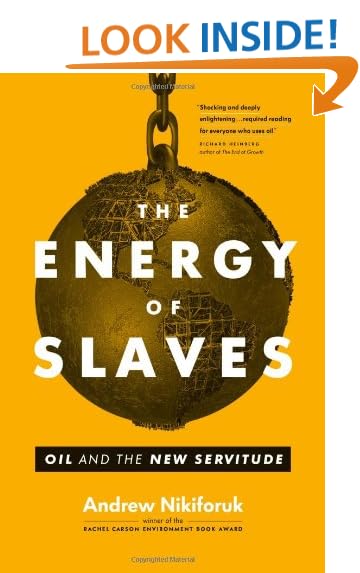
I've been reading Andrew Nikiforuk's The Energy of Slaves this week (check out the pop-up interview with him on CBC' radio show The Current) and it has been a great read and an interesting take on the links between the hydrocarbon economy and the slave economy. He also dedicates a chapter to what he calls "The Unsettling of Agriculture": the change from solar to slave to hydrocarbon-based production.
In the chapter on agriculture, he looks at the example of China between the 8th and 12th centuries: during that time, China constructed
...a unique agro-energy empire, diverting enough natural flows of energy to feed nearly half a billion people. It did so by carefully marshaling solar energy in intensely farmed plots of millet and wheat int he north and of rice in the south. Innovations in rice farming--the artificial flooding of land and multiple cropping--tripled the yield of an average peasant family. One square mile of carefully tended land could feed 225 peasants. Peasants hoed, fertilized, and irrigated these highly nutritious crops like some great garden. The land was manured with human shit.But even this system faced problems. As the population grew from 100 million people in the 12th century to 500 million in the 18th, the country inevitably ran into a series of energy and environmental shocks. they ran out of land, and they ran out of wood. The amount of food necessary increased, but the crop surpluses declined. No empire, co government, no country can withstand a collapse in caloric stocks (I've talked about Empires of Food by Fraser and Rimas before (Check out Evan Fraser's discussion here)). the basic structures of Chinese solar energy harvesting remained until the 1970s. This steady-state agriculture finally collapsed under the assault of oil and oil's industrial agriculture programmes--leading to China becoming an ag-product exporter, but, as has been mentioned before in the posts on honey laundering, not one without problems.
We've been through these issues before, too. In 1973, energy analyst Earl Cook pointed out that it was taking 26,745 calories to produce 3,300 kilocalories of food. In 1930, in a manifesto called I'll Take My Stand, a group of southern US farmers said that machines did not emancipate farmers, but in fact evicted them from their farms. In 1943, Sir Albert Howard, in An Agricultural Testament (pdf) pointed out that the replacement of animal traction with mechanical traction came with a significant drawback--mechanical traction doesn't produce urine or manure. he predicted that a people fed on improperly grown food would eventually become dependant on "an expensive system of patent medicines, panel doctors, dispensaries, hospitals, and convalescent homes".
In the end, Andrew Nikiforuk looks at the Cuban experience and takes, as I do, hope from it. Slavery, whether human or hydrocarbon, is a dead end, suitable only for short-term gains, but antithetical to long-term sustainability. The hydrocarbon economy is, at best, a dead-end side road we've mistakenly diverted down. As in the video below, sometimes we discover that the only way to go forward is to move a ways back.
Shaped by Hand from Elias K. on Vimeo.
Wednesday, October 2, 2013
Art Of The Memoir

I've just finished Bob Spitz' memoir The Saucier's Apprentice, which, I have to say, has been a real relief from Breadlines Knee Deep In Wheat and Food Banks And The Welfare Crisis. The only crisis in Apprentice are bad cooking schools and a broken heart--neither of which are particularly world-in-peril stuff.
The book can be described fairly simply: person reaches a point in their life that requires a re-evaluation of said life. Person realizes that one of the things they really like to do is cook. Person pursues an education in cooking that also enables them to re-evaluate their life. Cut to narratively elegant wrap-up. Ba-da-boom, satisfying read.
And don't get me wrong, The Saucier's Apprentice is a satisfying read. Spitz expresses just enough self-reflection and exposes enough personal angst to make him a sympathetic character (although I did want to smack him a few times). He writes well about his experience as a dilettante ADD-like cook-wannabe travelling around France and Italy attending various cooking schools. When he confronts a problem with a school experience, he is careful to differentiate between whether the problem is one with the school, or if it's a problem with what he needs from a school. That is to say, if the teaching is okay, but simply not teaching him what he wants/needs to know, or if the actual instruction is less than advertised or less than satisfactory for a paying student. This is an important distinction....
There are some very nice info chunks in the book; why to pursue both Italian and French cooking (because together they form the two pillars of modern cuisine), how the approaches differ (French is more disciplined, Italian more expansive), and he includes some of the best recipes he learned while on the road. Of course, what he can't tell us are the techniques he learned. Knife skills are not a topic that communicates best through writing.... About halfway through the read, I came across his description of working with a Michelin-starred chef, who taught him how to make an omelet. I'd previously read a version in the Best Food Writing series, so it was a treat to come across it again. And it's an excellent piece of writing, describing how the chef challenges him, and when he sees Spitz' failure, quickly drops his "great chef" persona and becomes a journeyman cook again, teaching a technique that must be got right, for a result that is simply perfect.
But the actual technique (involving striking one's wrist three times boom boom boom to fold and finish the omelet) is not something that can be communicated on the page. It is the practice that teaches. Here we can only get Spitz' reaction to the teaching, how exhausted he becomes with the repetition necessary to acquire the skill, and how it feels to see his final, perfect omelet be taken away from him and sent to a customer.
This is common to all of the books in this genre; we can only experience the learned skill vicariously, through the narrator's reaction to learning. We don't become better at using a knife while reading about Julia Child honing her knife skills in My Life In France. Our sauce-making ability is not improved by reading The Sharper Your Knife, The Less You Cry. What instead we share is the narrator’s internal journey, and it is how this journey resonates with our own journey that makes a memoir of this type matter or not to us.
And I have to say, I love these books. I'm not in the position to pack up and leave for France tomorrow (if, indeed, ever). But the desire is there, and a good writer (like Julia Child, Bob Spitz, Kathleen Flinn, or Julie Powell) gives me hope that I could still make the transition from mediocre cook to decent one.
Friday, August 16, 2013
Books!
I read what seems to be a lot of books. I don't really think it is--I read around 80-100 books a year, mostly non-fiction, and mostly about food issues. When compared to my Significant Other, the writer Paula Johanson (author of, among others, Fake Foods: Fried, Fast and Processed and Fish: From the Catch to Your Table and the codifier of Johanson's Law: "When a system achieves the same outcome regardless of stated goals and altered tactics, then the outcome is the goal"), I really don't read all that much--she probably averages 200 books a year. Even among my peer group, I don't read all that much--but my peers aren't exactly a statistical snapshot of "average" Canadians.
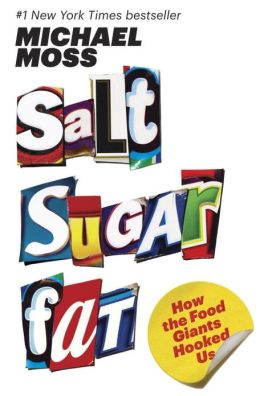
I mention this only because I've had a pretty good run, recently, of interesting reading. Michael Moss' Sugar, Salt Fat started the run.
Tuesday, August 7, 2012
East Coast vs West Coast


I've recently finished a couple of urban farming memoirs: Novella Carpenter's Farm City: the education of an urban farmer and My Empire of Dirt : how one man turned his big city backyard into a farm : a cautionary tale by Manny Howard. Both were interesting to read, but both were really American in their assumptions. Novella Carpenter wrote her book from Oakland, CA, while Manny Howard was writing his from Brooklyn, and the bi-coastal divide is really apparent in their approaches, their style, and their outcomes. Manny, like Julie Powell of Julie and Julia fame, takes on a project that becomes obsessive and relationship-destroying. We meet him suffering a moment in his life that I remember well, the moment when you look around at the reality of being married and having young children. You suddenly realize that it's not all about you, and you are a grown-up now, even if you don't feel like it, want it, or believe it. Its disorienting at best, and in our modern consumer-oriented, atomized culture, distressing. We've created a culture that is best served when we remain self-obsessed adolescents for our entire lives, where “growing up” is seen as the end of the best times rather than a transition into a richer time. In Manny Howard's case, there is a serendipitous phone call from an editor: “How about you turn your yard into an urban farm and live off it for a month?” I can only assume that there was large amounts of alcohol available at that story meeting..... Manny is trapped in that space between adolescent invulnerability and adult sense, and so agrees. His expenses will be covered and there's a nice chunk of change at the end of it all. It is, for anyone who's ever thought about turning their yard into a farm, a perfect situation. You do the work, and someone else pays the bills. Manny bulls ahead, clearing out his backyard, installing a French drain system, and trucking in a load of good topsoil. His aspirations quickly spiral out of control, as he plans a garden, ducks, chickens, and rabbits. His approach is best described when he notes that “this cage, like the rest, was built on the driveway with no plans.” He's never gardened, let alone farmed, and there's no time to do the research up front, so go, go, go! His wife, a long-suffering, highly paid executive at a New York publishing firm (yes, a chauffeured town car picks her up and drops her off daily), watches her husband descend into a madness of obsession and manure, where his definition of the perfect world is radically different from her own. And he appears committed to taking the two children with him into this nightmare. Ultimately, Manny doesn't do a good job of living for a month from the work of his hands. Its not all his fault—there is, after all, a tornado that touches down on his street. And his forays into home meat production are ill-considered at best. All of which stand in stark contrast to the joyous madness happening in Oakland. Novella and her partner Bill move into GhostTown, a neighbourhood in Oakland that is barely functional, where there are shootings blocks away, where the best you can say is that it has become a Temporary Autonomous Zone. Bill, Novella's partner, refits vehicles to burn bio-diesel made from recycled vegetable oil. She works miscellaneous temp or part-time jobs, and comes from a pair of 70s back-to-the-landers. Suffice it to say, Novella is not without clue. Not that she makes it easy on herself. GhostTown is a tough place to live—almost unimaginable for a Canadian working class kid like myself. But when she spies the seemingly abandoned lot next door, Novella hatches a plan. Like the Diggers of England, and the Diggers of San Francisco, she sees that ownership and use must go together. So she begins to clear an abandoned city lot in order to build a garden. And right from the get-go, people start showing up to help. This would be Reader's Digest stuff, except for the strong whiff of counter-culture and the lack of respect for property rights. So, more Utne Reader then.... Novella's book is filled with people who are not her. The people she talks with about how to kill a pig, the drunks and druggies, her neighbours. In each case she tries to give the reader an impression of who this person is, to help make the same connection to them that she felt. The farm is central, but the real story in Farm City is the web of relationships that develop in the temporary Autonomous Zone. Novella gains self-definition when she meets Willow, the woman who drives the area's food security program by farming vacant space and refers to herself as an “urban farmer.” It is a label that Novella quickly adopts (and with good reason). Novella builds gardens,and then decides to indulge in the gateway drug of the urban agriculture movement: chickens. Or, in this case, chickens, turkeys, and ducks. Chickens really are a gateway drug. They add something alive to the landscape—whether urban or rural—and by the time they are ready to lay eggs, you're already addicted to watching alien-yet-understandable activities. And the first time you steal eggs from a nest, you know you're never going back again. I've a farming background, even though I was brought up in the city, so I have always known about the linkage between raising an animal and having to kill one. But killing an animal, any animal, is one of the rituals of humanity from which we have become abstracted. Death is something we shelter ourselves from, hide away, and by doing so, make more powerful. Death is the act that separates the gardener from the farmer. Death is the hurdle that has to be cleared. Both Manny Howard and Novella Carpenter manage it, but Novella manages it with grace and understanding. The two books reflect their authors, but also the places they are written about. Manny Howard's is intense and neurotic—much like the Greater New York area seems to be. Novella Carpenter's book is sprawling and inviting, a masterful combination of memoir and research. Perhaps my being more of a West Coaster than an East Coaster affects my response to the two books. Or maybe being a hippie at heart and a back-to-the-lander myself defines my response. But I'd rather read about Novella's successes rather than Manny's meltdown.
Wednesday, August 24, 2011
Some Food Writing
Since, most famously, Jean Anthelme Brillat-Savarin and, slightly less famously, Alexandre Balthazar Laurent Grimod de La Reynière invented food writing in the first quarter of the 1800s, food writers have battered language almost insensible trying to describe the transports of delight that food has wrought upon their palates. Brillat-Savarin famously said "Tell me what you eat, and I will tell you what you are," in his Physiologie du Goût, ou Méditations de Gastronomie Transcendante; ouvrage théorique, historique et à l'ordre du jour, dédié aux Gastronomes parisiens, par un Professeur, membre de plusieurs sociétés littéraires et savantes. (commonly translated as The Physiology of Taste). The Physiology of Taste is available in a plain text format through archive.org. Sadly, Grimod's Manuel des amphitryons : contenant un traité de la dissection des viandes à table, la nomenclature des menus les plus nouveaux pour chaque saison, et des élémens de politesse gourmande : ouvrage indispensable à tous ceux qui sont jaloux de faire bonne cher̀e, et de la faire faire aux autres (1808) is less accessible in translation (although available in French).
(It is fitting that, as I write this, I've been offered a sample of coffee with instructions to taste it like I would a wine; first the nose, then a slurp and swish to spread the taste over my whole tongue.)
In addition to his mots and aphorisms, Brillat-Savarin dealt with many of the issues that concern us today, such as the globalisation of of food and food culture. He writes:
Gourmandise offers great resources to fiscality, for it increases customs, imports, etc. All we consume pays tribute in one degree or another, and there is no source of public revenue to which gourmands do not contribute. Let us speak for a moment of that crowd of preparers who every year leave France, to instruct foreign nations in gourmandise. The majority succeed and obedient to the unfasting instinct of a Frenchman's fever, return to their country with the fruits of their economy. This return is greater than one would think.
Brillat-Savarin continues on to talk about how food and the businesses surrounding it contributed an extraordinary amount to France's GDP and balance of payments. But he writes about the joys of the table:
The centuries last passed have also given the taste important extension; the discovery of sugar, and its different preparations, of alcoholic liquors, of wine, ices, vanilla, tea and coffee, have given us flavors hitherto unknown. Who knows if touch will not have its day, and if some fortuitous circumstance will not open to us thence some new enjoyments? This is especially probable as tactile sensitiveness
exists every where in the body, and consequently can every where be excited. We have seen that physical love has taken possession of all the sciences. In this respect it acts with its habitual tyranny. The taste is a more prudent measure but not less active faculty. Taste, we say, has
accomplished the same thing, with a slowness which ensures its success. Elsewhere we will consider the march. We may, however, observe, that he who has enjoyed a sumptuous banquet in a hall decked with flowers, mirrors, paintings, and statues, embalmed in perfume, enriched with pretty women, filled with delicious
harmony, will not require any great effort of thought to satisfy himself that all sciences have been put in requisition to exalt and to enhance the pleasures of taste.
“[A]ll sciences have been put in requisition to exalt and to enhance the pleasures of taste.” A bold statement, although, considering the state of the hall described, a defensible one.
Brillat-Savarin was writing in the early 1800s, but, in many ways, he set standards that have echoed down the years. In his book Blue trout and black truffles : the peregrinations of an epicure, Joseph Wechsberg writes similarly about the Restaurant de la Pyramide in Vienne. In what turns out to be a sheer delight of a read, Wechsberg at first resists the pilgrimage to Pyramide:
I objected mildly that I wasn't too much interested in the “show places” of la grande cuisine. France's restaurants are, by and large, the best in the world, I said, and I could see no reason for patronizing fancy establishments when there is such an astonishing number of small restaurants all over the country where one can get a delicious omelet, a succulent blanquette de veau, a fine Brie, and a bottle of honest vin du pays for the equivalent of a dollar and a half.Of course, cooler heads prevail, a letter of introduction is written, and Wechsberg is off (again) to France where he meets “incontestably the greatest chef on earth”, the Formidable Monsieur Point (the title of the chapter).
Sunday, June 5, 2011
The Earth Can Feed Us
Hugo Osvald, The Earth Can Feed Us, George Allen and Unwin 1966
Hugo Osvald was an academic, politician and writer deeply involved in food security issues back in the fifties and sixties. A professor of crop science at the Swedish Agricultural University, he was also a member of the Swedish parliament from 1948-1963. His book The Earth Can Feed Us is an important look at food security issues and the plans made to confront those issues just prior to the Green Revolution.
As you can see from the title of his book, Hugo was actually fairly optimistic about the ability of humans to feed a population of six billion or so (about double the population at the time he wrote this book). As he says in his preface:
I have also refrained from giving terrifying descriptions of the situation in the over-populated countries, with their starving and diseased populations, or detailed accounts of the mistakes mankind has made in exploiting natural resources. For if we want to improve the situation, it is, in my opinion, necessary first of all to show what possibilities there are of increasing food production. Mankind must be given a gleam of hope, a chance to believe in a brighter future, if it is to make the necessary effort. Otherwise it will become discouraged and apathetic.1
Hugo provides an overview of the current condition of the food supply circa 1966, and what he sees isn't good. “The sad truth is, that more than half the world's population of more than three milliard people has not enough to eat.2” He also did not think, after reviewing the numbers, that even with perfect distribution there would be enough calories to go around at the then current rate of production. Whether there is currently enough to go around is still one of those open questions; if you cancel biofuel production in the US and quit feeding so much livestock on so much corn, there might be enough calories produced. But practically there will never be enough, if only because those that have access to food are in no hurry to give it up to eat a 2300 calorie/day diet high in grains and low in animal protein.
Tuesday, April 19, 2011
Outgrowing the Earth
At the end of each chapter is the note: "Data for figures and additional information can be found at [...]." I finally found myself needing to check the figures for an end-note and popped over to take a look at the website for the book. Oh my. Research heaven. Data and charts provided in Excel formatted spreadsheets. And each chapter provided in both .pdf and html formats. All the end-notes converted to footnotes. Everything in the book and more. And all available for online browsing or download.
Now, I'm unlikely to read the entire book online (I still prefer a paper copy for reading), but I could load the whole thing up on a Kobo and read it. Brown has decided that communicating the information in his book is more important than killing trees, and for that, I applaud him. Now, I'm not sure that Brown's (and Cory Doctorow's) business model is viable for everyone, but it certainly is convenient when you're looking to quote from a book. It's also an excellent way to provide more information than you might want to cram onto dead trees, and connect to readers.
So how does this connect to food security? Well, that's what Brown's book topic is, so off you go. Have a read. Here's a .pdf of chapter one to get you started.
Wednesday, March 30, 2011
Medium Raw
Medium raw : a bloody valentine to the world of food and the people who cook
Anthony Bourdain
Ecco Press, New York, NY. 2010

Anthony Bourdain is the Hunter Thompson of food writers; profane, insightful, and funny as hell. He also possesses a personal honesty that Thompson never had. His latest book, Medium Raw, is a collection of short essays, really, each delving into an aspect of the food world. Why he despises the Food Network, but understands why his friends are in thrall to it. Whether or not you should attend cooking school or get a job in the restaurant industry (probably not). A crazy-funny chapter called The Rich Eat Differently Than You and Me that is brilliantly observed. And another called The Fear that details what happened to the New York restaurant industry in 2008. And some pure unadulterated food porn in a chapter called, simply, Lust.
But the chapter Meat is simply one of the great jeremiads about industrial food. It's' so good that I wish I had written it. I want to quote a long passage from it--by no means the whole thing. I think it best expresses the rage, horror, and sense of betrayal all of us should or would express at the current industrial food system.
Medium Raw is a great read. You should pick it up.
Anthony Bourdain
Ecco Press, New York, NY. 2010
Anthony Bourdain is the Hunter Thompson of food writers; profane, insightful, and funny as hell. He also possesses a personal honesty that Thompson never had. His latest book, Medium Raw, is a collection of short essays, really, each delving into an aspect of the food world. Why he despises the Food Network, but understands why his friends are in thrall to it. Whether or not you should attend cooking school or get a job in the restaurant industry (probably not). A crazy-funny chapter called The Rich Eat Differently Than You and Me that is brilliantly observed. And another called The Fear that details what happened to the New York restaurant industry in 2008. And some pure unadulterated food porn in a chapter called, simply, Lust.
But the chapter Meat is simply one of the great jeremiads about industrial food. It's' so good that I wish I had written it. I want to quote a long passage from it--by no means the whole thing. I think it best expresses the rage, horror, and sense of betrayal all of us should or would express at the current industrial food system.
Medium Raw is a great read. You should pick it up.
Friday, March 4, 2011
Feeding People Is Easy review
Recently finished reading Colin Tudge's book Feeding People is Easy, a book about food security that offers a couple of focused ideas for reforming the world food system.

Feeding People is Easy is a bit different than most of the food security library I'm reading my way through. First off, it doesn't spend all its time on discussing what's wrong with the current food system. And that's good, because Raj Patel, Eric Schlosser, and Michael Pollan have really covered that aspect, and covered it well. Colin Tudge takes the approach that:
Feeding People is Easy is a bit different than most of the food security library I'm reading my way through. First off, it doesn't spend all its time on discussing what's wrong with the current food system. And that's good, because Raj Patel, Eric Schlosser, and Michael Pollan have really covered that aspect, and covered it well. Colin Tudge takes the approach that:
The world's most powerful governments, industries,and their attendant experts and intellectuals have their minds set on quite different goals, and are pulling in quite different directions--to a large extent completely opposite to what is really required. To be sure, the title of this book [Feeding People is Easy] is a little hyperbolic: the human population will reach nine billion by 2050 and it won't exactly be easy to feed everybody to the highest standards. Yet it should be well within our grasp. Indeed this goal is so obviously achievable that it would surely be extraordinarily remiss not to give it a try. In this book I will explain how. But the harder task by far is to by-pass the powers-that-be. To do what needs doing we have to re-invent democracy, or rather to make it work almost for the first time in the history of civilization, for the chief rule of democracy--that we should be able to get rid of our "leaders" when they cease to function on our behalf--has gone missing. "They" do not know how to run the world, but they do know how to hang on to power. In the last chapter, I will be addressing this, too. Revolution is not required. Renaissance is what's needed--and that is very achievable.Tudge argues that our current inability to feed the world (according to Raj Patel, "There are 75 million people more undernourished now than in 2008") has nothing to do with the inhospitality of the earth, or some basic flaw in humankind, but that it has "everything to do with policy." That we do not feed everyone is a matter of decisions we have made--maybe not individually, but certainly in our political centres. These decisions are things like deciding to treat food as a commodity, and driving people off the land in order to "modernize" agriculture. "Real agriculture," argues Tudge, involves having people on the land growing crops.
(page 13)
The cause of all our troubles has almost nothing to do with the difficulties that nature presents us with. The fault lies almost entirely with policy and strategy: ideas and courses of action dreamed up by human beings. If we, humanity, analyzed our own problems more astutely and from first principles, and if we did things differently, then even at this late hour we could create a world that was good for everyone, and for all our fellow creatures, forever. We should certainly be thinking of the next 10,000 years, or indeed of the next million. There is no good biological reason why our species should not last at least that long. That we should be seriously doubting our ability to make the world safe even for our grandchildren is ludicrous.
(page 18)
Tuesday, March 1, 2011
Something Good
I read a lot, and a lot about food security. I try and synthesize the information I read into a whole and to communicate from a position of intellectual coherence. But occasionally I run across a bit of writing that is just excellent and needs no real gloss from me. Today is one of those moments.
I'm currently burning through Colin Tudge's book Feeding People is Easy. I'm really appreciating how solutions oriented the book is. (An article of his in the journal Public Health Nutrition is available as a pdf here.) But in the meantime, he pretty well summed up my feelings with this passage:
I'm currently burning through Colin Tudge's book Feeding People is Easy. I'm really appreciating how solutions oriented the book is. (An article of his in the journal Public Health Nutrition is available as a pdf here.) But in the meantime, he pretty well summed up my feelings with this passage:
But never in all history have the powers-that-be had the wherewithal to operate on the global scale as they do now. Never have they been able, as now, to take the whole of world farming by the scruff of its neck and ram it so procrusteanly into a structure and philosophy that are so alien to its purpose, and so at odds with the needs of humanity and the biological and physical constraints of the world. The powers-that-be behave as if they were playing a game--which indeed they are: a game of money and power. They are forever lecturing protestors like me about the need to be "realistic"; but the only reality they recognize is the political-economic, commercial-military power game that they happen to be engaged in, and which makes them rich. They have no feel at all for the physical realities of the world itself, and the creatures within it, and for the ways in which farming has, in reality, been practiced this past ten thousand years, and by whom. They have a great deal of "data", which they collect and publish selectively and manipulate with the aid of lawyers and other rhetoricians this way and that, largely for our bamboozlement, but that is not the same thing at all. The world is suffering, possibly terminally, from a huge irony: that the powers-that-be live in a fantasy world of their own devising, blind to every observation that is in any way inconvenient, yet they believe that they really do know what they are doing, and that they alone are the realists. We are dying of their illusions."...take the whole of world farming by the scruff of its neck and ram it so procrusteanly into a structure and philosophy that are so alien to its purpose...." That just sums up our approach to the natural world. The difficulty is, Gaia will fight back. Contrary to popular belief, it is we who must adapt or die.
(pages 46-47)
Subscribe to:
Posts (Atom)