Showing posts with label Michael Moss. Show all posts

Friday, August 16, 2013

Books!


I read what seems to be a lot of books. I don't really think it is--I read around 80-100 books a year, mostly non-fiction, and mostly about food issues. When compared to my Significant Other, the writer Paula Johanson (author of, among others, Fake Foods: Fried, Fast and Processed and Fish: From the Catch to Your Table and the codifier of Johanson's Law: "When a system achieves the same outcome regardless of stated goals and altered tactics, then the outcome is the goal"), I really don't read all that much--she probably averages 200 books a year. Even among my peer group, I don't read all that much--but my peers aren't exactly a statistical snapshot of "average" Canadians.
I mention this only because I've had a pretty good run, recently, of interesting reading. Michael Moss' Sugar, Salt Fat started the run.
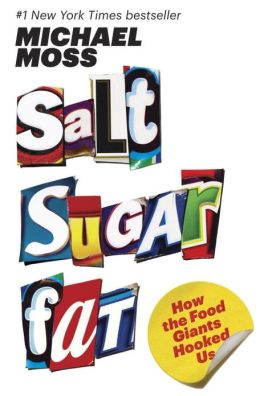
 I really enjoyed the read--Moss looks in depth at the way in which each of the three titular ingredients affects the "food" we eat. Along the way, we get a history of the industrialization of food and an excellent example of how Johanson's Law can be applied: for all that the food companies claim to want to serve us safe, nutritious food, we still get food that is addictive, damaging to the environment and the public, and very very profitable. Thus, the stated goal is the smokescreen, the desired outcome is the one we are dealing with. After all, why would food companies want us to eat a nutritious and balanced diet? There's no real money in it. Maximizing profits, that's the real goal.

Tuesday, June 4, 2013

Stop Food Banks Now!

I'm in love! Over at Civilieats they're talking about:
What if the little old ladies who run the neighborhood church food pantry rebelled? What if they said “we’re 70 years old, we’ve been feeding people for 20 years, and hell if we want to do it for another 20?” What if they demanded that the government reduce the incidence of poverty so that food pantries don’t need to exist in the first place?
Hard to imagine? Well, that’s exactly what has happened in the province of Ontario. With the support of an experienced community organizer, volunteers from emergency meal programs, and food banks (what we call a food pantry in the U.S.) have decided to form a “union.” They’re calling it Freedom 90, a spoof on the “Freedom 55” financial planning advertisements that promise the good life to Canadians who work hard and invest their savings wisely, so they can retire by 55.
Tongue in cheek, yet deadly serious, these volunteers want to “retire” by the time they hit 90. They are tired of the perpetual emergency of having to provide free food boxes every week for the past two decades, but are compelled to continue because of the need they see in their communities.
We're thirty years into a slow-motion famine in Canada. And what's worse, it is a famine that was planned for, and brought about by, our own government in order to funnel more money into the pockets of the 1%. They knew what they were doing, they decided to do it, and they were amply warned when they did it. But no member of the Mulroney government (or any of those that followed without reversing the policies) will ever be brought to bar to answer for the destruction and death their policies have caused.
Food security is thought (viz. Watts and Bohle in The space of vulnerability: the causal structure of hunger and famine  Progress in Human Geography 17:43-67.) is a function of elements: the exposure to a risk or hazard, the capacity to adapt to this hazard, and the potential of the problem to have severe consequences. While most threats to food security come from natural hazards--lack of rainfall, global warming, desertification-- we don't expect the hazard to be caused by our own government. Particularly not in a "democracy" such as ours. But that is exactly what the neo-liberal policies pursued under Mulroney et al. have done. Food banks sprang up immediately as the Mulroney government attacked income re-distributive programmes in Canada. And they have never gone away.