Tuesday, March 29, 2011

Quinoa and Food Faddism

Photo from Wikipedia


    Over at The Independent (22 March 2011) they're talking about "the "lost crop" of the Incas, a health-giving seed found in the Andes which is increasingly providing the garnish on fashionable Western dinner plates." The crop is quinoa, a high protein seed with a balance of amino acids long used by people needing a gluten-free grain alternative. It's not particularly "long-lost" either, being a staple of health food shops since at least the seventies.
      What has changed is the demand. The price of quinoa has trebled over the last couple of years, and the article in The Independent makes the unsupported claim that some of this price increase has trickled down to "agricultural workers" in the growing regions. While market prices may have risen over the last five years, it is doubtful that peasant farmers have seen all that much of an increase in their personal income as the majority of profit is always taken by the purchasing desk.

Sunday, March 27, 2011

Propaganda Films

Sometimes it's difficult to get people's attention. And so the message has to be simplified and then simplified again. Stop at the right place, and you have a clear, powerful message to be delivered.  Backward Hamburger seems to stop at the right place, and then present its message in an engaging manner. Have a look.


Sometimes the medium seduces the maker away from the message. 2005's Grocery Store Wars is very inventive and has some funny moments. But sometimes it seems to be about the film-making process rather than about the topic at hand. That it has, it seems, oversimplified its message is mostly borne out by the last five years; "organic" is available, but it's not the organic we think it is.


Still, the call to "learn the ways of the farm" is still a good one. The more you know, the better the decisions you can make.
Still one of the best short propaganda films made about food issues has to be The Meatrix."


All three films were made by the same studio: Free Range Studios. Their mission statement?
"While traditional creative agencies work to sell stuff, we work to sell revolutionary ideas and products that build a more just and sustainable world. We're driven by a belief that the right stories told in revolutionary ways can transform society."

Wednesday, March 23, 2011

Organic Community

Since the 1990s, we've seen an explosion in the availability of organic produce in grocery stores across North America. The question is, obviously, just how organic is this food?
Profit margins in the food business have been flat for decades in the grocery biz, with profit growth coming from squeezing growers and upping prices rather than from increased sales. The one bright spot has been in organic food sales. Organics have been posting growth rates of twenty to thirty percent yearly since the 1970s. Impressive, but still too small a market share to be noticeable until the 90s.
One of the reasons for this is that organic could mean different things in different places. Standards for the organic label varied from state to state and province to province. As Sally Miller details in her book Edible Action: Food Activism and Alternative Economics, "organic" was a dialogue between growers and customers, often mediated by distributor co-operatives. This is borne out by my experience as a grower; we marketed directly to the end consumer, and quickly found that we weren't selling vegetables as much as we were establishing relationships with consumers. People came to our stall not only for fresh and pesticide-free food, but for contact with the growers, for narratives about the food, and generally for a sense of community.

Tuesday, March 15, 2011

Supply, Demand, and Speculation

     Two articles in the Monday 14 March 2011 Globe and Mail business section caught my attention. One, a column by Brian Milner called Taking Stock (B1) talks about the recent rises in the commodities and futures market. The other, by Jeremy Torobin, The seed for food inflation (B3) is about the rise in food prices now underway. Reading them back to back is instructive. Torobin points out that the current value of the Canadian dollar is helping keep a lid on import prices--particularly those used in food processing. But with George Weston Ltd. announcing an average 5 percent price rise starting April first, and other major producers set to follow, it is expected that the average increase in a Canadian family food bill will be about 7 percent by the end of the year.
     The reasons for this food price inflation are the usual suspects; higher fuel prices (the disruption of Libya's 1.5 percent of global production is cited), growing population and rising incomes in the developing world (particularly China), and "diminishing supply". This last is interesting, because two pages earlier Brian Milner is quoting the U.S. Department of Agriculture as calling for bigger harvests and higher global stockpiles than previously expected. Also, other oil producing nations have announced that they will be able to pick up the slack in oil production, and China is busy buying farmland around the world (particularly in Africa) and getting into industrial food production in a big way (trying to avoid contagion from Egypt and Tunisia, among others).
     So what is driving food price inflation? The same thing that drove house price inflation--hedge funds and "other speculators who have shoved hundreds of millions into agricultural futures and swaps" (Milner, B4). Commodities have been one of the plays of choice for speculative money since the meltdown of 2008. Milner interviews Ron Lawson, co-founder of Logic Advisors, who spends a lot of time and energy following agricultural commodity markets for his clients. And Lawson is pretty blunt in his analysis:
     Supply and demand establish the balance sheet. But when participants come in with amounts of money that are multiples of the available commodity, that's speculation. We always say that the specs got more money than the trade has cotton.
     If you're a big money manager, your round lot, your loaf of bread, is $100-million. Well, with $100-million you can buy the entire open interest of a commodity contract. So when these guys come into the market, they're not doing it on a demand-supply basis. They're looking for somewhere to place money. they're looking for an investment that gives them alpha, some kind of yield that can improve their returns. They're the whale that jumps into the pond.
     The whale that jumps into the pond, indeed. And they're entering a system that is not designed to feed people, but rather to maximize profit. And a 7 percent return looks a lot better on the year end report than the battering speculative money took in the housing collapse.
     So speculative money drives up the price of agricultural (or "soft") commodities, the processors jack their prices, and we all pay for it because food is one of those weird things--a necessity that is not a right, but a commodity. Unlike, say, air.
     But what happens with all this frothing of the futures market? Right. the same thing that happened in housing; a speculative bubble. Let's give the last word back to Mr. Lawson:
I've only been doing this 30 years. There are guys who have been around longer. But one of the things I learned a long time ago is that speculating in futures is God's way of telling you you've got too much money.

Saturday, March 12, 2011

Different Definitions

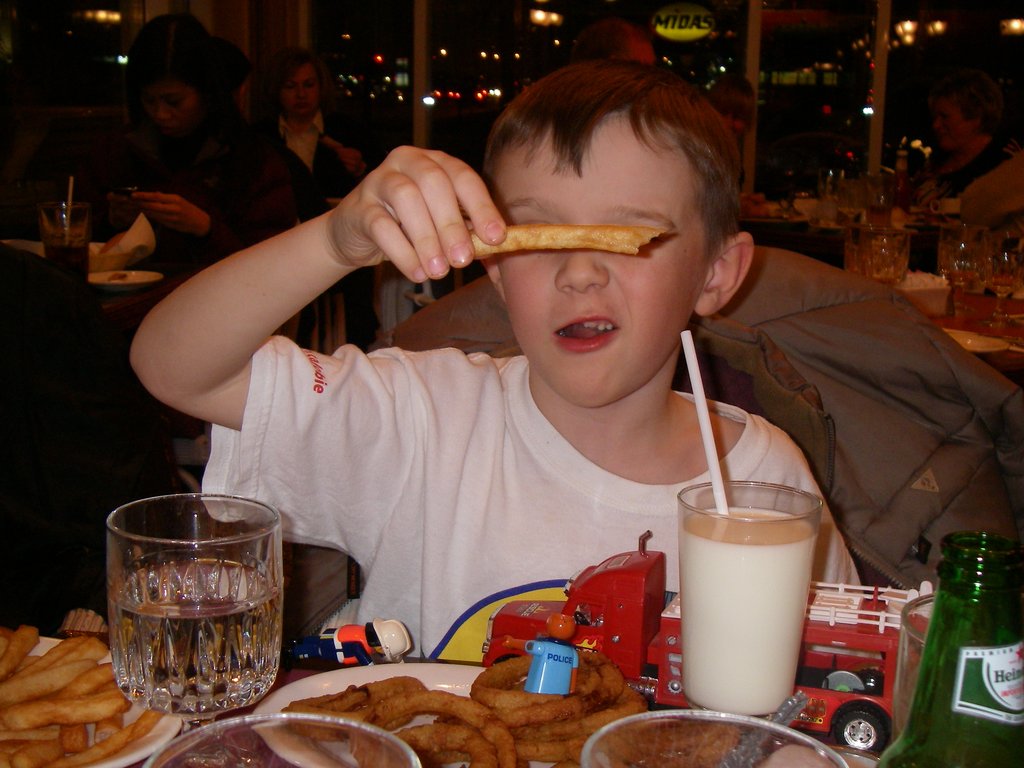
     My nephew clearly has his own definition of "food security".

Yes, that is a policeman in the middle of his onion rings. And there's also a firetruck on standby. So his food is definitely secure.

Thursday, March 10, 2011

The Far North

     Of all the places in Canada, the North is the most food insecure. The North faces a number of factors that intensify problems north of sixty. The Yukon is at high risk for earthquakes (in 1964 a quake killed 134 people in Alaska), highways face more extreme conditions while dependance on trucked-in produce is high and energy prices are heading up, extreme weather conditions make flown-in produce both dear and uncertain, and local production is almost non-existent.
     The Yukon does not grow its own food. The Globe and Mail reports that the total population of food animals, for example, is about that of a large southern farm: 220 cattle, 160 hogs, 62 farmed elk, 130 goats and sheep, and 150 farmed bison. That is the population of farmed animals for the whole of the Territory. Production of grains and vegetables is similarly anaemic.
     It is true that conditions are not the best for southern-style agribusiness. After all, the number of frost-free days ranges from 93 down to 21. But that doesn't mean that local production can't exist; there was a government program back in 1988 that studied how to grow wheat, peas, and oilseed. And an Albertan couple have spent the last seven years overcoming the crap conditions and poor soils to grow oats, barley, carrots and potatoes. The couple, Steve and Bonnie Mackenzie-Grieve, have taken almost the whole food chain under their control, milling their own grain, and washing and bagging their own potatoes.
     But although there is a history of small-scale agriculture in the Yukon, there is currently significant resistance to agriculture in the North. Rick Tone, executive director of the Yukon Agricultural Association, is quoted in the G&M as saying "They [much of the northern population] see agriculture here as a blot on the environment." Fair enough, but what then of wild harvesting? Migratory populations have long served to keep the northern population fed (and housed, and clothed). Part of the problem is cramming too many people into an environment not equipped to handle them, but also by that population's reliance on a southern diet of chicken, pork, and beef. The Lapp of Finland have successfully ranched reindeer for generations; what is there to stop northerners from doing the same? This would mesh northern requirements with northern conditions. It doesn't meet the requirements for produce, but raising local food production from the current ~2 percent of needs, well, any increase would help.
     Ultimately, of course, maintenance of a northern population requires both local food production, southern supplement (particularly with the extreme conditions of the North), and a sustainable population size. There was a reason that the Inuit were never too populous--they lived in an environment that restricted population growth. Modern northern populations are dependant on fossil fuels; the houses are not built for the northern environment, but rather to be heated with imported fuel. Food is transported, the local population is abstracted from the environment, and if the oil stops, everything stops. Essentially, these are the problems we all face, just writ large. And the solutions are the same; solutions that are local, sustainable, and environmentally sensitive.

Friday, March 4, 2011

Feeding People Is Easy review

Recently finished reading Colin Tudge's book Feeding People is Easy, a book about food security that offers a couple of focused ideas for reforming the world food system.

Feeding People is Easy is a bit different than most of the food security library I'm reading my way through. First off, it doesn't spend all its time on discussing what's wrong with the current food system. And that's good, because Raj Patel, Eric Schlosser, and Michael Pollan have really covered that aspect, and covered it well. Colin Tudge takes the approach that:
The world's most powerful governments, industries,and their attendant experts and intellectuals have their minds set on quite different goals, and are pulling in quite different directions--to a large extent completely opposite to what is really required. To be sure, the title of this book [Feeding People is Easy] is a little hyperbolic: the human population will reach nine billion by 2050 and it won't exactly be easy to feed everybody to the highest standards. Yet it should be well within our grasp. Indeed this goal is so obviously achievable that it would surely be extraordinarily remiss not to give it a try. In this book I will explain how. But the harder task by far is to by-pass the powers-that-be. To do what needs doing we have to re-invent democracy, or rather to make it work almost for the first time in the history of civilization, for the chief rule of democracy--that we should be able to get rid of our "leaders" when they cease to function on our behalf--has gone missing. "They" do not know how to run the world, but they do know how to hang on to power. In the last chapter, I will be addressing this, too. Revolution is not required. Renaissance is what's needed--and that is very achievable.
(page 13)
Tudge argues that our current inability to feed the world (according to Raj Patel, "There are 75 million people more undernourished now than in 2008") has nothing to do with the inhospitality of the earth, or some basic flaw in humankind, but that it has "everything to do with policy." That we do not feed everyone is a matter of decisions we have made--maybe not individually, but certainly in our political centres. These decisions are things like deciding to treat food as a commodity, and driving people off the land in order to "modernize" agriculture. "Real agriculture," argues Tudge, involves having people on the land growing crops.
The cause of all our troubles has almost nothing to do with the difficulties that nature presents us with. The fault lies almost entirely with policy and strategy: ideas and courses of action dreamed up by human beings. If we, humanity, analyzed our own problems more astutely and from first principles, and if we did things differently, then even at this late hour we could create a world that was good for everyone, and for all our fellow creatures, forever. We should certainly be thinking of the next 10,000 years, or indeed of the next million. There is no good biological reason why our species should not last at least that long. That we should be seriously doubting our ability to make the world safe even for our grandchildren is ludicrous.
(page 18)

Tuesday, March 1, 2011

Something Good

     I read a lot, and a lot about food security. I try and synthesize the information I read into a whole and to communicate from a position of intellectual coherence. But occasionally I run across a bit of writing that is just excellent and needs no real gloss from me. Today is one of those moments.
     I'm currently burning through Colin Tudge's book Feeding People is Easy. I'm really appreciating how solutions oriented the book is. (An article of his in the journal Public Health Nutrition is available as a pdf here.) But in the meantime, he pretty well summed up my feelings with this passage:
    But never in all history have the powers-that-be had the wherewithal to operate on the global scale as they do now. Never have they been able, as now, to take the whole of world farming by the scruff of its neck and ram it so procrusteanly into a structure and philosophy that are so alien to its purpose, and so at odds with the needs of humanity and the biological and physical constraints of the world. The powers-that-be behave as if they were playing a game--which indeed they are: a game of money and power. They are forever lecturing protestors like me about the need to be "realistic"; but the only reality they recognize is the political-economic, commercial-military power game that they happen to be engaged in, and which makes them rich. They have no feel at all for the physical realities of the world itself, and the creatures within it, and for the ways in which farming has, in reality, been practiced this past ten thousand years, and by whom.  They have a great deal of "data", which they collect and publish selectively and manipulate with the aid of lawyers and other rhetoricians this way and that, largely for our bamboozlement, but that is not the same thing at all. The world is suffering, possibly terminally, from a huge irony: that the powers-that-be live in a fantasy world of their own devising, blind to every observation that is in any way inconvenient, yet they believe that they really do know what they are doing, and that they alone are the realists. We are dying of their illusions.
(pages 46-47)
"...take the whole of world farming by the scruff of its neck and ram it so procrusteanly into a structure and philosophy that are so alien to its purpose...." That just sums up our approach to the natural world. The difficulty is, Gaia will fight back. Contrary to popular belief, it is we who must adapt or die.

Wednesday, February 23, 2011

Blueberries and the Bigger Question


     I would have preferred to  have embedded this, but there you go. It is worth watching, though.
Blueberries faked in cereals, muffins, bagels and other food products - Food Investigations - NaturalNews.tv
     The point of the piece is pretty good; you may think you know what you're buying, but you really don't. Of course, glancing at the ingredients list would have told you that. Or the fact that you're already buying a processed food-like substance rather than, you know, food. But nevertheless, there is a lot of marketing money being spent to ensure that you are mislead about what it really is that you're buying.
     This is the reason that Michael Pollan and others suggest that you simply skip the inside of your local supermarket. If you must shop there, minimize the damage by shopping the outer edges rather than the centre shelving. If your grandmother wouldn't recognize it as food, don't buy it.
     This does show one of the reasons that farmers are getting less than ever of each food dollar spent these days: most of the "food" being sold isn't food, but manufactured edible food like products. And thankfully, vegetables are still vegetables, fruit is still fruit, and we can still recognize them as such. 

Tuesday, February 22, 2011

Population Pressures


The global food system will experience an unprecedented confluence of pressures over the next 40 years. On the demand side, global population size will increase from nearly seven billion today to eight billion by 2030, and probably to over nine billion by 2050; many people are likely to be wealthier, creating demand for a more varied, high-quality diet requiring additional resources to produce. On the production side, competition for land, water and energy will intensify, while the effects of climate change will become increasingly apparent. The need to reduce greenhouse gas emissions and adapt to a changing climate will become imperative. Over this period globalisation will continue, exposing the food system to novel economic and political pressures.
So understates the British report The Future of Food and Farming: Challenges and choices for global sustainability. Two billion more people to feed by about 2050, and we can't even get food from farm to plate with the people we've already got.
     We're bloody useless at food, really. We've experience with famine that stretches back to the dawn of time, but we still haven't figured out how to handle famine relief. When food prices began their upward movement in 2008, it was clear that  a lot of people were going to fall off the food delivery waggon. And they did. As Raj Patel points out, "There are 75 million people more undernourished now than in 2008."And that's in the modern fossil fuel age--and that's not the total number of people who are food insecure or actually starving to death. That's just the people added to the total in the last two years.

     Part of the problem is the way we treat food.
These perverse poles of the global food economy, obesity and hunger, reflect the basic reality that while food is elemental to life and health it is conceived as a commodity and not a right--food aid and food banks, which reflect a minimalist conception of food rights, notwithstanding--and the motive force of profit prevails over concerns about equity and nutrition.
The global food economy : the battle for the future of farming p. 13
Food is not a right, but a commodity. As such, steps have to be taken to ensure that the maximum of profit can be realized; thus the use of food aid as a lever to destroy local markets, depress food prices, drive farmers off small holdings and into the cities, and the concentration of land ownership into fewer and fewer hands. none of this actually improves access to food, quality of food, or security of supply--although all of these claims are made, none of them stand up to sustained scrutiny.