As Naomi Klein has so ably dissected in her book The Shock Doctrine, disaster capitalism has learned how to maximize profit during periods of social crisis. If necessary, these same disaster capitalists (people like Dick Cheney, with his deep ties to Halliburton), will engineer crisis' in order to move additional wealth into their (and their corporation's) pockets. This is one of the reasons that the modern corporation can be seen as psychopathic: what to normal sane human beings seems like horror and destruction (places such as Haiti, Iraq, and Afghanistan) are seen by disaster capital as opportunities to be created and then exploited. Particularly if public money can be funnelled into their private profits.
it is not new thinking that communities in crisis---crisis such as war or natural disaster or other such upheavals--are communities which are vulnerable. Simply imagining or remembering a crisis in your own family and extrapolating out to a city, country or social grouping should display the degree of vulnerability these communities experience. But what happens when the crisis is planetary?
Global warming, or global climate change, is such a crisis. But because it is so slow moving (like an avalanche, it starts slow and build up size and power as it continues), we're having trouble recognizing it. And because the initial effects are felt most in the developing world, we in the developed world (by virtue of our institutionalized alienation from the natural world) can choose to avoid and ignore the first overhangs of snow breaking loose and starting down the mountainside.
Currently, farming is in crisis. A recent Bloomberg article remarked:
The global food system will remain
“vulnerable” in the years to come as a growing population
boosts demand for crops and climate change makes weather
disruption more frequent, according to the World Bank.
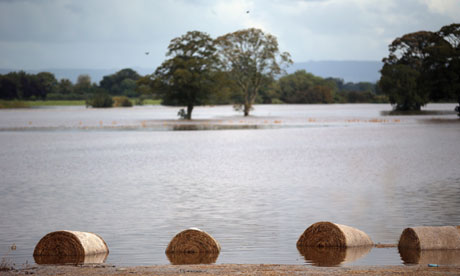
With a warning that Canada should be paying particular attention to--but won't--the Guardian is reporting on the public policy failure around floods.
A high proportion of
the most valuable agricultural land is at risk of flooding, the MPs
said. Photograph: Christopher Furlong/Getty Images via The Guardian
Ministers are failing to protect the UK's most valuable farmland from flooding, posing a long-term risk to the security of UK food production, according to an influential group of MPs.
A run of poor weather since 2011 has led to extensive flooding of properties but has also severely dented the production of many foods, with the UK now being a net importer of wheat.
The
environment select committee's report also said the government's
spending by the Department for Environment, Food and Rural Affairs
(Defra) to protect homes from flooding is not keeping pace with the
rising risk, which is increasing as climate change intensifies
downpours, and were also failing to act effectively to block the
building of new homes on floodplains.
"Record rainfall in the past
two years has led to extensive flooding, cost the economy millions and
caused disruption and distress to householders and communities across
the UK," said Anne McIntosh, a Conservative MP, and chair of the commons
select committee on environment, food and rural affairs.
Extreme weather events are not just a problem for the UK. In a related article, the Guardian reports on the new UN World Meteorological Organization report that points out the unprecedented climate extremes seen around the world over the last decade.
If you think the world is warming and the weather getting nastier,
you're right, according to the United Nations agency committed to
understanding weather and climate.
The World Meteorological
Organization says the planet "experienced unprecedented high-impact
climate extremes" in the ten years from 2001 to 2010, the warmest decade
since the start of modern measurements in 1850.
Those ten years
also continued an extended period of accelerating global warming, with
more national temperature records reported broken than in any previous
decade. Sea levels rose about twice as fast as the trend in the last
century.
A WMO report, The Global Climate 2001-2010, A Decade of Climate Extremes,
analyses global and regional temperatures and precipitation, and
extreme weather such as the heat waves in Europe and Russia, Hurricane
Katrina in the US, tropical cyclone Nargis in Myanmar, droughts in the
Amazon basin, Australia and East Africa, and floods in Pakistan.
Looking at something a bit lighter, let's learn how to make an excellent lamb kofte, shall we? Felicity Cloake writes in the Word of Mouth blog about the process. As an aside, this is part of a series of posts; How to Cook the Perfect. And this is how you present a recipe in a blog post, people. We've really got to up our game. This gives you the information you need, the context to work from, and a sense that maybe the writer has actually tried to make the recipe (I'm reminded of the scene in Julie and Julia where Julia Child discovers that Ms. Rombauer hasn't checked the recipes in Joy of Cooking to see if they even work). It's like linking to source articles when writing an opinion piece--it adds a level of verifiability to your work.
So here's Felicity herself to tell you about the process of making kofte.
Global food prices fell 1% in June due to improving supply prospects, the United Nations' food agency has said , raising forecasts for wheat and maize output in the new season.
Food
prices spiked during the summer of 2012 due to a historic drought in
the US but prospects for a rebound in global grain supply and good
weather forecasts are now weighing on markets.
The Food and
Agriculture Organisation's (FAO) price index that measures price changes
for a basket of cereals, oil seeds, dairy, meat and sugar, fell for a
second month running to 211.3 points in June – its lowest level since
February.
If you haven't discovered it yet, there's a lovely interactive map sponsored by The economist that lets you see where you--and pretty much everyone else, ranks in terms of food security. Click on your country (or the country you're interested in) and pull up the world ranking of food security and what went into generating that rank. Canada, by the way, ranks 8th worldwide. Among the key findings?
Falling national incomes hurt food security in some developed countries over the past year.
Greece recorded the steepest fall among developed nations,
dropping six places. Greece’s GDP has plummeted by more than 20% since
the 2008-09 global recession. Income per person dropped in most advanced
economies in the past year, the result of weak economies. Although this
reduced food security in these countries, they remain, for the most
part, in the top 20% of the index and thus are not in serious danger of
food insecurity.
And, finally, if you're not following the Journal of Peasant Studies, you're missing out. Open source, peer reviewed.
Don't think for a minute that I think the folks over at NECSI (The New England Complex Systems Institute, about whom I've written before) are tenting their fingers and cackling in a Mr. Burns-like way while they manipulate the world's food markets in order to test their theory of food price spikes and social unrest. Rather, it is the rest of us who have embarked on the testing program.
The researchers at NECSI have been modelling food prices, ethanol production and the effect of speculative money on the international food system. In their model, once the FAO (Food and Agricultural Organization) food price index hits about 215 (or 190 adjusted for inflation), all hell breaks loose. Food prices have been advanced as the most reasonable explanation why, for instance, unrest in the Middle East went so quickly from regional to widespread, birthing what we now know as the Arab Spring. And the Arab Spring followed one of these price spikes.
And it makes sense. Bread riots are a recurring theme throughout history. Hunger is a strong motivating force.
FAO Price Index at current prices (black curve) and corrected for
inflation (blue curve) between January 2004 and May 2011. Red dashed
lines signify the beginning dates of food riots and unrest in North
Africa and the Middle East. Black and blue horizontal lines represent
the current-price and inflation-adjusted food price thresholds for
riots. Bar-Yam et al/arXiv
And the researchers at NECSI, following their noses, noted last year that world food prices were going up (driven by corn-to-fuel programs in the US, but even more so by speculative money), and the food price index looked like it would peak above the magic 215 again in 2012. And then climate change kicked in and drought spread across North America.
Big money has already bid prices up, driving another speculative bubble in food. To quote from the NECSI press release:
The worst drought in the American Midwest and the highest temperatures in a half-century are poised to trigger an imminent global food crisis, scientists at the New England Complex Systems Institute said Monday. NECSI has warned for months that misguided food-to-ethanol conversion programs and rampant commodity speculation have created a food price bubble, leading to an inevitable spike in prices by 2013. Now it appears the "crop shock" will arrive even sooner due to drought, unless measures to curb ethanol production and rein in speculators are adopted immediately.
FPI over time From the NECSI website
Canada and the US are probably going to be relatively insulated from the worst effects. We'll see a rise in food prices of, well, 4% or so is being bandied about. But if the markets actually do get crazy, this will probably rise significantly. Spending more on food is not the worst thing that could happen to us—North America has some of the lowest food prices ever in the history of civilization. But taking money out of discretionary spending and putting it toward food will push us closer to a full-on depression and the potential for major social unrest.
It is interesting to me that in all the coverage that the current NA drought is getting, the risk to, and effect on, food prices from speculation has been pretty much ignored. Yet, as NECSI research has shown, “while the behavior [of the food price index] could not be explained by supply and demand economics, it could be parsimoniously and accurately described by a model which included both the conversion of corn into ethanol and speculator trend following.” Like the idea of serious banking reform after the appalling criminality of the past decade among the international banks (as I write this Standard Chartered is taking a hammering after the New York state regulator accused the U.K. bank of being involved in laundering money for Iran), reining in speculation in the international food market has been deemed “off the table” apparently.
We are facing a bleak future in which billions of us will starve to death, not because there isn't enough to eat, but rather because of the imperative to maximize profit. We've seen this before: in Ireland during the Great Famine, there was always food in the markets, there just wasn't any money for the poor to buy it. And in many famines since the 1950s, food aid has been used as a way to dump excess production and often to destroy local food production and distribution networks to allow foreign companies into the market (this would be one of the major reasons behind the homogenization of world food culture). So once again we will see why forgoing food sovereignty for reliance in imported foodstuffs is historically a very bad idea. And the message will be delivered on the baked bread scent on the breath of the starving.
The pressure's indeed on--the World Bank is reporting global food price increases, increases due to global warming and oil price increases.
The April Food Price Watch report says "Global food prices have increased by 8% in the last four months since
December 2011, and in March 2012 were only 6% below their February 2011
historical peak. All key food prices have increased, except for rice."
Cold weather in extreme cold in Europe, the Russian Federation, and other countries is blamed for upward pressure on wheat prices, while hot and dry conditions in South America have affected sugar, maize, and soybeans. There is a little good news in that a slowdown in maize-to-ethanol conversion in the US is helping put a brake on price rises, as is aa lower value for the Euro.Also, record prices in 2010-2011 have encouraged more planting, which should help offset weather/climate induced shortfalls.
The report also points out some dramatic domestic price changes around the world:
Wheat price increases between March 2011 and March 2012
reached 92% in Belarus and 56% in Moldova, while they declined by 30% in
El Salvador, 19% in Kyrgyzstan, and 16% in South Africa. The price of
maize rose by 82% in Malawi, 80% in Ethiopia, and 71% in Mexico. The
largest maize declines occurred in Honduras (31%), Somalia (20%), and El
Salvador (19%). Rice prices in the same period rose by 125% in Uganda,
54% in Tanzania, and 38% in Rwanda. In turn, Bolivia saw its rice prices
decline by a more modest 21% and Bangladesh's declined by 18%.
So while there have been some declines in prices, the rises have more than outweighed them. But once again, the shortfalls in production, while worrying, and the price increases, while scary, do not mean that there isn't enough food in the world. Famine is not an automatic byproduct of these shortfalls. Starvation will result from a lack of purchasing power, not a lack of food.
And, to repeat:
Models that just treat
supply and demand are not consistent with the actual price dynamics. There is a consistent firm
upward pressure on food prices from the increased demand from ethanol
conversion programs, but the big driver of food prices is "specifically
due to
investor speculation."
There is a lot of serious, high-level worry going on over the state of our current and future world food supply these days. Such as the Planet Under Pressure conference that just wound up at the end of March. As the New York Times reported about a year ago:
A rising unease about the future of the world’s food supply came through
during interviews this year with more than 50 agricultural experts
working in nine countries.
These experts say that in coming decades, farmers need to withstand
whatever climate shocks come their way while roughly doubling the amount
of food they produce to meet rising demand. And they need to do it
while reducing the considerable environmental damage caused by the
business of agriculture.
Agronomists emphasize that the situation is far from hopeless. Examples
are already available, from the deserts of Mexico to the rice paddies of
India, to show that it may be possible to make agriculture more
productive and more resilient in the face of climate change. Farmers
have achieved huge gains in output in the past, and rising prices are a
powerful incentive to do so again.
Of course, if we really wanted to increase productivity, we'd do something about the size of our farms. Most of the world has small farms that are highly productive--weather permitting. But particularly here in North America and in Europe, farm sizes are large, which means high productivity per worker, but a lower calorie yield per acre. This is known as the Inverse Size Yield Relationship, and coupled with traditional farming techniques, means a higher sustainable yield from small farms over large ones. Here in Victoria, the founding farmers of Saanich Organics, a farmer-run local food distributor, have published All The Dirt: Reflections on organic farming. None of them runs more than a couple of acres, choosing to farm intesively and sustainably, rather than even try to take on a small Canadian farm of a couple of hundred acres. And they're making it pay.
But the combination of biofuel production in the US and commodities speculation following the 2008 crash, mean that food prices are headed back up again this year. Same reasons, just another speculation-driven price bubble.But, in order to ensure that speculators make their nut, a few hundred million more people will drop into food insecurity, and those already hungry will die.
We're facing a perfect storm: population pressures, unregulated capitalism, an international monopsony/monopoly market in foodstuffs, climate change seriously messing up weather patterns, the list goes on. As a society, we won't stop--Canadian rime Minister Stephen Harper has announced that the environment will not inhibit Canadian resource (read: petrochemical and mining) extraction and export. On the climate front, this winter Canada has seen records going back 150 fall regularly; one "warmest day" record was smashed by 20°C.
But this boat's too big to turn.Too many people are making far too much money with things the way they are now. As Yvo de Boer, former head of the UN Intergovernmental Panel on Climate Change and now Special Global Advisor to KPMG, notes [pdf],
“if companies had to pay for the full environmental costs of their
activities, they would have lost 41 cents out of every (US) $1 earned in
2010. The external environmental costs of 11 key industry sectors rose
by almost 50 percent between 2002 and 2010, from $566 billion to $854
billion.”And if you own the governments, are you going to allow a sudden tax increase of 41%? Even if it means saving the planet for your children? No, and not just because you are legally constrained from doing so, but because destruction of the world just means you better get yours now. But you don't want to believe it might well be the end of civilization (Hell, I don't want to believe it). Just like Pol Pot didn't see himself as a genocidal monster, we don't want to see ourselves as environmental criminals. But it doesn't change the fact that we are.
Over at Climate Change Agriculture and Food Security, they're worried about feeding the world in 2050. Using the following video as a teaching tool, they're showing us what a small target we're currently trying to hit. They also point out how we might make the target a bit bigger. So they, at least, are trying to remain optomistic.
Over at the Council on Foreign Relations, Laurie Garrett is interviewed about how the stumbling value of the US dollar and rising international food prices mean that donor pledges are worth less (although not yet worthless). $300 million just doesn't buy what it used to. So what does that mean for the starving? To say nothing of how food aid is used by governments to destroy local food markets and buy access for "their" multinational industrial food corporations. (If you dump free food onto a market you change the price local farmers can get for their crops to zero, and everyone knows, you can't compete with free. This destroys local farming communities and infrastructure, leaving the field clear for the Monsanto's and ConAgra's to come in preaching the "Green Revolution" doctrine of big farms and monocropping with high input costs). This would be an example of the law of unintended consequences, except that it was intentional.
And, in Thailand, there's a new delicacy on the menu:
The New England Complex Systems Institute and their President, Professor Yaneer Bar-Yam who's study I quoted when writing about debt and food prices, have issued an update to the landmark study done on the relationship between corn ethanol production, food commodity speculation and food prices. And Professor Bar-Yam is pretty convinced we're not done with the madness yet.
The Institute's web site hosts three very interesting short videos (regretfully, not embeddable) about the relationship of corn ethanol production, food commodity speculation, and food prices. The first shows how food prices between 1980 and 2000 fluctuated moderately around a consistent value, where prices neither spiked nor collapsed. Then food prices begin a dramatic upward climb peaking in 2008 and 2011. These two spikes are rather dramatic, and Professor Bar-Yam draws a direct link between the price spikes and social unrest. This is shown in the second video which links social unrest (like the Arab Spring) with food prices between 2004 and 2011.
The third video graphs actual food prices with increases in demand from ethanol production and speculation. To quote the update:
Our analysis shows that dominant causes of price increases are investor
speculation and corn to ethanol conversion. Models that just treat
supply and demand are not consistent with the actual price dynamics. The
two sharp peaks in 2007/2008 and 2010/2011 are specifically due to
investor speculation, while an underlying upward trend is due to
increasing demand from ethanol conversion.
Models that just treat
supply and demand are not consistent with the actual price dynamics. I thought that bore repeating with emphasis. There is a consistent firm upward pressure on food prices from the increased demand from ethanol conversion programs, but the big driver of food prices is "specifically due to
investor speculation."
"The food price bubble of 2011 caused widespread hunger and helped
trigger the Arab spring. In 2013 we expect prices to be even higher and
may lead to major social disruptions." said Professor Bar-Yam President
of NECSI, who has just returned from Davos where he presented his
findings on speculation in global commodity markets. His paper "The Food
Crises: A Quantitative Model of Food Prices Including Speculators and
Ethanol Conversion" was called by Wired magazine one of the top 10
discoveries in science of 2011.
In 2008 and 2011 increases in global food prices triggered hunger,
food riots and social unrest in North Africa, the Middle East, and
elsewhere, at a cost to global stability which policy makers can no
longer ignore. Over the past decade, world unrest has sharply increased
at time of peak food prices; now the long-term price trend is getting
close to what used to be episodic peaks.
According to the new study, the next food price peak will take place
in about a year. The results will be dramatically higher prices than we
have encountered thus far. The study warns that should ethanol
production continue to grow according to multiyear trends, even the
underlying trend will reach social-crisis levels in just one year.
So get a garden in, build a chicken coop in you backyard, and plan to do a lot less of everything, because you're going to need your $$ for food. Our refusal to find a way to put the brakes on global capitalism means that we're in for a rough few years. A lot more people are going to fall from "working poor" into "destitute poor" and none of it needs to happen. I don't want to go off on a rant here, but really people:
Is it really going to have to take a revolution to get the comfortable to pay attention?
Eric Reguly, in the weekend Globe and Mail, tries to compare and contrast two different crisis which originated in 2008: the European debt crisis, and the international food crisis. The two crisis were linked, mostly by nervous money fleeing the world's debt markets for commodities (and both were precipitated by the criminal activity engaged in by various investment banks like Goldman Sachs and Bear Stearns prior to the housing bubble popping). The role of speculative money in causing the worldwide food price inflation of 2008 through 2011 is pretty common knowledge. Starbucks president Howard Shultz, as reported in the The Telegraph, has said:
... the current spike in the cost of commodities such as coffee and other foodstuffs is "not based on supply and demand" but based on market speculation. He said that the farmers who actually produce the commodities are receiving a "de minimus" proportion of the price rises.
"Right now we are experiencing a very strange and almost inexplicable phenomenon in the commodities market. Without any real supply or demand issues we are witness to the fact that most agricultural food commodities are at record highs at once, and coffee is at a 34-year high."
Frederick Kaufmann, in The Guardian, follows up with a brief interview with Professor Yaneer Bar-Yam, of the New England Complex Systems Institute (Necsi):
"Prices have been way out of equilibrium in 2011," Bar-Yam told me. "The bubble has not burst yet."
According to Bar-Yam, the international thirst for biofuels has put a strain on arable land previously reserved for food production. At the same time as the rise of the biofuel mandate, the rise of investable commodity indexes and other electronically traded funds has offered investors of all stripes a chance to sink their cash in a sparkling new casino of derivative products. As a result, an ever-flowing spring of speculative capital sustains the status quo.
But just as food is no ordinary widget, speculation in commodity markets is not simply a matter of financial predation. "The high prices of food have resulted in accumulations of inventories at the same time as people can't afford food," said Bar-Yam, who noted that the Arab spring was triggered by the food-price bubble. In fact, Necsi's quantitative model of speculation predicted the uprisings in Tunisia, Libya and Egypt, and warned that if food prices remain inflated, riots and revolutions will go global sometime between July 2012 and August 2013.
"We are at a critical point," said Bar-Yam. "We don't have a stay-the-course option right now."
Notice that quote: "The high prices of food have resulted in accumulations of inventories at the same time as people can't afford food." That makes it very clear that this is about speculation, not supply and demand.
A few years back--about 2008--there was rice rationing in the US and a great fear of rice shortages around the world. This lead to a certain amount of panic, particularly in Asia where citizens have traditionally consumed 70-80% of their calories in rice. The story of what actually happened is a combination of non-transparent markets, panic, reasonable actions on the part of governments, corrupt actions on the part of governments and their officials, reasonable actions on the part of consumers, screwy international trade activity, and just a general mess.
NPR ran a great story on the "crisis" and thankfully it's available in a podcast of the show Planet Money.
There's also a short interview with economist Peter Timmer on their website. But what is interesting are the lessons learned from the crisis. If you listen to the whole story, you hear that the lesson that the WTO and Western economists take away from the "crisis" is exactly the opposite of the lesson learned by the governments involved. The interesting thing is, both sides appear to be right; open markets and transparency are good, but food security is a necessity. The problem is, neither side can see that maybe both lessons need to be learned.
Over in China, flooding has innundated over 1 million acres (just over 404 thousand hectares) of farmland, raising local food prices by a minimum 20%. Flooding has been bad this year pretty much everywhere--like southern Saskatchewan and Manitoba. Warm air holds more water than cold, and the steady upward drift of average global temperature means we're going to face more of this. There's a short article on the China flood in The Guardian.
In an op-ed piece in the NYTimes, Patricia McArdle writes about how the US is destroying one of the last locavore cultures with foreign aid. No surprise there. This has been the role of foreign aid since the mid-sixties and the birth of the "Green Revolution." That the US is still pursuing a policy decades after it was shown to be misguided and wrong isn't much of a surprise either; the US is a ship that may no longer be able to turn. Oh, and the locavore culture being destroyed? Afghanistan.
Verlyn Klinkenborg writes a very short piece (A Welcome Silence) on the joys of leaving the hearing protection on when working. It echoes one I read in Harrowsmith a decade or two back that suggested that rather than using hearing protection, one could just give up the chainsaw....
Xinhua News, on their English news site, is reporting that "China, South Korea and Japan will each provide up to 200,000 tons of rice for a contingency plan of the Association of Southeast Asia Nations (ASEAN) plus three, out of total allocation of 787,000 tons" destined for an ASEAN +3 stockpile. The idea is to manage price volatility and ensure emergency stocks of rice. Indonesian Agriculture Minister Suswono said "We will propose that it wouldn't be only for emergency situation but also for price stability. It means that we should increase the reserves in case of price volatility so that we could conduct market operation." It's interesting that ASEAN has taken this action now, as International prices, Thailand: Bangkok, Rice (Thai 100% B) , Export, US Dollar per Tonne have dropped considerably since peaking in 2008 (peaking at $962.60, prices have since dropped to $507.25--which is still double the 2000 price of $243.50/ton according to the FAO). It means that the collective governments of the Association of Southeast Asia Nations (+3, of course) are concerned about continued price volatility in their collective markets. The FAO is also showing that, worldwide, prices are climbing again, after having spiked in 2008 and dropping last year. Meat and dairy products have either almost recovered or have (in the case of meat) exceeded their 2008 price highs. Cereals are still down--lower than last year, even--but oils and fats have showed increases. All in all, this brings the global food price index to 164--the second highest point it's achieved this century; having started at 90 and peaked at 191 in 2008. We can expect continuing volatility over the next several decades; global climate change has shown us increased agricultural impacts in (for example) Australia with drought, flooding, and brush-fires, and according to a recent report [.pdf] (reported by the CBC) expected sea level rise on the BC coast of a half metre by 2050, which will put a great deal of our local agricultural land at risk. If in fact the report is correct when it says: "At the present time, scientific information on the expected changes in storms approaching British Columbia coastal waters and their characteristics, specifically on the intensity of the storms, their related wave conditions and the associated storm surges in the future, is only starting to emerge. Based on the available information it appears reasonable to conclude that no significant change is expected in coastal BC waters," one would expect that if sea levels have increased by a half-metre, any storm activity will have greater effect on coastal areas.
Report on Business Magazine (May 2011) is running an article this month called “How Do We Feed Seven billion People—and Counting?” In it, reporters interview various people, looking for their take on what is evolving into an international food crisis.
The range of opinions and suggestions is much broader than expected—mostly because several of the interviewees are pushing for more of the same discredited policies that we've been pursuing. Sometimes dressed in new rhetorical clothes, but the same solutions nonetheless.
Jeffrey Sachs, the director of the Earth Institute and special adviser to UN Secretary-General Ban Ki-moon, takes on one of the elephants in the room by saying simply that we can't afford to reach nine billion. And its true, we can't. We could, if we took agriculture and feeding people very seriously indeed, manage—just!—to feed nine billion. But it would be incompatible with the international economic order as it is currently constituted. And, as Sachs is quoted as saying:
“This crisis cannot be solved just by food aid or short-term tricks. We have to look at the basic issue: that politicians are locally oriented and cynical, that they make announcements they don't follow through on, and that they're in the pockets of lobbyists intent on preventing solutions.”
As long as the focus is on maximizing return on investment, and not on farmers making a living by feeding people, we will continue to starve both poor people and poor nations. It will be a brutal way to keep population pressure under control—after all, we are increasing by 80 million people a year at this point—but famine will be a very effective method of international social control. But famine does appear to be the weapon of choice at this time.
Abby Abassian is the senior grains economist at the FAO in Rome, and he mentions the other elephant in the room—if only obliquely. When asked “What caused the latest surge in food prices?” his reply is “In one word—weather. This is not like 2007 and 2008, where we had so many other factors mixed in.”
Two articles in the Monday 14 March 2011 Globe and Mail business section caught my attention. One, a column by Brian Milner called Taking Stock (B1) talks about the recent rises in the commodities and futures market. The other, by Jeremy Torobin, The seed for food inflation (B3) is about the rise in food prices now underway. Reading them back to back is instructive. Torobin points out that the current value of the Canadian dollar is helping keep a lid on import prices--particularly those used in food processing. But with George Weston Ltd. announcing an average 5 percent price rise starting April first, and other major producers set to follow, it is expected that the average increase in a Canadian family food bill will be about 7 percent by the end of the year.
The reasons for this food price inflation are the usual suspects; higher fuel prices (the disruption of Libya's 1.5 percent of global production is cited), growing population and rising incomes in the developing world (particularly China), and "diminishing supply". This last is interesting, because two pages earlier Brian Milner is quoting the U.S. Department of Agriculture as calling for bigger harvests and higher global stockpiles than previously expected. Also, other oil producing nations have announced that they will be able to pick up the slack in oil production, and China is busy buying farmland around the world (particularly in Africa) and getting into industrial food production in a big way (trying to avoid contagion from Egypt and Tunisia, among others).
So what is driving food price inflation? The same thing that drove house price inflation--hedge funds and "other speculators who have shoved hundreds of millions into agricultural futures and swaps" (Milner, B4). Commodities have been one of the plays of choice for speculative money since the meltdown of 2008. Milner interviews Ron Lawson, co-founder of Logic Advisors, who spends a lot of time and energy following agricultural commodity markets for his clients. And Lawson is pretty blunt in his analysis:
Supply and demand establish the balance sheet. But when participants come in with amounts of money that are multiples of the available commodity, that's speculation. We always say that the specs got more money than the trade has cotton.
If you're a big money manager, your round lot, your loaf of bread, is $100-million. Well, with $100-million you can buy the entire open interest of a commodity contract. So when these guys come into the market, they're not doing it on a demand-supply basis. They're looking for somewhere to place money. they're looking for an investment that gives them alpha, some kind of yield that can improve their returns. They're the whale that jumps into the pond.
The whale that jumps into the pond, indeed. And they're entering a system that is not designed to feed people, but rather to maximize profit. And a 7 percent return looks a lot better on the year end report than the battering speculative money took in the housing collapse.
So speculative money drives up the price of agricultural (or "soft") commodities, the processors jack their prices, and we all pay for it because food is one of those weird things--a necessity that is not a right, but a commodity. Unlike, say, air.
But what happens with all this frothing of the futures market? Right. the same thing that happened in housing; a speculative bubble. Let's give the last word back to Mr. Lawson:
I've only been doing this 30 years. There are guys who have been around longer. But one of the things I learned a long time ago is that speculating in futures is God's way of telling you you've got too much money.
The global food system will experience an unprecedented confluence of pressures over the next 40 years. On the demand side, global population size will increase from nearly seven billion today to eight billion by 2030, and probably to over nine billion by 2050; many people are likely to be wealthier, creating demand for a more varied, high-quality diet requiring additional resources to produce. On the production side, competition for land, water and energy will intensify, while the effects of climate change will become increasingly apparent. The need to reduce greenhouse gas emissions and adapt to a changing climate will become imperative. Over this period globalisation will continue, exposing the food system to novel economic and political pressures.
So understates the British report The Future of Food and Farming: Challenges and choices for global sustainability. Two billion more people to feed by about 2050, and we can't even get food from farm to plate with the people we've already got.
We're bloody useless at food, really. We've experience with famine that stretches back to the dawn of time, but we still haven't figured out how to handle famine relief. When food prices began their upward movement in 2008, it was clear that a lot of people were going to fall off the food delivery waggon. And they did. As Raj Patel points out, "There are 75 million people more undernourished now than in 2008."And that's in the modern fossil fuel age--and that's not the total number of people who are food insecure or actually starving to death. That's just the people added to the total in the last two years.
Part of the problem is the way we treat food.
These perverse poles of the global food economy, obesity and hunger, reflect the basic reality that while food is elemental to life and health it is conceived as a commodity and not a right--food aid and food banks, which reflect a minimalist conception of food rights, notwithstanding--and the motive force of profit prevails over concerns about equity and nutrition. The global food economy : the battle for the future of farmingp. 13
Food is not a right, but a commodity. As such, steps have to be taken to ensure that the maximum of profit can be realized; thus the use of food aid as a lever to destroy local markets, depress food prices, drive farmers off small holdings and into the cities, and the concentration of land ownership into fewer and fewer hands. none of this actually improves access to food, quality of food, or security of supply--although all of these claims are made, none of them stand up to sustained scrutiny.
Well before 8 o'clock on a late April morning, a line of about 30 eager customers forms at a modest bakery in this working-class neighborhood. With a global food crisis roiling countries from Asia to the edge of Europe, at least 11 people have been killed recently in such lines here, struggling to get their daily bread.
There's no panic, no desperate scrambling for sustenance — a tentative sign of success for an emergency government plan that involves dramatic increases in spending on bread subsidies and the use of Egyptian soldiers as bakers.
"Now we're able to find bread," says Dalia Hafez, 40, seated on a nearby curb in a cappuccino-colored headscarf. "Thanks God, the crisis is over."
For now, anyway. But the aftershocks from the food trauma here are only beginning to be felt. Tensions are continuing to build in this key U.S. ally, evidence that the global food crisis — the product of factors ranging from unusual weather in producing nations to increased competition for grains from biofuels programs — is now about much more than food.
"This crisis threatens not only the hungry, but also peace and stability," the head of the United Nations World Food Program (WFP), Josette Sheeran, warned in a recent speech.
That Egyptian officials regard photos of bakers at work as potentially incendiary is a measure both of bread's unrivaled importance in the Egyptian diet and of the government's concern that continued public discontent over food supplies could metastasize into something more threatening.
"People in Egypt may be considered passive or silent, but there's a limit to this. And when they reach that limit, one day there will be a popular explosion," said lawyer Esam Salam, interviewed at a cafe near Cairo's train station. USA Today 4/30/2008
The roots of the revolution are in food. Much of my life I've heard the saying that no city is more than three days away from revolution--all you have to do is cut off the food supply. Since the Bush regime decided to encourage the production of ethanol in '07-08, speculators have had a field day in the food futures market. And after years of the "green revolution," increasing reliance on petrochemical inputs, and land hunger (and a failure to reform consolidation and exclusion in land ownership), have combined to produce global unrest over the future of eating.
Canada has lost its statue as a food-producing superpower and needs a drastic overhaul of its agricultural policy if it hopes to compete in world markets and feed more of its own people.
The country, hobbled by out-of-date policies and a continuing battle for scarce government dollars, has dropped from third-largest global exporter of food to No. 7 at a time when we can least afford it: Climate change and population growth are putting enormous pressure on the food system while diet-related healthcare costs are weighing on the national economy.
The article is by Jessica Leeder, the full time "global food reporter" at the G&M. Leeder also reported on the cuts at NSERC a while back. And I've gotta say, she's doing a bang-up job of reporting on global food issues. But that the G&M has felt it necessary to appoint a full time reporter shows that we're about five years past the tipping point on the issue.
The problems we face here in Canada can, according to Leeder, be boiled down to three points:
• Farm incomes have stagnated over the last two decades, debt levels are "soaring", even with direct government subsidies tripling to $8 billion over the same time period.
• "Food processors have also struggled, squeezed by demanding retailers who have been lured by higher margins they can reap by selling cheaper imported food."
• "Consumers, in turn, have grown used to spending only a fraction of their income on food and demand cheap prices--at any cost."
Funnily enough, these three problems look familiar. They look exactly like the problems being encountered by other producers and manufacturers in a globalized neo-liberal economic regime.
The Globe and Mail (12 January, 2011, p. A8) reports that the Natural Sciences and Engineering Research Council (NSERC) has removed food-related research from its target funding areas this year. This means that research into new plant breeds and better farming techniques will continue to be slowed. Of course, this comes just as several organizations, including the United Nations, are warning that we are entering a period of global food crisis.
In the first half of this century, as the world’s population grows to around 9 billion, global demand for food, feed and fibre will nearly double while, increasingly, crops may also be used for bioenergy and other industrial purposes. New and traditional demand for agricultural produce will thus put growing pressure on already scarce agricultural resources. And while agriculture will be forced to compete for land and water with sprawling urban settlements, it will also be required to serve on other major fronts: adapting to and contributing to the mitigation of climate change, helping preserve natural habitats, protecting endangered species and maintaining a high level of biodiversity. As though this were not challenging enough, in most regions fewer people will be living in rural areas and even fewer will be farmers. They will need new technologies to grow more from less land, with fewer hands.
NSERC insists, in a statement, that "food-related research, despite not being listed as a target area, continues to be a priority for NSERC funding." NSERC funding has been commonly in the areas of traditional plant breeding--like canola, which was developed by Canadian scientists in the 1960s with government funding, and led to increased oil yields per acre.