Showing posts with label food sovereignty. Show all posts

Wednesday, August 15, 2012

Cuba, Sí


It's amazing how good I feel today. Seriously. Because one of the big clouds has been lifted.
What happens if it all goes wrong? What if estimates of Middle East oil reserves turn out to have been fabricated out of whole cloth for the last thirty years? (A real possibility, much like the way the same Soviet ICBMs became more and more accurate with each budget appropriation cycle in the US during the late 70s and early 80s.) What happens if global climate change doesn't follow the nice timetable laid out by the IPCC, but instead beats us like Buddy Rich doing a solo? If food miles turns out to actually be a real problem? If industrial food collapses like a house of cards? What if the nightmare scenarios actually come to pass?
Well, after reading an article in The Journal of Peasant Studies, I feel a bit more relaxed when I think about the nightmare scenarios. Because Cuba has already been there, done that, and can see light on the other side.
Cuba, post-revolution, invested in extensive agrarian reform, but a combination of circumstances (the US blockade, and joining the international socialist division of labour for two), led Cuba to strengthen their sugar-producing sector; a sector that dominated 30% of the available farmland and generated 75% of export revenues by 1989. At the same time, Cuba was importing some 57% of its food.
Cuba embraced the Green Revolution wholeheartedly, with the most tractors per person and per unit of area, importing 48% of its fertilizers (which doesn't tell the whole story: of the fertilizer produced domestically, there was a 94% import coefficient), and importing 82% of its pesticides. Cuba was a poster child for Green revolution industrial agriculture. With the second-highest average grain yields of Latin America, Cuba achieved a high level of food security for its population. But what they discovered they did not have was food sovereignty. The 1980s brought increasing pest problems and the yields of some key crops began to decline due to soil degradation and pests (this is actually typical of Green Revolution lead areas around the world; long-term yield levelling or decline seem to be part of the model). 

Thursday, August 9, 2012

A Dangerous Way To Test A Theory

Don't think for a minute that I think the folks over at NECSI (The New England Complex Systems Institute, about whom I've written before) are tenting their fingers and cackling in a Mr. Burns-like way while they manipulate the world's food markets in order to test their theory of food price spikes and social unrest. Rather, it is the rest of us who have embarked on the testing program. The researchers at NECSI have been modelling food prices, ethanol production and the effect of speculative money on the international food system. In their model, once the FAO (Food and Agricultural Organization) food price index hits about 215 (or 190 adjusted for inflation), all hell breaks loose. Food prices have been advanced as the most reasonable explanation why, for instance, unrest in the Middle East went so quickly from regional to widespread, birthing what we now know as the Arab Spring. And the Arab Spring followed one of these price spikes. And it makes sense. Bread riots are a recurring theme throughout history. Hunger is a strong motivating force.

FAO Price Index at current prices (black curve) and corrected for inflation (blue curve) between January 2004 and May 2011. Red dashed lines signify the beginning dates of food riots and unrest in North Africa and the Middle East. Black and blue horizontal lines represent the current-price and inflation-adjusted food price thresholds for riots. Bar-Yam et al/arXiv
 
And the researchers at NECSI, following their noses, noted last year that world food prices were going up (driven by corn-to-fuel programs in the US, but even more so by speculative money), and the food price index looked like it would peak above the magic 215 again in 2012. And then climate change kicked in and drought spread across North America. Big money has already bid prices up, driving another speculative bubble in food. To quote from the NECSI press release:
The worst drought in the American Midwest and the highest temperatures in a half-century are poised to trigger an imminent global food crisis, scientists at the New England Complex Systems Institute said Monday. NECSI has warned for months that misguided food-to-ethanol conversion programs and rampant commodity speculation have created a food price bubble, leading to an inevitable spike in prices by 2013. Now it appears the "crop shock" will arrive even sooner due to drought, unless measures to curb ethanol production and rein in speculators are adopted immediately.
FPI over time From the NECSI website

 Canada and the US are probably going to be relatively insulated from the worst effects. We'll see a rise in food prices of, well, 4% or so is being bandied about. But if the markets actually do get crazy, this will probably rise significantly. Spending more on food is not the worst thing that could happen to us—North America has some of the lowest food prices ever in the history of civilization. But taking money out of discretionary spending and putting it toward food will push us closer to a full-on depression and the potential for major social unrest. It is interesting to me that in all the coverage that the current NA drought is getting, the risk to, and effect on, food prices from speculation has been pretty much ignored. Yet, as NECSI research has shown, “while the behavior [of the food price index] could not be explained by supply and demand economics, it could be parsimoniously and accurately described by a model which included both the conversion of corn into ethanol and speculator trend following.” Like the idea of serious banking reform after the appalling criminality of the past decade among the international banks (as I write this Standard Chartered is taking a hammering after the New York state regulator accused the U.K. bank of being involved in laundering money for Iran), reining in speculation in the international food market has been deemed “off the table” apparently. We are facing a bleak future in which billions of us will starve to death, not because there isn't enough to eat, but rather because of the imperative to maximize profit. We've seen this before: in Ireland during the Great Famine, there was always food in the markets, there just wasn't any money for the poor to buy it. And in many famines since the 1950s, food aid has been used as a way to dump excess production and often to destroy local food production and distribution networks to allow foreign companies into the market (this would be one of the major reasons behind the homogenization of world food culture). So once again we will see why forgoing food sovereignty for reliance in imported foodstuffs is historically a very bad idea. And the message will be delivered on the baked bread scent on the breath of the starving.

Monday, August 6, 2012

Pushback 1


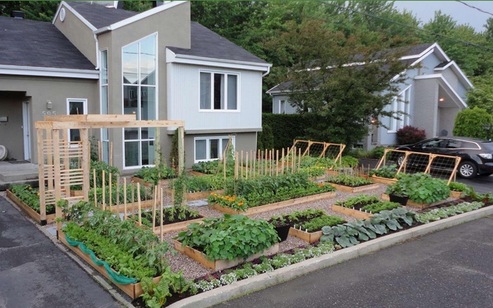
That's a lovely house, don't you think? And a nice yard in front of it.But Drummondville, Qe. (about 100 km NE of Montreal) doesn't seem to think so. After apparently getting a verbal approval from the town's Environmental Inspector, CBC reports that the couple who planted this lovely garden were served with a notice that they had to tear it out within 7 days or face fines of between $100 and $300 a day.
A follow-up report notes that the tear-out date has been extended to 01 September. It also notes that "Drummondville plans to make it illegal to grow vegetables on front lawns anywhere in the city." Apparently the city "held public consultations on the new rule and it said no one objected."
This is the beginning of push back; expect to see more and more of this. I expect it will be framed as a "property values" argument, and be claimed as being non-discriminatory because the new bylaws will affect everyone the same way (ask the residents of Africville how that worked out for them...).  Drummondville is saying that a 30% grass rule already exists--from the look of the above photo, sodding the paths would come close to taking care of that requirement).
In the US, things are the same. According to an article in Grist, push back is occuring there too:
[In] Tulsa [they] bulldozed the entire thing.
If you start looking for stories like these, you’ll turn them up in droves. In 2010, Clarkston, Ga., fined a gardener named Steve Miller for planting too many vegetables. In 2011, Oak Park, Mich., told Julie Bass she couldn’t grow any vegetables in her front yard because vegetables weren’t “suitable” yard plants. (“You can look all throughout the city and you’ll never find another vegetable garden that consumes the entire front yard,” a city official told the local TV station.) And in Chatham, N.J., Mike Bucuk, a young would-be organic farmer, had to fight with the entire town just to grow some vegetables his family’s property.
Gardens are productive. They serve a purpose, and part of that purpose leads to reduced sales for some businesses (fresh produce markets, or farmer's markets, often face stiff opposition from major supermarket players. Here in BC, Save-On Foods is supposed to be one of the big anti-farmer's-market forces). 
But home gardens breed neither fear nor consumption, the two major drivers of modern society. They encourage independence and self-reliance, neither of which sells industrial food. In fact, farmer's markets and home gardens produce exactly what the industrial food system cannot supply: good quality, good tasting produce.
And don't kid yourself. Industrial food will fight back against the home producers, the small and alternative producers. They have to--their business model is based on compliance, on being unable to see any alternatives. Local food has scared them (there are various talking heads that have produced "studies" showing that best-case New Zealand lamb has a smaller carbon footprint than worst-case local lamb, for instance). Industrial food already sends a private police force into the Canadian prairies to see what you're growing and if they can put a stop to it (check out the Percy Schmeiser story, as one example). Industrial food will continue to follow the Big Tobacco playbook to slow the challenge to its business. Like Big Tobacco, there are billions of dollars a year at stake as long as they can keep us solitary, afraid, and dependent. The solution is straightforward: be fearless (read Farm city : the education of an urban farmer by Novella Carpenter, or her blog). Form community. Grow, raise, or produce anything of your own. Its not your job to keep Industrial Agriculture on the top of the food chain. Its your job to do what's best for you, your family and community, and the planet.

Friday, July 27, 2012

Local Food Fair!

Not huge, but really a lot of fun. Peppers, the food store on the left of the photo, held a local food producers fair yesterday, to advertise many of the brands they carry. With the two large exhibition tents set up on the right, people started showing up even before the producers had set up.
In addition to Level Ground (about whom I've written before), there were3 numerous other producers, several of whom I was unaware. Portofino is not one of them.
Portofino Bakery
Portofino makes a large variety of breads and supplies a number of outlets, from Peppers to Hotel Grand Pacific. They've become a significant voice among local food producers.
Daksha's Gourmet Spices is producing a line of curry mixes: Butter Chicken, Chicken Curry, Korma, Tikka Masala, Tandoori,Vindaloo, Spicy Fish,Chana Masala, Aloo Gobi and Daal.

Wednesday, July 4, 2012

Level Ground, Fair Trade

So I got the opportunity this week to do one of my favourite things: getting behind the “Employees Only” door. On June 12th, I was with a group of about a dozen and a half other members of the UVic University 101 program got the opportunity to meet one of the founders of Level Ground TradingCompany. Stacey Toews helped found Level Ground back in 1997 in order to provide Fair Trade coffee to lower Vancouver Island. In the beginning, they didn't even have a building to work from, instead borrowing space from another company after their workday was over, in order to roast and pack the coffee they were bringing in from Columbia. Now in their third building and fifteenth year, Level Ground has a compact, efficient space and about 25 employees.
Level Ground facilities

Level Ground is now bringing in coffee from about 5000 farms and 12 different producer groups in 8 different countries, supplying a number of local retailers with both beans and ground coffee. Stacey is clearly still passionate about the work he's doing. I inferred that a lot of what he does is explain just what he does: talking about the business, he had a casual command of both facts and concepts that he wanted to communicate, and his delivery was both polished and personal. We started the tour with, of course, coffee. Level Ground buys top-end, shade-grown beans, roasts and packages them on-site, and apparently have figured out a good grounds-to-water ratio, because I thoroughly enjoyed my cup. Which, of course, was the point. Stacey started our tour with a history of the fair trade movement, the modern version of which is said to have started about 65 years ago with Edna Ruth Byler, a Mennonite missionary. While on mission work, she found herself in a village where the women were producing high quality linen needlework. Six years later, she and a colleague, Ruth Lederach, took some of the items to a Mennonite conference in Switzerland and sold them, and by 1958 had opened a small shop. These shops have become the Ten Thousand Villages stores found across North America. In Victoria, Level Ground imports, roasts, grinds, and bags coffee for the Ten Thousand Villages shop.
 In Europe, Oxfam picked up the ball in the mid-sixties and ran with it, becoming the force behind the European fair trade movement. Both the Mennonites and Oxfam were drawing on a much deeper and older tradition. Gavin Fridell writes [pdf] that
 “it is difficult for anyone in our present age to imagine that at an earlier point in world history it appeared “unnatural” that one person should profit by denying others the basic right to subsistence. Yet this conviction was common amongst local communities in pre-capitalist societies before the imperatives of the capitalist market and the new ideology of political economy replaced the “old moral economy of provision.” ”
Fridell links this pre-capitalist moral economy with the modern fair trade movement:
 “The greatest virtue of fair trade lies in its attempt to take advantage of its market niche to construct a new moral economy, one which crosses national boundaries and re-asserts the notion of people’s right to live taking precedence over the flows of supply and demand. Whereas the old moral economy described by Thompson asserted the rights of poor consumers to gain access to the means of life, the new moral economy of fair trade asserts the right of poor producers to get a fair price for what they sell on the market.”
It is this “new moral economy of fair trade” that Level Ground works in and that Stacey Toews is so passionate about. The front of every package of Level ground coffee has the face of a producer emblazoned on it—a producer who grew some of the beans in the roast, GPS coordinates to the community nearest their farm on the package, and who relieved a fee for the use of his or her face. The goal is to produce a perceived relationship between the producer and consumer, to make you think about where your food came from. And it wasn't until food became part of the fair trade movement that it really became visible to the public. Because of the central place food holds in all human cultures. Level Ground is branching out into non-coffee items as well, distributing dried fruit, chocolate, cane sugar (an excellent sugar, primarily a dehydrated sugar can juice that leaves a great deal of flavour with the sweet), and most recently, vanilla beans. The “A” quality vanilla beans are being sold as beans, and the “B” grade are being used to make extract. Level Ground is partnering with a local vodka maker to create an authentic vanilla extract, and early experiments seem quite promising, according to Stacey. Coffee also needs special handling when being picked. 

As coffee is a berry when it is picked, beans must be de-pulped and washed within hours of being picked or it ferments, rots and is valueless. Farmers must have access to a buying station or buying post or their crop is worth nothing. Level Ground is pursuing a project in Columbia with an organic grower to purchase his sun-dried pulp (the remains of the cherry) and make a tea from it. Apparently it is naturally quite sweet tasting.
The roasting room

 But, according to Stacey, fair trade remains an imperfect solution to the problems of ensuring producers a fair price for their goods. While the fair trade standards set by a German NGO (Non-Governmental Organization) provide for a minimum price for various goods from different places, there is no guarantee that the price flows all the way back to the original farmer rather than a larger producer group. “So without a dialogue and relationship with the producer group you can actually completely dehumanize trade and call it fair at the same time by current global standards,” Toews says. And points out that Nestlé in the UK now produces a two-finger Kit Kat bar that is fair trade certified.He sees the prices established by Fair Trade certification to be akin to a minimum wage: The goal is not to pay the minimum wage, but to pay more than that. When Level Ground started trading, world coffee prices were $2 US / pound. Since then, prices have fluctuated between a low of $0.45/lb and as high as $3.10/lb.
Grinding and bagging station

Currently at ~$1.75/lb, on the international market, Level Ground is paying its suppliers for top quality export beans (green) between $3 and $4 /lb depending on the country and producer group. Keeping in mind that roasting reduces the weight of beans (it takes, on average, 1.3 pounds of green beans to get a finished pound of roast beans), there's a lot of product moving through level Ground.
Distribution area--for ground and whole bean coffee

From their first container load of green beans, Level Ground is now working with 5000 farms, 12 different producer groups, 8 different countries, 25 staff, and goes through about 4 million pounds of beans a year.
Stacey Toews in front of green beans
 They store very little coffee on site. Warehouse costs are so much lower in Vancouver that they store their coffee there, only bringing it over a container at a time to roast and distribute.
Stacey with a handful of "coffee paper"

Level Ground is also paying attention to their waste stream as well. The bags the green beans come in are a natural burlap that decomposes, making them a great mulch in local gardens.  The "paper" that covers the bean and comes off during roasting is also recycled. With an aggressive recycling program, Level Ground generates very little actual "waste.
Level Ground also offers their employees a subsidy program, helping pay for the workers to commute by bus or by bike. And provide coffee to a number of non-profit organizations (including both Uni101 and The Rainbow Kitchen). Sustainability and responsibility take  pride of place in the corporate vision, making Level Ground a most unusual business. Is it obvious I had a good time?

Wednesday, June 27, 2012

Additives 1

This interesting piece from the Food Integrity Campaign:
As the health debate over soda continues, new test results reignite concerns regarding manufactured ingredients commonly used in soft drinks and other processed foods. It was enough that mercury has been found in products with high fructose corn syrup thanks to industrial processing, but now industrially produced caramel coloring (ubiquitous in soda to create a more appealing, dark color) has been linked to a carcinogen known as 4-MI.
The Center for Science in the Public Interest (CSPI) found "alarming levels" of the cancer-causing chemical 4 methylimidizole (4-MI) in Coca-Cola drinks around the world. It forms when a solution of sugars is heated with ammonia to make the artificial brown coloring, which is also used in baked goods, soy sauces, gravies and beer.
As of January 2012, California requires a cancer-warning label on soft drinks and other widely consumed products that lead to people consuming at least 30 micrograms of 4-MI per day. In response to that rule, Coke started using an alternative caramel coloring with considerably lower 4-MI levels … but has yet to market the less-contaminated drinks outside California

And then, the interesting part. A chart of 4-MI content by country. And look at who's number two...


This on the heels of renewed interest in how fast food / industrial food manufacturers are using the same deflect and deny tactics employed so successfully by the tobacco industry for so long. And what difference will this make to our current government? I predict "none at all." The current Tory government isn't simply business friendly, it's more like international business' crack whore. The evidence, on the other hand, just keeps piling up: if it has been commercially grown, or modified from the field in any way, it is probably better not to eat it. The only way to have true food security is to democratise the food system. By that I mean to distribute production across as many people as possible, to export nothing we do not priduce in surplus, and to import as little as possible. Canada needs to pursue food sovereigity before it pursues export capacity or the Trans-Pacific Partnership.

Tuesday, May 29, 2012

Link-straveganza!

Food Trucks

From The Toronto Standard. Credit: Jen Chan

Sometimes, there's a lot going on. And those days (like today), well, I can't posibly put an explanatory gloss on everything I see. Like food trucks. Not an entirely new phenomena, but suddenly they've taken off again in popularity.Now, I've had some terrific food truck food: at the St. Albert market we used to get pulled pork and bbq beans made with Cattleboyz BBQ sauce that was to die for. And green onion cakes were always a food you bought at a street vendor tent. I've even thought about opening one. But the current mania just seems an invitation to bad food driving out good (in the foodie version of Gresham's Law). Bronwyn Kienapple is asking a few of the same questions in the Toronto Standard.

Occupy The Farm

From Climate Connection.org


Trying to get a handle on what the Occupy movement means seems impossible--except to say that as a movement that seems dedicated to citizen involvement and democratic empowerment, I couldn't be more supportive. The Occupy the Farm group taking over UC Berkley lands and procceeding to plant food crops is an interesting idea. Jeff Conant explores it in more depth at Climate Connection.org.

Corporate Land Purchases


from the Grain website

Not just corporations, but nations (I'm looking at you, China), are busy buying up farmland--particularly in the developing workd--not to grow food to feed indigenous populations, but to support their own populations. This is a good idea from the corporate and national governments perspectives, but really is unsustainable. Carey L. Biron takes on the issue at Farm Land grab.org. Carey Gillam, at the same site, points out the ongoing influence of speculators in investment in agriculture. And at the Grain website, an article pursues the question of how these land grabs are affecting food security in Latin America.


Private Profit, Public Cost

is the issue around pig farms in a new report (pdf) from the WSPA (World Society for the Protection of Animals). Now, I have a few problems with PETA, but I have a lot more concerns around CAFOs. The Financial Post has a pretty neutral article discussing the points contained in the above report.


Food Security and Farms

Both Alternet and Rabble.ca  have articles on Why Big Food Must Go (alternet), and Why Hunger is a Farm Issue (rabble.ca). Both good, and both symptomatic of the discussion that is being heard more and more these days. As Michael Pollen says, the way we raise food is the issue that floats overtop all the other envirinmental issues we face.

The Madness of Smoked Pig Bellies

This recipe got passed around a while back.

Bacon Jam
Ingredients

    1 1/2 pounds sliced bacon, cut crosswise into 1-inch pieces
    2 medium yellow onions, diced small
    3 garlic cloves, smashed and peeled
    1/2 cup cider vinegar
    1/2 cup packed dark-brown sugar
    1/4 cup pure maple syrup
    3/4 cup brewed coffee

Directions

    In a large skillet, cook bacon over medium-high, stirring occasionally, until fat is rendered and bacon is lightly browned, about 20 minutes. With a slotted spoon, transfer bacon to paper towels to drain. Pour off all but 1 tablespoon fat from skillet (reserve for another use); add onions and garlic, and cook until onions are translucent, about 6 minutes. Add vinegar, brown sugar, maple syrup, and coffee and bring to a boil, stirring and scraping up browned bits from skillet with a wooden spoon, about 2 minutes. Add bacon and stir to combine.
    Transfer mixture to a 6-quart slow cooker and cook on high, uncovered, until liquid is syrupy, 3 1/2 to 4 hours. Transfer to a food processor; pulse until coarsely chopped. Let cool, then refrigerate in airtight containers, up to 4 weeks.

When did such a simple product like bacon become the object of such veneration and our latest food of mass destruction?

Tuesday, May 22, 2012

Peace. Bread. Land

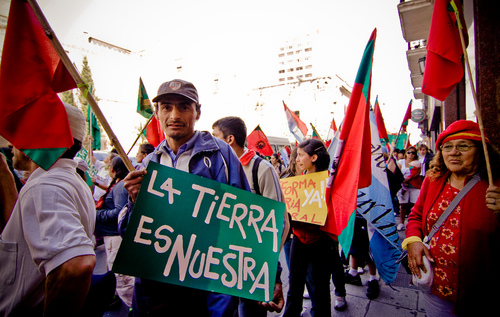
The struggle for social justice is deeply tied to the struggle for land reform around the world.  At a conference in Islamabad Monday, participants echoed the rallying cry of the Bolshevik revolutionaries: Peace. Bread. Land.
The Express Tribune is reporting today that participants in a conference had "underlined the need for equal distribution of land rather than land reforms and ensuring food sovereignty, rather food security in the country.
They pointed out that due to corporatisasion of farming and giving land to foreigners, not only food security, but due food sovereignty is largely at the stake."
The call for countries to be food sovereign is pretty much worldwide, at this point. Participants in the Pakistan conference pointed to a " military-bureaucracy-feudal troika" standing in the way of land reform. According to the Express Times, "It was also highlighted that lands are given to generals, bureaucrats, cricketers and actors, but not to peasants, who are the real owners."
Increasingly, we are also seeing members of the national business press seeing problems with the continuing commodifying of everything threatening nation-states. The article closes with "Pakistan Business Review Chief Editor Dr Shahida Wazarat also advocated land reforms. “There will be adverse affects on food security if corporate farming continues in future,” she opined."