Showing posts with label food riots. Show all posts

Saturday, March 24, 2012

NECSI Update

The New England Complex Systems Institute and their President, Professor Yaneer Bar-Yam who's study I quoted when writing about debt and food prices, have issued an update to the landmark study done on the relationship between corn ethanol production, food commodity speculation and food prices. And Professor Bar-Yam is pretty convinced we're not done with the madness yet.
The Institute's web site hosts three very interesting short videos (regretfully, not embeddable) about the relationship of corn ethanol production, food commodity speculation, and food prices. The first shows how food prices between 1980 and 2000 fluctuated moderately around a consistent value, where prices neither spiked nor collapsed. Then food prices begin a dramatic upward climb peaking in 2008 and 2011. These two spikes are rather dramatic, and Professor Bar-Yam draws a direct link between the price spikes and social unrest. This is shown in the second video which links social unrest (like the Arab Spring) with food prices between 2004 and 2011.
The third video graphs actual food prices with increases in demand from ethanol production and speculation. To quote the update:
Our analysis shows that dominant causes of price increases are investor speculation and corn to ethanol conversion. Models that just treat supply and demand are not consistent with the actual price dynamics. The two sharp peaks in 2007/2008 and 2010/2011 are specifically due to investor speculation, while an underlying upward trend is due to increasing demand from ethanol conversion.
 Models that just treat supply and demand are not consistent with the actual price dynamics. I thought that bore repeating with emphasis. There is a consistent firm upward pressure on food prices from the increased demand from ethanol conversion programs, but the big driver of food prices is "specifically due to investor speculation."
"The food price bubble of 2011 caused widespread hunger and helped trigger the Arab spring. In 2013 we expect prices to be even higher and may lead to major social disruptions." said Professor Bar-Yam President of NECSI, who has just returned from Davos where he presented his findings on speculation in global commodity markets. His paper "The Food Crises: A Quantitative Model of Food Prices Including Speculators and Ethanol Conversion" was called by Wired magazine one of the top 10 discoveries in science of 2011.
In 2008 and 2011 increases in global food prices triggered hunger, food riots and social unrest in North Africa, the Middle East, and elsewhere, at a cost to global stability which policy makers can no longer ignore. Over the past decade, world unrest has sharply increased at time of peak food prices; now the long-term price trend is getting close to what used to be episodic peaks.
According to the new study, the next food price peak will take place in about a year. The results will be dramatically higher prices than we have encountered thus far. The study warns that should ethanol production continue to grow according to multiyear trends, even the underlying trend will reach social-crisis levels in just one year.
from the update
So get a garden in, build a chicken coop in you backyard, and plan to do a lot less of everything, because you're going to need your $$ for food. Our refusal to find a way to put the brakes on global capitalism means that we're in for a rough few years. A lot more people are going to fall from "working poor" into "destitute poor" and none of it needs to happen. I don't want to go off on a rant here, but really people:

 
 Is it really going to have to take a revolution to get the comfortable to pay attention?

Sunday, November 6, 2011

The Rice Shortage

A few years back--about 2008--there was rice rationing in the US and a great fear of rice shortages around the world. This lead to a certain amount of panic, particularly in Asia where citizens have traditionally consumed 70-80% of their calories in rice. The story of what actually happened is a combination of non-transparent markets, panic, reasonable actions on the part of governments, corrupt actions on the part of governments and their officials, reasonable actions on the part of consumers, screwy international trade activity, and just a general mess.
NPR ran a great story on the "crisis" and thankfully it's available in a podcast of the show Planet Money.

There's also a short interview with economist Peter Timmer on their website. But what is interesting are the lessons learned from the crisis. If you listen to the whole story, you hear that the lesson that the WTO and  Western economists take away from the "crisis" is exactly the opposite of the lesson learned by the governments involved. The interesting thing is, both sides appear to be right; open markets and transparency are good, but food security is a necessity. The problem is, neither side can see that maybe both lessons need to be learned.

Wednesday, August 31, 2011

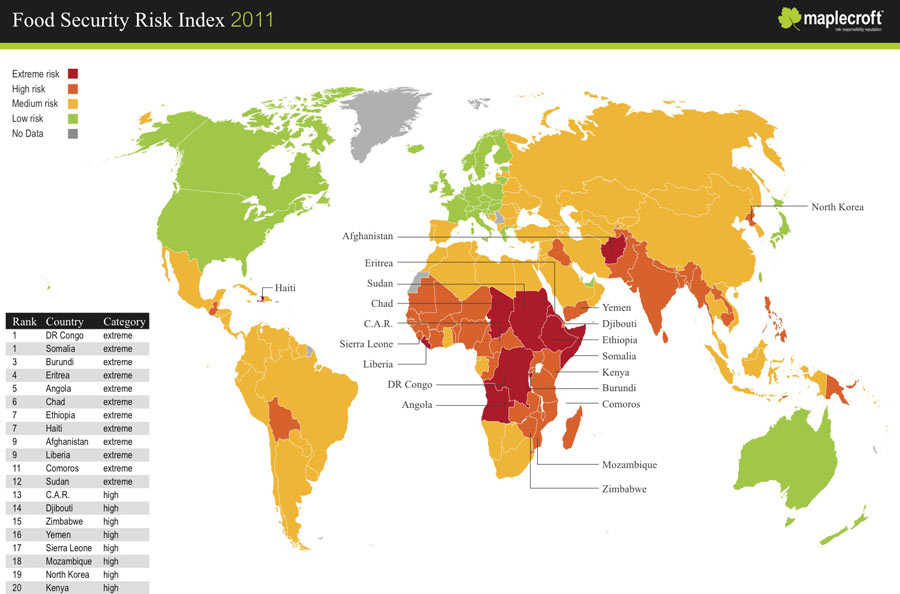
Food Security IS Security

Damian Carrington, over at the Guardian, is pointing out, with reference to the map above, the links between food security and conflict. I'll quote the opening couple of paragraphs:

A new map of food security risk around the world is, in some ways, depressingly familiar. Sub-saharan Africa leaps out as the place where the most people fear for their next meal, while the rich world has more to fear from obesity. But there's plenty of salutary reminders and fascinating detail, like India's food problems and the vulnerability of Spain.
And it demonstrates the sickening, symbiotic relationship between lack of food and conflict: where one leads, the other follows.
We must start with the worst, in the horn of Africa. In Somalia, Ethiopia and Eritrea, human failings mean a severe drought has tipped millions into famine. It's a textbook case of why things go wrong. War begets poverty, leaving food unaffordable. Devastated infrastructure destroys both food production and the ability to truck in emergency food. The collapse of society means the effects of extreme weather such as drought cannot be dealt with. And the fear of violence turns people into refugees, leaving their livelihoods and social networks behind.
I really haven't anything to add to his concise and poignant piece, except to say that overextending your food supply is the classic way empires fall, as detailed in Evan D.G. Fraser and Andrew Rimas' book
Empires of Food: Feast, Famine, and the Rise and Fall of Civilizations.

Tuesday, February 22, 2011

Population Pressures


The global food system will experience an unprecedented confluence of pressures over the next 40 years. On the demand side, global population size will increase from nearly seven billion today to eight billion by 2030, and probably to over nine billion by 2050; many people are likely to be wealthier, creating demand for a more varied, high-quality diet requiring additional resources to produce. On the production side, competition for land, water and energy will intensify, while the effects of climate change will become increasingly apparent. The need to reduce greenhouse gas emissions and adapt to a changing climate will become imperative. Over this period globalisation will continue, exposing the food system to novel economic and political pressures.
So understates the British report The Future of Food and Farming: Challenges and choices for global sustainability. Two billion more people to feed by about 2050, and we can't even get food from farm to plate with the people we've already got.
     We're bloody useless at food, really. We've experience with famine that stretches back to the dawn of time, but we still haven't figured out how to handle famine relief. When food prices began their upward movement in 2008, it was clear that  a lot of people were going to fall off the food delivery waggon. And they did. As Raj Patel points out, "There are 75 million people more undernourished now than in 2008."And that's in the modern fossil fuel age--and that's not the total number of people who are food insecure or actually starving to death. That's just the people added to the total in the last two years.

     Part of the problem is the way we treat food.
These perverse poles of the global food economy, obesity and hunger, reflect the basic reality that while food is elemental to life and health it is conceived as a commodity and not a right--food aid and food banks, which reflect a minimalist conception of food rights, notwithstanding--and the motive force of profit prevails over concerns about equity and nutrition.
The global food economy : the battle for the future of farming p. 13
Food is not a right, but a commodity. As such, steps have to be taken to ensure that the maximum of profit can be realized; thus the use of food aid as a lever to destroy local markets, depress food prices, drive farmers off small holdings and into the cities, and the concentration of land ownership into fewer and fewer hands. none of this actually improves access to food, quality of food, or security of supply--although all of these claims are made, none of them stand up to sustained scrutiny.

Sunday, February 13, 2011

Egypt

Court bakery of Ramses III

Well before 8 o'clock on a late April morning, a line of about 30 eager customers forms at a modest bakery in this working-class neighborhood. With a global food crisis roiling countries from Asia to the edge of Europe, at least 11 people have been killed recently in such lines here, struggling to get their daily bread.
There's no panic, no desperate scrambling for sustenance — a tentative sign of success for an emergency government plan that involves dramatic increases in spending on bread subsidies and the use of Egyptian soldiers as bakers.
"Now we're able to find bread," says Dalia Hafez, 40, seated on a nearby curb in a cappuccino-colored headscarf. "Thanks God, the crisis is over."
For now, anyway. But the aftershocks from the food trauma here are only beginning to be felt. Tensions are continuing to build in this key U.S. ally, evidence that the global food crisis — the product of factors ranging from unusual weather in producing nations to increased competition for grains from biofuels programs — is now about much more than food.
"This crisis threatens not only the hungry, but also peace and stability," the head of the United Nations World Food Program (WFP), Josette Sheeran, warned in a recent speech.
That Egyptian officials regard photos of bakers at work as potentially incendiary is a measure both of bread's unrivaled importance in the Egyptian diet and of the government's concern that continued public discontent over food supplies could metastasize into something more threatening.
"People in Egypt may be considered passive or silent, but there's a limit to this. And when they reach that limit, one day there will be a popular explosion," said lawyer Esam Salam, interviewed at a cafe near Cairo's train station.
USA Today 4/30/2008

The roots of the revolution are in food. Much of my life I've heard the saying that no city is more than three days away from revolution--all you have to do is cut off the food supply. Since the Bush regime decided to encourage the production of ethanol in '07-08, speculators have had a field day in the food futures market. And after years of the "green revolution," increasing reliance on petrochemical inputs, and land hunger (and a failure to reform consolidation and exclusion in land ownership), have combined to produce global unrest over the future of eating.

Friday, February 11, 2011

Short-sighted cuts at NSERC

     The Globe and Mail (12 January, 2011, p. A8) reports that the Natural Sciences and Engineering Research Council (NSERC) has removed food-related research from its target funding areas this year. This means that research into new plant breeds and better farming techniques will continue to be slowed. Of course, this comes just as several organizations, including the United Nations, are warning that we are entering a period of global food crisis.
In the first half of this century, as the world’s population grows to around 9 billion, global demand for food, feed and fibre will nearly double while, increasingly, crops may also be used for bioenergy and other industrial purposes. New and traditional demand for agricultural produce will thus put growing pressure on already scarce agricultural resources. And while agriculture will be forced to compete for land and water with sprawling urban settlements, it will also be required to serve on other major fronts: adapting to and contributing to the mitigation of climate change, helping preserve natural habitats, protecting endangered species and maintaining a high level of biodiversity. As though this were not challenging enough, in most regions fewer people will be living in rural areas and even fewer will be farmers. They will need new technologies to grow more from less land, with fewer hands.

     NSERC insists, in a statement, that "food-related research, despite not being listed as a target area, continues to be a priority for NSERC funding." NSERC funding has been commonly in the areas of traditional plant breeding--like canola, which was developed by Canadian scientists in the 1960s with government funding, and led to increased oil yields per acre.