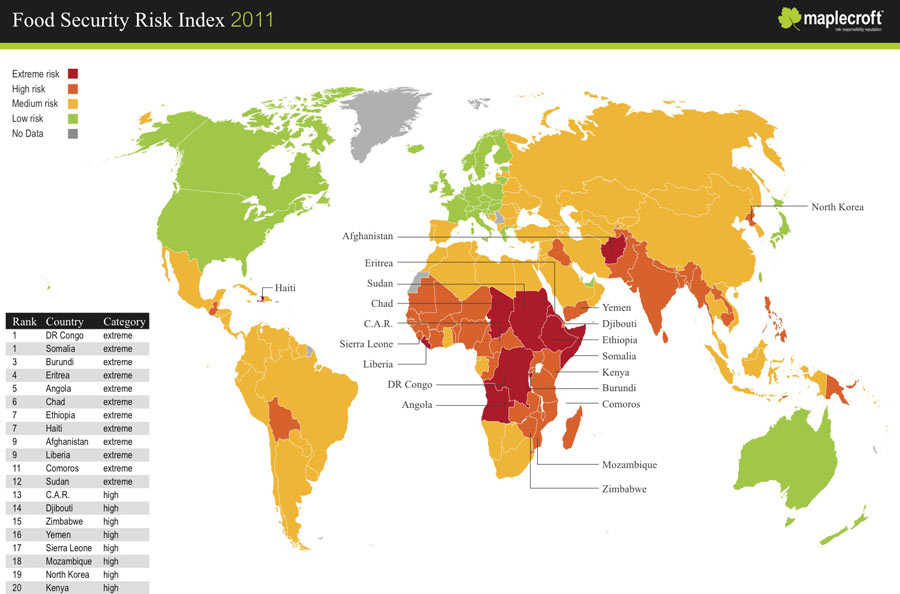
Damian Carrington, over at the Guardian, is pointing out, with reference to the map above, the links between food security and conflict. I'll quote the opening couple of paragraphs:
A new map of food security risk around the world is, in some ways, depressingly familiar. Sub-saharan Africa leaps out as the place where the most people fear for their next meal, while the rich world has more to fear from obesity. But there's plenty of salutary reminders and fascinating detail, like India's food problems and the vulnerability of Spain.
And it demonstrates the sickening, symbiotic relationship between lack of food and conflict: where one leads, the other follows.
We must start with the worst, in the horn of Africa. In Somalia, Ethiopia and Eritrea, human failings mean a severe drought has tipped millions into famine. It's a textbook case of why things go wrong. War begets poverty, leaving food unaffordable. Devastated infrastructure destroys both food production and the ability to truck in emergency food. The collapse of society means the effects of extreme weather such as drought cannot be dealt with. And the fear of violence turns people into refugees, leaving their livelihoods and social networks behind.
Since, most famously, Jean Anthelme Brillat-Savarin and, slightly less famously, Alexandre Balthazar Laurent Grimod de La Reynière invented food writing in the first quarter of the 1800s, food writers have battered language almost insensible trying to describe the transports of delight that food has wrought upon their palates. Brillat-Savarin famously said "Tell me what you eat, and I will tell you what you are," in his Physiologie du Goût, ou Méditations de Gastronomie Transcendante; ouvrage théorique, historique et à l'ordre du jour, dédié aux Gastronomes parisiens, par un Professeur, membre de plusieurs sociétés littéraires et savantes. (commonly translated as The Physiology of Taste). The Physiology of Taste is available in a plain text format through archive.org. Sadly, Grimod's Manuel des amphitryons : contenant un traité de la dissection des viandes à table, la nomenclature des menus les plus nouveaux pour chaque saison, et des élémens de politesse gourmande : ouvrage indispensable à tous ceux qui sont jaloux de faire bonne cher̀e, et de la faire faire aux autres (1808) is less accessible in translation (although available in French).
(It is fitting that, as I write this, I've been offered a sample of coffee with instructions to taste it like I would a wine; first the nose, then a slurp and swish to spread the taste over my whole tongue.)
In addition to his mots and aphorisms, Brillat-Savarin dealt with many of the issues that concern us today, such as the globalisation of of food and food culture. He writes:
Gourmandise offers great resources to fiscality, for it increases customs, imports, etc. All we consume pays tribute in one degree or another, and there is no source of public revenue to which gourmands do not contribute.
Let us speak for a moment of that crowd of preparers who every year leave France, to instruct foreign nations in gourmandise. The majority succeed and obedient to the unfasting instinct of a Frenchman's fever, return to their country with the fruits of their economy. This return is greater than one would think.
Brillat-Savarin continues on to talk about how food and the businesses surrounding it contributed an extraordinary amount to France's GDP and balance of payments. But he writes about the joys of the table:
The centuries last passed have also given the taste important extension; the discovery of sugar, and its different preparations, of alcoholic liquors, of wine, ices, vanilla, tea and coffee, have given us flavors hitherto unknown.
Who knows if touch will not have its day, and if some fortuitous circumstance will not open to us thence some new enjoyments? This is especially probable as tactile sensitiveness
exists every where in the body, and consequently can every where be excited.
We have seen that physical love has taken possession of all the sciences. In this respect it acts with its habitual tyranny.
The taste is a more prudent measure but not less active faculty. Taste, we say, has
accomplished the same thing, with a slowness which ensures its success.
Elsewhere we will consider the march. We may, however, observe, that he who has enjoyed a sumptuous banquet in a hall decked with flowers, mirrors, paintings, and statues, embalmed in perfume, enriched with pretty women, filled with delicious
harmony, will not require any great effort of thought to satisfy himself that all sciences have been put in requisition to exalt and to enhance the pleasures of taste.
“[A]ll sciences have been put in requisition to exalt and to enhance the pleasures of taste.” A bold statement, although, considering the state of the hall described, a defensible one.
Brillat-Savarin was writing in the early 1800s, but, in many ways, he set standards that have echoed down the years. In his book Blue trout and black truffles : the peregrinations of an epicure, Joseph Wechsberg writes similarly about the Restaurant de la Pyramide in Vienne. In what turns out to be a sheer delight of a read, Wechsberg at first resists the pilgrimage to Pyramide:
I objected mildly that I wasn't too much interested in the “show places” of la grande cuisine. France's restaurants are, by and large, the best in the world, I said, and I could see no reason for patronizing fancy establishments when there is such an astonishing number of small restaurants all over the country where one can get a delicious omelet, a succulent blanquette de veau, a fine Brie, and a bottle of honest vin du pays for the equivalent of a dollar and a half.
Of course, cooler heads prevail, a letter of introduction is written, and Wechsberg is off (again) to France where he meets “incontestably the greatest chef on earth”, the Formidable Monsieur Point (the title of the chapter).
I wrote about the international fishery’s problems with by-catch about six weeks back, and how so many fish are being caught, killed, and then dumped overboard because they are not currently in season or are not in quota. Its a terrible waste, and is doing nothing to ensure we have a sustainable source of food from the ocean.
So the other day, gonzo filmmaker and favourite Victoria brother-in-law Karl Johanson spotted an article he thought would interest me. Recently, David Watson (currently a student in the Innovation Design Engineering joint course between the Royal College of Art and Imperial College, London), submitted a design for a retro-fit for fishing nets designed to reduce the problem of nets catching too many small fish along with the commercial-sized ones to the Victorinox sustainable design competition. It is a very interesting design in that it addresses a couple of problems; that small fish can't escape commercial trawling nets, and that when they can escape, they can't see the way out.
I know that when I think of a trawling net being pulled through the ocean, I think of a curtain where large fish get caught up trying to pass through the holes. The reality is a bit different, where an open bag is pulled through the water, and the netting's holes collapse, allowing primarily water to pass through. Small fish either can't get out or are crushed in the mass of fish being swept up.
David Watson's design solution is fairly straightforward; reinforcing grommets that hold the netting open. And because the small fish often can't see their way out, he's included a couple of LED lights in each grommet (nicely powered by small turbine in the grommet, powered by the motion of the net through the water).
Its an elegant solution, one where you fit the net with reinforcing grommets and then pretty much forget about it. And its one solution that will never be used. Even if the cost of the grommets was a nickle each installed, the sheer number needed makes the cost prohibitive. And without effective international regulation, any requirements to install these grommets would quickly un-level the playing field, making adoption untenable. Such is the reality of a globalized food system: the worst and cheapest practices become the de facto standard.
Its the same on-land as it is in the oceans. If Ghana has no regulation on agricultural practices and produces cheap food, that's the food that will end up on your plate. Unless, of course you're paying attention and make a conscious choice not to purchase it. When it comes to fish, the Monterey Bay Aquarium produces a sustainable seafood guide that helps you make better choices about what goes on your plate. And keep in mind, that while prairie-farmed rainbow trout are a good choice, ocean-raised Atlantic salmon from the Pacific coast are a terrible choice.
Over in China, flooding has innundated over 1 million acres (just over 404 thousand hectares) of farmland, raising local food prices by a minimum 20%. Flooding has been bad this year pretty much everywhere--like southern Saskatchewan and Manitoba. Warm air holds more water than cold, and the steady upward drift of average global temperature means we're going to face more of this. There's a short article on the China flood in The Guardian.
In an op-ed piece in the NYTimes, Patricia McArdle writes about how the US is destroying one of the last locavore cultures with foreign aid. No surprise there. This has been the role of foreign aid since the mid-sixties and the birth of the "Green Revolution." That the US is still pursuing a policy decades after it was shown to be misguided and wrong isn't much of a surprise either; the US is a ship that may no longer be able to turn. Oh, and the locavore culture being destroyed? Afghanistan.
Verlyn Klinkenborg writes a very short piece (A Welcome Silence) on the joys of leaving the hearing protection on when working. It echoes one I read in Harrowsmith a decade or two back that suggested that rather than using hearing protection, one could just give up the chainsaw....
The summertime lobster sandwich from McDonald's is back! Yes, Micky D's serving a lobster which is only available in New England and the Atlantic provinces. Apparently the lobster is being sourced from lobster-men in Escuminac, New Brunswick in a move to try sourcing and selling a local sandwich.
Now, this feels really strange, but I have to compliment McDonald's on this move. Locally sourced for local consumption,these are the actions we need to see in the food world. If we could add “sustainably harvested” to the list, we'd have the whole trifecta.
Honestly, do we really need to eat the same things everywhere in the world? I know that this is the concept behind food outlets like McDonalds. You serve the same thing everywhere, standardizing production, preparation, and service across your chain in order to present the same experience to every consumer on every visit. But we've done that, and it's killing us.
Regardless of what we've been teaching ourselves for the last century, people are not all the same everywhere. Motivations may be, general needs may be, but that doesn't make us identical. Just as an example, cow's milk isn't great for everyone (often, goat's milk is a better fit). So force feeding everyone a burger and shake combination may not be the best idea.
We, as humans, have spent thousands of years developing local and regional cuisines. This food is one of the ways we define ourselves. I know most Canadians don't get it (other than poutine, we really have no national cuisine), but most places aren't Canada. Provence, Tuscany, Ethiopia, all of these places have things they eat or ways they eat that are particular to themselves. Parmesan cheese is not the white grainy food-like substance we consume in North America; rather it is particular to the Parma region of Italy. And when you feed pigs on the waste whey from making Parmigiano-Reggiano cheese, you get a specifically-flavoured pig that, when you've butchered and salt-cured it, makes prosciutto. Salt-curing a ham doesn't make prosciutto, terroir makes prosciutto. And that terrior is place-specific. Techniques are transferable (thus you can cure a prosciutto-style ham), but place isn't transferable. If I cure a ham from a Berkshire hog on a farm north of Sudbury which I raised on whey from milk from Jersey cows made into a Cheddar style cheese, what I get is not prosciutto, but a salt-cured ham that represents the place in which it was produced. And no one can copy that terroir—which is why I shouldn't be trying to represent that ham as being something its not. Call it Tondalayo Ham produced using adapted Parman techniques, which would explain what it was better than simply calling it prosciutto.
Eating local isn't about sourcing the same items everywhere, it's about letting farmers do what they've done for fifteen thousand years—figure out what grows well and grow it. And just because something exists doesn't mean everyone should be able to get it. Total gratification of every whim is not just killing us, its killing the planet.
Hugo Osvald, The Earth Can Feed Us, George Allen and Unwin 1966
Hugo Osvald was an academic, politician and writer deeply involved in food security issues back in the fifties and sixties. A professor of crop science at the Swedish Agricultural University, he was also a member of the Swedish parliament from 1948-1963. His book The Earth Can Feed Us is an important look at food security issues and the plans made to confront those issues just prior to the Green Revolution.
As you can see from the title of his book, Hugo was actually fairly optimistic about the ability of humans to feed a population of six billion or so (about double the population at the time he wrote this book). As he says in his preface:
I have also refrained from giving terrifying descriptions of the situation in the over-populated countries, with their starving and diseased populations, or detailed accounts of the mistakes mankind has made in exploiting natural resources. For if we want to improve the situation, it is, in my opinion, necessary first of all to show what possibilities there are of increasing food production. Mankind must be given a gleam of hope, a chance to believe in a brighter future, if it is to make the necessary effort. Otherwise it will become discouraged and apathetic.1
Hugo provides an overview of the current condition of the food supply circa 1966, and what he sees isn't good. “The sad truth is, that more than half the world's population of more than three milliard people has not enough to eat.2” He also did not think, after reviewing the numbers, that even with perfect distribution there would be enough calories to go around at the then current rate of production. Whether there is currently enough to go around is still one of those open questions; if you cancel biofuel production in the US and quit feeding so much livestock on so much corn, there might be enough calories produced. But practically there will never be enough, if only because those that have access to food are in no hurry to give it up to eat a 2300 calorie/day diet high in grains and low in animal protein.
I've just about finished reading an influential book which helped lead to the green revolution (Hugo Osvald's The Earth Can Feed Us. Hugo was a Swedish academic, writer, and legislator.). I've also begun Empires of Food: Feast, Famine, and the Rise and Fall of Civilizations by Fraser and Rimas (you have no idea how nice it is to have access to the University of Victoria library system...), a book that has helped clarify my thinking about famine and I'm only about fifty pages into it.
There's also the matter of the difficult-to-predict flood in southern Manitoba (and in Saskatchewan) and the sudden explosion of wildfires in northern Alberta (one of which took out almost half the town of Slave Lake). Both the floods and the fires are exactly what climate scientists have been predicting (both more frequent weather-related events, and more extreme weather-related events) and events like these are going to have tremendous impact on our future food production in this country.
But I would rather talk about my new volunteer position instead. It is now official; as of 23 May, I am the volunteer coordinator and kitchen manager at the Rainbow Kitchen in Victoria. Well, at least for the next six weeks or so.
This is an outgrowth of my long-held desire to feed the world. Or at least, the part of it I can reach. When we were growing vegetables on DoubleJoy Farm and selling them at market (what is called “truck gardening”), we would haul upwards of a quarter to a half tonne of veg to market on any given day. We tried to provide a high-quality fresh product, and while we did want a pretty good price for it, that price more accurately reflected the real costs of raising food. Sustainable agriculture is not cheap, and unless you can take advantage of cheap labour or major equipment (or both), small producers are always going to be asking a premium price. But they are offering a premium product. And there is something else they offer; contact with the farmer. After we'd been selling vegetables a while, I noticed that, at market, it wasn't so much the veg we were selling, but the contact. A link to the land, the product, and the producer was essential to the customer. It was also essential to us as producers. My mother, who started vegetable production on the family farm back in the mid-seventies, took me aside on day and questioned me about the pounds of produce we were giving away. We did it right from the beginning—people would walk by and we'd offer them whatever we had on hand. Peas, beans, tomatoes, potatoes, whatever. Mother couldn't get over how many we gave out. Fistfuls, one two, three at a time, to kids. More to their parents. That, mother pointed out, was money out of my pocket.
Xinhua News, on their English news site, is reporting that "China, South Korea and Japan will each provide up to 200,000 tons of rice for a contingency plan of the Association of Southeast Asia Nations (ASEAN) plus three, out of total allocation of 787,000 tons" destined for an ASEAN +3 stockpile. The idea is to manage price volatility and ensure emergency stocks of rice. Indonesian Agriculture Minister Suswono said "We will propose that it wouldn't be only for emergency situation but also for price stability. It means that we should increase the reserves in case of price volatility so that we could conduct market operation." It's interesting that ASEAN has taken this action now, as International prices, Thailand: Bangkok, Rice (Thai 100% B) , Export, US Dollar per Tonne have dropped considerably since peaking in 2008 (peaking at $962.60, prices have since dropped to $507.25--which is still double the 2000 price of $243.50/ton according to the FAO). It means that the collective governments of the Association of Southeast Asia Nations (+3, of course) are concerned about continued price volatility in their collective markets. The FAO is also showing that, worldwide, prices are climbing again, after having spiked in 2008 and dropping last year. Meat and dairy products have either almost recovered or have (in the case of meat) exceeded their 2008 price highs. Cereals are still down--lower than last year, even--but oils and fats have showed increases. All in all, this brings the global food price index to 164--the second highest point it's achieved this century; having started at 90 and peaked at 191 in 2008. We can expect continuing volatility over the next several decades; global climate change has shown us increased agricultural impacts in (for example) Australia with drought, flooding, and brush-fires, and according to a recent report [.pdf] (reported by the CBC) expected sea level rise on the BC coast of a half metre by 2050, which will put a great deal of our local agricultural land at risk. If in fact the report is correct when it says: "At the present time, scientific information on the expected changes in storms approaching British Columbia coastal waters and their characteristics, specifically on the intensity of the storms, their related wave conditions and the associated storm surges in the future, is only starting to emerge. Based on the available information it appears reasonable to conclude that no significant change is expected in coastal BC waters," one would expect that if sea levels have increased by a half-metre, any storm activity will have greater effect on coastal areas.
Report on Business Magazine (May 2011) is running an article this month called “How Do We Feed Seven billion People—and Counting?” In it, reporters interview various people, looking for their take on what is evolving into an international food crisis.
The range of opinions and suggestions is much broader than expected—mostly because several of the interviewees are pushing for more of the same discredited policies that we've been pursuing. Sometimes dressed in new rhetorical clothes, but the same solutions nonetheless.
Jeffrey Sachs, the director of the Earth Institute and special adviser to UN Secretary-General Ban Ki-moon, takes on one of the elephants in the room by saying simply that we can't afford to reach nine billion. And its true, we can't. We could, if we took agriculture and feeding people very seriously indeed, manage—just!—to feed nine billion. But it would be incompatible with the international economic order as it is currently constituted. And, as Sachs is quoted as saying:
“This crisis cannot be solved just by food aid or short-term tricks. We have to look at the basic issue: that politicians are locally oriented and cynical, that they make announcements they don't follow through on, and that they're in the pockets of lobbyists intent on preventing solutions.”
As long as the focus is on maximizing return on investment, and not on farmers making a living by feeding people, we will continue to starve both poor people and poor nations. It will be a brutal way to keep population pressure under control—after all, we are increasing by 80 million people a year at this point—but famine will be a very effective method of international social control. But famine does appear to be the weapon of choice at this time.
Abby Abassian is the senior grains economist at the FAO in Rome, and he mentions the other elephant in the room—if only obliquely. When asked “What caused the latest surge in food prices?” his reply is “In one word—weather. This is not like 2007 and 2008, where we had so many other factors mixed in.”
Just reading in The Guardian that the European Union is finally trying to deal with the issue of by-catch. By-catch (or "discards" in the article) are the fish discarded by fish boats because the fish are of low commercial demand or the boat has no quota for catching the species. It is one of the unintended consequences of the quota system of fishing: no quota, you don't land the catch.
This is not to say that the fish are in any way no good or inedible. It is simply that if you are fishing, say, halibut, you don't want to land other fish with your catch; you only have quota to catch halibut. Rockfish, ling cod, whatever else gets swept up in your nets gets tossed back overboard.
The volume of by-catch is large--often up to fifty percent of the catch. We might like to think that if you're fishing coho, that coho is all you catch, but it's simply not the case. The problem is particularly difficult with trawlers--the nets tend to sweep up everything they can, leaving the sorting for the men on deck.
European Union commissioner Maria Damanaki brought forward a plan [.pdf] earlier this year to ban discards. Speaking in Brussels 03 May 2011, she said ;
"Legislators must establish a new legal framework that removes all compulsory discarding. We also need clear objectives and time limits. And the fishing industry should devise ways in which the fish they don't want, is simply not caught in the first place. Or if it is caught we can help them to build storage mechanisms, to wait for a better price."
The fishing industry is not onside. Anything that means landing less than the highest-priced catch means difficulty for the industry. The problem is, the public is no longer buying the reasons for by-catch. As Ms. Damanaki says:
"We live in a hungry world and we cannot keep a policy that obliges fishermen to throw away perfectly good food. Just look at the picture behind me showing fishermen throwing away big cod, because they ran out of quota. There is no way that we can explain this to the people on the street."
In the UK, the arguments against by-catch disposal are being led by chef Hugh Fearnley-Whittingstall , who has signed on over a half-million supporters to change the by-catch rules. And it's having an effect--sales of sustainably-fished varieties are up in the UK.
Here in North America, we too have similar rules about by-catch and also waste enormous amounts of fish.And in a world where the once full oceans are being rapidly converted into deserts--much like farmland is rapidly being converted to desert--we really can't afford this. As Greenpeace pointed out in 2008:
Bycatch also undermines the recovery of protected species. In the North Atlantic trawling is netting huge numbers of juvenile cod, undermining efforts at rebuilding decimated Atlantic cod stocks. For example on the Grand Banks, cod fishing is banned but in 2003 an estimated 90 per cent of the biomass was caught as bycatch in other groundfish fisheries. Our wild king salmon populations in the northeast Pacific are also suffering with about 160,000 fish being caught as bycatch in the Alaskan pollock fishery last year. This mass incidental catch resulted in a collapse of a subsistence fishery because not enough fish returned from the ocean to spawn.
The World Wildlife Fund is also concerned. The Fisheries Council of Canada seems to think that things are well under control [.pdf], but How We Fish offers a .pdf brochure on all the things we don't know. And with our new government here in Canada, don't expect to see conservation on the agenda--which baffles me. One would think Conservatives would be wanting to conserve resources, it being right there in their name. Instead, look for maximum exploitation to be the order of the day.