.JPG) |
| via Saanich Fair website |
Seriously, there is so much going on this past week. I attended the Farmer2Farmer conference at the Saanich fairgrounds, which was a great day, which I really want to talk at length about, and which left me with some hope. But that will have to wait for another post.
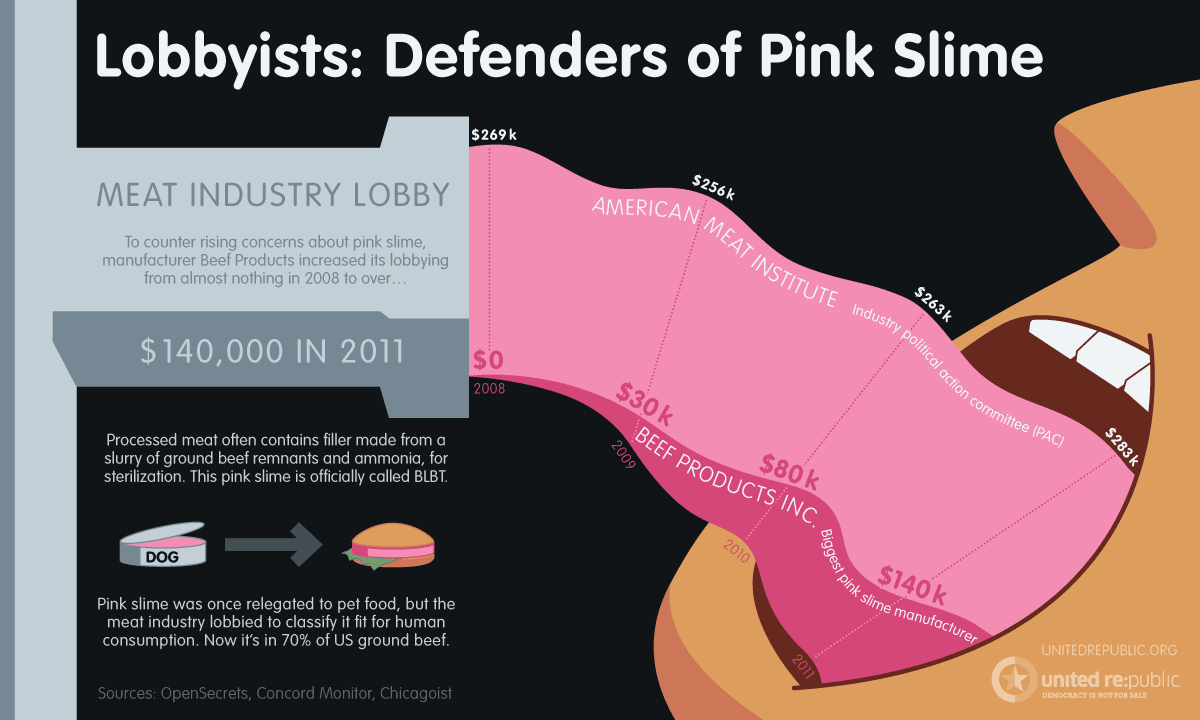
Pink slime--mechanically seperated lean beef that 's been treated with ammonia--is still around.
 |
| graphic via republicreport.org |
The lawsuit, originally filed in South Dakota state court, is hinged partly on a state product-disparagement statute designed to protect farming interests. Twelve other states have similar laws - dubbed "veggie libel" measures by critics - but they have rarely been invoked.But you can see why they feel they have to silence criticism--BPI has gone from 4 plants and about $650 milliion (US) in revenue to 1 plant and about $130 million (US) in revenue. And, as usual, buy direct from a farmer--make sure they get whatever profit's to be made and have the security of knowing where your food comes from.
Under the South Dakota version of the law, plaintiffs must show that defendants publicly spread information they knew to be false and stated or implied "that an agricultural food product is not safe for consumption by the public."
If BPI were to win on that claim, under the law it could be awarded triple the damages that were caused. That means that the company's claim of more than $400 million in projected lost profits could balloon to damages of more than $1.2 billion.
 |
| image via inhabitat.com |
NewsRx Science is reporting on the potential for urban agriculture in one of the US' most depressed cities: Detroit.
Now we just need some political will. CBC is reporting that Sudbury's city planning staff is getting onboard, but the councilors are dragging their heels.
Transforming vacant urban lots into farms and community gardens could provide Detroit residents with a majority of their fruits and vegetables.As city officials ponder proposals for urban farms, a Michigan State University study indicates that a combination of urban farms, community gardens, storage facilities and hoop houses - greenhouses used to extend the growing season - could supply local residents with more than 75 percent of their vegetables and more than 40 percent of their fruits.The study, which appears in the current issue of The Journal of Agriculture, Food Systems, and Community Development, evaluates many aspects of the production potential of the Motor City's vacant properties, from identifying available parcels of land to addressing residents' attitudes toward blending agrarian traits with their urban lifestyles."What's clear from our production analysis is that even with a limited growing season, significant quantities of fresh fruits and vegetables eaten by Detroiters could be grown locally," said Kathryn Colasanti, the graduate student who led the study for the C.S. Mott Group for Sustainable Food Systems at MSU. "And investments in produce storage facilities and hoop houses would increase this capacity substantially."
It is just an idea at this point — and something many other cities are considering — but city Coun. André Rivest said right now his vote would be a no.You can listen to the report here.
"You got houses that are worth a lot of dollars and you want to keep that,” he said.
“You start having chickens in backyards ... I sense that wouldn't be well received."
But city planner Kris Longston said Sudbury's long-range plans should focus more on urban agriculture.
And that's the problem, innit? Political will.In a city you have to be willing to stare down local developers--who carry a lot of political and financial weight. And the ability to scare the public with the thought that the value of our homes may decrease. Canadians have become utterly reliant on their homes as their savings accounts--and on increasing home prices fueling consumer purchases--so any threat to house prices threatens the entire myth that we currently function under. The question of just who is expected to pay inflated prices for houses when all the boomers decide to retire isn't one that gets asked--because there is no real good answer. Wealth inequity is becoming more and more pronounced in Canada, and the middle class is starting to lose people off the bottom. The Fear, as Hunter Thompson used to describe it, is starting to set in.


