A few years back--about 2008--there was rice rationing in the US and a great fear of rice shortages around the world. This lead to a certain amount of panic, particularly in Asia where citizens have traditionally consumed 70-80% of their calories in rice. The story of what actually happened is a combination of non-transparent markets, panic, reasonable actions on the part of governments, corrupt actions on the part of governments and their officials, reasonable actions on the part of consumers, screwy international trade activity, and just a general mess.
NPR ran a great story on the "crisis" and thankfully it's available in a podcast of the show Planet Money.
There's also a short interview with economist Peter Timmer on their website. But what is interesting are the lessons learned from the crisis. If you listen to the whole story, you hear that the lesson that the WTO and Western economists take away from the "crisis" is exactly the opposite of the lesson learned by the governments involved. The interesting thing is, both sides appear to be right; open markets and transparency are good, but food security is a necessity. The problem is, neither side can see that maybe both lessons need to be learned.
Sunday, November 6, 2011


Thursday, November 3, 2011
Behind the Scenes
The New York Times posted a lovely little video of food porn in the making. It's not the full monty on how its done, but it does give some insight into the work of food stylists.
It does give some suggestion as to why what you make doesn't look the same as what you see in Gourmet or Cooks or on the Food Network.
It does give some suggestion as to why what you make doesn't look the same as what you see in Gourmet or Cooks or on the Food Network.
Wednesday, November 2, 2011
Good News / Bad News
The good news: an application to develop a 25,000 head pig farm has been turned down by a municipal council. It may not be the death knell for this particular farm, but it is a significant set-back.
The bad news? Regretfully, this took place in South Derbyshire on a greenfield site west of the historic village of Foston. Industrial pig farming is still alive and well in North America.
And really, it is absurd; there have been a numbert of studies in Canada that show that mega-farms like this actually damage the local economy and lower a municipality's tax revenue when adjacent property values are lowered because of the mega-farm.
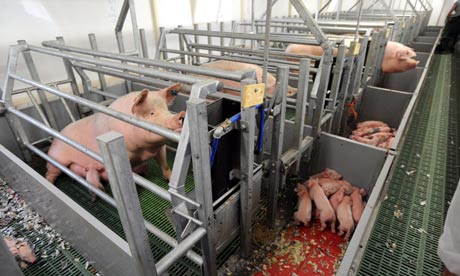
image sourced from The Guardian
When I raised pigs, I worried about not having farrowing crates for my sows (as in the photograph above). What I discovered is that pigs have perfectly good instinctual behaviour that keeps them from laying down on their young--which is what the farrowing crate is supposed to prevent. Pigs will walk in an ever-tightening circle before laying down, pushing their iglets into the centre of the circle. Then, when they are certain that ll the little ones are in a heap, they flop down to the outside of the circle, at which the piglets charge to attach to a nipple. Just like only bored and overcrowded pigs will bite each others tails, so docking isn't necessary. Pictures like the one above are artifacts of imposing an industrial production model in place of natural behaviours.
The bad news? Regretfully, this took place in South Derbyshire on a greenfield site west of the historic village of Foston. Industrial pig farming is still alive and well in North America.
And really, it is absurd; there have been a numbert of studies in Canada that show that mega-farms like this actually damage the local economy and lower a municipality's tax revenue when adjacent property values are lowered because of the mega-farm.
image sourced from The Guardian
When I raised pigs, I worried about not having farrowing crates for my sows (as in the photograph above). What I discovered is that pigs have perfectly good instinctual behaviour that keeps them from laying down on their young--which is what the farrowing crate is supposed to prevent. Pigs will walk in an ever-tightening circle before laying down, pushing their iglets into the centre of the circle. Then, when they are certain that ll the little ones are in a heap, they flop down to the outside of the circle, at which the piglets charge to attach to a nipple. Just like only bored and overcrowded pigs will bite each others tails, so docking isn't necessary. Pictures like the one above are artifacts of imposing an industrial production model in place of natural behaviours.
Monday, October 24, 2011
The Kitchen--on TV
The local cable news program ran an article on the Rainbow Kitchen on October 19th. I finally got the recording from my (amazing) sister-in-law and edited it down to the four minutes it ran. I think it went well; although the report neglects the larger issues of food security, it does a good job of reporting on the sense of community the Kitchen is trying to foster and support and on the need in the community.
That Friday we had a group of about a dozen kids about 12-15 years old come in to help for the morning. I found it interesting that one of the kids said afterwards that "I didn't know that people needed help like this here in Canada" or words to that effect. The educational component of the Kitchen seems to be almost as important as the proactical aspect of feeding people. *sigh*
That Friday we had a group of about a dozen kids about 12-15 years old come in to help for the morning. I found it interesting that one of the kids said afterwards that "I didn't know that people needed help like this here in Canada" or words to that effect. The educational component of the Kitchen seems to be almost as important as the proactical aspect of feeding people. *sigh*
Thursday, October 13, 2011
The Balance
Think of two lines of force in perfect balanced opposition:
 Whatever the intensity of the force each side is exerting, in order to separate the two you have to apply a force to each side that is slightly greater than the one pushing them together. And then, in order to keep them apart, you have to maintain that level of effort forever.
But if you have the same lines of force pressing against each other and you apply your effort perpendicular to the opposed forces, it takes a great deal less effort to dislodge the two, and they pop apart quite readily.
Whatever the intensity of the force each side is exerting, in order to separate the two you have to apply a force to each side that is slightly greater than the one pushing them together. And then, in order to keep them apart, you have to maintain that level of effort forever.
But if you have the same lines of force pressing against each other and you apply your effort perpendicular to the opposed forces, it takes a great deal less effort to dislodge the two, and they pop apart quite readily.
 If we think of the world's food producers (a whole lot of people everywhere except in the developed world) and the world's food consumers (which is, of course, everyone) and we track how the first group gets their produce to the second group, we find that by far the majority of food in the world ends up going through maybe a dozen transnational corporations with names like Cargill, and Monsanto, and Archer Daniel Midlands. Economists look upon this state of affairs and say that these corporations have both a monopsony and a monopoly; that is, they are both the only buyers for the products and the only sellers for the products. This makes the corporations very happy. In order to maximize their profits (which is their goal), they can put pressure on the producers to accept lower prices (because, after all, where else are you going to sell your coffee?) and on the consumers to pay higher prices (after all, where else are you going to get your coffee?).
While this is not a good state of affairs for consumers or producers, it is a great state of affairs for the guys in the middle. In a healthy, functioning economic ecosystem, competition between different companies keeps pressure on to ensure a fair price to the producers of materials and to keep prices down when selling to the consumer. When a monopsony or a monopoly develops, things get out of whack.
If we look at a diagram of this state of affairs (viz. Raj Patel) we see an hourglass:
If we think of the world's food producers (a whole lot of people everywhere except in the developed world) and the world's food consumers (which is, of course, everyone) and we track how the first group gets their produce to the second group, we find that by far the majority of food in the world ends up going through maybe a dozen transnational corporations with names like Cargill, and Monsanto, and Archer Daniel Midlands. Economists look upon this state of affairs and say that these corporations have both a monopsony and a monopoly; that is, they are both the only buyers for the products and the only sellers for the products. This makes the corporations very happy. In order to maximize their profits (which is their goal), they can put pressure on the producers to accept lower prices (because, after all, where else are you going to sell your coffee?) and on the consumers to pay higher prices (after all, where else are you going to get your coffee?).
While this is not a good state of affairs for consumers or producers, it is a great state of affairs for the guys in the middle. In a healthy, functioning economic ecosystem, competition between different companies keeps pressure on to ensure a fair price to the producers of materials and to keep prices down when selling to the consumer. When a monopsony or a monopoly develops, things get out of whack.
If we look at a diagram of this state of affairs (viz. Raj Patel) we see an hourglass:

But it kind of looks like the first illustration of the two balanced forces, and that bothers me. As Frederick Kirchenmann of the Leopold Center in Ames, Iowa says:


"... we should be asking ourselves what kind of agricultural system could produce the food and fiber we need in a world where oil is $250 and where we have twice the severe weather but only half the water that we have now. What kind of agriculture could we come up with? It's an entirely reasonable question to ask and yet, no one wants to touch it because when you get down to it, no one has a clue."The current industrial food system does two things very very well—it moves large amounts of food from one place to another (primarily from low cost of production areas to wealthy areas, but still...), and it makes the corporations in the middle very very wealthy (particularly now that they are working so hard to become the only place you can purchase seed). The current system also produces large amounts of food-like substances very cheaply (though mostly at the expense of those producing the feedstock), and distributes them very efficiently (at least in economic terms). But $250/bbl oil or more rain or less rain are perpendicular forces operating on the balance of forces we currently have. Forty years into the awareness of global climate change and we still have allowed an unstable, non-resilient food supply system to be developed. There are, of course, alternatives. But, like the transition to a sustainable energy system, the food system needs a backbone and the industrial food system is pretty much all we have. We are going to need to be able to move food and agricultural knowledge around the world during any transition to a sustainable food system. And it won't always be for profit, as we try to offer relief in areas suffering severe weather and crop failure. If we manage to transition into a sustainable food system—and that is a really big IF—we will need the systems Monsanto and Cargill and the like have developed. The thing is, we may not need the corporations. And that presents us with a massive problem; they will not want to disappear, and they will not wish to disappear quietly. Considering that these corporations are so large that their economies surpass most of the national economies they service, the potential for trouble is immense. If we consider the case of Monsanto and glyphosate-ready seeds like canola, we can see the redlinings of what we can expect in the future. As reported in Businessweek online, what was expected has indeed come to pass; glyphosate (better known by the trademark name Roundup)-resistant “superweeds” have begun appearing. And being able to say “See! I told you so!” isn't doing anyone any good. The problem is that the large chemical companies aren't seeing this as evidence of a blind alley and turning around. Rather, they are seeing it as an opportunity to revive older herbicides, develop crops resistant to those herbicides, and follow Monsanto into large short-term profits for the next ten or fifteen years. Monsanto denied for years that glyphosate resistance could occur in weeds, then denied for years that it had occurred, and now has announced that they will be adding resistance to a second herbicide into glyphosate resistant crops by 2015. To quote Monsanto Chief Executive Officer Hugh Grant, “The calvary is coming.” All this for a problem that never needed to exist in the first place. So what will companies like Monsanto do when they discover that they are being made redundant? The prevailing business theory is that corporations need to embrace change and pursue new markets in an ever-evolving environment. But just as Apple under Steve Jobs have shown, companies don't embrace change; they instead fall back on the same solutions. Solutions like closed systems, reduction of alternatives, growth by buying innovation, feudalism, and slavery. Most farmers are already not much better than serfs on their own land. Now corporations are buying up enormous tracts of farmland with the intent of hiring people to work it, changing farming from a profession of small and medium-sized businesses into classic wage-slavery. And not incidentally ending fourteen thousand years of cooperative innovation.
Thursday, September 29, 2011
Good Morning
I'm writing this at about 7:30am so it is a "good morning" from me.
 The illo above popped up on Facebook and manages to sum up a whole lot of food security issues in one pithy quoteable moment.
On the other side of the coin, the CBC ran this article:
I really hate it when improvements aren't....
On the other side of the coin, the CBC ran this article:
Friday, September 23, 2011
A Damn Good Question
"... we should be asking ourselves what kind of agricultural system could produce the food and fiber we need in a world where oil is $250 and where we have twice the severe weather but only half the water that we have now. What kind of agriculture could we come up with? It's an entirely reasonable question to ask and yet, no one wants to touch it because when you get down to it, no one has a clue."
Frederick Kirchenmann
Leopold Center in Ames, Iowa
Saturday, September 17, 2011
Jammin'
Spent much of the afternoon making jam
yesterday. Put me in mind of a couple of things, not the least of
which was Michell Shocked's excellent tune “Strawberry
Jam” from her Arkansas Traveller
cd/tape/album/download. The song is a tribute to making jam—but jam
becomes a metaphor for all DIY culture, and how culture is something
made, not consumed. And how making things, particularly jam, is a
liberating experience.
But
standing there in the kitchen, mushing berries down and adding sugar
(not too much, because I've been using Pomona's
Universal Pectin instead of Certo
for a while now), put me in mind of my mother and growing up in
Edmonton.
Mom put up a lot of preserves.
My
mother was not a great cook, but she was pretty darned good at
putting up jars of fruit in syrup, jams, and the like. Growing up in
the suburban sixties, our family kept contact with the land by
picking local berries, and keeping a garden. Living in Alberta, we
had access to wild
Saskatoon berries. Mom and Dad would keep track of where the
berries were heaviest and how ripe they were—in rural areas,
Saskatoons grew along fence lines, so you had to park, cross the
ditch at the side of the road, and then push your way through wild
roses to get to the berries.
I have great
memories of having a pail hung off my belt, a hot summer day with
that high background sound of heat, mosquitoes,grasshoppers, and sun,
stuffing handfuls of plump, sweet, purple berries into my mouth (and
occasionally into the pail). It would take forever to fill the pail
(I wonder why?) and when I came out of the bushes, Mom and Dad would
have emptied several of the smaller buckets into the large pail.
I never thought
about it, but when we got home, Mom would have to sit for hours,
sorting the berries, tossing out all the crap I'd cheerfully picked
(because it helped fill the bucket, you see), and prep the berries
for preserving. She made mountains of jam, and also preserved
Saskatoons in a sugar syrup. This was a long-time favourite of mine;
there was always an air of festival when there were Saskatoons for
dessert.
There were other
berries in our lives; one of the first things the folk did when
setting up the garden was to plant raspberries along the fence-line.
As kids, we picked handfuls of them as they ripened, but the larger
volumes were reserved for Mom. We also, like pretty much every house
on our block, had rhubarb plants. In July, we would crack off the
largest stalks and grab a drinking glass with a couple of centimetres
of sugar into which we'd dip our rhubarb. At first you'd eat the
sugared rhubarb, but by the end you'd just be sucking vaguely
rhubarb-flavoured sugar off the stalk without biting it at all.
It
was unusual to see a yard without a kitchen garden in it. In late
summer, as the evenings lengthened, we'd gather in groups and roam
the back alleys, hopping over fences to steal fresh vegetables and
fruit from carefully tended plots. We'd eat fresh peas, and then chew
on the shells for the blast of flavour, spitting huge mouthfuls of
pulp as we went along. We'd search out massive carrots that were on
the verge of changing from sweet to woody, rub the dirt off on our
pants, and walk along talking, feeling that satisfying crunch
as your teeth finally made it though the bright orange flesh.
Wed could simply
have stayed home and eaten our fill of veg out of our family gardens,
but “garden raiding” (as we called it) made the vegetables taste
so much sweeter. The same with fruits; many families had apple trees
(mostly the smaller crab apples), and you quickly became aware which
apples were good raw, and which weren't. Crab apples were also
pickled—I still remember taking the entire apple into my mouth and
pressing it with my tongue. The softened flesh and skin of the apple
would mush into an explosion of flavours, and I would pull the stem
with the core still attached out of my mouth through pursed lips,
sucking the last of the goodness off of it.
Tuesday, September 13, 2011
Taking on the Giant
I've been spending a fair bit of time thinking about foods that are under-used, ignored, or simply have fallen out of favour. An excellent example of this is Fat : an appreciation of a misunderstood ingredient with recipes by Jennifer McLagan, a book that attempts to single-handedly restore one of the most irrationally hated substances in cooking to its rightful place. Another is Bones: recipes, history and lore, coincidentally also by Jennifer McLagan.
Bones, fat, and offal interest me because historically we've eaten all of them, yet currently we eat almost none of them. There are many vegetables that have suffered the same fate; like the pumpkin. Between mid-October and New Years, we eat a few pumpkin pies (usually commercially made, or made with commercial filling), but the majority of pumpkins are cut into jack o'lanterns and discarded a day or two later.
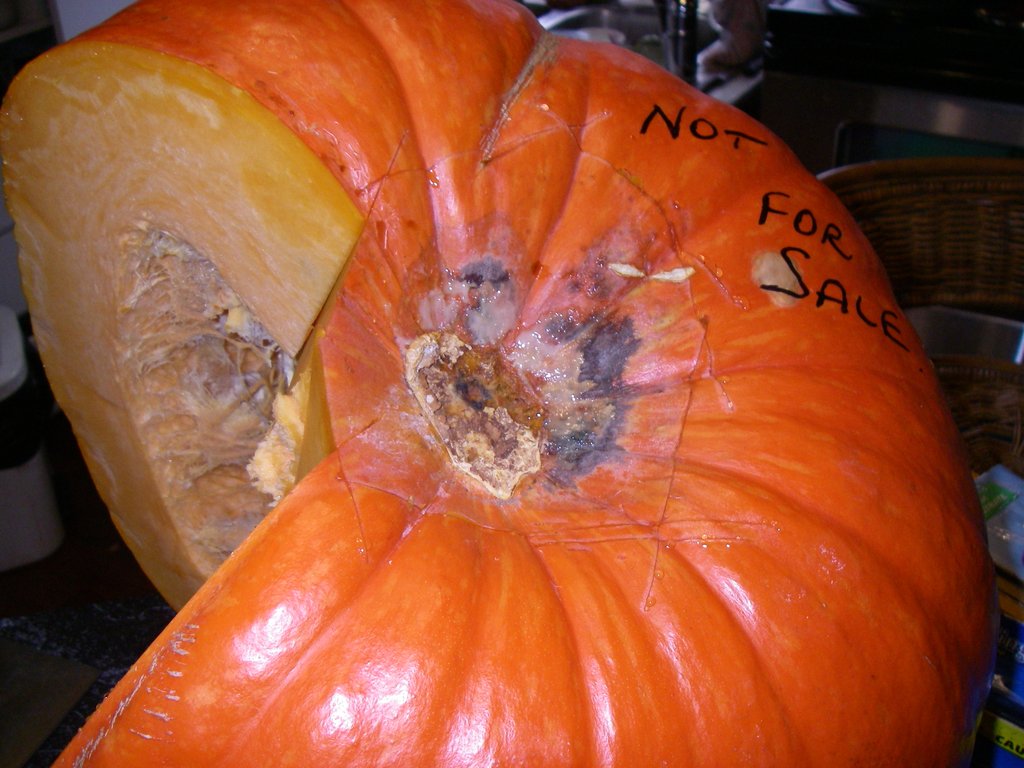
So I ended up with a massive pumpkin back in early November. Maybe no Atlantic Giant, but it was a good 18 kilos or so. When reading Annie Hill's book Voyaging on a Small Income, I learned that squash can be stored for extended periods with not much more than a quick wipe-down with a 5% bleach solution. The bleach impairs the growth of fungus and other microorganisms that degrade the shell of a squash, and once that's accomplished, squash slowly desiccate, but will last a long time without spoiling.
A few weeks after rescuing this pumpkin, I noticed a little bit of white mold starting to grow on some of the rind scars, so I wiped it down and let it sit on a counter in the kitchen for the last eight weeks or so while I figured out what to do with it. It didn't really matter what I cooked it into, this was a big squash and was going to require a lot of preservation after that first cut. Yesterday I decided to get on with the job and picked up the pumpkin for the first time in months.
And it was a good thing I did; I hadn't managed to stop all spoilage on the squash. Around the stem, the pumpkin rind had begun to soften and rot, but the pumpkin itself was in remarkably good shape.
The Food We Eat
An interesting editorial from The Guardian--it's also worth following the link to the Scientific American article about halfway down.
Food sustainability: Modified opinions
Historians of the future may mark the early 21st century as the point where the science of agriculture finally broke into public understanding. Ten years of ill-tempered debate over genetically modified organisms (GMOs) has had many malign effects, not least adding to public scepticism about science and scientists. But it has had one benign one. It has pumped dye into the veins of the global food business, graphically illustrating the monopolistic ambitions of agribusiness and ultimately, perhaps, its ability to control the very food we eat.
On Wednesday night a debate on GMOs at the illustrious Royal Society of Chemistry HQ in London suggested a breakthrough. Afterwards the feeling was that it was a win on points for the GM sceptics. This is not what was meant to happen: the scientific community, and the government, insist Britain's future food sustainability depends on employing some form of GM to increase yields, as the Royal Society recently argued. But they can take heart: the debate was less a defeat for GM than for the way it has developed. The corollary is that if the government really believes that the only way to increase yields is through GM technology, it will have to fund this itself.
The winning argument on Wednesday was not really about science at all, but about the ethics of a method of increasing yields that delivers such power into the hands of the multinationals. Yesterday the Soil Association published a report claiming that next year's GM soya bean seed will cost US farmers almost half as much again as this year's. Genetically modified seed is, as a technology, intended primarily to benefit the corporations that develop it. Claims that it is the way to save the world came later. This does not necessarily make it a bad technology; it only means – as Sussex University's Erik Millstone argued in the debate – its commercial trajectory is too narrow to provide much in the way of answers to global hunger. It is a technology developed for large-scale agriculture in advanced capitalist economies that has scant regard for other producers or other economic models. It has been accompanied by unsubstantiated claims which, according to independent scientists backed by the powerful voice of Scientific American, cannot be tested, since all research on GM seed has to be licensed as part of the impenetrable defences erected by agribusiness around its expensive patents.
This model excludes all kinds of developments that might make a more significant contribution to food sustainability than merely increasing yield (often by enabling heavier use of herbicides or pesticides). Food sustainability in an era of climate change requires not only, nor even primarily, higher yields, but greater resilience – the ability to survive in harsher conditions and on poorer soils. There is work to be done on developments that would lower the need for high-cost (and often high-carbon) inputs, by for example developing crops grown as annuals into perennials, or breeding varieties that do not require soil cultivation, or that improve the soil by fixing nitrogen.
Here, GM may be a small part of the answer. But it has a mixed record in Asia, where it has tended to enrich the rich and impoverish the poor, and it is unlikely to be any part of the answer to food security in Africa for the foreseeable future. As the UN's Food and Agriculture Organisation pointed out last year, there is enough food for everyone. It just isn't available in the right places. Subsistence farmers are cut off from all but the most local markets, and if they take the risk of buying commercial GM seed their increased yield might just lower local prices. They need simpler improvements. And globally the need is for publicly funded science to investigate sustainable agriculture in the widest possible meaning of the word: better farming practices, a viable pricing system and, for the global north, a radical change in patterns of consumption.
Food sustainability: Modified opinions
Historians of the future may mark the early 21st century as the point where the science of agriculture finally broke into public understanding. Ten years of ill-tempered debate over genetically modified organisms (GMOs) has had many malign effects, not least adding to public scepticism about science and scientists. But it has had one benign one. It has pumped dye into the veins of the global food business, graphically illustrating the monopolistic ambitions of agribusiness and ultimately, perhaps, its ability to control the very food we eat.
On Wednesday night a debate on GMOs at the illustrious Royal Society of Chemistry HQ in London suggested a breakthrough. Afterwards the feeling was that it was a win on points for the GM sceptics. This is not what was meant to happen: the scientific community, and the government, insist Britain's future food sustainability depends on employing some form of GM to increase yields, as the Royal Society recently argued. But they can take heart: the debate was less a defeat for GM than for the way it has developed. The corollary is that if the government really believes that the only way to increase yields is through GM technology, it will have to fund this itself.
The winning argument on Wednesday was not really about science at all, but about the ethics of a method of increasing yields that delivers such power into the hands of the multinationals. Yesterday the Soil Association published a report claiming that next year's GM soya bean seed will cost US farmers almost half as much again as this year's. Genetically modified seed is, as a technology, intended primarily to benefit the corporations that develop it. Claims that it is the way to save the world came later. This does not necessarily make it a bad technology; it only means – as Sussex University's Erik Millstone argued in the debate – its commercial trajectory is too narrow to provide much in the way of answers to global hunger. It is a technology developed for large-scale agriculture in advanced capitalist economies that has scant regard for other producers or other economic models. It has been accompanied by unsubstantiated claims which, according to independent scientists backed by the powerful voice of Scientific American, cannot be tested, since all research on GM seed has to be licensed as part of the impenetrable defences erected by agribusiness around its expensive patents.
This model excludes all kinds of developments that might make a more significant contribution to food sustainability than merely increasing yield (often by enabling heavier use of herbicides or pesticides). Food sustainability in an era of climate change requires not only, nor even primarily, higher yields, but greater resilience – the ability to survive in harsher conditions and on poorer soils. There is work to be done on developments that would lower the need for high-cost (and often high-carbon) inputs, by for example developing crops grown as annuals into perennials, or breeding varieties that do not require soil cultivation, or that improve the soil by fixing nitrogen.
Here, GM may be a small part of the answer. But it has a mixed record in Asia, where it has tended to enrich the rich and impoverish the poor, and it is unlikely to be any part of the answer to food security in Africa for the foreseeable future. As the UN's Food and Agriculture Organisation pointed out last year, there is enough food for everyone. It just isn't available in the right places. Subsistence farmers are cut off from all but the most local markets, and if they take the risk of buying commercial GM seed their increased yield might just lower local prices. They need simpler improvements. And globally the need is for publicly funded science to investigate sustainable agriculture in the widest possible meaning of the word: better farming practices, a viable pricing system and, for the global north, a radical change in patterns of consumption.
Subscribe to:
Posts (Atom)