Friday, May 18, 2012

The Garden Update

I planted early this year--my first year planting in this climate. Of course, it was radishes, which are an early crop to begin with.I learned from my brother that you plant radishes early and cover them with floating crop cover (a spun-bonded fabric of polyester threads that allows light and water through the weave). The crop cover does two things; it offers maybe a degree of frost protection and it doesn't allow pests to get through. So you end up with radishes without worms.
In Alberta, we would lay out our pieces of crop cover, mark their size, and then plant to that size. The crop cover was carefully re-folded, and stored for next year, as we only had so much and could only get it in massive commercial rols that I could never afford. So the pieces from my brother (Frank Klassen of Sunnyside Fruit and Vegetables) ended up lasting us most of a decade.
Crop cover is very light (a few grams per sq. metre)--important, because it has to lay directly on top of the plants and mustn't interfere with their growth. It's now available pretty much everywhere (here in Victoria at Buckerfields and Lee Valley) and in home garden sizes. Which I think is a real boon to small growers.

Radishes at three weeks under crop cover

I was in a hurry when I planted the radishes this year and over-planted. They're far too close together. But they came up nicely, and delivered what they're supposed to--that first blast of colour and flavour in the spring after a winter of preserved food and store-bought vegetables.


The Big One

We had the last of the first crop of radishes for dinner last night. A couple of small rows will go into the same bed for eating in June. But Paula found the radish above while cleaning out the last of the radishes. Normally radishes like this would be woody and inedible, but this one was still crunchy and tasty.Actually the flavour was less intense than the smaller versions of the same cultivar. This one was more like a daikon radish--lots of crunch, less intense.
Currently, under a tunnel, we've got some transplant pepper plants, beets (up), shallots (up, from sets), Royal Burgundy beans (bush beans that produce purple beans that turn deep green when steamed. Also up.), and carrots (Paris Market, I think, but not up the last time I checked).
Paula's transplant peas (at the far end of the crop cover picture above) are huge and ready to flower. Should have fresh peas before too long! We've also got some tomatoes in with more to go, potatoes in (some yellows that sprouted in the cupboard) and squash. The medlar tree has leafed out and should make it through the summer (assuming I water it regularly), but has taken a bit of a hit from an insect attack to the leaves. Nothing fatal, though. Summer's starting to look tasty.....


Thursday, May 17, 2012

Special Rapporteur Spanks Canada

Yesterday, the United Nations Special Rapporteur on the right to food delivered his preliminary reflections [pdf] on his eleven day trip to Canada. Olivier De Schutter's press conference and report on the state of food security in Canada and our progress on the human right to food spanked Canada pretty good. You could tell how accurate it was by the three members of cabinet that attacked him, claiming he knew nothing of Canada and shouldn't have been here anyway--even though he was here at the invitation of the federal government.


The CBC report on De Shutter's Visit

The reason for the Harper government's upset is mentioned in the report from the CBC: De Shutter's report to the UN Human Rights Commission becomes part of Canada's human rights record at the UN. And the report is quite critical about Canada's food security status.
The Special Rapporteur visited four provinces (Quebec, Ontario, Manitoba, and Alberta) and convened eight civil society meetings in which he met with farmer's organizations,food security groups, human rights organizations, academics, researchers, and communities. He also read a number of written submissions from individuals and communities.
Health Minister Leona Aglukkaq was one of the Harper government's attack dogs, saying that as De Shutter had not visited her home community, there was no way he could comment on the food security status of Canada's First nations people. On the CBC program Power and Politics, De Shutter pointed out that a trip to Aglukkaq's home would have involved two days travel each way. In his preliminary remarks, he does mention that he met with First Nation's groups and communities in all four provinces, including the Inuit Tapiriit Kanatami and the Congress of Aboriginal Peoples. He then thanks a number of First Nation's organizations and chiefs, council, and community members with whom he visited. Having failed to travel two days to a remote village doesn't really seem to have affected his meeting with a wide variety and cross-section of Canada's First People.
De Shutter's report doesn't say anything really new--anyone paying attention to poverty and/or food security issues in Canada over the last 35 years will not be at all surprised.
A growing number of people across Canada remain unable to meet their basic food needs. In 2007/2008, approximately 7.7 per cent of households in Canada reported experiencing moderate or severe food insecurity.4 Approximately 1.92 million people in Canada, aged 12 or older, lived in food insecure households in 2007/2008 and a staggering 1 in 10 families, 10.8 per cent, with at least one child under the age of six were food insecure during the same period
Fifty-five per cent of households in which the main source of income was social assistance are food insecure, the result of a huge discrepancy between social assistance levels and the rising costs of
living.6 The failures of social assistance levels to meet the basic needs of households, have resulted in the proliferation of private and charity-based food supplements. In 2011, Food Banks Canada
calculated that close to 900,000 Canadians were accessing food banks for assistance each month, slightly over half of whom were receiving social assistance.
The Special Rapporteur was disconcerted by the deep and severe food insecurity faced by aboriginal peoples across Canada living both on- and off-reserve in remote and urban areas. Statistics on First Nations specific food insecurity are few, however the First Nations Regional Longitudinal Health Survey (RHS 2008/10) indicates that 17.8 per cent of First Nations adults (age 25–39) and 16.1 per cent of First Nations adults (age 40–54) reported being hungry but did not eat due to lack of money for food in 2007/2008.
[from the preliminary  remarks page 2]

But the Special Rapporteur's remarks have made it very clear why the Harper government went on the attack so quickly; after pointing out how many strong actions have been taken on the human right to food and food security at the municipal and provincial level, he points clearly to the lack of a national food strategy in Canada. During his interview with Evan Solomon on Power and Politics, De Shutter comments on the strong grassroots commitment and concern over food and food security issues in Canada--a constituency he feels is unrecognized at the federal level.


Evan Solomon interviewing Olivier De Shutter on CBC's Power and Politics

Olivier De Shutter has been the UN Special Rapporteur on the right to food since March of 2008, and this was his first visit to a developed country like Canada. I, for one, was pleased that he held Canada to the same standards that he would a country in the developing world. he has also been paying attention to the agroecological movement taking place in the developing world--which he talks about in the following video clip:


UPDATE:
Food Secure Canada  has a transcript of the questions asked in the House about the Special Rapporteur's preliminary report. Depressingly low-quality questions and answers.

Wednesday, May 16, 2012

Spice

I was in my local grocery store this week because I wanted to buy some walnuts. Chopped walnuts, 400 grams (just shy of a pound) were $10. "No no," I thought, and went next door to the specialty store to compare prices. Same thing. What the hell happened to the price of walnuts when I wasn't looking? Turns out, walnuts are just like oil--there is a world price and you have to pay it no matter what the local supply price should be. And in the last couple of years, even though California has had record walnut harvests, demand from China has exploded.This year's price is expected to be 35% higher than last year's price. Western Farm Press reports:
Despite this biggest-ever California crop, buyers have been willing to pay more for walnuts. Compared to a year ago, in-shell prices are currently 20 percent to 30 percent higher, while shelled walnuts are selling for 20 percent to 50 percent more, Jelavich reports.
He attributes much of this to strong demand by buyers in China and Hong Kong, who first entered the market just three years ago.
“Last year, at this point in the marketing year, these two markets had bought a combined total of 14,000 tons. This year, they’ve already purchased about 40,000 tons.”
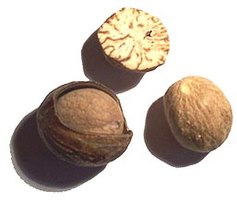
Nutmeg


While I was buying a quarter cup of walnut pieces, I noticed the jar of whole nutmeg behind the counter: $19.99/100 grams. That would be $90.75 / lb. I was amazed that the nuts weren't guilded or locked in a safe. I bought one mid-size nut and paid a dollar for it. When I asked about why, the proprietor didn't know, but said that mace--the spice obtained from dried covering of the nutmeg fruit seed--was so expensive that his distributor wouldn't even carry it, as no one could afford to buy it.

Mace is the red covering the nutmeg seed above


Turns out, nutmeg has been experiencing bad crop years in India. From 2009 to 2010, crop yields fell 50-60% and the price rose from Rs 120-135 to Rs 180-200. Again by 2011, the Hindu Business Line reported:
The prices of nutmeg and mace continued to soar on short supply in the domestic and international markets.
Unfavourable weather in growing countries such as Sri Lanka and Indonesia reduced the output last year and harvesting is reported to be delayed in Sri Lanka this year due to untimely rains, trade sources here said.
Meanwhile, industry sources claimed that in India “unseasonal rains have destroyed the flowers hence, 30 per cent shortage is expected in the coming 2011season.” According to them, there is a likely shortage in Sri Lanka also in the coming seasons due to unseasonal rains and hence prices are expected to move up further.
Decline in output in supply sources has pushed up the prices of mace to Rs 1,700-2,000 a kg here depending upon the quality/colour, they said.
Farm grade nutmeg with a shell is ruling at Rs 425-450 a kg while that without shell is at Rs 700 a kg and above, they said.
Indian output of nutmeg with shell is estimated at 13,000 tonnes and when the shells are removed it would come to about 9,000 tonnes.
 So "unseasonal rains" have pushed the price from Rs 120/kg to  Rs 700/kg in the course of a couple of years. There was also some profiteering by producers not shipping crops as the price was appreciating daily.
But the whole "unseasonal rains" thing is the issue that should concern us most. Russia has seen "unseasonable non-rains" in the last couple of years--leading to shutting down wheat exports a couple of years back to ensure a sufficiency for the country--as well as wildfires and heat deaths among the population. Global climate change is here, and its a bastard. 15,000 warmest day records fell this past winter across the US. Canadians should not be relying on food from anywhere else, but rather concentrating on producing as much as possible locally. That way there might be food from away when we need it most, when the "unseasonable rains" happen here.

Tuesday, May 15, 2012

The Urban Experience (II)

The CBC covered the story of the urban garden going in in Vancouver this week. What is most interesting is to see how they are building the garden: pallets, cloth/tarp, boxes, soil. In doing this, I'm sure Concord Pacific is getting a great return somewhere along the way (although no one is saying where). But that's fine. What is important is how much food is expected to be grown on an unused parking lot--something like 100,000 kilos. SoleFood has their work cut out for them. Growing that much will be a lot of work--even if not grown in the most sustainable manner. But this is all to the good.
It is, of course, nothing really new. Cuba has been doing this since 1988 and the collapse of the Soviet Union. In Havana, the local government authorized people to use, free of charge, state-owned vacant lots in and around Havana. During the years 1990-1994 (the "special period" when food imports evaporated and the average Cuban lost 9 kilos of weight) it was estimated that more than 27,000 people were linked to some 1,800 hectares of community gardens. Cuba has made great strides in achieving food sovereignty since then.


Sunday, May 13, 2012

The Urban Experience

From The Vancouver Sun website:


A parking lot is not exactly the place you might expect to see organic beans, bok choy and baby beets growing in abundance.

But part of the empty lot on the former Expo lands on the north side of False Creek will become a two-acre urban farm, bursting with 40 varieties of fruits and vegetables, if all goes according to plan.

“It’s an enormous leap,” said Michael Ableman, an urban farmer and director of Solefood, an organization that creates agriculture jobs and training for inner-city residents.

It’s the largest city farm attempted in Vancouver, and will be tended mostly by residents of the Downtown Eastside. The group plans to employ 25 people along with four farming apprentices and sell its produce to restaurants and farmers’ markets. The farm is portable, growing in containers above ground, because the site is on a three-year lease.

“We’re demonstrating this can in fact be considered a serious enterprise for urban areas. We’re not talking about community gardens any more. We’re taking it up a level,” said Ableman, who founded the Centre for Urban Agriculture in Santa Barbara, Calif., in 1981 and now farms on Saltspring Island.

A Brief History Lesson

Over at Slate, there's a terrific article I wish I'd written; All Churned Around: how buttermilk lost its butter by L. V. Anderson. I had noticed that buttermilk wasn't the leftover milk product of buttermaking anymore, but I didn't take the time to follow up on that thought.Ms. Anderson does take that time. She starts out with a personal recollection--one that I totally get:

I first saw the word buttermilk in print while reading Laura Ingalls Wilder’s Little House in the Big Woods. In one riveting scene (I was 7 years old) Laura’s mom dyes some cream yellow with grated carrot and then churns it into butter. After shaping and embossing the butter, she takes the leftover liquid from the churn and gives Laura and her sister “each a drink of good, fresh buttermilk.”
This whole process—and especially the celebratory buttermilk quaff—stuck with me, as exotic images from literature tend to do when one is a child. So when I saw buttermilk on the menu at a Southern-themed restaurant called Threadgill’s a few months later, I promptly ordered a glass. My parents advised me to reconsider, but I persevered: This was a chance to commune with my favorite author and to prove to my parents that I had a hardy, advanced palate. (My ability to enjoy a glass of buttermilk at the age of 7 carried the same symbolic weight that my ability to enjoy a scotch neat does today.)
My parents were right. The buttermilk was sour, tart: awful. So overwhelmingly acidic was its flavor that I hardly even noticed the creaminess. I abandoned the glass after one sip.
Read the rest at Slate.

Saturday, May 12, 2012

A Number of Issues

A Huffington Post article echoed on Alternet. Martha Rosenberg introduces her list of BigAg's Nine Issues:
Food scandals are so costly to Big Food, it has repeatedly tried to kill the messenger rather than clean up its act. In the 1990s it pushed through "food disparagement" laws under which Oprah Winfrey herself was sued by cattlemen in 1997 (Winfrey said she would never eat a hamburger again upon learning that cows were being fed to cows). Winfrey was acquitted and cow cannibalism was made illegal but the US still lost $3 billion in beef exports when a first mad cow was discovered in 2003. April's new mad cow will not help foreign trade.
Last year, Big Food introduced Animal Facility Interference laws in several states which make it a crime to "produce, distribute or possess photos and video taken without permission at an agricultural facility." The bills also criminalize lying on an application to work at an agriculture facility "with an intent to commit an act not authorized by the Owner"--in an effort to stop the flow of grisly undercover videos. The first facility interference offense would be an aggravated misdemeanor but subsequent offenses could be felonies.

Of course, the Ag-Gag bills, as they were quickly dubbed, are anti-free-speech and would chill both whistle-blowers and news media (who couldn't legally even receive non-approved farm images). The bills were scorified by CNN, the New York Times, Time magazine and First Amendment and food safety activists and, luckily, were defeated in 2011. But they are creeping back.
It would be difficult to argue with her sentiments, but for the moment, at least, Canada isn't seeing quite the same activity on the part of BigAg. Well, not until the Stephen Harper government attacked environmentalists....  With a government inspired by a fundamentalist right-wing theology that doesn't acknowledge the validity of science and believes that mankind cannot harm the environment (no, really.), BigAg, just like BigOil, doesn't actually have to get it's hands dirty. They can simply watch our government go further faster than even they would have hoped. [Martha Rosenberg's Nine Issues and my Canadian-perspective gloss follow the jump]

Friday, May 11, 2012

Things We're Losing (1)

Glass Gem Corn. How cool is this?


Apparently this has gone viral from Milkwood Permaculture's
Facebook page. The original caption:


Glass Gem Corn... hands-down winner of the most amazing heirloom corn variety we've seen yet! Carefully stewarded by Seeds Trust in Arizona...

"Seedsman Greg Schoen got this seed from Carl Barnes, a part-Cherokee man, now in his 80's, in Oklahoma. He was Greg's "corn-teacher". Greg was in the process of moving last year and wanted someone else to store and protect some of his seeds. He left samples of several corn varieties, including glass gem. I grew out a small handful this past summer just to see. The rest, as they say is history. I got so excited, I posted a picture on Facebook. We have never seen anything like this - Bill (Seeds Trust)

More photos at http://www.facebook.com/seedstrust

Thursday, May 10, 2012

Why "Organic" Does Not Mean What You Think It Means

From OrganicSalmon.org

New Canadian ‘Organic’ Aquaculture Standard Fails to Meet True Organic Principles

For Immediate Release
May 9th, 2012
East and West Coast conservation organisations today expressed united concern over the undermining of the Canadian ‘organic’ label by a new organic standard that would allow net-pen aquaculture products to be certified.
By including open-net pen finfish in to the organic aquaculture standard, the standard fails miserably at one of its claimed principles, to ‘Protect the environment, minimize benthic degradation and erosion and water quality degradation, decrease pollution, optimize biological productivity and promote a sound state of health’.
“The finfish standards would allow conventional open net pen farmed salmon to be certified organic despite the large body of scientific evidence linking this farming practice to detrimental impacts on wild salmon and on the marine environment,” stated Matt Abbott from the Conservation Council of New Brunswick.   “Organic producers and customers should be concerned as this weak aquaculture standard threatens the integrity of all organic labels,” concluded Abbott.
The Conservation Council of New Brunswick, Living Oceans Society and three other voting members including organic associations,  formally voted ‘No’ to the new Canadian Organic Aquaculture Standard as members of the standard committee. However the standard still passed the Canadian General Standards Board (CGSB)’s requirement of 50% plus one vote.
The restrictive voting membership of the committee was heavily government and industry based, including a number of the largest salmon aquaculture companies and their associations. “The bias of the membership base, definitely aided this standard being passed,” said Kelly Roebuck from Living Oceans Society, a member group of the Coastal Alliance for Aquaculture Reform (CAAR).  “In fact the standard sponsor, Department of Fisheries and Oceans (DFO) has been a major driver for obtaining an organic standard for open net pen farmed salmon” stated Roebuck.
The Canadian so-called ‘Organic’ Aquaculture Standard allows:
  • The use of synthetic pesticides;
  • The continued, uncontrollable spread of disease and parasites to wild fish;
  • Uncontrolled disposal of fish feces into the ocean;
  • Escapes of farmed fish that compete or interbreed with wild fish;
  • Entanglement and drowning deaths of marine mammals;
  • The unrestricted use of feed from non-organic, potentially unsustainable sources, as opposed to the 100 per cent organic feed requirement currently in place for all other organic livestock;
  • The unlimited use of wild fish in feed. Since operations use substantially more wild fish in feed than farmed salmon produced, this allows farmed fish to be certified “organic” despite contributing to a net loss of marine protein and a drain on already strained global fish stocks.
“With growing consumer interest in sustainable, local and organic food – this organic labelling will undermine public confidence in all organic and sustainable labels,” stated Rob Johnson of the Ecology Action Centre. “With this standard for open net pen fish, we’re seeing greenwashing being taken to an entirely new level,” concluded Johnson.
Innovative technology such as closed containment systems can greatly reduce or eliminate environmental risks such as escapes, diseases and parasites, waste discharge and pesticide use, yet  these aquaculture production systems that are more compatible with organic principles have not been prioritized within the standard.
The Coastal Alliance for Aquaculture Reform (CAAR), Conservation Council of New Brunswick and Ecology Action Centre today launched the website www.organicsalmon.org to provide more information on the concerns associated with the Canadian Organic Aquaculture Standard and how shoppers can make a difference by supporting aquaculture producers who are farming more sustainably.
For more information, please contact:
Kelly Roebuck, Living Oceans Society (CAAR member group)
604.696.5044/Cell: 778.232.0329
kroebuck@livingoceans.org
Matthew Abbott, Conservation Council of New Brunswick
506-529-8838/Cell: 506-321-0429
marine@conservationcouncil.ca
Rob Johnson, Ecology Action Centre
902-222-4933
rob@ecologyaction.ca
About the Coastal Alliance for Aquaculture Reform (CAAR)
CAAR was formed in 2001 to ensure salmon farming in British Columbia is safe for wild salmon, marine ecosystems, coastal communities and human health. Today the coalition has over 10,000 supporters across four continents and is comprised of the following conservation groups:
About Conservation Council of New Brunswick (CCNB)
CCNB is a membership-based organization that has been at the forefront of environmental action in New Brunswick since 1969. CCNB believes the future of all life depends on bringing human activity in balance with ecological limits. CCNB is a citizens’ action group that creates awareness of environmental problems and advocates solutions through research, education and interventions.
About Ecology Action Centre (EAC)
Since 1971, the EAC has been working to build a healthier, more sustainable Nova Scotia. The Ecology Action Centre works closely with social and natural scientists and makes strong use of science in communicating its message to the public. The Centre’s earliest projects included recycling, composting, and energy conservation, and these are now widely recognized environmental issues. Our current areas of focus include Built Environment, Marine Issues, Coastal Issues, Wilderness, Food, Transportation and Energy Issues.

Wednesday, May 9, 2012

Reducing e. coli Contamination

There's a report at Science Daily that talks about research by a "Cand.agric. Sigrun J. Hauge defended her doctoral research on 2nd May 2012 at The Norwegian School of Veterinary Science (NVH) with a thesis entitled "Hygienic impact of measures related to unclean cattle and sheep at farm level and in the abattoir."" The article goes on to detail Sigrun's testing of  a "hot water pasteurization" process for destroying e. coli  on lamb carcases. It is an interesting read (a copy follows), but its predicated on treating animals as industrial inputs. Stop doing that and meeat will become more expensive, better, and better for us.
ScienceDaily (May 4, 2012) — Following the E. coli case in Norway in 2006, when 17 people fell ill and one child died after eating mutton sausages, the meat industry introduced a number of measures in order to reduce the risk of food poisoning from meat. Clean animals and good hygiene during slaughtering are essential preconditions for food safety.
Sigrun J. Hauge has studied the effect of the measures implemented on farms and in slaughterhouses. The aim of the project "Uncontaminated Carcasses" was to uncover data that would help to improve the hygienic quality of meat from cattle and sheep by means of cleaner animals and efficient ways of slaughtering high-risk animals.
E. coli is a commonly occurring bacterium in the digestive tract of humans, animals and birds. Just a few strains are pathogenic and can cause diarrhea and kidney failure, particularly in children. The bacteria die at temperatures over 60-70 °C and are therefore normally eliminated by boiling and roasting. Hauge has shown that a new, rapid enzymatic method for detecting E. coli is equally as reliable as the traditional method of growing bacteria culture. This new method is therefore suitable for monitoring E. coli in abattoirs.