Showing posts with label India. Show all posts

Wednesday, July 2, 2014

The Questions Begin With Onions

This image is in the public domain because it contains materials that originally came from the Agricultural Research Service, the research agency of the United States Department of Agriculture.

It is rather amazing just how many questions can arise out of a simple onion. Following Noam Chomsky's advice that the only honest reporting is done in the business pages, I was browsing the Bloomberg website when I can across an article about how onion traders were viewing current Indian anti-inflation policy. The article opens with a man named Arun Kumar, a produce market middleman, saying he " has seen many Indian governments try and fail to eliminate middlemen at produce markets who are blamed for hoarding and stoking inflation." One of the big drivers for the concern over inflation and food markets is the lack of monsoon season rains this year--India is experiencing a 45 percent drop in rainfall amounts. A full scale drought, according to HSBC Holdings Plc., could reduce Indian economic growth by as much as a half-percent this year.Food prices in India make up about 50 percent of the consumer price index, which rose 8.28 percent in May of this year alone. (By way of comparison, food prices make up about 15 percent of the US CPI).
Notice of this drought in India comes at the same time that some sixty communities in Saskatchewan and Manitoba are dealing with floods from major storms dropping between 75 and 150 mm of rain in 24 hours. Both the drought and the rains (similar to last year's Alberta rains that flooded Calgary and High River), are driven by global warming changing the amount of water held by the air and changes to weather patterns; India sees 45 percent less rain during monsoon season and southern Saskatchewan and Manitoba get a whole summer's worth of rain in 24 hours.
Both these events will negatively impact the production of food in their respective countries. Bloomberg's reports that, in India:
After an emergency meeting two days ago, Jaitley said the government would ask states to crack down on hoarders, aid imports of pulses and cooking oil, and fix a minimum export price for potatoes and onions to discourage overseas sales. Food Minister Ram Vilas Paswan said India will offload about a quarter of its rice stockpiles.

Thursday, February 21, 2013

Less is More

From the Guardian:
Sumant Kumar was overjoyed when he harvested his rice last year. There had been good rains in his village of Darveshpura in north-east India and he knew he could improve on the four or five tonnes per hectare that he usually managed. But every stalk he cut on his paddy field near the bank of the Sakri river seemed to weigh heavier than usual, every grain of rice was bigger and when his crop was weighed on the old village scales, even Kumar was shocked.
This was not six or even 10 or 20 tonnes. Kumar, a shy young farmer in Nalanda district of India's poorest state Bihar, had – using only farmyard manure and without any herbicides – grown an astonishing 22.4 tonnes of rice on one hectare of land. This was a world record and with rice the staple food of more than half the world's population of seven billion, big news.
It beat not just the 19.4 tonnes achieved by the "father of rice", the Chinese agricultural scientist Yuan Longping, but the World Bank-funded scientists at the International Rice Research Institute in the Philippines, and anything achieved by the biggest European and American seed and GM companies. And it was not just Sumant Kumar. Krishna, Nitish, Sanjay and Bijay, his friends and rivals in Darveshpura, all recorded over 17 tonnes, and many others in the villages around claimed to have more than doubled their usual yields.
The villagers, at the mercy of erratic weather and used to going without food in bad years, celebrated. But the Bihar state agricultural universities didn't believe them at first, while India's leading rice scientists muttered about freak results. The Nalanda farmers were accused of cheating. Only when the state's head of agriculture, a rice farmer himself, came to the village with his own men and personally verified Sumant's crop, was the record confirmed.

Monday, November 19, 2012

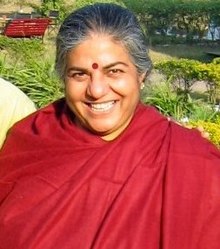
HARDtalk with Vanada Shiva

Vananda Shiva from Wikipedia


HARDtalk is a BBC News programme the does extended interviews. At 4:30 am on 19 Nov. 2012, the extended interview is/was with Vananda Shiva, the original treehugger (no, really. In the '70s, she and a group of women hugged trees to keep them from being cut down). She:
(...) is a philosopher, environmental activist, author and eco feminist.[1] Shiva, currently based in Delhi, has authored more than 20 books.[2] She was trained as a physicist and received her Ph.D. in philosophy from the University of Western Ontario, Canada, in 1978 with the doctoral dissertation "Hidden variables and locality in quantum theory."[3][4]
She is one of the leaders and board members of the International Forum on Globalization, (along with Jerry Mander, Edward Goldsmith, Ralph Nader, Jeremy Rifkin, et al.), and a figure of the global solidarity movement known as the alter-globalization movement. She has argued for the wisdom of many traditional practices, as is evident from her interview in the book Vedic Ecology (by Ranchor Prime) that draws upon India's Vedic heritage. She is a member of the scientific committee of the Fundacion IDEAS, Spain's Socialist Party's think tank. She is also a member of the International Organization for a Participatory Society.[5]
She was awarded the Right Livelihood Award in 1993. [via wikipedia]
There's a great deal of info on Vanada Shiva available (like this interview).  But the HARDtalk interview is really quite good. When the interviewer says that cotton yields have increased with the introduction of BT cotton from Monsanto, Vanada calls her out, saying, in essence  "Bull. The yields have increased not because its bt cotton, but because its now being monocropped instead of intercropped. There's simply more cotton being grown." The interview isn't available for download yet--as the programme hasn't yet been aired in most of the world. But the link above will make it available soon. And I'll post it once it becomes available.
UPDATE: BBC has restricted viewing of HARDtalk to the UK. There is a clip from the interview here.