Wednesday, July 4, 2012

Level Ground, Fair Trade

So I got the opportunity this week to do one of my favourite things: getting behind the “Employees Only” door. On June 12th, I was with a group of about a dozen and a half other members of the UVic University 101 program got the opportunity to meet one of the founders of Level Ground TradingCompany. Stacey Toews helped found Level Ground back in 1997 in order to provide Fair Trade coffee to lower Vancouver Island. In the beginning, they didn't even have a building to work from, instead borrowing space from another company after their workday was over, in order to roast and pack the coffee they were bringing in from Columbia. Now in their third building and fifteenth year, Level Ground has a compact, efficient space and about 25 employees.
Level Ground facilities

Level Ground is now bringing in coffee from about 5000 farms and 12 different producer groups in 8 different countries, supplying a number of local retailers with both beans and ground coffee. Stacey is clearly still passionate about the work he's doing. I inferred that a lot of what he does is explain just what he does: talking about the business, he had a casual command of both facts and concepts that he wanted to communicate, and his delivery was both polished and personal. We started the tour with, of course, coffee. Level Ground buys top-end, shade-grown beans, roasts and packages them on-site, and apparently have figured out a good grounds-to-water ratio, because I thoroughly enjoyed my cup. Which, of course, was the point. Stacey started our tour with a history of the fair trade movement, the modern version of which is said to have started about 65 years ago with Edna Ruth Byler, a Mennonite missionary. While on mission work, she found herself in a village where the women were producing high quality linen needlework. Six years later, she and a colleague, Ruth Lederach, took some of the items to a Mennonite conference in Switzerland and sold them, and by 1958 had opened a small shop. These shops have become the Ten Thousand Villages stores found across North America. In Victoria, Level Ground imports, roasts, grinds, and bags coffee for the Ten Thousand Villages shop.
 In Europe, Oxfam picked up the ball in the mid-sixties and ran with it, becoming the force behind the European fair trade movement. Both the Mennonites and Oxfam were drawing on a much deeper and older tradition. Gavin Fridell writes [pdf] that
 “it is difficult for anyone in our present age to imagine that at an earlier point in world history it appeared “unnatural” that one person should profit by denying others the basic right to subsistence. Yet this conviction was common amongst local communities in pre-capitalist societies before the imperatives of the capitalist market and the new ideology of political economy replaced the “old moral economy of provision.” ”
Fridell links this pre-capitalist moral economy with the modern fair trade movement:
 “The greatest virtue of fair trade lies in its attempt to take advantage of its market niche to construct a new moral economy, one which crosses national boundaries and re-asserts the notion of people’s right to live taking precedence over the flows of supply and demand. Whereas the old moral economy described by Thompson asserted the rights of poor consumers to gain access to the means of life, the new moral economy of fair trade asserts the right of poor producers to get a fair price for what they sell on the market.”
It is this “new moral economy of fair trade” that Level Ground works in and that Stacey Toews is so passionate about. The front of every package of Level ground coffee has the face of a producer emblazoned on it—a producer who grew some of the beans in the roast, GPS coordinates to the community nearest their farm on the package, and who relieved a fee for the use of his or her face. The goal is to produce a perceived relationship between the producer and consumer, to make you think about where your food came from. And it wasn't until food became part of the fair trade movement that it really became visible to the public. Because of the central place food holds in all human cultures. Level Ground is branching out into non-coffee items as well, distributing dried fruit, chocolate, cane sugar (an excellent sugar, primarily a dehydrated sugar can juice that leaves a great deal of flavour with the sweet), and most recently, vanilla beans. The “A” quality vanilla beans are being sold as beans, and the “B” grade are being used to make extract. Level Ground is partnering with a local vodka maker to create an authentic vanilla extract, and early experiments seem quite promising, according to Stacey. Coffee also needs special handling when being picked. 

As coffee is a berry when it is picked, beans must be de-pulped and washed within hours of being picked or it ferments, rots and is valueless. Farmers must have access to a buying station or buying post or their crop is worth nothing. Level Ground is pursuing a project in Columbia with an organic grower to purchase his sun-dried pulp (the remains of the cherry) and make a tea from it. Apparently it is naturally quite sweet tasting.
The roasting room

 But, according to Stacey, fair trade remains an imperfect solution to the problems of ensuring producers a fair price for their goods. While the fair trade standards set by a German NGO (Non-Governmental Organization) provide for a minimum price for various goods from different places, there is no guarantee that the price flows all the way back to the original farmer rather than a larger producer group. “So without a dialogue and relationship with the producer group you can actually completely dehumanize trade and call it fair at the same time by current global standards,” Toews says. And points out that NestlĂ© in the UK now produces a two-finger Kit Kat bar that is fair trade certified.He sees the prices established by Fair Trade certification to be akin to a minimum wage: The goal is not to pay the minimum wage, but to pay more than that. When Level Ground started trading, world coffee prices were $2 US / pound. Since then, prices have fluctuated between a low of $0.45/lb and as high as $3.10/lb.
Grinding and bagging station

Currently at ~$1.75/lb, on the international market, Level Ground is paying its suppliers for top quality export beans (green) between $3 and $4 /lb depending on the country and producer group. Keeping in mind that roasting reduces the weight of beans (it takes, on average, 1.3 pounds of green beans to get a finished pound of roast beans), there's a lot of product moving through level Ground.
Distribution area--for ground and whole bean coffee

From their first container load of green beans, Level Ground is now working with 5000 farms, 12 different producer groups, 8 different countries, 25 staff, and goes through about 4 million pounds of beans a year.
Stacey Toews in front of green beans
 They store very little coffee on site. Warehouse costs are so much lower in Vancouver that they store their coffee there, only bringing it over a container at a time to roast and distribute.
Stacey with a handful of "coffee paper"

Level Ground is also paying attention to their waste stream as well. The bags the green beans come in are a natural burlap that decomposes, making them a great mulch in local gardens.  The "paper" that covers the bean and comes off during roasting is also recycled. With an aggressive recycling program, Level Ground generates very little actual "waste.
Level Ground also offers their employees a subsidy program, helping pay for the workers to commute by bus or by bike. And provide coffee to a number of non-profit organizations (including both Uni101 and The Rainbow Kitchen). Sustainability and responsibility take  pride of place in the corporate vision, making Level Ground a most unusual business. Is it obvious I had a good time?

Sunday, July 1, 2012

Animals and Animals

Wednesday, June 27th, I presented the inaugural film in the Uni101Presents series at the University of Victoria. The film I chose and introduced is (big surprise to anyone who knows me) both Canadian and about food: Jason Young's Animals. So I was working on the notes for the screening and thought I'd do a somewhat expanded version for the blog.
Jason Young's film Animals is a film about a young man from Toronto who marries, and he and his wife buy a farm in Nova Scotia. He decides that he should take responsibility for raising his own meat, and the film follows him through a year of learning to raise and butcher his own meat.
The parallels between Jason's journey and my own were quite striking. While previewing the film, it was unexpectedly funny: my hair was a bit longer but we both braided it, I wore tie-dyed T-shirts, and I've never been that skinny in my life, but other than that, we could have been twin sons of different mothers.
While Jason moves from Central to Atlantic Canada, I moved from the Wet Coast to the Prairies—the difference here being that while Jason Young is unfamiliar with East Coast culture, I was familiar with Alberta. It was, after all, where I'd been born and where I'd lived until my early twenties. But it was while I was living on the Wet Coast that I read John Robbins' book Diet For a New America. I remember looking at Paula as I opened the book and saying “Just warning you. This might change everything.” It did; for the next seven years we lived a primarily vegetarian lifestyle.

You should try it. No, really. Not for seven years, maybe, but for a month or two at least. Because once you start trying to figure out what you're getting in your food, you begin to see it differently. I remember eating lunch at Camosun College and thinking “Great! Potato salad!” right up until I saw the chunks of ham in it. Or wondering if that order of fries had been deep fried in beef tallow or not. Because animal products and by-products are bloody everywhere. And so difficult to avoid. And once you start looking at your food for what it contains, all kinds of questions come up: What is that ingredient? What is it derived from? And how will that affect me?” After living on a vegetarian diet, it's difficult not to be a conscious eater.
I didn't decide to live as a vegetarian for health reasons, or to lower my carbon footprint (in the early eighties, I hadn't started thinking about that yet). The reason was pretty simple; I couldn't justify supporting (with my food dollars) the criminal way animals are treated in North America. I'd had an unusual upbringing for the sixties. While everyone else was exploring what it meant to be urban, I was still connected to Canadian traditional mixed farming through my grandfather Klassen.

Thursday, June 28, 2012

Seed Saving 1

It is a bit early in the season to be thinking about seed saving. But for the people over at Milkwood Permaculture, its that time of year (being as their in the antipodes...). They posted this picture, which is brilliant. Making me think about saving containers for seed saving. If only I ate TicTacs....


If you are a seed saver or are interested in saving seed check out the Seed Savers Network and their YouTube channel.

Wednesday, June 27, 2012

Additives 1

This interesting piece from the Food Integrity Campaign:
As the health debate over soda continues, new test results reignite concerns regarding manufactured ingredients commonly used in soft drinks and other processed foods. It was enough that mercury has been found in products with high fructose corn syrup thanks to industrial processing, but now industrially produced caramel coloring (ubiquitous in soda to create a more appealing, dark color) has been linked to a carcinogen known as 4-MI.
The Center for Science in the Public Interest (CSPI) found "alarming levels" of the cancer-causing chemical 4 methylimidizole (4-MI) in Coca-Cola drinks around the world. It forms when a solution of sugars is heated with ammonia to make the artificial brown coloring, which is also used in baked goods, soy sauces, gravies and beer.
As of January 2012, California requires a cancer-warning label on soft drinks and other widely consumed products that lead to people consuming at least 30 micrograms of 4-MI per day. In response to that rule, Coke started using an alternative caramel coloring with considerably lower 4-MI levels … but has yet to market the less-contaminated drinks outside California

And then, the interesting part. A chart of 4-MI content by country. And look at who's number two...


This on the heels of renewed interest in how fast food / industrial food manufacturers are using the same deflect and deny tactics employed so successfully by the tobacco industry for so long. And what difference will this make to our current government? I predict "none at all." The current Tory government isn't simply business friendly, it's more like international business' crack whore. The evidence, on the other hand, just keeps piling up: if it has been commercially grown, or modified from the field in any way, it is probably better not to eat it. The only way to have true food security is to democratise the food system. By that I mean to distribute production across as many people as possible, to export nothing we do not priduce in surplus, and to import as little as possible. Canada needs to pursue food sovereigity before it pursues export capacity or the Trans-Pacific Partnership.

Tuesday, June 19, 2012

Wrong, But Understandable

I am in no way expressing support for whomever did this. I'm just saying that I kind of get this. MSN News is reporting (via AP and CP):

VIENNA - There's been a tasty break-in at a farm in southeastern Austria, where a ton of strawberries went missing under cover of darkness.
Police in Styria province said Saturday that the thieves cut down a fence in Kalsdorf, near Graz, during the night and stripped 10 rows of strawberry plants bare. They say the fruit was worth some €2,400 ($3,030).
It wasn't clear who the thieves were or where the strawberries ended up.
From Wikipedia

Above is an image of  "plasticulture" strawberries. These are fields that have been mulched with a heavy balck plastic, usually with an irrigation line under the plastic running along each row, and then strawbs planted through the plastic. This means that there are no weeds (or almost no weeds) without the use of herbicides, and the berries stand out like little "eat me!" signs when they're ripe. Works really well too, especially when you hill the rows first. When my brother, Frank Klassen of Sunnyside Fruit and Vegetable did this, that winter the deer decided that they'd found an amazing salad bar and ate every plant down the rows. However, the roots were sound, and the next spring presented an excellent crop despite the mid-winter nosh.

Wednesday, June 13, 2012

Bragging Rights

Nothing serious. Just had our first vine ripened strawberries on June 1st and Paula just handed me three snap peas to eat. Which is early. And makes me very happy. And there's lots of blossoms on both the peas and strawbs, so there will be more summer goodness.
In addition, the pepper plants are doing well, the shallots are getting big, as are the Royal Burgundy bush beans (though no blossoms yet), and the carrots are all up. The tomatoes are struggling, but not dead yet. And the climbing beans are up and growing. So life is pretty good in the garden.

By The Numbers

The Sunday New York Times published this graphic, comparing three different meals both in cost and nutritional value.

From The NYT

The problem, of course, is the rapidly declining ability among the population to actually prepare a meal from scratch.

Tuesday, June 12, 2012

Visualize Variety

A stunning photo--thanks to Milkwood Permaculture--of heirloom tomatoes. This is a reminder of what the world is supposed to look like; exuberant diversity.

Tuesday, June 5, 2012

Food, Near Food, and Vitamins

We've all heard the story of scurvy; a disease aboard ship, traced to a vitamin C deficiency, the introduction of lime juice to the sailor's diet, and hurrah! Problem solved! The moral of the story? That sometimes diet is not enough, and you have to take supplementary vitamins and minerals.
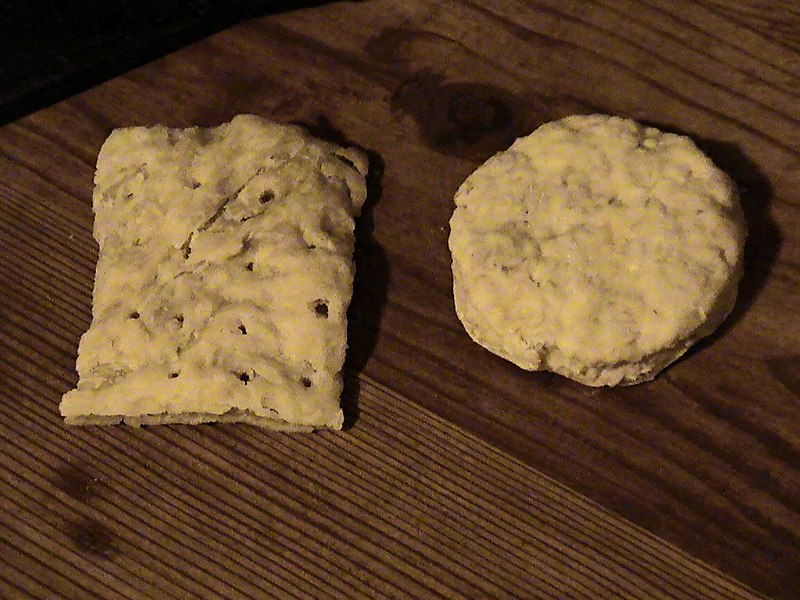
What we're not really thinking about is why the sailors faced scurvy in the first place. Navy life was brutal, badly paid, and if you weren't an officer, you were the lowest of the low—roughly equivalent to footpads and cut-purses. And the food was horrible. In the damp confines of the ship, everything developed moulds and spoiled, there was no refrigeration, and food storage techniques were less than effective. Hardtack, or ship's bread, was nothing much more than flour, water, and maybe salt, fashioned into a biscuit and baked four times to drive all the water out of it. Properly prepared, it would last effectively forever on board ship, but provided a badly nutrient-deficient food for sailors.
Reproduction hardtack (from wikipedia)
Today we take nutritional supplements for many different reasons—scurvy and beri beri no longer among them. We take anti-oxidants to protect against heart disease or cancer. We hear repeated statements about how good they are, and how we should all be taking various pills—you know, if we actually care about our health. Problem with this all is, we don't actually know if these supplements are doing us any good.
Turns out, they're not. Research over the last three or four years is showing that not only may they not be doing us any good, but they are actually being linked to earlier death in certain populations (primarily women). There are questions being raised about dose absorption from pills, timed-release seems to mean poorer uptake rates, and on and on.
In response, we hear people saying “All you have to do is eat properly and you won't need supplements.” Hey, I've said it myself. Concentrate on cooking from scratch, use lots of whole vegetables rather than processed ones, and everything should be fine. Except... it's probably not fine. Thomas F. Pawlick, in his book The End of Food (a good Canadian boy, btw. And what is it about Canadians that they write so many excellent books about the food system?) talks about a number of tests—Canadian, American, and British—that show similar results: over the last half century or so, the nutritional content of food has changed. And seldom for the better.
Thomas F. Pawlick

In 2002, André Picard reported on a joint investigation by CTV and the Globe and Mail that looked at nutritional content of six fruits and vegetables. They published this table of the changes in the nutritional make-up between 1951 and 1999:

Food
Calcium
Iron
Vitamin A
Vitamin C
Thiamine
Riboflavin
Niacin
Apple
20.0
-55.3
-41.1
16.0
-75.0
-66.7
-30.0
Banana
-23.8
-41.7
-81.2
-13.0
0
-100.0
-1.4
Broccoli
-62.8
-33.9
-55.9
-10.1
-40.0
-42.9
-2.7
Onion
-37.5
-52.9
-100.0
-54.8
56.9
-41.2
135.3
Potato
-27.5
-58.6
-100.0
-57.4
-14.6
-50.0
44.9
Tomato
-55.7
-18.8
-43.4
-1.6
0
21.8
46.3

Notice how some of the listed foods have lost all their nutritional content in one category or another: Bananas have lost all their riboflavin, Onions and potatoes have lost all their vitamin A. And across these seven categories, the majority have lost significant amounts of nutritional value.
In the UK, the story is similar. British researcher Anne-Marie Mayer published a study called Historical Changes in the Mineral Content of Fruits and Vegetables [pdf] (British Food Journal, 99(6), 1997, 207-211) in which she wrote:
There were significant reductions in the levels of calcium, magnesium, copper and sodium in vegetables, and magnesium, iron, copper, and potassium in fruits. The greatest change was the reduction in copper levels in vegetables to less than one-fifth of the old level. The only mineral that showed no significant differences over the 50-year period was phosphorus. [p. 209]
Pawlick has also looked into the US experience, particularly that of tomatoes. “Tomatoes were once among the best sources of these vitamins [A and C]. But 100 grams of today's fresh tomato contain 30.7 percent less Vitamin A and 16.9 percent less Vitamin C (ascorbic acid) than its 1963 counterpart. [emphasis in original] It also has fully 61.5 percent less calcium [...], 11.1 percent less phosphorus, 9 percent less potassium, 7.97 percent less niacin, 10 percent less iron and 1 percent less thiamine.” [p. 6 The End of Food]
That's since 1963—the numbers look worse if you go back to the nutrient tables produced by the USDA in 1950. Then it becomes apparent that while the tomato may be down 10 percent in its iron content since 1963, it is down 25 percent since 1950. But there are increases as well: fats (lipids) are up by 65 percent and sodium is up by 200 percent.
This is also true in processed tomatoes; canned tomato juice is down 35.4 percent on iron content and 30.5 percent of its Vitamin A—again since 1963. Vitamin A is down 47 percent in tomato juice since 1950. And these are only the primary vitamin and mineral components that have been measured. We really have no idea as to any change in the micro-nutrient component of what we're forced to consider as food.
So conventional agriculture has left us with an ongoing legacy of lots of cheap food, but of declining nutritional value. [Oh, and don't you love that bit of Orwellian Newspeak? Industrial agricultural methods—only about 60 years old—are referred to as “conventional,” while the techniques that date back to the beginning of agriculture have their own, separate classification of “organic.”] To replace the missing nutrients, we're expected to pick up oral multivitamins—which may or may not be bio-utilizable and which seem to shorten some lifespans.
What's to be done? It's pretty straightforward; begin cutting industrially-produced foods out of your diet. Replace it with homegrown food (because most of the changes in the various cultivars has been to increase storage life and transportability) grown from heritage seeds. Save your own seed and plant in good quality soil replenished with compost from your food waste. Preserve your own food wherever possible (really, its not that difficult). Even if you can't be entirely self-sufficient (and that is difficult to do), you can be a great deal more self-reliant and reduce your intake of poor quality food by replacing it with high-quality real food.