 |
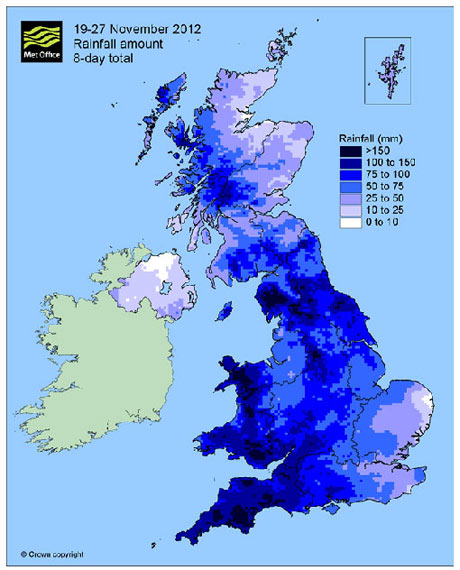
| The Met Office map of UK rainfall between 20 and 27 November Illustration: Met Office |
The Guardian has an extended report on the plight of farmers in the UK. The American drought got a lot of press over the last year, but the situation in the UK is almost as dire--if rather wetter.
The UK was facing drought conditions across large a large swath of their farming country. Then last spring, the rains returned. And then they didn't stop.
 |
| Wakestock festival in July 2012.Image from The Week |
And the effect on farms has been devastating. From The Guardian:
It is only now becoming apparent just how terrible sodden 2012 has been for farmers, particularly those in the north-west and south-west. Wheat yields were at their lowest level since the 1980s, the potato crop at its lowest since 1976. The oilseed rape harvest and barley yields also suffered. Livestock farmers suffered too. The wet weather conditions sent the price of animal feed soaring as farmers were forced to keep their animals indoors.Climate change is an elephant in the room, when it comes to food security. We can't grow food in a world with 400ppm carbon in the atmosphere. The evidence is mounting that we can't do it at the current average of 395 (this past spring of 2012 saw the atmospheric concentrations pass 400 is some places for the first time in human history). We probably can't do it at anything over 360, at least not long term. Farming needs a generally stable climate to function, and once we get over that magic 350 mark, things start to spin off into more and more frequent extreme events. Places like Tewksbury in England have become pretty much un-insurable because of flooding.
For some, the consequences threaten to be devastating. Recent figures from the Department for Environment, Food and Rural Affairs paint a bleak picture of a year many would prefer to forget. Dairy farmers saw their income plunge by 42%. Livestock and pig farmers have seen their incomes as much as halved. There were double-digit decreases for cereal and crop farmers, too.
Many have seen their profits completely wiped out. The only way they can survive is by borrowing from the banks. "We are seeing increased levels of indebtedness," said Charles Smith, chief executive of Farm Crisis Network. "For some it's becoming unsustainable."
We've had a climate buffer, as the oceans absorbed more CO2 for us, and this gave us a half-century or so to adapt our lives over to a lower carbon footprint, and to begin mitigation. Of course we didn't do anything like that at all. We ramped up industrial agriculture, we kept burning coal, and we opened up the Tar Sands in Alberta; all really, really stupid things to have done. Currently we're on track for sea level rise of 69 feet (21 metres)--that's going to make it a bit difficult to farm any of the world's deltas--like the one under Vancouver or the mouth of the Nile.


