Showing posts with label overfishing. Show all posts

Wednesday, January 21, 2015

The Halibut Is...

...that millions of kilograms of halibut are being caught by the big boats while they're trying to catch other species. A problem called “bycatch”.
Pacific halibut from Cook's Inlet, Alaska.
Photo by Jlikes2Fish via Wikipedia


The problem on the west coast of North America is primarily in Alaska, where the rules state that all fish, bycatch or not, must be identified, measured, and sexed by below-deck observers. The process can take up to two hours, and even though part of that time is spent in fish tanks with some water, when they are finally returned to the ocean, most halibut don't make it alive.
Other jurisdictions, such as British Columbia, allow the fish to be sorted on deck, making for a quicker return of bycatch into the water. A practice that significantly lowers the mortality rate.
The head of Seattle's Groundfish Forum, Chris Woodley (representing five companies operating 14 factory fishing vessels in Alaskan waters), has said that trawlers have cut down bycatch, making flatfish only about 0.5 percent of current catch levels of flatfish.
This brings up the question “If 0.5 percent of the flatfish caught in the Bering Sea is millions of kilos, then how much is being caught overall?” It's no wonder that modern fisheries are unsustainable and our oceans are collapsing into nothing but jellyfish, krill, and plastics. Halibut, for example, can grow larger than 2.4 metres (~7 feet long) and weigh over 225 kilos (about 500 pounds). But they cannot grow that big overnight. Fish of that size are survivors, maximum breeders, and targeted by us. Fish that big don't get taken by canoes, dories, or small boats, leaving them plenty of opportunity to re-stock any volumes humans take. But the advent of trawlers and big factory ships meant that these big fish became prime targets.
Overfishing of all species has lead to a quota system, where boats are only allowed a set amount of a specific fish over a limited time. But by allowing the factory ships and their massive nets into productive waters has meant that while the ships might be limited in their catch size of a target fish, bycatch numbers have stayed very high. And this is a worldwide problem.
Current quota-based jurisdictions on the West Coast, other than Alaska, have also instituted a bycatch quota, meaning that vessels must stop fishing when they hit their bycatch limit. I won't say that this is best practice, but it is better than the unlimited bycatch allowed in Alaska.

This piece references Keven Drews' Canadian Press article printed in the Times-Colonist of 20 January, 2015.

Sunday, August 4, 2013

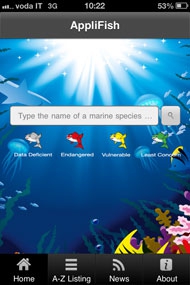
AppliFish


Nope, not an app for desperate singles, AppliFish was developed with help from the FAO:
You want to know more about the fish you are eating or going to buy? Is it maybe an endangered species? AppliFish will tell you. This free mobile application developed by the fisheries and biodiversity knowledge platform i-Marine makes aquatic-related information available to anyone, anytime, anywhere.

While human consumption of fish products has doubled in the last half century, policies for sustainable use of aquatic ecosystems must address the challenges facing global fish stocks.

Some 30 percent of the world's marine fish stocks assessed in 2009 were overexploited, according to FAO's State of World Fisheries and Aquaculture 2012.
"With AppliFish, consumers can choose fish that's not endangered, helping ensure that there will be enough for future generations," says FAO's Marc Taconet, Senior Fishery Information Officer and chair of the iMarine board. "Consumers can also use the application to learn more about species, capture levels and habitats, as well as the level of threats faced by these species."


Wednesday, March 13, 2013

Who Owns The Fish animated short

A nice little animation from the Center For Investigative Reporting.Who Owns the Fish? tries to recap the history of fishing, overfishing, and national boundary issues in less than six minutes.

Monday, March 11, 2013

Overwhelmed Monday Link-straveganza

via Saanich Fair website

Seriously, there is so much going on this past week. I attended the Farmer2Farmer conference at the Saanich fairgrounds, which was a great day, which I really want to talk at length about, and which left me with some hope. But that will have to wait for another post.
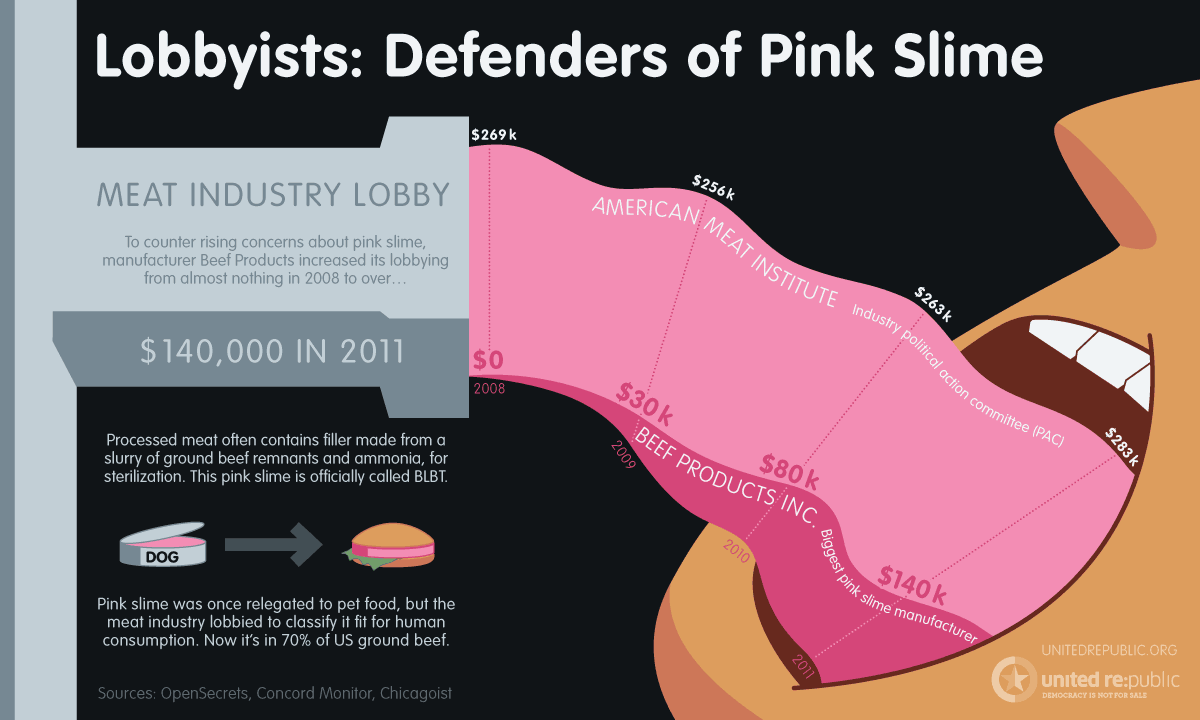
Pink slime--mechanically seperated lean beef that 's been treated with ammonia--is still around.
graphic via republicreport.org
Reuters is carrying a special report (.pdf) on Beef Product Inc.'s lawsuit against ABC, Diane Sawyer and others on their reporting of the use of "lean finely textured beef" in ground beef products like hamburgers. The suit has all the earmarks of a SLAPP (Strategic Lawsuit Against Public Participation) suit, particularly with the potential damages heading north of a billion dollars.
The lawsuit, originally filed in South Dakota state court, is hinged partly on a state product-disparagement statute designed to protect farming interests. Twelve other states have similar laws - dubbed "veggie libel" measures by critics - but they have rarely been invoked.

Under the South Dakota version of the law, plaintiffs must show that defendants publicly spread information they knew to be false and stated or implied "that an agricultural food product is not safe for consumption by the public."

If BPI were to win on that claim, under the law it could be awarded triple the damages that were caused. That means that the company's claim of more than $400 million in projected lost profits could balloon to damages of more than $1.2 billion.
But you can see why they feel they have to silence criticism--BPI has gone from 4 plants and about $650 milliion (US) in revenue to 1 plant and about $130 million (US) in revenue. And, as usual, buy direct from a farmer--make sure they get whatever profit's to be made and have the security of knowing where your food comes from.


image via inhabitat.com

NewsRx Science is reporting on the potential for urban agriculture in one of the US' most depressed cities: Detroit.

Transforming vacant urban lots into farms and community gardens could provide Detroit residents with a majority of their fruits and vegetables.
As city officials ponder proposals for urban farms, a Michigan State University study indicates that a combination of urban farms, community gardens, storage facilities and hoop houses - greenhouses used to extend the growing season - could supply local residents with more than 75 percent of their vegetables and more than 40 percent of their fruits.
The study, which appears in the current issue of The Journal of Agriculture, Food Systems, and Community Development, evaluates many aspects of the production potential of the Motor City's vacant properties, from identifying available parcels of land to addressing residents' attitudes toward blending agrarian traits with their urban lifestyles.
"What's clear from our production analysis is that even with a limited growing season, significant quantities of fresh fruits and vegetables eaten by Detroiters could be grown locally," said Kathryn Colasanti, the graduate student who led the study for the C.S. Mott Group for Sustainable Food Systems at MSU. "And investments in produce storage facilities and hoop houses would increase this capacity substantially."

Now we just need some political will. CBC is reporting that Sudbury's city planning staff is getting onboard, but the councilors are dragging their heels.
It is just an idea at this point — and something many other cities are considering — but city Coun. AndrĂ© Rivest said right now his vote would be a no.
"You got houses that are worth a lot of dollars and you want to keep that,” he said.
“You start having chickens in backyards ... I sense that wouldn't be well received."
But city planner Kris Longston said Sudbury's long-range plans should focus more on urban agriculture.
You can listen to the report here.
And that's the problem, innit? Political will.In a city you have to be willing to stare down local developers--who carry a lot of political and financial weight. And the ability to scare the public with the thought that the value of our homes may decrease. Canadians have become utterly reliant on their homes as their savings accounts--and on increasing home prices fueling consumer purchases--so any threat to house prices threatens the entire myth that we currently function under. The question of just who is expected to pay inflated prices for houses when all the boomers decide to retire isn't one that gets asked--because there is no real good answer. Wealth inequity is becoming more and more pronounced in Canada, and the middle class is starting to lose people off the bottom. The Fear, as Hunter Thompson used to describe it, is starting to set in.

Friday, February 22, 2013

Friday Link-straveganza

via The Guardian
The Guardian is reporting on an over-fishing scheme in the UK:
An inquiry into the UK's largest fishing scandal has uncovered "serious and organised" criminality by Scottish trawlermen and fish processors in an elaborate scam to illegally sell nearly £63m of undeclared fish.
Three large fish factories and 27 skippers have pleaded guilty to sophisticated and lucrative schemes to breach EU fishing quotas, in what one senior police officer described as "industrial level" deception.
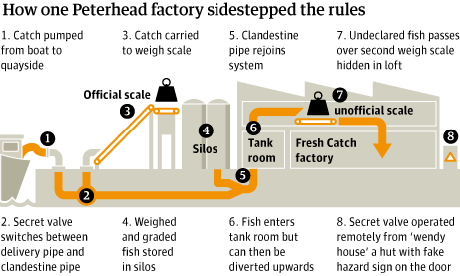
They went to extraordinary lengths to conceal their illegally caught fish, installing underground pipelines, secret weighing machines and extra conveyor belts and computers to allow them to land 170,000 tonnes above their EU quota of mackerel and herring between 2002 and 2005.
The extent of the "black landings" scandal emerged as 17 skippers and one of the three factories were given fines totalling nearly £1m at the high court in Glasgow on Friday, after admitting repeated breaches of the Sea Fishing (Enforcement of Community Control Measures) (Scotland) Order 2000. Another six skippers pleaded guilty at the same hearing to landing undeclared fish worth nearly £7m at Lerwick, in the Shetlands, and Peterhead, Aberdeenshire.
{...}Judge Lord Turnbull, told the 17 skippers sentenced on Friday they were guilty of a "cynical and sophisticated" operation, which brought embarrassment and shame on them and their families. "The motivation was purely financial," he said. "Those who were already making a good living saw this as a way more income could be generated and were prepared to participate in deliberate lies and falsehoods."
It's no wonder the bloody cod are gone. Even when we know we're over-fishing, even when we're already making a good buck, we still connive and scheme to empty the bloody ocean when we know better!  And notice, this lot got fined a million pounds on £63 million in fish. And they will be allowed to go back to doing what they were doing in the first place.

Community Food Centres Canada get animated!


CFCC gets animated! from Community Food Centres Canada on Vimeo.

more after the jump....

Tuesday, January 29, 2013

Mackerel--Welcome to the Overfished List

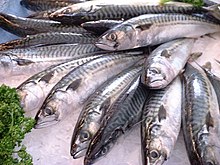
Mackerel via Wikipedia
The Guardian is reporting that mackerel have been taken off the "fish to eat" list:
For years it has been trumpeted as a popular sustainable fish, renowned for its health benefits and favoured by celebrity chefs.
But the UK's biggest marine charity, the Marine Conservation Society (MCS), has removed mackerel from its "fish to eat" list recommending that it should only be consumed occasionally, like monkfish and plaice. The society is advising consumers to eat herrings or sardines instead.
The MCS says international arguments about quotas mean mackerel is no longer a sustainable choice. Overfishing led to the suspension of the north-east Atlantic stock's Marine Stewardship Council certification as a sustainable fishery.
There has been an increasingly bitter three-year dispute between Iceland and the EU – mainly the UK – over who has the right to land the once-plentiful fish.