Showing posts with label cheap eats. Show all posts

Monday, July 23, 2012

Nose To Tail 1

Spent my Sunday in the kitchen, dodging the Significant Other, who was baking bread and cinnamon rolls. I, on the other hand, was trying my hand at a couple of new things.
First up was rolls. I had meant to pick up some won-ton wrappers at the local market (Victoria is extremely lucky in that we have both a large Asian community and a local grocery chain that caters to them. This means access to a lot of items that are more difficult to find in the majors—like the black-skinned Silky chickens that are the breed used in traditional Chinese cooking). Instead of buying the won-ton wrappers, I found egg roll wrappers. The ingredient list was short (five items, only one of which was a preservative), and they were cheap (around two bucks), and they had a suggested use recipe on the front. So, I was sold.
 So, lunch was pretty simple. Ground pork, spiced and flavoured, fried up. Added rice flour to thicken the juices. Flipped it out onto a plate. Put the skillet back on the stove and added about 25mm of (GM free) canola oil and let it heat. Peeled a wrap off the stack, wet the edges with a flour/water paste, and began building. I kept it pretty simple; spiced meat, enoki mushrooms, and bean sprouts.
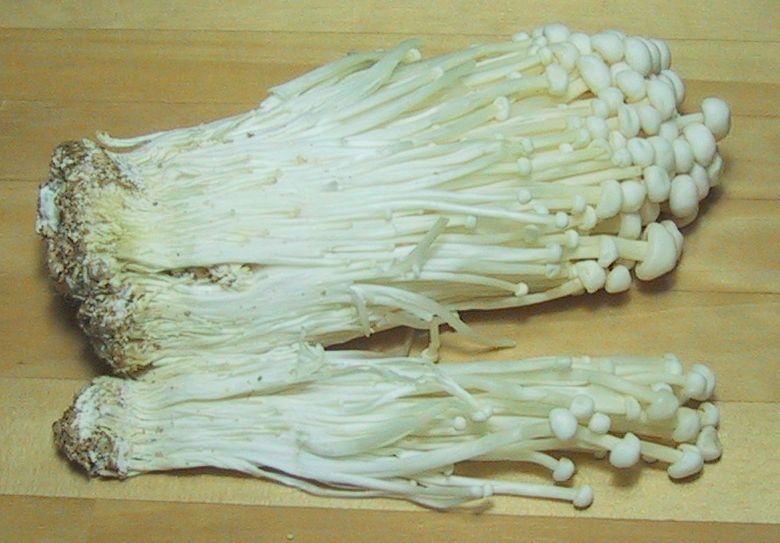
Enoki Mushrooms--Photo by Chris 73 / Wikimedia Commons

Created the roll (following the folding instructions on the package, but really, it is pretty straightforward), slipped it into the hot oil, and went back to make another. Apparently I heated the oil just right. As I put one in, the previous roll was ready for flipping or removal. No smoke, no excessive browning. Just nice, crisp, deep-fried rolls.
 With lunch under our belts (and the rolls were good enough that it was difficult to stop eating them, so the belt was a bit strained), my next chore was poaching tongue. I had bought two pork tongues Friday, and, on getting them home, put them in brine for about twenty-four hours as per my guru of nose-to-tail eating, Jennifer McLagan.
Odd Bits cover from Jennifer McLagan

Sunday, February 20, 2011

Dinner on the Cheap

     I've been reading Bill Buford's excellent book Heat: an amateur's adventures as a kitchen slave, line cook, pasta maker, and apprentice to a Dante-quoting butcher in Tuscany (which is an terrific read--I doubt you can get through it without reading choice passages aloud!) in which he describes braising at it's most basic. So today, while in a local grocery store, while thinking about Buford and Anthony Bordain, I picked up a tray of the cheapest meat I could find. Described on the package as "pork bones for stewing," I could see that there was actually a fair bit of meat on the bone, and that this would give me a chance to pursue braising as described by Buford.
     Talking about braising short ribs at Mario Batali's three star restaurant in New York, Buford writes:
After the browning, the rest is straightforward. [...] There are five remaining steps.
One. remove the now brown and glistening ribs (using tongs, por favor) from the rondo and make a braising liquid, the stuff that's going to cover the ribs while they cook. In this method, the liquid is the essential ingredient, and it doesn't matter what it is as long as it's wet and plentiful (in an Irish pot roast, it's water), although the ideal liquid is both flavoring and flavorful and is made from one part wine (at Babbo, about three magnums' worth, which, as it happens, is not the Barolo of the dish's name but a perfectly acceptable, very cheap California Merlot) and one part meat broth (say, a chicken stock), plus loads of vegetables: some carrots, an onion, two stalks of celery, and five peeled cloves of garlic, all roughly chopped, which you throw back into the rondo, still hot, and stir. You add the wine, the broth, a can of tomatoes, and cook for a few minutes.
Two. Put the now-browned ribs in a roasting pan, pour the braising liquid over them, add some rosemary and thyme, put a lid on top, stick it in the oven (350 degrees), and forget about it.
Three. (Three hours later, the ribs now cooked.) Turn the braising liquid into a sauce, although the instruction itself raises an obvious question: what is a sauce? In this preparation, for instance, this is what you do: first you remove the ribs and set them aside to cool; then you pour the liquid they were cooked in through a strainer into another pot. This liquid, even before you'd begun cooking the ribs in it, had been pretty rich, being a broth that had been made from chicken feet, plus lots of vegetables, herbs, and plenty of wine. Then the ribs themselves had been cooked in it. (The bones of any animal, simmered slowly, make for a wet, intense expression of the meat; here you're getting a double expression, like a broth made from a broth.) Next, you take this dense, aromatic, already highly extracted liquid and hammer it: you put it back on a burner and boil it to hell. Just torch it. Full blast. Lots of yellow-frothy melted fat will rise disgustingly to the surface. You skim this off and keep boiling the thing until it's reduced by more than half, when, lo and behold, it is no longer a braising liquid or a broth: it's a sauce. The result is very, very, very concentrated. (In fact, it's really almost French.)
Four. Once the ribs are cool, you discover that the bones have loosened themselves from the meat and come right out. You also discover that what's left is really quite ugly. It consists of two parts: a muscly tendon of some kind (the texture is non unlike a baseball catcher's mitt) that is smooshed, by way of a fatty sinew, to the meat. The two parts can be pulled apart by hand. The bit that looks like a catcher's mitt is, in addition to being very ugly, entirely inedible. With great pleasure, you throw this away. The other bit is quite yummy, although you need to trim it into a rectangle, eliminating any fatty goo. But, curiously, mixed in with your good short ribs are a number of mutants. In these, for some reason, there is no distinction between the two parts, the bad and good bits (that is, catcher's mitt and dinner). They're all mushed together, and you can't pull them apart without tearing the thing to shreds, which is what you do: tear the thing to shreds to find something, anything really, that Cesar can use to make the family meal with.
Five. Assembly. Your meat is now arranged like so many dead toy soldiers, neatly tidied up. The sauce has been skimmed of fat and reduced to something that could be described as the food equivalent of most male movie stars: dark, rich, and thick. Everything is ready, Next you want to put it away in a fashion that allows you to retrieve it quickly, blast it in an oven, and serve: say, six short ribs in a half-hotel pan (which isn't a pan, either, but a tray, and is half the size of the full hotel not-actually-a-pan-but-a-tray pan, or in normal life what you cook brownies in), pour some sauce on top to keep the meat moist, and bundle the whole thing up first with plastic wrap, then with foil, tightly, tightly, so that, once stacked on the floor of the walk-in, it can be stepped on (and in the frantic rush of service, things happen--they always happen) without short-rib juice squirting out and adhering to the bottom of your shoes, leaving a disgraceful track to the toilet when you finally get a chance to go. What you now have is a wholly typical restaurant preparation, in which most of the work is done long before the dish is even ordered (and if a restaurant can do it, why can't you?). It keeps for a week.
These steps--brown meat, make a liquid, cook meat in it, remove it, and reduce the liquid until it's a sauce--are the same for every braised dish everywhere. Lamb shanks are done this way; so, too, are lamb shoulders, veal shanks, wild boar hams, venison shoulders: it's all the same.

pp. 74-75