Showing posts with label phosphorus. Show all posts
Showing posts with label phosphorus. Show all posts
Wednesday, March 11, 2015
The Re-Cycle
From Al Jazeera English
Phosphorus is one of those elements necessary to plant growth, but also seriously abused by modern farmers. Excessive fertilization contaminates runoff, causing algal blooms and killing off lakes and rivers (and, during the Eighties, lead to the deaths of beluga whales in the St. Lawrence river).
Technology, developed in Canada, looks to make us less reliant on mining phosphorus, instead allowing us to recycle it. Amandeep Bhangu, an Al Jazeera reporter in London, UK, visits Europe's first facility that is turning raw sewage into fertiliser.


Monday, August 4, 2014
Everything Is Connected (Water Edition)
 |
| Beluga photo via premier.gov.ru |

A while back I found out the whole story about why Beluga whales were washing up on the shores of the St. Lawrence around Montreal--whales whose carcases were so contaminated with toxins that they had to be handled as toxic waste. Turns out it had to do with farmers in the American Midwest applying fertilizer to their fields. Excess nitrogen and phosphorus was washing into the rivers in the (rather immense) Mississippi catchment basin, concentrating in the waterways, spilling out into the Gulf where it was creating a dead zone. Algae from the dead zone found their way up the Atlantic coast in blooms, generating the neurotoxin found in red tide. Various predators concentrated the toxin up the food chain as the bloom moved north, finally resulting in dead whales in the St. Lawrence. Everything is connected.
 |
| Lake Erie photo via National Oceanic Service |
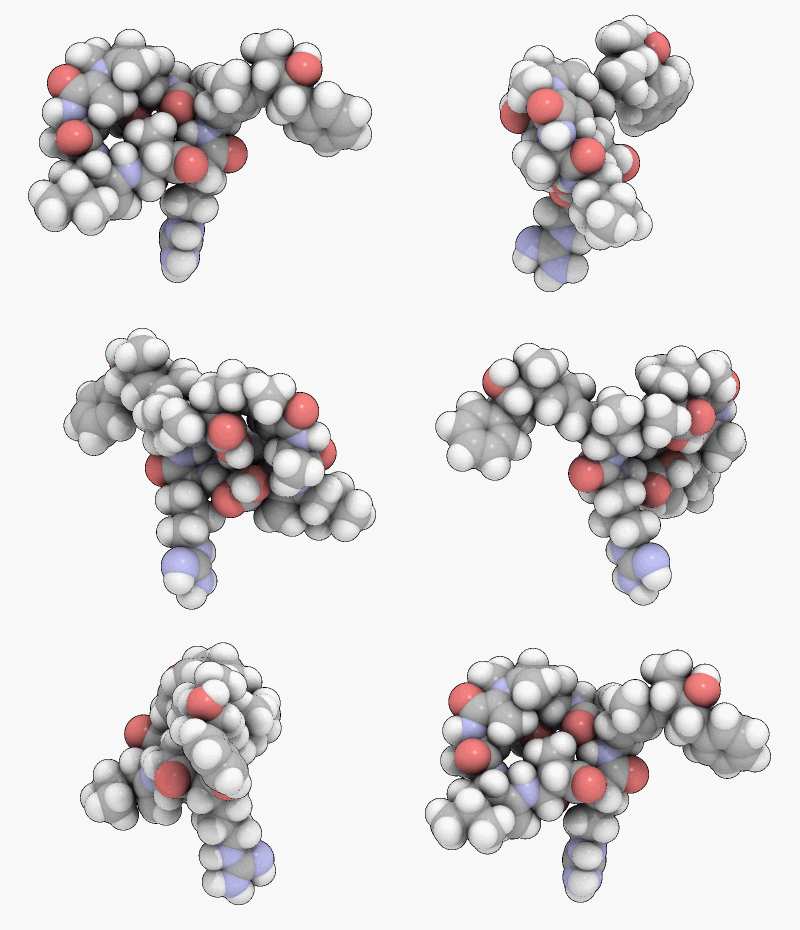 |
| microcystin-LR molecule via Toxmais, mostly because it's so frickin' cool! |
Monday, January 21, 2013
Phosphorus
The role of diet in phosphorus demand
Geneviève S Metson et al 2012 Environ. Res. Lett. 7 044043 doi:10.1088/1748-9326/7/4/044043
Phosphorus (P) is an element essential to modern industrial agriculture. As Science Daily reported:
Phosphorus is just as important to agriculture as water. But a lack of availability and accessibility of phosphorus is an emerging problem that threatens our capacity to feed the global population. Like nitrogen and potassium, it is a nutrient that plants take up from the soil and it is crucial to soil fertility and crop growth.But, as Metson et al. point out, most of the drivers for phosphorus use are changes in diet.That the source-to-fork process is so inefficient that only one part in five of mined phosphorus makes it to our food doesn't help either.
"Unless something is done, the scarcity of phosphorus will cause problems of a global dimension. As early as 2035 it is calculated that the demand for phosphorus map outpace the supply," says Dana Cordell, who presented her thesis at the Department of Thematic Studies -- Water and Environmental Studies, Linköping University, Sweden on the implications of phosphorus scarcity on global food security.
Phosphorus is extracted from phosphate rock, a non-renewable resource that is used almost exclusively in agriculture. Two thirds of the world's resources are in China, Morocco, and Western Sahara.
"The demand for phosphorus has increased and prices soared by 800 percent between 2006 and 2008," says Dana Cordell.
But poultry litter is a good source of P. But the litter from industrial poultry operations, while high in P, is often to high in P. And the excess tends to wash off the fields and into local waterways, causing algal blooms and killing aquatic life through oxygen depletion.We saw a lot of this in the '70s, and it lead to legislation to protect waterways--legislation that is currently under attack or fully repealed.
The current thinking, as reported on Science Daily again, is to wash litter and rapidly remove and recover phosphorus in solid form. The litter can then be used as a nitrogen fertilizer (washing doesn't remove the N apparently), or re-used as litter.
But all this presupposes industrial agriculture the way it is currently practised. And that presupposes continued access to cheap hydrocarbon energy with no consequences from burning it. Sustainable farming has long used manure to fertilize and rebuild soil, and chickens walking about on a patch of ground don't tend to over-fertilize. The use of chicken tractors means that chickens are moved to fresh pasture before they denude and over-fertilize. But the focus remains on maintaining the status quo, and keeping financial power where it currently resides.
Subscribe to:
Posts (Atom)