Showing posts with label Evan Fraser. Show all posts

Wednesday, May 28, 2014

Holographic System

Browsing the "environment" section of the Guardian online, I came across a couple of stories that interested me. One was from the incomparable Evan Fraser and Elisabeth Fraser, about whom the Guardian says:
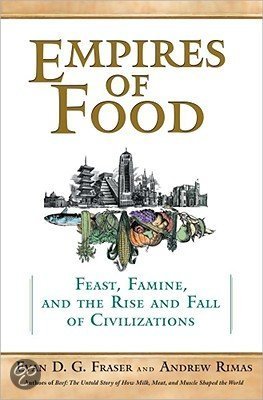
Evan Fraser holds the Canada research chair in Global Food Security in the department of geography at the University of Guelph. He is the author of Empires of Food: Feast Famine and the Rise and Fall of Civilizations. Elizabeth Fraser is completing her MA in Global Governance at the Balsillie School of International Affairs at the University of Waterloo
They list ten things that we should know about the food system. The first three points run:

1. There's enough food for everybody

The most important thing to know about the global food system is also one of the least appreciated: there is enough food for everyone on the planet to live a healthy and nutritious life. In fact, the UN tells us that there is about 2,800 kcal per person per day available. But, the global food system is deeply inequitable. There are about 842 million people hungry on the planet, while at the same time there are about 1.5 billion who are overweight or obese.

2. Price volatility

The price of food is wildly volatile. In 2008, the United Nations Food Price Index almost doubled in less than a year before crashing in 2009. Prices then shot up again in 2010 and 2011. Despite this volatility, our supply of food stayed stable throughout this period. This suggests that the price of food is not determined by our ability to produce food at a global level.

3. One third of food is wasted

Approximately one third of the world's food is wasted before it is consumed (pdf). In the developed world most of the waste happens at the consumer end, when food spoils in grocery stores or in refrigerators. Most of the waste in the developing world happens on the farm as a consequence of inefficient storage and processing facilities.
These three points alone begin to explore the incredible complexity of the modern industrial food system. The second point, that prices are unhinged from production, tell me one of the reasons the system is in such a mess--it is tied to the international speculation casino. I've written before about how after 2007, big money was looking for a safe harbour, and enormous volumes descended on agriculture futures contracts, driving up the consumer price index internationally.

Tuesday, October 8, 2013

The Way Forward


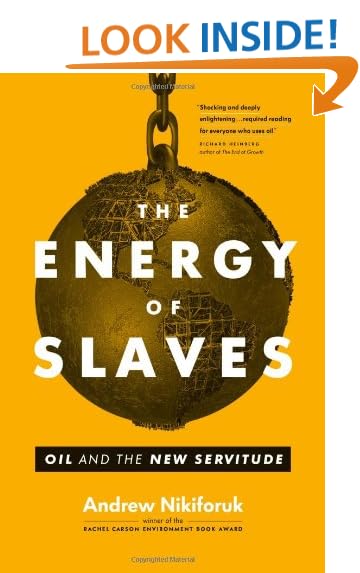
I've been reading Andrew Nikiforuk's The Energy of Slaves this week (check out the pop-up interview with him on CBC' radio show The Current) and it has been a great read and an interesting take on the links between the hydrocarbon economy and the slave economy. He also dedicates a chapter to what he calls "The Unsettling of Agriculture": the change from solar to slave to hydrocarbon-based production.
In the chapter on agriculture, he looks at the example of China between the 8th and 12th centuries: during that time, China constructed
...a unique agro-energy empire, diverting enough natural flows of energy to feed nearly half a billion people. It did so by carefully marshaling solar energy in intensely farmed plots of millet and wheat int he north and of rice in the south. Innovations in rice farming--the artificial flooding of land and multiple cropping--tripled the yield of an average peasant family. One square mile of carefully tended land could feed 225 peasants. Peasants hoed, fertilized, and irrigated these highly nutritious crops like some great garden. The land was manured with human shit.
But even this system faced problems. As the population grew from 100 million people in the 12th century to 500 million in the 18th, the country inevitably ran into a series of energy and environmental shocks. they ran out of land, and they ran out of wood. The amount of food necessary increased, but the crop surpluses declined.  No empire, co government, no country can withstand a collapse in caloric stocks (I've talked about Empires of Food  by Fraser and Rimas before (Check out Evan Fraser's discussion here)). the basic structures of Chinese solar energy harvesting remained until the 1970s. This steady-state agriculture finally collapsed under the assault of oil and oil's industrial agriculture programmes--leading to China becoming an ag-product exporter, but, as has been mentioned before in the posts on honey laundering, not one without problems.
We've been through these issues before, too. In 1973, energy analyst Earl Cook pointed out that it was taking 26,745 calories to produce 3,300 kilocalories of food. In 1930, in a manifesto called  I'll  Take My Stand, a group of southern US farmers said that machines did not emancipate farmers, but in fact evicted them from their farms. In 1943, Sir Albert Howard, in An Agricultural Testament (pdf) pointed out that the replacement of animal traction with mechanical traction came with a significant drawback--mechanical traction doesn't produce urine or manure. he predicted that a people fed on improperly grown food would eventually become dependant on "an expensive system of patent medicines, panel doctors, dispensaries, hospitals, and convalescent homes".
In the end, Andrew Nikiforuk looks at the Cuban experience and takes, as I do, hope from it. Slavery, whether human or hydrocarbon, is a dead end, suitable only for short-term gains, but antithetical to long-term sustainability. The hydrocarbon economy is, at best, a dead-end side road we've mistakenly diverted down. As in the video below, sometimes we discover that the only way to go forward is to move a ways back.


Shaped by Hand from Elias K. on Vimeo.